PART 2
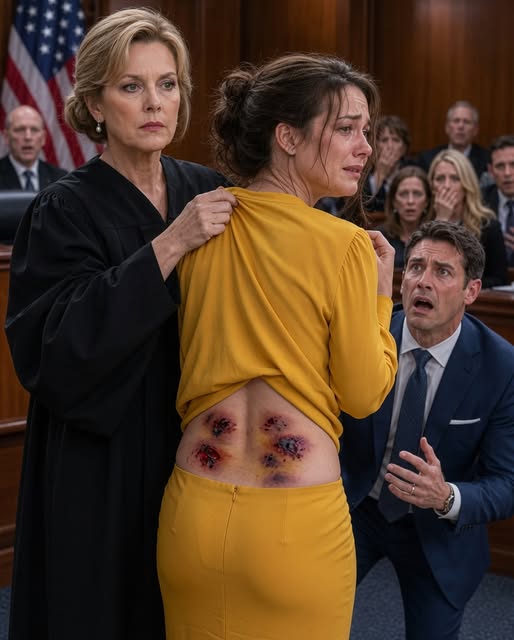
Daniel’s laughter disappeared the moment I said my name.
“Judge Evelyn Hart,” I repeated, each word calm and deliberate. “United States District Court for the Eastern District of Virginia.”
For several seconds, the only sound in my living room was the rain tapping against the windows and Clara’s uneven breathing beside me.
Daniel had met me at birthdays, holiday dinners, and Sophie’s preschool recital. To him, I had always been Evelyn Cross—Clara’s quiet, widowed mother who wore modest dresses, baked apple pie, and rarely discussed her career. He had never bothered to ask what I did before retirement because powerful men like Daniel rarely investigated women they considered irrelevant.
“You’re lying,” he finally said.
I looked at the red recording indicator glowing on Clara’s phone.
“You are welcome to verify it.”
His breathing changed. It was subtle, but I had spent decades listening for the instant confidence became fear.
“This is a private marital dispute,” he said. “You have no authority here.”
“You are correct about one thing. I have no judicial authority over my daughter’s case, and I will not misuse my position. But the police, the prosecutor, and the family court do have authority. You just threatened a protected person while she was recording.”
“I didn’t threaten anyone.”
Clara’s hands were trembling so violently that I covered them with mine.
“You said you would destroy her.”
“That was emotional language.”
“Then continue explaining,” I said. “The recording is still running.”
He hung up.
For one fragile moment, silence filled the room.
Then Clara broke.
She folded forward, pressing both hands over her face as sobs tore through her. I had seen witnesses cry on the stand, defendants collapse after sentencing, and parents discover that justice could not return what violence had taken from them. But nothing had prepared me for the sound of my own daughter finally releasing three years of terror.
“I should have told you,” she gasped. “I should have left the first time.”
I knelt in front of her.
“No.”
“He pushed me when Sophie was a baby. I told myself he was exhausted. Then he grabbed my arm. Then he slapped me. Every time, he cried afterward. He bought flowers. He promised therapy.”
“Clara, look at me.”
She lowered her hands.
“You did not cause this. You survived it.”
Her eyes searched mine as though she were trying to remember whether those words could be true.
“I was ashamed,” she whispered.
“The shame belongs to him.”
Before she could answer, her phone began vibrating across the coffee table.
One message appeared.
Then another.
Then twelve more.
I’M SORRY.
YOU KNOW I LOVE YOU.
YOUR MOTHER IS MANIPULATING YOU.
SOPHIE NEEDS HER FATHER.
BRING HER HOME NOW.
The messages changed as we watched.
YOU ARE UNSTABLE.
I HAVE PROOF.
NO JUDGE WILL GIVE A CHILD TO A WOMAN LIKE YOU.
The final message arrived at 8:29 p.m.
I’M COMING TO GET MY DAUGHTER.
Clara’s face drained of color.
“He knows where we are.”
“The protective order forbids him from coming here,” I said.
“He doesn’t care.”
I immediately called the detective assigned to Clara’s case. Patrol officers arrived eleven minutes later, checked the property, and remained outside while the detective arranged for additional surveillance.
Sophie slept upstairs, unaware that her father’s name had become something her mother could barely say aloud.
At ten o’clock, headlights swept across my front windows.
Clara screamed.
I rose from the sofa as a dark sedan slowed near the driveway. Two officers stepped from their patrol car, but the sedan accelerated and disappeared around the corner.
“It wasn’t him,” one officer said after checking the license plate. “Probably a neighbor.”
But I had seen the passenger’s face.
A woman with silver-blond hair had been looking directly at my house.
I knew her.
Margaret Vale.
Senior partner at Mercer, Vale and Knox—and Daniel’s most powerful mentor.
That was when I understood that Daniel’s confidence did not come merely from arrogance. Someone else had been protecting him.
The next morning, the attack arrived not through the front door, but through the legal system.
At 7:15 a.m., two sheriff’s deputies appeared with an emergency custody petition.
The papers accused Clara of suffering from severe psychiatric instability, abusing prescription medication, and placing Sophie in danger. Attached were medical records showing two involuntary hospitalizations, repeated hallucinations, and a diagnosis of paranoid personality disorder.
Clara stared at the documents.
“That isn’t me.”
The records listed her full name, date of birth, former address, and insurance number. They looked authentic enough to persuade anyone who read them quickly.
But I did not read documents quickly.
I examined the physician’s signature, the dates, the treatment codes, and the hospital letterhead. The records claimed Clara had been admitted to Saint Matthew’s Behavioral Center during a week when she had been staying with me after Sophie’s birth.
“There’s more,” Clara’s attorney, Rachel Kim, said after arriving. “Daniel filed a request for immediate temporary custody. The hearing is at noon.”
Clara swayed.
“He planned this.”
I looked at the oldest medical record. It had been created nearly three years earlier.
“Yes,” I said. “He planned for the day you tried to leave.”
Rachel took photographs of every page and contacted Saint Matthew’s. Their records department initially refused to discuss confidential information, but after receiving Clara’s written authorization, they confirmed they had no patient under her name or birth date.
“That helps,” Rachel said, “but Daniel will claim the hospital lost the file.”
I pointed to the physician’s name.
“Dr. Leonard Pierce.”
Rachel typed it into her laptop. Her eyebrows rose.
“His medical license was suspended four years ago for falsifying insurance claims.”
“Then why would Daniel use him?”
“Because Pierce now works as a private consultant for law firms,” Rachel said. “Including Mercer, Vale and Knox.”
Clara pressed both hands against her stomach.
“I remember him.”
We turned toward her.
“Daniel brought him to our house once. He said Pierce was helping with a case. They locked themselves in the study for hours.”
“When?” I asked.
“About three months after Sophie was born.”
The date matched the first fraudulent hospitalization.
The custody hearing took place in a crowded family courtroom beneath fluorescent lights that made everyone look exhausted. I sat in the gallery, not beside Clara, because even the appearance of influence could damage her case.
I had contacted the court’s chief judge that morning and disclosed my relationship to the matter. I would not speak to the presiding judge, approach court staff, or participate in any strategic decision beyond supporting my daughter as a mother.
Daniel entered through the opposite door wearing a navy suit, a pale blue tie, and an expression of practiced sorrow.
He looked exactly like the kind of man strangers trusted.
Margaret Vale walked behind him.
She was in her late sixties, elegant and composed, with silver-blond hair swept neatly away from her face. I had known her for twenty years. She had argued cases in my courtroom, attended judicial conferences, and once sent flowers after my husband died.
Our eyes met across the room.
She gave me a slight nod.
Not sympathy.
A warning.
Daniel sat beside his attorney and looked toward Clara. His face softened instantly.
It was a performance so polished that, had I not seen the bruises, I might have believed he was a grieving husband desperate to protect his child.
The hearing began.
Daniel’s attorney described Clara as emotionally fragile, paranoid, and recently influenced by an “overbearing relative with professional power.”
He never said my title. He did not need to.
“The father fears that the child has been unlawfully removed from her stable home environment,” he said. “He asks only that Sophie be returned while the mother receives necessary treatment.”
Rachel stood.
“The mother did not remove Sophie unlawfully. Police supervised the transfer after receiving evidence of domestic violence. A protective order is in effect. Furthermore, the medical records supporting this petition are fraudulent.”
A murmur moved through the courtroom.
Daniel lowered his head as though the accusation pained him.
The judge examined the documents.
“What evidence do you have of fraud?”
Rachel submitted the hospital’s written confirmation and information about Dr. Pierce’s suspended license.
Daniel’s attorney rose immediately.
“Saint Matthew’s underwent a records conversion. Missing data is not unusual. As for Dr. Pierce, his licensing issue occurred after these evaluations.”
“That is false,” Rachel replied. “His license was suspended before the earliest record was allegedly created.”
For the first time, Daniel looked at Margaret.
She did not move.
Rachel then submitted the photographs from Clara’s forensic examination, Daniel’s messages, and the audio recording of his threat.
The courtroom listened as his voice filled the speakers.
Bring her back, Clara, or I’ll destroy you.
Daniel stared straight ahead.
His attorney argued that the statement had been taken out of context, but the judge’s expression had changed.
“Mr. Mercer,” the judge said, “did you send the messages stating that the mother was unstable and that you possessed proof?”
Daniel stood.
“Yes, Your Honor. But only because I was genuinely concerned.”
“When did you first obtain these medical documents?”
“My wife gave them to me.”
Clara inhaled sharply.
Daniel continued.
“She has struggled for years. Her mother was unaware because Clara concealed it from her family.”
The lie was delivered gently, almost compassionately.
Rachel requested permission to call Clara.
My daughter walked to the witness stand with pale cheeks but steady steps.
Daniel watched her the way a hunter watches an injured animal.
Rachel began carefully.
“Did you ever receive treatment at Saint Matthew’s Behavioral Center?”
“No.”
“Were you ever diagnosed with paranoid personality disorder?”
“No.”
“Did you give these records to your husband?”
“No.”
“Why did you leave your marital home?”
Clara’s gaze moved toward Sophie’s empty seat beside Rachel. Children were not permitted in the courtroom, and Sophie was waiting with a victim advocate in another room.
“Because my husband hurt me,” she said.
Daniel’s jaw tightened.
Clara described the first slap, the apologies, the isolation, and the financial control. She explained how Daniel monitored her phone, controlled her bank access, and threatened to take Sophie if she ever told anyone.
His attorney stood for cross-examination.
“Mrs. Mercer, isn’t it true that you sometimes experience panic attacks?”
“Yes.”
“And you take medication?”
“For anxiety. Prescribed by my doctor.”
“Isn’t anxiety capable of affecting memory?”
Rachel objected.
The judge sustained it.
The attorney changed direction.
“You claim your husband isolated you. Yet you visited your mother.”
“Only when Daniel allowed it.”
“Allowed it? You are an educated adult.”
Clara looked toward Daniel.
“That is what I kept telling myself.”
Something shifted in the courtroom. Her answer was quiet, but it carried more truth than all the polished arguments that had come before it.
The attorney held up a photograph.
“Did you send this message to your husband six months ago?”
The screen displayed Clara’s words.
I’m sorry. I make everything worse. Maybe you and Sophie would be safer without me.
Daniel’s attorney let the silence linger.
“Does that sound like a mentally stable mother?”
Clara’s fingers tightened around the edge of the witness stand.
“I wrote that after he locked me in the bathroom for five hours.”
Daniel’s face hardened.
“Can you prove that?”
“No.”
“Then the court has only your interpretation.”
Clara swallowed. For a moment, I saw the frightened girl who had hidden bruises beneath long sleeves.
Then she straightened.
“No,” she said. “The court has the truth. Whether you can prove every moment does not change what happened.”
Daniel’s attorney sat down.
During a brief recess, Rachel received an email from the forensic technology consultant she had contacted that morning. The metadata from the medical documents revealed they had been created on a computer registered to Mercer, Vale and Knox.
More specifically, the user account belonged to Daniel.
Three months earlier.
Not three years earlier.
The dates inside the records had been manipulated.
When court resumed, Rachel presented the metadata report.
Daniel’s attorney objected, but the judge permitted limited consideration because the case involved the immediate safety of a child.
“Mr. Mercer,” the judge said, “do you have an explanation?”
Daniel stood slowly.
“My firm handles hundreds of documents. Someone may have scanned the records into my account.”
“The creation history shows manual editing,” Rachel said. “The patient name, dates, and diagnostic details were inserted while logged into Mr. Mercer’s profile.”
Daniel turned toward Margaret again.
This time she looked away.
The judge denied his emergency custody petition, ordered Sophie to remain with Clara, and extended the protective order. She also referred the suspected falsification of medical records to the commonwealth’s attorney and the state bar.
For one breathless second, Clara did not react.
Then Rachel squeezed her hand.
“You won today,” she whispered.
But I knew better than to call it a victory.
A cornered man with influence was often more dangerous than a confident one.
Outside the courtroom, two detectives waited near the elevators.
Daniel walked toward them, but before they reached him, Margaret stepped between us.
“Evelyn,” she said quietly.
“Margaret.”
“This has gone too far.”
“You were outside my home last night.”
“I was trying to prevent a disaster.”
“You were watching a protected victim.”
Her expression remained smooth, but her eyes were cold.
“Daniel is under extraordinary pressure. Clara has always been sensitive.”
I felt anger rise inside me, but I kept my voice even.
“Did you help him fabricate those records?”
“Be careful.”
“Is that professional advice or a threat?”
For the first time, her composure slipped.
“You do not understand what your daughter has involved herself in.”
Before I could respond, Daniel passed behind her, escorted by the detectives.
He stopped beside me.
“You think this is about bruises?” he murmured.
One detective ordered him to keep moving.
Daniel leaned closer anyway.
“Ask Clara who gave me access to those records.”
Then he smiled.
It was not the smile of a man who had lost.
It was the smile of someone who believed the worst secret had not yet been revealed.
That evening, I locked every door in my house and activated the security system. Sophie sat at the kitchen table drawing a picture of three women holding hands beneath a yellow sun.
“This is Mommy,” she said, pointing to the tallest figure. “This is Grandma. And this is me.”
“There’s no Daddy,” Clara said softly.
Sophie lowered her crayon.
“Daddy gets mad in pictures.”
Clara turned away so her daughter would not see her cry.
I knelt beside Sophie.
“You are safe here.”
She looked at me with the solemn eyes of a child who had learned too early that promises could be broken.
“Is Mommy safe too?”
“Yes.”
I said it with confidence, though I no longer knew whether safety was something I could guarantee.
After Sophie went to sleep, Clara stood near the living room window, staring into the darkness.
“What did Daniel mean?” I asked.
She wrapped her arms around herself.
“I don’t know.”
“He told me to ask who gave him access to the records.”
“He lies, Mom.”
“Yes. But liars often hide truth inside their threats.”
Clara remained silent.
I waited.
Judges learn that silence can be more effective than interrogation. People rush to fill it, especially when they are afraid.
Finally, Clara crossed the room and lifted the small suitcase she had brought that morning.
“I need to show you something.”
She placed it on the dining table and removed the folded clothes inside. Beneath them was a black document pouch secured by a tiny combination lock.
Her fingers shook as she entered the code.
Inside were bank statements, photographs, a flash drive, and a thick folder marked CONFIDENTIAL.
“What is this?”
“I found it in Daniel’s study two weeks ago.”
“You entered his files?”
“He left the safe open when he was drinking. I saw my name on a folder.”
She handed me the first document.
It was not a medical record.
It was an internal memorandum from Mercer, Vale and Knox describing a “judicial vulnerability strategy.” My name appeared repeatedly beside references to old cases, private travel records, and my late husband’s financial accounts.
I turned the page.
There were photographs of me leaving the courthouse, entering my church, and visiting Clara’s home.
They had been watching me for years.
“Why would Daniel have this?” I whispered.
“I thought he was collecting information because of your position.”
The next section contained sealed court documents from cases I had presided over—documents Daniel should never have possessed.
My stomach tightened.
These were not random files.
They involved a federal contracting investigation from twelve years earlier. At the time, several executives had been accused of bribing government officials. The case collapsed after a key witness disappeared and crucial evidence was ruled inadmissible.
Margaret Vale had represented one of the defendants.
I turned another page.
A confidential judicial complaint lay beneath the surveillance photographs.
The complaint accused me of concealing a financial conflict in that same case. It alleged that my late husband, Thomas, had accepted money through a shell company connected to the defendants.
“That is impossible,” I said.
Clara stared at me.
“Is it?”
The question hurt more than I expected.
“Your father was an honest man.”
“I know. But Daniel said everyone has a price.”
“Daniel says whatever causes the most damage.”
I examined the bank records attached to the complaint. They showed deposits totaling four hundred thousand dollars into an account bearing Thomas’s name.
The signature looked authentic.
The account number was unfamiliar.
At the bottom of the complaint was a certification stating that the information had been provided by a credible confidential source.
The source’s signature was redacted.
But the final page was not.
Someone had carelessly included a routing email showing who had submitted the complaint to the judicial conduct committee.
Margaret Vale.
My hands became cold.
“She filed this eleven years ago,” I said.
“What happened?”
“I was never informed.”
“Wouldn’t they have investigated?”
“Not necessarily. Anonymous or unsubstantiated complaints can be dismissed without notifying the judge.”
Clara removed the flash drive.
“There’s more.”
We inserted it into an old laptop disconnected from the internet. The drive contained hundreds of scanned files, audio recordings, and internal emails.
One folder was labeled HART.
Inside was an audio recording dated eight months before Thomas died.
I clicked it.
Static filled the room.
Then my husband’s voice emerged.
“I won’t do it, Margaret.”
My breath stopped.
Margaret answered.
“You already did.”
“No. You used my name.”
“You signed the papers.”
“You told me they were charitable trust documents.”
“And now they are whatever I need them to be.”
There was a long pause.
Then Thomas said, “Evelyn will find out.”
“If she does, she loses the bench, you lose everything, and Clara learns exactly what kind of father you were.”
The recording ended.
I sat motionless.
Thomas had died in a car accident seven months after that conversation.
For years, I had believed wet pavement and poor visibility caused him to lose control on a mountain road.
Now the memory shifted.
His anxiety during the final months of his life.
The locked drawers.
The late-night phone calls he dismissed as business.
The envelope he had tried to mail the morning before the crash—an envelope I never found.
“Mom,” Clara whispered.
I closed my eyes.
My grief had always been a sealed room. Now someone had opened the door and rearranged everything inside.
“Daniel found these files,” Clara said. “He told me he could ruin you if I ever left.”
“Why didn’t you tell me?”
“He said the complaint would destroy your career and Dad’s memory. He said you might be prosecuted.”
“My career is not worth your safety.”
“I know that now.”
I looked at her bruised face and realized how Daniel had imprisoned her. He had not relied only on fear for herself. He had weaponized her love for me.
“He made you believe staying protected me.”
She nodded, tears gathering in her eyes.
“I thought I could endure it.”
I reached for her.
“No mother wants to be protected by her daughter’s suffering.”
She collapsed into my arms.
For several minutes, neither of us spoke.
Then the old laptop screen flickered.
A new window appeared.
That should have been impossible. The computer was not connected to the internet.
A black box opened across the screen, displaying a single line of white text.
YOU SHOULD NOT HAVE OPENED THE DRIVE.
Clara pulled away from me.
“Mom…”
Another line appeared.
THE HOUSE IS NOT SAFE.
I stood and reached for my phone.
Before I could call the police, the security alarm went dead.
Every light in the house turned off.
Upstairs, Sophie screamed.
Clara ran toward the staircase, but I caught her arm.
“Stay behind me.”
A sound came from the back hallway.
Not breaking glass.
Not a forced door.
The quiet click of a lock being opened with a key.
Someone entered the house.
I grabbed the heavy brass candlestick from the side table and moved toward the hallway. Clara followed despite my warning, holding a kitchen knife with both hands.
A figure stepped through the darkness.
“Don’t move,” I said.
The person raised both hands.
“Judge Hart, please. I’m not here to hurt you.”
The voice belonged to a man.
I switched on my phone’s flashlight.
Dr. Leonard Pierce stood inside my home.
His coat was soaked with rain. Blood ran from a cut above his eyebrow, and terror filled his face.
“You fabricated Clara’s medical records,” I said.
“Yes.”
Clara gripped the knife tighter.
“Why are you here?”
“Because Daniel knows you found the drive.”
“How did you enter my house?”
Pierce held up a key.
“Margaret has copies.”
A chill passed through me.
“Where is Sophie?” Clara demanded.
“Upstairs. Alone, I think.”
Clara ran past him.
I kept the candlestick raised.
“Start talking.”
Pierce glanced toward the windows.
“Margaret has spent twenty years controlling cases through blackmail. Judges, attorneys, witnesses, investigators. Daniel became involved after joining the firm.”
“And my husband?”
“He discovered one of the shell companies. Margaret used his signature to move money. When he threatened to expose her, she created evidence making him look responsible.”
“Did she kill him?”
Pierce’s face tightened.
“I don’t know.”
It was not a convincing denial.
“Did she kill him?”
Before he could answer, a red dot appeared on his chest.
I recognized it a fraction of a second too late.
“Down!”
I lunged toward him.
The window shattered.
Pierce fell backward as the sound of the gunshot tore through the house.
Clara screamed from upstairs.
I dropped beside Pierce. Blood spread rapidly across his shirt.
He clutched my wrist with surprising strength.
“The recording,” he gasped.
“What recording?”
“Thomas… left one.”
“Where?”
Pierce’s eyes moved toward the black document pouch.
“Not on the drive.”
His grip weakened.
“Inside… the judge.”
Then his hand fell.
Sirens approached in the distance, but I barely heard them.
Inside the judge.
The phrase meant nothing until I remembered the small wooden statue Thomas had given me on the day of my confirmation—a blindfolded figure of Justice holding a set of scales.
It had stood in my chambers for twenty-two years.
And that morning, before leaving for Clara’s custody hearing, I had noticed something unusual.
The statue had been turned toward the wall.
Someone had already been inside my chambers.
…If you want to know what happened next, please type “YES” and like for more.