PART 3 — THE DEAD MAN AT THE DOOR
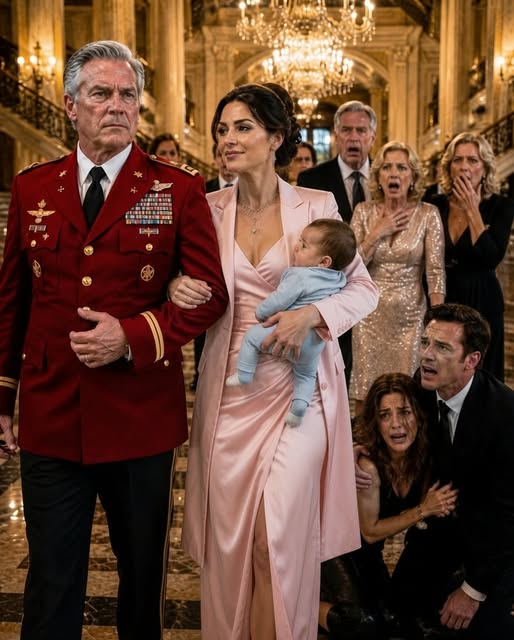
The stranger outside Richard’s house held my photograph against the rain like proof that I existed.
For several seconds, nobody moved.
Richard stood beside the dining-room window, his face drained of color. Aunt Evelyn clutched the back of a chair. Elena Ruiz, the attorney, quietly reached for her phone.
I stared through the glass at the man who had mouthed two impossible words.
My daughter.
He looked to be in his late fifties. Silver threaded through his dark hair, and a pale scar curved from his left temple to his jaw. He stood unevenly, favoring one leg, but his shoulders remained straight beneath his black coat.
My father—Robert, the man I had called Dad my entire life—stood several feet away from him.
That frightened me more than anything.
Robert had brought him here.
“Who is he?” I whispered.
Richard did not answer immediately.
Then he said the name as though speaking it might summon a ghost.
“Jonathan Hayes.”
The name printed on my birth record.
My biological father.
The man who had supposedly died nearly thirty years ago.
Elena moved toward the door, but Richard stopped her.
“Wait.”
Outside, Robert pointed angrily toward the house. Jonathan did not react. He kept his eyes fixed on me.
My mother remained inside the sedan, staring straight ahead.
“What are they doing together?” Evelyn asked.
Richard’s jaw tightened.
“That is exactly what we need to find out.”
He opened the front door but blocked the entrance with his body.
Jonathan looked past him.
“Claire?”
Hearing my name in his voice shattered something inside me.
Not because I recognized him.
Because part of me wanted to.
“You don’t get to say her name,” Richard warned.
Jonathan’s face twisted with pain.
“I have spent twenty-nine years trying to remember it.”
Robert laughed harshly. “Don’t listen to him. He’s confused. He has been unstable for decades.”
Jonathan turned slowly.
“You told me she died.”
Robert’s confidence flickered.
“You were injured.”
“You showed me a death certificate.”
My breath caught.
Richard stepped onto the porch. “Jonathan, tell me what happened.”
Rain struck the roof in hard silver sheets.
Jonathan raised the battered military file.
“I woke up in a private rehabilitation clinic six months after the fire. I had burns, a fractured skull, and almost no memory. A man visited me twice. He said my wife and daughter were dead.”
His eyes shifted to Robert.
“That man was him.”
Robert’s expression hardened.
“This is absurd.”
Jonathan opened the file and removed an old photograph. It showed him in military uniform beside Richard. Between them stood a young woman with long dark hair and a baby wrapped in a yellow blanket.
My mother.
My real mother.
Anna.
The baby was me.
On the back of the photograph, someone had written:
To Jonathan—come home safely. Claire and I are waiting. Love, Anna.
My knees weakened.
Evelyn caught my elbow before I fell.
Jonathan’s voice broke.
“I found this photograph three weeks ago in a sealed personnel archive. I remembered Anna’s face first. Then the fire. Then a baby crying.”
Richard stared at Robert.
“You knew he was alive.”
Robert stepped backward.
“You don’t understand what happened.”
“Then explain it.”
My mother finally climbed out of the car.
Her silver dress from Whitney’s engagement dinner was hidden beneath a dark coat, but she still looked like a woman arriving late to a party rather than someone whose life had begun collapsing.
“Claire,” she called, “please come outside. We can settle this privately.”
I almost laughed.
That word again.
Privately.
The place where my parents buried every truth.
Elena stepped onto the porch beside Richard.
“No one is discussing anything without legal representation.”
My mother’s face tightened.
“This is a family matter.”
Elena’s response was immediate.
“No. This may involve kidnapping, identity fraud, theft, falsified death records, and attempted concealment of a beneficiary. It stopped being merely a family matter a long time ago.”
Robert grabbed Jonathan’s arm.
“Tell them what you really want.”
Jonathan ripped free.
“I want my daughter.”
“You want her money.”
The accusation landed like broken glass.
Jonathan looked genuinely stunned.
Then he turned toward me.
“I didn’t know about the trust until yesterday.”
“How did you find us?” I asked.
My voice was barely audible.
He took one careful step forward.
“A former military records officer contacted me after Richard requested archived files connected to Jonathan Hayes. I have lived under the name John Hale since the clinic released me. I thought I had no family.”
His eyes filled with tears.
“Then he told me a woman named Claire Morgan had my birth record.”
I pressed my left hand over my mouth.
For years, I had believed my parents considered me a burden.
Now I was learning that somewhere in the world, a man had grieved me without even remembering why.
Robert suddenly moved toward the car.
Richard caught his shoulder.
“Where are you going?”
“Get your hand off me.”
A siren sounded at the end of the road.
Then another.
Two police vehicles turned into the driveway, followed by an unmarked sedan.
My mother spun toward Elena.
“You called them?”
Elena’s expression remained calm.
“I called federal investigators when I saw the name on that birth record.”
Robert’s face collapsed.
Not anger.
Fear.
That was the moment I knew the truth was even worse than we understood.
An investigator approached and introduced herself as Special Agent Mara Bennett. She asked Jonathan to step aside and ordered Robert and my mother to remain where they were.
My mother looked at me through the rain.
“Claire, whatever they say, remember that we raised you.”
I stared at the woman who had used my inheritance, rejected my son, and hidden my living father.
“No,” I said. “You kept me.”
Her face changed.
The distinction wounded her because it was true.
As the investigators separated everyone, Jonathan remained near the porch.
He did not try to touch me.
He did not demand forgiveness.
He simply removed a small wooden object from his pocket and placed it on the railing.
It was a carved bird.
One wing was unfinished.
“I made that before the fire,” he said. “I remembered carving it for a nursery.”
I picked it up with my left hand.
Beneath the bird’s tiny feet were four carved letters.
C.L.A.I.
He had never finished my name.
Before I could speak, Special Agent Bennett opened Robert’s trunk.
Inside were two packed suitcases, a folder of passports, and a metal cash box.
But the most shocking item was a notarized document dated three days earlier.
It transferred the remaining balance of my trust to a private offshore account.
The signature at the bottom looked exactly like mine.
Except I had never signed it.
Bennett held the document beneath the porch light.
“Mr. Morgan,” she said, “you are not leaving tonight.”
Robert looked at my mother.
My mother looked at Jonathan.
And Jonathan looked at me.
Then Robert said the sentence that changed the investigation completely.
“You’re arresting the wrong person.”
He pointed at my mother.
“The fire was her idea.”
PART 4 — THE NIGHT MY MOTHER BURNED THE TRUTH
My mother did not deny it.
That was the most terrifying part.
She stood in the rain while Robert accused her of planning the fire that had killed Anna and nearly killed Jonathan. Her face remained pale but strangely composed, as if she had spent years rehearsing for the moment the secret escaped.
Special Agent Bennett separated them immediately.
Robert was placed in one police vehicle.
My mother was taken toward another.
Before the door closed, she turned to me.
“Ask Richard what Anna was really involved in.”
Then the officer pushed her inside.
Richard went still.
I looked at him.
“What did she mean?”
“Nothing you need to deal with tonight.”
“Stop protecting me from the truth.”
His eyes closed briefly.
He had spent only a few hours learning that I had survived, yet he already looked afraid of losing me again.
“Anna worked as a civilian financial analyst attached to a military procurement office,” he said. “She discovered irregular payments linked to defense contracts.”
Elena understood first.
“Money laundering?”
Richard nodded.
“And theft. Someone was diverting millions through shell companies.”
I looked toward the police vehicle holding Robert.
“Was he involved?”
“We never proved it.”
Jonathan stepped closer.
“I remember Anna telling me she had found something dangerous. She wanted to contact Richard.”
“Why didn’t she?”
“She did.”
Richard’s face tightened.
“A package arrived while I was deployed. By the time I opened it, Anna was dead, Jonathan was missing, and Robert told me their baby had died.”
“What was in the package?”
“Copies of payment records. Names. Account numbers.”
“Did you investigate?”
“I tried. But the records disappeared from my office before military investigators could verify them.”
The meaning settled over us.
Someone close enough to Richard’s command had stolen the evidence.
Someone who knew where it was kept.
Jonathan looked at him.
“Robert served as a civilian contractor at your base.”
Richard nodded slowly.
“And Diane worked in administrative records.”
My mother.
Together, they had access to Anna’s files, Jonathan’s casualty reports, and my identity documents.
The truth was no longer a collection of cruel choices.
It was a design.
They had not found me accidentally after a tragedy.
They had built their future from the ruins of my family.
That night, investigators searched Richard’s house, Robert’s car, and my parents’ home.
I sat in the guest room with Noah sleeping against my chest while Evelyn supported his weight so I would not injure my ribs.
Jonathan waited downstairs.
He had asked permission before entering the house.
He asked before sitting near me.
He asked before looking at Noah.
Every question carried the caution of a man terrified that one wrong movement would make me disappear.
At midnight, I finally invited him into the room.
He stopped beside the doorway.
Noah stirred beneath his blanket.
“This is your grandson,” I said.
Jonathan’s eyes filled instantly.
“He has Anna’s chin.”
The words broke me.
No one had ever told me I looked like anyone except the family who had raised me.
Whitney had my mother’s eyes.
Whitney had my father’s smile.
I had always been described as different.
Difficult.
Too sensitive.
Too quiet.
Now, for the first time, those differences had somewhere to belong.
“What was she like?” I asked.
Jonathan sat in the chair near the window.
“Brilliant. Stubborn. She laughed whenever she was angry because she hated letting cruel people know they had hurt her.”
A laugh escaped me before turning into a sob.
“I do that.”
“I know.”
“How?”
“You did it at the hospital when they talked about the party. Richard told me.”
I looked down at Noah.
“Did you love her?”
“With everything I had.”
“Then why weren’t you there the night of the fire?”
His face darkened.
“I received orders to report to the base for an emergency briefing. The message was false.”
Someone had lured him away.
“When I returned, the house was burning. I ran inside. I remember finding Anna near the stairs. She was alive.”
My heart stopped.
“She told me to get you.”
His voice cracked.
“I heard you crying upstairs. Then something struck me from behind.”
“Robert?”
“I never saw who did it.”
He woke months later in a clinic several states away, listed under a false name. His treatment had been paid through a private charitable foundation that later dissolved.
The foundation’s director had been my mother’s cousin.
The conspiracy extended beyond two people.
It had required doctors, forged documents, altered military records, and silence purchased over decades.
At two in the morning, Special Agent Bennett returned.
She carried a box taken from my parents’ attic.
Inside were files, photographs, and cassette tapes.
One tape had my grandmother Margaret’s name written across it.
Bennett placed an old recorder on the table.
“We believe you should hear this with your attorney present.”
Elena sat beside me.
Richard stood behind my chair.
Jonathan remained near the wall.
The tape hissed.
Then my grandmother’s voice filled the room.
“If this recording is being played, Diane has finally been exposed.”
My skin prickled.
Margaret explained that she had discovered my true identity when I was six years old after finding an old hospital bracelet hidden inside my mother’s jewelry box.
She confronted Robert.
He claimed Anna and Jonathan had named them as temporary guardians.
Margaret did not believe him.
She secretly hired an investigator and learned that no legal adoption existed.
But when she threatened to report them, Robert showed her photographs of Whitney and me sleeping.
“He told me accidents happen to children whose grandmothers ask dangerous questions,” Margaret said on the tape.
Evelyn covered her mouth.
I felt nothing at first.
Then the horror arrived all at once.
Grandma had stayed silent because she thought silence kept me alive.
She created the trust to protect what remained of my biological parents’ estate. She hid evidence with attorneys and wrote the sealed letter.
But she had not known Jonathan survived.
Near the end of the recording, Margaret’s voice weakened.
“There is one more truth Claire must know. Diane did not take Claire only for money. She believed Anna had hidden the final evidence inside something belonging to the baby.”
The tape clicked off.
We stared at one another.
Jonathan looked toward the wooden bird on the bedside table.
“No,” he whispered.
He took the carving and examined the unfinished wing.
His fingers found a narrow seam.
Richard brought a small knife.
Carefully, he separated the wood.
Inside the hollow bird was a tightly rolled strip of microfilm.
Anna had hidden the evidence in the toy Jonathan carved for me.
For nearly thirty years, my parents had searched for it.
And it had returned to me the same night my father did.
Bennett held the microfilm beneath the lamp.
“This could identify everyone involved.”
A crash sounded downstairs.
Then the lights went out.
Evelyn screamed.
Richard reached for me, but someone moved through the darkness faster.
A hand clamped over my mouth.
Another arm dragged me from the bed.
Noah began crying.
I tried to fight, but pain exploded through my ribs.
A voice whispered beside my ear.
“You should have stayed ignorant.”
I recognized it.
Whitney.
PART 5 — THE SISTER WHO CHOSE A SIDE
Whitney pulled me toward the hallway while the house remained dark.
Her hand trembled over my mouth.
“Don’t scream,” she whispered. “I’m trying to save you.”
I bit her palm.
She cried out and released me.
Richard appeared with a flashlight, followed by Jonathan and Special Agent Bennett.
“Get away from her!” Richard shouted.
Whitney raised both hands.
She was soaked from the rain, her hair tangled around her face. She no longer looked like the polished favorite child.
She looked terrified.
“I cut the power because I thought the house was being watched,” she said. “Mom’s cousin followed me here.”
Bennett seized her arm.
“What cousin?”
“Paul Mercer. He helped Mom move Jonathan after the fire.”
Jonathan stepped forward.
“Where is he?”
Whitney started crying.
“I don’t know. He called me after Mom was arrested. He said Claire had found something and that I had to get it before federal agents did.”
“The microfilm?” Bennett asked.
Whitney stared at the wooden bird.
“Yes.”
Bennett pulled her toward the stairs.
“You are coming with us.”
“No!” Whitney twisted free. “Listen to me. Paul said if I failed, he would kill Claire and the baby.”
The room fell silent.
I believed her fear.
But belief was not forgiveness.
“Why did you come alone?” I asked.
“Because I didn’t know who to trust.”
“You could have called the police.”
She laughed bitterly.
“Our parents taught me the police were enemies, lawyers were thieves, and everyone outside the family wanted to destroy us.”
“They taught you that because the truth would destroy them.”
“I know that now.”
Her eyes met mine.
“I found documents in Mom’s dressing room. They planned to transfer the trust, leave the country, and blame the withdrawals on me.”
Daniel’s screenshot.
The forged transfers.
The money given to Whitney.
My parents had created a trail leading directly to their favorite daughter.
Whitney had never been loved more.
She had merely been protected longer because she was useful.
“I thought they chose me,” she whispered. “But they were preparing to sacrifice me.”
A gunshot shattered the bedroom window.
Glass exploded across the floor.
Jonathan threw himself over me.
Richard pulled Evelyn and Noah behind the bed.
Bennett drew her weapon and shouted into her radio.
Another shot struck the wall.
From outside came the roar of an engine.
Paul Mercer was escaping.
Police vehicles pursued him down the road while paramedics checked us for injuries.
Jonathan had a cut above his eyebrow.
He dismissed it until I touched the blood with my left hand.
“You protected me.”
His expression softened.
“I failed once.”
“You didn’t fail. Someone attacked you.”
“For twenty-nine years, I believed I had not reached you in time.”
“You’re here now.”
The words came before I could stop them.
Jonathan closed his eyes.
That was the first moment I allowed myself to think of him as my father.
Not Dad.
That name still belonged to too many wounds.
But my father.
Whitney surrendered to investigators and provided the documents she had stolen from our mother’s room.
Among them was a ledger listing bribes paid to clinic administrators, records clerks, contractors, and military personnel.
Paul Mercer’s name appeared repeatedly.
So did Robert’s.
My mother’s name appeared beside the largest transactions.
But one name shocked Richard.
Colonel Samuel Voss.
His former commanding officer.
The man who had approved the false emergency briefing that lured Jonathan away on the night of the fire.
Voss had been the leader.
Robert and my mother had been accomplices.
Anna discovered the stolen defense funds.
Voss ordered her silenced.
Robert agreed to help because he was deeply in debt.
My mother manipulated the records.
Paul moved Jonathan to the clinic.
After the fire, they discovered I had inherited Anna’s insurance settlement and Jonathan’s military death benefits.
Instead of killing me, they decided I was more valuable alive.
The plan had been simple.
Raise me.
Control me.
Take everything.
But Margaret complicated it by creating the trust.
And Anna defeated them by hiding the microfilm where none of them thought to look.
Inside a father’s unfinished gift.
Paul Mercer was captured before sunrise after crashing his car near the state line.
He survived.
Faced with federal charges, he began talking.
So did Whitney.
For two days, she answered every question investigators asked.
She admitted knowing about the trust account for almost a year.
She admitted accepting money.
She admitted lying to Daniel.
But she insisted she had not known I was kidnapped.
I believed that part.
Whitney had been selfish, cruel, and spoiled.
But she had also been raised inside the same machine that abused me.
The difference was that the machine fed her while it starved me.
On the third evening, she visited Richard’s house under supervision.
I sat on the porch with Noah asleep beside me.
Whitney stood at the bottom of the steps.
“I don’t expect you to forgive me,” she said.
“Good.”
She nodded, accepting the blow.
“I hated you.”
“I know.”
“No. I hated you because every time Mom praised me, she compared me to you. I thought winning meant you had to lose.”
“And you enjoyed it.”
“Yes.”
Her honesty surprised me.
She looked toward Noah.
“When Mom refused to help you, I knew it was wrong. I still let her.”
“Why?”
“Because for one night, everything was about me.”
I felt the old anger rise.
But beneath it was something else.
Pity.
Not the gentle kind.
The painful kind one feels when seeing what another person willingly became.
“Daniel was right to leave you,” I said.
“I know.”
“You stole from me.”
“I know.”
“You helped them humiliate me for years.”
Her lips trembled.
“I know.”
I looked at my sister and understood that forgiveness was not the same as reunion.
I could release hatred without reopening the door.
“I hope you become someone better,” I said. “But you won’t practice on me.”
She lowered her head.
“That’s fair.”
Before leaving, she placed the engagement ring on the porch rail.
“Daniel said it was mine to keep. I don’t want it.”
“I don’t want it either.”
“Sell it. Put the money in Noah’s college account.”
I almost refused.
Then I thought of all the money taken from me in Whitney’s name.
“Fine.”
She gave a small, broken smile.
It was the first honest thing she had ever given my son.
That night, Bennett called with news.
The microfilm had been developed.
It contained enough financial evidence to reopen the entire defense-contract investigation.
Dozens of people would be charged.
But one image had nothing to do with money.
It was a photograph of Anna standing beside Colonel Voss, Robert, and my mother.
On the back, Anna had written:
If I die, ask Diane why she called me her sister.
I stared at the image.
My mother and Anna had the same eyes.
The same narrow chin.
The same dark hair.
Elena ordered DNA testing immediately.
The results arrived forty-eight hours later.
Anna Hayes had not been a stranger to the woman who raised me.
She had been my mother’s older half sister.
Which meant the woman I called Mom had stolen me not only from an endangered family.
She had stolen me from her own sister.
PART 6 — THE WOMAN BEHIND THE FIRE
My mother requested to speak with me after the DNA results arrived.
I said no.
Then she offered to reveal where Anna’s original files were hidden.
Special Agent Bennett recommended that I attend the interview.
Elena objected.
Richard objected more loudly.
Jonathan said nothing until I asked what he thought.
“If seeing her will break you, don’t go,” he said. “If not seeing her will leave you wondering forever, go.”
So I went.
The interview room was small, cold, and windowless.
My mother sat behind a metal table wearing a gray detention uniform. Without styled hair, jewelry, and makeup, she looked smaller.
But not weaker.
Some people carried control inside them.
She smiled when I entered.
“Claire.”
I sat across from her.
“My name was Claire before you stole me?”
“Yes.”
“Why didn’t you change it?”
“Anna had embroidered it on everything. Blankets. Clothing. That ridiculous wooden bird. You responded to it.”
The cruelty of her casual tone made my stomach twist.
“Why did you take me?”
Her smile faded.
“At first? Because Robert said we had no choice.”
“You always had a choice.”
“You don’t understand what it was like.”
“Then explain.”
She looked toward the camera in the corner.
“Anna was my father’s daughter from his first marriage. She was brilliant, admired, and given every opportunity. I was the secret child he acknowledged only when convenient.”
Jealousy had begun long before I was born.
When Anna discovered the laundering scheme, she confided in my mother, believing blood meant loyalty.
Instead, my mother told Robert.
Robert told Voss.
Voss ordered the fire.
“I did not know they planned to kill her,” my mother said.
“Do you expect me to believe that?”
“I thought they would frighten her.”
“You falsified the records afterward.”
“Because by then it was too late.”
“No. It was inconvenient.”
Her eyes sharpened.
“You sound like Margaret.”
“Good.”
That wounded her.
My grandmother had seen through her.
“You want me to say I never cared for you,” she continued. “That would make everything easier, wouldn’t it?”
I remained silent.
“But I did care. Sometimes.”
“Sometimes?”
“You were a difficult child.”
“I was a kidnapped child being raised by the people who killed my mother.”
Her face tightened.
“You knew nothing about that.”
“Children know when love is unsafe.”
For the first time, she looked away.
I asked where Anna’s files were hidden.
She leaned back.
“Promise me something first.”
“No.”
“You haven’t heard what I want.”
“I don’t bargain with you.”
Her smile returned faintly.
“There she is. Anna’s daughter.”
The files were hidden beneath the floor of my parents’ old lake cabin.
In exchange for revealing the location, my mother wanted prosecutors to protect Whitney from the most serious conspiracy charges.
Even after everything, she chose Whitney.
I almost laughed.
But then she surprised me.
“Whitney didn’t know,” she said. “Not about the fire. Not about Jonathan. Not about Anna. Robert wanted her involved, but I refused.”
“Why protect her and not me?”
My mother stared at the table.
“Because Whitney was mine.”
The words should have destroyed me.
Instead, they freed me.
I had spent my life trying to earn something she had decided at the beginning I would never receive.
Her rejection had never measured my worth.
It measured her capacity.
I stood.
“Thank you.”
She looked confused.
“For what?”
“For finally telling the truth.”
At the door, she called my name.
“Claire, I raised you for twenty-nine years.”
I turned back.
“And still, you never knew me.”
Investigators recovered Anna’s files from the cabin.
They contained original contracts, payment trails, recorded conversations, and one handwritten letter addressed to Richard.
In it, Anna explained that she feared Jonathan would be targeted. She asked Richard to raise me if anything happened to both of them.
But there was another request.
Do not let Claire inherit our fear. Teach her that survival is not the same as living.
Richard read the line aloud and broke down.
For decades, he had believed he failed Jonathan.
Now he learned Anna had trusted him with the thing she loved most.
Me.
The federal case moved quickly.
Voss was arrested at his retirement home.
Robert was charged with conspiracy, fraud, kidnapping, attempted theft, and obstruction.
My mother faced the same charges, along with falsifying official documents.
Paul Mercer accepted a plea agreement in exchange for testimony.
Whitney received immunity from conspiracy charges but remained responsible for financial fraud connected to the trust.
She agreed to restitution and probation.
Daniel never returned to her.
He sent me a brief letter wishing Noah and me peace.
I did not answer.
Some people entered a story only to open a locked door.
They were not meant to remain after it swung wide.
My trust was frozen and audited.
The remaining balance was protected.
Investigators identified more than seven hundred thousand dollars taken over the years.
Some assets could be recovered.
Others were gone.
For the first time, money did not feel like security.
It felt like evidence.
Jonathan stayed nearby but never forced closeness.
He rented a small house ten minutes from Richard and Evelyn.
He visited when invited.
He learned how Noah liked to be held.
He told me stories about Anna.
One afternoon, he brought a box of letters he had written during deployments.
Most were addressed to his wife.
One was addressed to me.
My darling Claire,
Today your mother wrote that you smiled when she said my name. I don’t know whether that is true or whether she is trying to make me jealous of a six-week-old baby. Either way, it worked.
I folded the letter carefully.
“What should I call you?” I asked.
Jonathan looked startled.
“Whatever feels honest.”
I considered Dad.
The word still carried Robert’s cold voice.
Father sounded formal.
Jonathan sounded safe.
“For now,” I said, “I’ll call you Jonathan.”
He smiled.
“For now is more than I thought I would ever have.”
Then he handed me another document.
It was a military insurance policy.
I was the named beneficiary.
But beside my name was a handwritten amendment made before the fire.
If Claire cannot be found, all benefits are to pass to Colonel Richard Lawson for the purpose of searching for her.
Richard had never known.
Jonathan had trusted him completely.
That evening, while we sat together on the porch, a black vehicle stopped at the end of the driveway.
My body tensed.
But it was not an investigator.
A young man stepped out carrying flowers.
I recognized him immediately.
Ethan Cole.
Noah’s father.
The man who had disappeared after learning I was pregnant.
He walked toward me with tears in his eyes.
“I heard what happened,” he said. “I want to come back.”
For one dangerous second, hope stirred.
Then I noticed the camera crew parked behind his car.
A reporter stepped out.
Ethan had not returned for Noah.
He had returned because my story was becoming national news.
PART 7 — THE LAST PERSON WHO TRIED TO USE ME
Ethan spread his arms as though expecting me to run into them.
“Claire, please. I know I made mistakes.”
Behind him, the reporter lifted a microphone.
A camera operator began recording.
Jonathan stood from his chair.
Richard appeared in the doorway.
Evelyn picked up Noah and carried him inside.
I remained seated.
“What are they doing here?” I asked.
Ethan glanced back, pretending surprise.
“They followed me.”
The reporter immediately said, “Mr. Cole contacted our station this morning.”
Ethan’s face changed.
Only slightly.
But I saw it.
The same calculation I had seen in my parents.
The moment someone realized the story they designed was slipping away.
“I thought people should hear my side,” he said.
“Your side of abandoning me while I was pregnant?”
“I was scared.”
“So was I.”
“I wasn’t ready to be a father.”
“And I wasn’t ready to be hit by a truck. Yet somehow, I remained responsible for what happened next.”
The camera moved closer.
Ethan lowered his voice.
“This doesn’t need to become ugly.”
“You brought television cameras to my home.”
“Our son deserves to know both parents.”
“You haven’t seen him since he was born.”
“I want custody rights.”
There it was.
Not love.
Leverage.
My story had spread after court filings became public. News outlets reported the stolen inheritance, the kidnapping, and the military corruption case.
People began calling me “the stolen heiress.”
I hated the phrase.
It turned my life into entertainment.
Ethan saw money.
He saw attention.
He saw a son connected to both.
Elena stepped from the house carrying a folder.
“I was wondering when you would appear,” she said.
Ethan frowned.
“Who are you?”
“Claire’s attorney.”
“I have rights.”
“You signed a notarized acknowledgment declining parental involvement after Noah’s birth.”
“I was pressured.”
“You also sent Claire a message stating that if she ever contacted you again, you would deny the child was yours.”
The reporter lowered her microphone.
Ethan’s face reddened.
“That was private.”
I almost smiled.
Everyone who harmed me seemed to love that word.
Private.
Elena handed him an envelope.
“You have been served. Claire is petitioning for sole legal and physical custody. Any future communication goes through my office.”
Ethan looked toward the camera and realized the performance had reversed.
He had arrived expecting to play the repentant father.
Instead, everyone saw the opportunist.
“You’re keeping my son from me because of money,” he snapped.
“No,” I said. “I’m protecting him because I know what it feels like to be treated like property.”
The reporter turned toward me.
“Claire, would you like to make a statement?”
I looked directly into the lens.
“Yes.”
Richard started to object, but I raised my hand.
For my entire life, others had controlled the narrative.
My parents called me dramatic.
Whitney called me jealous.
Ethan called me difficult.
Now I would speak for myself.
“My name is Claire Hayes,” I said. “I am not a stolen heiress. I am a mother, a survivor, and the daughter of Anna and Jonathan Hayes. People took my identity, my inheritance, and nearly three decades of my life. They will not take my voice.”
The reporter said nothing.
Neither did Ethan.
“I don’t want sympathy,” I continued. “I want accountability. And I want anyone watching who has been told they are too emotional, too difficult, or too ungrateful to understand this: sometimes the person calling you dramatic is simply afraid you are beginning to see clearly.”
The video spread overnight.
Thousands of messages arrived.
Some came from strangers sharing their own stories.
Others came from people who had known Anna.
One message changed everything.
It came from a retired nurse named Helen Brooks.
She had worked at the private clinic where Jonathan awakened after the fire.
She remembered him.
More importantly, she remembered a second patient brought in the same night.
A woman with severe burns.
The clinic records listed her as Jane Doe.
Helen believed the woman had died.
But after seeing Anna’s photograph on the news, she was no longer certain.
Jonathan read the message three times.
“No,” he whispered. “I saw Anna in the house.”
“You said she was alive,” I reminded him.
“But the fire—”
“What if someone removed her too?”
Special Agent Bennett reopened the clinic investigation.
Old storage records showed that Jane Doe had been transferred to a long-term care facility six weeks later.
From there, the paper trail vanished.
But a payment record connected the facility to another charity controlled by Colonel Voss.
The search took investigators across three states.
Finally, they found a woman living in a neurological care center under the name Anne Hill.
She had no family listed.
She had suffered memory loss, burns, and partial paralysis.
Jonathan and I traveled there together.
I carried the wooden bird.
He carried the photograph of Anna holding me.
As we approached her room, I could not breathe.
The woman inside sat beside a window overlooking a garden.
Her hair was white.
Scars covered one side of her face and neck.
She turned when we entered.
Jonathan stopped so suddenly I nearly struck him.
“Anna?”
The woman stared.
Her hands began to tremble.
He moved toward her slowly.
“It’s Jonathan.”
She looked at his scar.
Then at his eyes.
Her mouth opened, but no sound emerged.
I stepped forward.
“My name is Claire.”
She looked at me.
Nothing happened.
My heart broke silently.
Then I placed the wooden bird in her lap.
Her fingers traced the unfinished wing.
A tear rolled down her cheek.
She whispered one word.
“Baby.”
My knees gave way.
Jonathan caught me.
Anna reached for my face.
Her hand shook violently, but when her fingertips touched my cheek, something passed through her expression.
Recognition deeper than memory.
Love surviving without language.
“Claire,” she breathed.
For the first time in twenty-nine years, my mother said my name.
PART 8 — THE FAMILY THAT CAME BACK TO LIFE
Anna’s recovery was slow.
Memory did not return like lightning.
It came like dawn.
A face.
A song.
The smell of cedar from the wooden bird.
Jonathan’s habit of tapping his thumb when nervous.
The way I laughed when angry.
She remembered pieces of the fire.
Robert entering the house.
My mother arguing with Anna near the stairs.
Paul Mercer striking Jonathan.
Colonel Voss ordering them to search for the evidence.
Anna remembered hiding me inside a laundry cabinet when smoke filled the hallway.
My mother found me there.
For years, I had imagined she took me from the fire because some buried instinct told her to save a child.
Anna corrected that illusion.
“She asked where the evidence was,” my mother said haltingly during a recorded interview. “I would not tell her. Then she took you.”
Anna had tried to follow but collapsed.
Paul later removed her from the house because Voss feared she might survive long enough to speak.
He sent her to the same clinic as Jonathan under a false identity.
When her memory did not return, she was hidden in long-term care.
For nearly three decades, my biological parents had lived less than a thousand miles apart.
Both believing the other was dead.
Both believing I was gone.
The court proceedings lasted eleven months.
Robert accepted a plea after financial records made conviction inevitable.
He received a decades-long federal sentence.
My mother went to trial.
She sat at the defense table wearing a navy suit and pearls, trying to look like the respectable woman who hosted engagement dinners and charity luncheons.
But Anna testified.
So did Jonathan.
So did Richard.
So did Whitney.
And finally, so did I.
My mother’s attorney asked whether she had ever shown me affection.
“Yes,” I answered.
“Did she feed you, clothe you, educate you?”
“Yes.”
“Then isn’t it possible she came to love you?”
I looked at the woman who had raised me.
“She may have loved what controlling me gave her. That is not the same thing as loving me.”
The jury convicted her on every major count.
As officers led her away, she turned toward Whitney.
Not me.
Whitney began to cry.
I took her hand.
Not because the past had disappeared.
Not because we were healed.
But because in that moment, we were both daughters watching the illusion of our mother finally end.
Whitney served eight months in a county facility for financial fraud and completed restitution through the sale of her car, jewelry, and other assets.
After her release, she moved to another city and began working at a women’s shelter.
She wrote to me once a month.
I answered twice a year.
That was enough.
Forgiveness, I learned, did not require returning to the scene of the wound.
Daniel married someone else two years later.
He sent Noah a small wooden train for his birthday.
There was no note.
Ethan abandoned his custody claim after the court ordered genetic testing, financial disclosure, and supervised visitation.
He had wanted publicity, not responsibility.
Noah grew without him.
But he did not grow without fathers.
Jonathan learned to change diapers with one hand while Anna corrected him from her wheelchair.
Richard taught Noah to salute before he could say complete sentences.
The three of them argued constantly over who spoiled him most.
Evelyn always won.
Anna moved into a small cottage beside Jonathan’s house.
They did not pretend the missing years had never happened.
They mourned them.
Then they began again.
Some evenings, I watched them sit together beneath the oak trees, their hands linked between two chairs.
They were not the young couple from the photograph.
They were scarred, older, and changed.
But they were alive.
And sometimes survival truly was the beginning of living.
With part of the recovered trust, I paid my medical bills and created a secure fund for Noah.
I donated money to help families challenge fraudulent guardianships and identity records.
The rest remained invested.
For once, nobody else controlled it.
I changed my legal name from Claire Elizabeth Morgan to Claire Anna Hayes.
I kept Elizabeth because Grandma Margaret had chosen it.
She had been trapped by fear, but within that fear she had preserved enough evidence to save me.
I wanted part of her to remain.
One spring morning, exactly three years after the truck accident, our family gathered at Richard and Evelyn’s house.
Anna could walk short distances with a cane.
Jonathan stood beside her.
Whitney watched from the edge of the garden, invited but cautious.
Noah ran between everyone wearing a tiny charcoal suit and carrying the wooden bird.
We were there for a wedding.
Not mine.
Anna and Jonathan had decided to marry again.
Their original marriage certificate had disappeared with the false records. Legally, their status had become tangled beyond recognition.
So they chose one another a second time.
Richard officiated.
His voice broke before he finished the first sentence.
Jonathan looked at Anna.
“I lost my memory,” he said, “but some part of me kept loving you.”
Anna smiled through tears.
“I lost my name,” she answered, “but I kept our daughter’s.”
Then they exchanged simple silver rings.
No cameras.
No champagne tower.
No performance.
Only the people who had survived long enough to find one another.
After the ceremony, Richard handed me a small package.
Inside was the wooden bird.
The damaged wing had been repaired.
My full name was carved beneath it.
CLAIRE.
“I thought Jonathan finished it,” I said.
Richard shook his head.
“Noah did.”
My three-year-old son proudly held up a blunt child’s carving tool.
The letters were crooked.
They were perfect.
As sunset spread gold through the trees, Anna sat beside me.
“You were four weeks old when Jonathan wrote you a promise,” she said.
“What promise?”
She handed me a folded page recovered from her old belongings.
The writing was faded.
Claire, if the world ever becomes frightening, remember that family is not the people who demand you suffer to prove you love them. Family is the person who comes when you call.
I looked around the garden.
At Richard, who entered a hospital room at two in the morning.
At Evelyn, who prepared a nursery before I had the courage to ask.
At Jonathan, who crossed three decades of darkness to find me.
At Anna, who survived fire, stolen years, and silence.
At Whitney, who had finally chosen truth even though it cost her everything she once valued.
And at Noah, the little boy whose existence forced me to understand that love should never feel like punishment.
The truck accident had broken my arm, cracked my ribs, and left a scar above my eye.
But it had also forced me to make one desperate phone call.
My parents refused to come.
For years, I thought that was the cruelest thing they had ever done.
I was wrong.
Their refusal became the first door out of the prison they built around my life.
At exactly 10:47 that night, three years after I called my father from the hospital, my phone rang.
The screen displayed an unknown number.
For one second, the old fear returned.
Then I answered.
A woman introduced herself as an investigator from another state.
She had found evidence that Robert and Diane had handled guardianship records for two other children during the same period they took me.
Both children were now adults.
Both had inherited money.
Both had been told their biological families were dead.
I looked toward Richard.
He saw my expression and came closer.
“What is it?” he asked.
I covered the phone.
“They found two more.”
His face hardened with the old colonel’s focus.
Anna reached for my hand.
Jonathan stood beside us.
For a moment, I understood that my story had ended—but the truth had not.
There were others still waiting to learn who they were.
Others who had been taught that abandonment was love.
Others whose names had been buried beneath someone else’s lies.
I lifted the phone again.
“Tell me where they are,” I said.
Noah ran across the grass and wrapped his arms around my legs.
Behind him stood the family I had lost, found, chosen, and rebuilt.
I was no longer the injured woman begging someone to come.
This time, I was the person answering the call.
THE END