PART 3 — THE SECRET HIDDEN INSIDE LADY JUSTICE
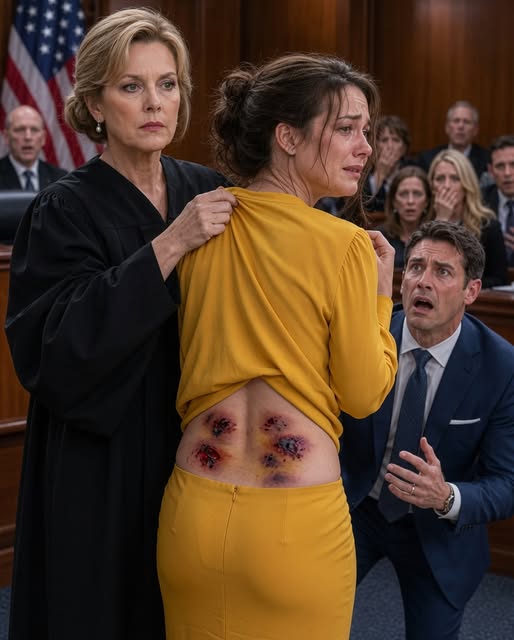
By the time the police secured my house, Dr. Leonard Pierce was dead.
Rain blew through the shattered window, scattering glass across the floor while paramedics worked over a body they already knew they could not save. Clara stood halfway down the staircase with Sophie clinging to her legs, both of them wrapped in blankets.
I had spent twenty-two years making decisions in rooms where tragedy arrived neatly labeled as evidence. Now tragedy lay bleeding across my carpet, and the evidence had spoken my husband’s name.
Inside the judge.
Detective Marcus Bell, the lead investigator, pulled me aside.
“You believe Pierce was referring to your chambers?”
“My husband gave me a wooden statue of Lady Justice when I was confirmed.”
“And someone recently moved it?”
“Yes.”
Bell’s expression hardened. “Then you’re not going there alone.”
At dawn, we entered the federal courthouse through the underground garage. Two marshals accompanied us. The corridors felt unnaturally quiet, as though the building itself sensed that something hidden inside its walls was about to be exposed.
My chambers door showed no sign of forced entry.
Inside, the statue stood on the bookshelf with its blindfolded face turned toward the wall.
I lifted it carefully.
The base felt heavier than I remembered.
A small brass plate beneath the statue bore my confirmation date. Bell examined it and found a nearly invisible seam around the edge. Using a thin blade, he loosened the plate.
A memory card dropped into his palm.
Thomas had hidden it there for more than a decade.
The files contained recordings, bank records, photographs, and an unfinished letter addressed to me.
Evelyn,
If you are hearing this, I failed to stop Margaret Vale.
She used my signature to transfer money through shell charities. When I discovered it, she threatened you, Clara, and every case you had ever decided. I pretended to cooperate while collecting evidence.
Do not trust the judicial complaint.
Do not trust the accident report.
And above all, do not trust the person who recommended Margaret to our family.
My chest tightened.
Margaret had not entered our lives through the law firm.
My brother, Charles Cross, had introduced her to Thomas.
Charles had been my closest remaining relative, Sophie’s beloved great-uncle, and the executor of Thomas’s estate.
I called him immediately.
He answered on the first ring.
“Evelyn?”
“Where are you?”
“At home. Why?”
“Thomas left evidence.”
The silence lasted only half a second, but it was enough.
“What kind of evidence?” he asked.
I closed my eyes.
The correct response would have been surprise.
Charles had responded with fear.
Before I could confront him, an alarm sounded in the courthouse lobby.
A marshal shouted through the open chamber door.
“Judge, step away from the window!”
A black SUV had stopped outside the courthouse. A man in a delivery uniform left a package near the entrance and ran.
The bomb squad arrived within minutes.
The package contained no explosive.
Only Thomas’s missing wedding ring.
Taped beneath it was a note.
STOP DIGGING, OR CLARA WILL BURY HER MOTHER NEXT.
Bell read it and looked toward me.
“They know we found the card.”
“No,” I said slowly. “They knew it was here before we did.”
Someone had entered my chambers to search for it and failed.
Someone with courthouse access.
As security officers reviewed surveillance footage, Clara called.
Her voice was frantic.
“Mom, Uncle Charles is here.”
“Do not let him inside.”
“He already is.”
I felt the blood leave my face.
“Take Sophie upstairs and lock the door.”
“What’s happening?”
“Do it now.”
The line remained open as Clara moved. I heard footsteps, Sophie asking questions, and Charles calling from the hallway.
“Clara, your mother is confused. Open the door.”
Then the connection died.
Bell and I raced toward the garage.
My phone rang again before we reached the elevator.
This time, the caller was Daniel.
“You should have listened,” he said.
“What have you done?”
“Nothing yet.”
“Where are Clara and Sophie?”
“With someone who understands the value of cooperation.”
“If you hurt them—”
“You still think I’m the monster in this story,” he interrupted. “But you haven’t met the person who taught me.”
In the background, I heard Sophie crying.
Then another voice came onto the line.
My brother’s voice.
“Come alone, Evelyn,” Charles said. “Bring the memory card, and I’ll explain why Thomas had to die.”
PART 4 — THE BROTHER WHO SOLD HIS OWN FAMILY
The address Charles gave me led to an abandoned riverside courthouse scheduled for demolition. It had once served a rural county before federal districts were reorganized. Now its windows were boarded, its stone steps cracked, and weeds pushed through the pavement.
Bell refused to let me enter alone.
“They demanded it,” I said.
“Kidnappers demand many things. We don’t reward them with exactly what they want.”
We compromised. I wore a transmitter beneath my blouse, while tactical officers surrounded the building beyond sight.
The memory card in my pocket was a duplicate.
The original had already been transferred into federal custody.
Inside the old courthouse, dust floated through shafts of gray morning light. The judge’s bench remained at the far end, warped by moisture. Clara sat in the jury box with her wrists bound. Sophie was beside her, crying silently.
Daniel stood near the aisle.
Charles waited behind the bench.
Seeing my brother there hurt more than any threat Daniel could have made. Charles had walked me down the aisle after our father died. He had held Clara when she was born. He had spoken at Thomas’s funeral with tears in his eyes.
Now he held a gun.
“Give me the card,” he said.
“Release them first.”
“You are in no position to negotiate.”
“I have spent my life negotiating with armed men who believed fear made them powerful.”
His mouth twisted.
“You always did love the sound of your own authority.”
Daniel moved closer to Clara.
She recoiled.
“Stay away from her,” I said.
Charles laughed bitterly.
“Even now, it’s always Clara. Always you. Always Thomas. Do you know what it was like growing up beside you? The brilliant daughter. The future judge. The moral center of the family.”
“This is not about childhood resentment.”
“No. It’s about survival.”
He told me the truth with the calmness of a man who had rehearsed it for years.
Decades earlier, Charles had lost heavily in private investments. Margaret Vale offered to erase his debts if he introduced her to Thomas’s charitable foundation. Thomas trusted Charles, and through that trust, Margaret gained access to signatures, accounts, and confidential donor networks.
The scheme grew.
Money from government contractors moved through fake charities, then returned as consulting fees and political donations. Thomas discovered the fraud and confronted Charles.
“He wanted to go to the authorities,” Charles said. “He would have destroyed everything.”
“So you killed him.”
His face tightened.
“I didn’t intend for him to die.”
“Tell me what happened.”
Charles looked toward the boarded windows.
“I followed him that night. Margaret said we only needed the documents in his car. We forced him off the road. The car went over the barrier.”
A roaring filled my ears.
My husband had not lost control.
He had been hunted.
“Was he alive afterward?”
Charles looked away.
That was answer enough.
“He was trapped,” Charles whispered. “I heard him calling my name.”
Clara began to cry.
“You left him there?” I asked.
“I panicked.”
“You listened to him die.”
“I had a family too!”
“No,” I said. “You had people who loved you. You chose money instead.”
Daniel shifted uneasily.
For the first time, I realized he had not known every detail.
“You told me the crash was Margaret’s operation,” he said.
Charles snapped, “Be quiet.”
Daniel stared at him. “You said no one was supposed to die.”
“Daniel,” Clara whispered, “he will kill us too.”
Charles raised the gun toward her.
“Enough.”
Sophie screamed, “Don’t hurt Mommy!”
The sound transformed Daniel’s expression.
He looked at his daughter as if seeing her fear clearly for the first time.
For years, he had treated fear as proof of control. Now his own child was looking at him as though he belonged among the monsters.
“Charles,” Daniel said, “lower the gun.”
“You are not in charge here.”
“I brought Clara to the firm. I created the records. I followed every instruction.”
“And you became careless.”
Daniel stepped between Charles and the jury box.
“What happens after she gives you the card?”
Charles smiled.
The truth finally reached Daniel.
None of us were leaving alive.
Daniel lunged.
The gun fired.
Clara screamed as Daniel collapsed against the railing, blood spreading across his shoulder.
Tactical officers burst through every entrance.
Charles fired toward the doors, then grabbed Sophie and dragged her behind the bench.
I moved before anyone could stop me.
“Charles!”
He turned the gun toward me.
I stepped into the center aisle.
“You wanted to defeat me all your life,” I said. “Here is your chance.”
“Mom, no!” Clara cried.
Charles pressed the gun against Sophie’s side.
“Drop your weapons!” he shouted at the officers.
No one moved.
I kept walking.
“You said I always stood above you. Yet every success I had, I shared with you. Every holiday, every birthday, every piece of our family—I gave you a place in it.”
“Stop.”
“You did not live in my shadow, Charles. You abandoned the light because darkness paid better.”
His hand began to tremble.
Sophie suddenly bit him.
Charles cried out.
She twisted free.
A shot exploded.
I felt the bullet pass close enough to disturb my hair.
Then Charles fell as officers fired.
For several seconds, no one moved.
Sophie ran into my arms.
Clara rushed toward us, sobbing.
Behind the bench, Charles lay dying. He looked up at me, bewildered, as though he still believed I might save him from the consequences of his choices.
“Evelyn,” he gasped. “I’m your brother.”
I knelt beside him.
“And Thomas was your brother too.”
His eyes closed.
Daniel survived the gunshot.
As paramedics carried him away, he caught Clara’s hand.
“I’m sorry,” he whispered.
She pulled away.
“No. You are afraid.”
The distinction struck him harder than the bullet.
But before he disappeared through the doors, he said something that changed everything again.
“Margaret isn’t running.”
“How do you know?” I asked.
“Because she thinks the evidence will clear her.”
PART 5 — THE WOMAN WHO PLANNED TO WIN FROM PRISON
Margaret Vale was arrested that afternoon at her law office.
She did not resist.
She wore a cream suit, asked for her attorney, and smiled for the cameras as federal agents escorted her through the lobby. Reporters described her as composed, dignified, and confident.
That confidence disturbed me.
The evidence against her appeared overwhelming: Thomas’s recordings, the shell-company accounts, Pierce’s confession, Charles’s statements captured by my transmitter, and the fraudulent documents created within her firm.
Yet Margaret behaved like a woman arriving at an appointment.
Three days later, the reason became clear.
The government received an anonymous packet suggesting that Thomas’s recordings had been altered. A respected audio expert claimed several files contained digital inconsistencies.
The shell-company records were challenged as fabricated copies.
Then the original memory card disappeared from federal evidence storage.
Someone had replaced it with a blank card.
Bell slammed his fist against a conference-room table.
“This requires access at a level far above a local clerk.”
I thought of Thomas’s warning.
Do not trust the person who recommended Margaret to our family.
Charles had introduced her, but perhaps Thomas meant someone else—someone who had recommended Margaret’s firm to Charles in the first place.
The answer came from an unexpected source.
Daniel asked to speak with Clara.
He was recovering under guard in a hospital and facing charges for domestic assault, evidence fabrication, conspiracy, and attempted custodial interference. Clara refused at first.
“He only wants to manipulate me again.”
“You owe him nothing,” I said.
“But if he knows how Margaret protected herself, we may need the information.”
Clara agreed under strict conditions. Rachel and Bell would be present, and the meeting would be recorded.
Daniel looked smaller in the hospital bed. Without the tailored suit and polished courtroom manner, he seemed like what he truly was: a frightened man who had built his identity from other people’s pain.
“I loved you,” he told Clara.
“No,” she replied. “You loved being obeyed.”
He looked down.
“I thought power meant never being vulnerable.”
“You made me bleed so you could feel strong.”
Daniel’s eyes filled with tears, but Clara did not comfort him.
He finally revealed that Margaret maintained a second network beyond the law firm. Judges, prosecutors, investigators, and evidence technicians had been compromised through money, affairs, addiction, or secret crimes.
“Who controls the evidence facility?” Bell asked.
Daniel hesitated.
“Deputy Attorney General Adrian Cole.”
I knew the name.
Cole had overseen federal prosecutions across the region for more than a decade. He was widely respected and frequently praised for integrity.
He had also been Thomas’s college roommate.
The room went silent.
“Cole recommended Margaret’s services to Charles,” Daniel said. “He was involved before she was.”
Thomas’s warning had not referred to Charles.
It referred to Adrian Cole.
Cole had attended Thomas’s funeral. He had stood beside me at the grave and promised that the accident would be fully investigated.
He had supervised the cover-up himself.
We could not confront him without evidence.
Daniel offered a path.
Margaret kept a physical ledger containing every payment, favor, and compromised official. She never trusted digital files completely.
“Where is it?” Bell asked.
“In a private vault beneath the Vale family estate.”
“And you can access it?”
Daniel nodded.
“Margaret gave me temporary access after Pierce became unreliable.”
Bell studied him.
“Why should we trust you?”
“You shouldn’t. But I know she ordered Charles to kill Clara and Sophie after Evelyn surrendered the card.”
Clara recoiled.
Daniel looked at her.
“I heard the call. That’s why I stepped between him and the gun.”
“One decent act does not erase what you did,” she said.
“I know.”
It was the first honest sentence I had ever heard from him.
A controlled operation was arranged.
Daniel would call Margaret from the hospital and claim that he had secretly kept a copy of Thomas’s complete files. He would offer to exchange it for money and immunity from her network.
Margaret took the bait.
Their call was brief.
“Meet me at the estate chapel at midnight,” she said. “Come alone.”
Daniel smiled faintly after she disconnected.
“She believes I’m still afraid of her.”
“You are,” Clara said.
“Yes,” he admitted. “But now I’m more afraid of what Sophie will remember about me.”
At midnight, agents surrounded the Vale estate.
Daniel entered the private chapel wearing a wire. Margaret waited beside the altar.
“Where is the copy?” she asked.
“First, I want protection.”
“You had protection. You wasted it on your wife.”
“She found the records.”
“Because you allowed emotion to interfere with discipline.”
Daniel’s jaw tightened.
“You ordered Charles to kill my daughter.”
Margaret’s expression remained cold.
“Children recover from grief. They do not recover from scandal.”
That sentence gave Bell probable cause to move.
But before agents entered, the chapel lights died.
Gunfire erupted outside.
Someone had warned Margaret.
When emergency lights flickered on, the altar stood empty.
A trapdoor beneath the rug led into a tunnel.
We reached the underground vault minutes later.
The steel door was open.
The ledger was gone.
On the floor lay Deputy Attorney General Adrian Cole, bleeding from the chest.
He looked at me and began to laugh.
“She beat you again,” he whispered.
“Where is Margaret?”
“Gone.”
“Where is the ledger?”
Cole’s smile widened.
“You still don’t understand. The ledger was never her insurance.”
“What was?”
He pointed weakly toward Daniel.
“Clara.”
PART 6 — THE EVIDENCE BURIED INSIDE CLARA’S MEMORY
Cole died before explaining.
For forty-eight hours, Margaret vanished.
Roadblocks, airport alerts, and financial monitoring found nothing. Her photograph appeared across every major news network, yet no confirmed sightings emerged.
Meanwhile, Bell examined Cole’s final word.
Clara.
At first, we assumed Margaret had hidden evidence in Clara’s possessions. Agents searched her suitcase, Daniel’s home, Sophie’s toys, old photographs, and every device she owned.
They found nothing.
Then Clara remembered the necklace.
Margaret had given it to her on her wedding day—a delicate gold locket engraved with the date. Daniel insisted she wear it at every firm event.
“I stopped wearing it after Sophie was born,” Clara said. “Daniel locked it in his study.”
Agents recovered it from his house.
Inside the locket was no photograph.
There was a tiny data-storage chip.
Margaret had hidden encrypted records on Clara for years, confident that no investigator would search the jewelry of an abused wife who did not even know what she carried.
The chip contained partial copies of the ledger, surveillance footage, and recordings from Margaret’s private meetings.
But one file was different.
It was a psychological profile of Clara.
Margaret had studied her routines, fears, medical history, friendships, and vulnerabilities before Daniel ever met her.
Their marriage had not been accidental.
Daniel had been encouraged to court Clara because she was my daughter.
Margaret intended to control me through my family.
Clara stared at the screen, devastated.
“He never chose me.”
Daniel sat across the interview room under guard.
“At first, no,” he admitted. “Margaret introduced us intentionally.”
Clara’s face crumpled.
“But I did love you,” he said.
“You studied me like a target.”
“I know.”
“You knew I was afraid of abandonment. You knew I hated conflict. You knew exactly how to make me doubt myself.”
Daniel had no answer.
Clara stood.
“I spent years asking what was wrong with me. Now I understand. Nothing was wrong with me. You were trained to find every wound and press until I obeyed.”
She removed her wedding ring from a chain inside her purse.
Daniel stared at it.
Clara placed it on the table.
“This is the last thing of yours I will ever carry.”
She walked out without looking back.
The files also revealed Margaret’s planned escape route.
A cargo aircraft was scheduled to depart from a private airfield under the identity of a medical relief organization. The organization was one of Thomas’s stolen shell charities.
Agents raced to the airfield.
The plane was still on the ground.
But Margaret was not aboard.
Instead, the cargo hold contained boxes of records and three terrified witnesses who had been imprisoned to prevent them from testifying.
Margaret had created the flight as a diversion.
Bell returned to my house near dawn.
“She may have left the country another way.”
“No,” I said.
He frowned.
“She does not want freedom. She wants vindication.”
Margaret had spent decades constructing an image of intellectual superiority. Running forever would mean admitting defeat. She needed to destroy the case publicly.
I searched Thomas’s recordings again.
One conversation mentioned a location called “the first courtroom.”
At first, I assumed it referred to the abandoned courthouse where Charles had taken Clara.
Then I remembered something Margaret once told me at a judicial reception.
She had argued her first case in the ceremonial courtroom of the old state capitol. The room was no longer used for trials but remained open for historical tours.
The next morning, I received an envelope without a return address.
Inside was a handwritten invitation.
Judge Hart,
You have always believed truth survives scrutiny.
Come prove it.
Old State Capitol. Ceremonial Courtroom. Noon.
Bring the press.
M.V.
Bell called it a trap.
“It is,” I agreed. “But not the kind you think.”
Margaret intended to stage her own trial.
By noon, reporters filled the capitol steps. Somehow, she had leaked the invitation to every major outlet.
Inside the ceremonial courtroom, cameras had been positioned in advance.
Margaret stood alone before the judge’s bench.
She wore black.
“Welcome, Evelyn,” she said as I entered with Bell and federal agents.
“You’re under arrest.”
“Soon. But first, the public deserves to know what you buried.”
A screen descended behind her.
She played a video of Thomas transferring documents into a safe. Then another clip showed him accepting a briefcase from a contractor later convicted of bribery.
The footage appeared devastating.
Margaret addressed the cameras.
“Judge Evelyn Hart protected her husband’s corruption, destroyed evidence, and built her career on concealed crimes.”
Reporters erupted with questions.
I watched the video again.
Then I smiled.
Margaret noticed.
“What is amusing?”
“You edited the wrong hand.”
Thomas was left-handed.
In the video, he signed the receipt with his right hand.
More importantly, he had injured that hand in a boating accident two days before the recording’s date. Hospital records showed it had been immobilized in a cast.
The man in the footage was not Thomas.
It was Charles, filmed from an angle that concealed most of his face.
Margaret’s expression changed.
I turned toward the cameras.
“My husband did not hide his innocence. He preserved evidence because he knew powerful officials would destroy it.”
Bell signaled.
The complete files from Clara’s locket appeared on every screen.
They included Margaret discussing the staged video, bribing Cole, ordering the theft from federal evidence, and instructing Charles to eliminate witnesses.
Her own voice filled the courtroom.
If Clara refuses to return, remove the child first. A grieving mother is easier to discredit.
For the first time, Margaret lost control.
She reached beneath her jacket.
Agents raised their weapons.
But she did not draw a gun.
She held a small remote.
“You still think this is a courtroom,” she said. “It is a tomb.”
A red light began flashing beneath the judge’s bench.
A bomb.
PART 7 — THE VERDICT THAT COST A MOTHER EVERYTHING
Agents rushed toward Margaret, but she pressed the remote.
Nothing happened.
She pressed it again.
The red light continued flashing.
Bell tackled her to the floor while the bomb squad moved in.
Within minutes, they discovered that the explosive device had been disabled.
Someone had cut the detonator wire before we arrived.
Only three people had known Margaret’s plan.
One was dead.
One was Margaret.
The third was Daniel.
From his hospital room, Daniel had remembered a coded reference to the capitol and warned Bell hours earlier. Agents had entered secretly and neutralized the device while allowing Margaret to believe her plan remained intact.
She was dragged from the courtroom screaming my name.
Not begging.
Cursing.
“You are no different from me!” she shouted. “You used your daughter as bait!”
Clara, standing near the doorway, heard every word.
I turned toward her.
Pain crossed her face.
Margaret had found one final weapon: doubt.
That night, Clara confronted me.
“Did you know she might come after me when you opened Thomas’s files?”
“I knew there was danger.”
“And you continued.”
“I tried to protect you.”
“You always say that.”
The words cut deeply.
Clara paced the kitchen while Sophie slept upstairs.
“Daniel said he was protecting me. Charles claimed he was protecting his family. Margaret said everything was necessary. Everyone keeps using love as permission to decide what risks I should survive.”
I had no defense.
As a judge, I had always believed that truth justified pursuit. As a mother, I had assumed my intentions excused my choices.
They did not.
“You’re right,” I said.
Clara stopped.
“I should have asked what you wanted. Instead, I treated you like a witness whose cooperation was necessary.”
Tears filled her eyes.
“I needed my mother.”
“I know.”
“No. You became Judge Hart the moment you saw my bruises.”
I lowered my head.
“Because the judge knows what to do when the mother is terrified.”
The anger left her face.
For the first time since she came home, I admitted the truth.
“I was afraid I had already failed you. I was afraid that if I stopped moving, I would feel what he had done to you, what Charles had done to Thomas, and what I had missed for years.”
Clara crossed the room.
“I didn’t need you to be fearless.”
“I know that now.”
She embraced me.
We stood together in the dark kitchen, not as judge and victim, but as mother and daughter—both wounded, both alive.
Margaret’s trial began six months later.
I recused myself from all proceedings and took temporary leave from the bench. The scandal surrounding Thomas required an independent judicial review, even though the evidence now supported his innocence.
Margaret faced charges including conspiracy, murder, kidnapping, bribery, obstruction, evidence tampering, and attempted mass killing.
Daniel pleaded guilty to domestic assault, fabrication of evidence, conspiracy, and intimidation. In exchange for his testimony, prosecutors recommended a reduced sentence.
At sentencing, Clara spoke directly to him.
“You did not only hurt my body. You taught me to distrust my memory, my judgment, and my voice. But you failed to erase them.”
Daniel wept.
Clara did not.
The judge sentenced him to twelve years in federal prison, followed by supervised release. His law license was permanently revoked, and all parental contact with Sophie would require future court approval and professional supervision.
Outside the courthouse, reporters asked Clara whether she forgave him.
She answered calmly.
“Forgiveness is not access. Compassion is not reconciliation. I hope he becomes better, but my daughter and I will not be the place where he practices.”
The statement spread across the country.
Margaret’s trial lasted eleven weeks.
Witness after witness described careers manipulated, evidence buried, and lives destroyed. The three people rescued from the cargo plane testified that Margaret held them in secret locations and threatened their families.
The most powerful testimony came from a retired mechanic.
He had repaired Charles’s car the night Thomas died. Charles asked him to replace a damaged front panel and keep silent. The mechanic had saved a fragment of paint from Thomas’s vehicle, hoping one day someone would investigate.
The fragment matched Charles’s car.
Thomas had been murdered exactly as Charles confessed.
The jury deliberated for less than five hours.
Guilty on every major count.
When the verdict was read, Margaret turned toward me in the gallery.
She smiled.
Then she mouthed three words.
Check Thomas’s will.
My heart sank.
The following morning, Thomas’s former estate attorney contacted me. He had discovered a sealed amendment stored under instructions that it be opened only if Margaret Vale were convicted.
Clara and I sat together as he read it.
Thomas had created a trust containing shares in several early technology companies. Their value had grown enormously.
The beneficiary was not me.
It was not Clara.
It was a child named Jonathan Pierce.
Leonard Pierce’s son.
Clara looked confused.
“Why would Dad leave money to Dr. Pierce’s child?”
The attorney handed me a letter.
Evelyn,
Leonard helped me gather evidence after discovering Margaret’s medical fraud. He risked everything. If I do not survive, his family may pay the price.
Protect the boy.
I asked the attorney, “Where is Jonathan now?”
He looked uncomfortable.
“No one knows.”
Pierce’s wife had died years earlier. Jonathan disappeared from foster care at age fourteen.
Margaret’s final words had not been a threat.
They were a clue.
Thomas had left behind another survivor.
And someone had spent years making sure we never found him.
PART 8 — THE SON WHO RETURNED WITH THE FINAL TRUTH
Finding Jonathan Pierce took four months.
He had changed his name, moved repeatedly, and lived outside every system that might record him. Bell eventually traced him through an online account used to expose corporate corruption.
He was thirty years old and working as a cybersecurity consultant under the name Jonah Reed.
When I saw his photograph, I recognized him immediately.
He was the delivery driver who had left Thomas’s wedding ring outside the courthouse.
He had not been threatening me.
He had been warning me.
Jonathan agreed to meet at a public park.
He arrived wearing a dark jacket, his expression guarded.
“You found the memory card,” he said.
“Yes.”
“My father told me Thomas hid it inside the statue.”
“Why didn’t you approach me directly?”
“Because I didn’t know whether you were part of it.”
The accusation hurt, but I understood.
“Did you move the statue in my chambers?”
“Yes. I entered through an old maintenance route to look for the card.”
“You left the wedding ring.”
“I found it in Margaret’s private archive. Charles took it from Thomas after the crash.”
I closed my eyes briefly.
“Why the threatening note?”
“I didn’t write it.”
Jonathan believed Margaret had followed him, replaced his message, and used the ring to frighten me. His original note had contained only four words:
YOUR HUSBAND TOLD THE TRUTH.
He also admitted disabling the bomb beneath the ceremonial courtroom.
“I had been tracking Margaret’s communications,” he said. “Daniel’s warning confirmed the location.”
“Why disappear afterward?”
“Because the case was not finished.”
He placed a small encrypted drive on the bench between us.
“This contains the final ledger.”
Margaret’s physical ledger had never been stolen from the estate vault.
It had never existed.
The real ledger was a distributed encrypted archive maintained by Jonathan’s father. Pierce pretended to assist Margaret while secretly documenting her network. Before Pierce went to my house, he sent the final access key to Jonathan.
The archive identified dozens of compromised officials across multiple states.
But it contained one revelation none of us expected.
Thomas had survived the crash for nearly forty minutes.
A state trooper reached him before the car burned.
The trooper was Adrian Cole’s younger brother.
He called Cole, who ordered him to delay the rescue and remove Thomas’s briefcase.
The trooper obeyed.
Years later, crushed by guilt, he recorded a confession and gave it to Pierce.
That confession completed the case.
Adrian Cole had not merely covered up Thomas’s murder.
He ensured Thomas died.
The Justice Department reopened dozens of cases. Officials resigned, judges were investigated, and millions in stolen funds were recovered.
Thomas’s name was publicly cleared.
The judicial complaint against me was dismissed as fabricated. After an independent review, I was permitted to return to the bench.
But I did not.
I resigned.
Reporters called it shocking. Colleagues urged me to reconsider. Some said leaving allowed Margaret to take one final victory.
They were wrong.
For decades, the bench had been my life. But survival had taught me that identity could become another kind of prison when we feared stepping beyond it.
I wanted mornings with Sophie.
I wanted time with Clara that did not begin with a crisis.
I wanted to build something from the truth Thomas died protecting.
The recovered money and Thomas’s trust funded the Hart-Pierce Center for Legal Safety, an organization providing attorneys, secure housing, forensic services, and digital protection to victims of domestic abuse and coercive control.
Jonathan became its cybersecurity director.
Clara studied victim advocacy and eventually joined the center as a family-support counselor.
She never returned to Daniel.
Two years after his sentencing, he wrote her a letter accepting responsibility without asking for forgiveness or contact. She placed it in a locked file for Sophie to read when she was older.
“That’s all?” I asked.
“That’s enough,” Clara said. “Change does not require my participation.”
Sophie grew into a bright, outspoken child who refused to color inside lines and corrected adults when they interrupted her mother.
One spring afternoon, the three of us attended the dedication of a memorial garden beside the center.
At its heart stood the restored wooden statue of Lady Justice.
We removed the blindfold.
Not because justice should be biased, but because survivors deserved to be seen.
Clara held Sophie’s hand while I read the inscription beneath the statue:
TRUTH DOES NOT ALWAYS ARRIVE IN TIME TO SAVE THE PAST. SOMETIMES IT ARRIVES TO PROTECT THE FUTURE.
After the ceremony, Jonathan approached me carrying an old envelope.
“This was inside my father’s safe,” he said. “It was addressed to you.”
The handwriting belonged to Thomas.
My hands trembled as I opened it.
Evelyn,
I spent too long believing I could protect you by carrying danger alone. Secrecy did not protect our family. It only gave fear more rooms to hide in.
If the truth reaches you, do not spend the rest of your life avenging me.
Live.
Love Clara without trying to control every storm around her.
Let our granddaughter know me through joy, not tragedy.
And when justice is finally done, walk away from the courtroom and come home.
I pressed the letter to my chest.
For years, I had imagined Thomas’s final moments filled only with fear. Now I understood that even while surrounded by betrayal, he had believed the truth would find us.
Sophie ran across the garden carrying three yellow flowers.
“One for Mommy,” she said, handing the first to Clara.
“One for Grandma.”
She gave the second to me.
“And one for Grandpa Thomas.”
She placed the final flower beneath the statue.
Clara slipped her arm through mine.
“Do you miss being Judge Hart?” she asked.
“Sometimes.”
“Do you regret leaving?”
I looked toward the center, where women and children entered through doors guarded not by secrecy, influence, or fear, but by people trained to believe them.
“No,” I said. “For the first time, I am exactly where justice needs me.”
A warm breeze moved through the garden.
Sophie laughed as yellow petals lifted into the air.
Behind us, the courthouse bell struck noon.
Once, that sound had called me to judgment.
Now it sounded like freedom.
THE END