The Venom in the Vows
Chapter 1: The Architecture of a Fever
“We’ll go tomorrow.”
The words floated through the stagnant, suffocating air of our master bedroom, delivered with the casual, absentminded cadence of a man deciding when to take out the recycling or run to the grocery store.
I lay paralyzed on the mattress, my body a hostage to a biological inferno. I was burning alive from the inside out. The digital thermometer resting on the nightstand a few hours ago had flashed a violent, flashing red: 104.2 degrees. I was shivering with such violent, uncontrollable force that my teeth ached in my skull, my jaw locked in a rictus of agony. The heavy winter duvet, soaked entirely through with my own foul-smelling, feverish sweat, felt like a lead shroud pinning me to the mattress. My lungs labored, pulling in shallow, ragged rasps of air that tasted of copper and decay.
And yet, across the room, sitting at his sleek, custom-built mahogany desk, my husband of five years, Tristan, was completely unbothered.
He didn’t turn his head. He didn’t rise from his ergonomic chair. He was bathed in the cool, sterile blue light of his dual monitors, the rhythmic, mechanical clack-clack-clack of his expensive keyboard filling the silence of the room. It was the sound of mundane routine. It was the sound of a man entirely comfortable with the reality unfolding behind his back.
“Tristan,” I rasped. My voice didn’t sound human. It was a dry, hollow croak, stripped of moisture and strength. The effort to force the syllables past my cracked lips sent a shockwave of dizziness through my skull. “I need… the emergency room. Please. It’s black.”
The focal point of my agony was not my chest, nor my head, but my right ankle. Five days ago, it had been a simple, innocuous scrape from a rogue piece of metal fencing in the garden. Tristan, ever the doting, meticulous husband, had insisted on cleaning it. He had taken charge of the first aid, kneeling before me, washing the wound, applying the ointment, and wrapping it in pristine white gauze. He had done it every single night since. He had told me to stay off it, to rest, to let him take care of everything.
But beneath the heavy adhesive tape, the skin no longer just hurt. It throbbed with an alien, venomous heat. It felt as though a pocket of boiling acid had been injected directly into my bloodstream, eating away at the muscle, the tissue, the very bone.
An hour ago, unable to bear the localized fire any longer, I had painstakingly peeled back the edge of the medical tape.
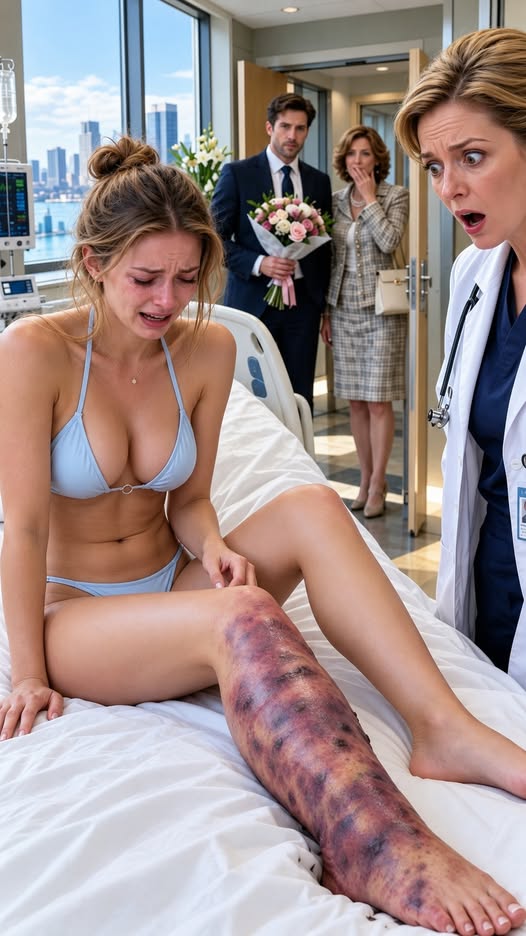
What I saw had stolen the breath from my lungs. The flesh around the small, insignificant garden scrape was necrotic. It was a horrific, bruised, sunken landscape of purple and pitch-black tissue. Dark, spider-web streaks were marching aggressively up my calf, following the roadmap of my veins, charting a course directly toward my heart. The smell wafting from the bandage was sickeningly sweet and deeply wrong—the unmistakable, primal scent of rotting meat.
I forced my heavy, bloodshot eyes toward the desk.
“Tristan,” I begged again, a tear slipping down my burning cheek, mixing with the sweat. “Look at it. Please look at it.”
The mechanical clacking stopped for a fraction of a second. Tristan let out a soft, patronizing sigh. It was the exact sound he made when a waiter brought him the wrong side dish, or when I misplaced my keys. It was a sound of mild, put-upon inconvenience.
“You’re fine, Reese,” he said, his tone as sterile and perfectly modulated as a corporate voicemail. He still didn’t turn around. His broad shoulders, clad in a soft cashmere sweater I had bought him for Christmas, remained perfectly relaxed. “I looked at it this morning. It’s just a localized infection. The antibiotics I gave you take time to build up in your system. You’re working yourself into a panic, and the anxiety is making your fever spike. We’ll go to urgent care tomorrow if it isn’t better.”
Tomorrow.
The word hung in the air, a physical weight pressing down on my chest. It was not a promise of future care. It was a calculated delay.
A profound, chilling paradigm shift violently cracked the fever dream I was drowning in.
I stared at the back of his head. I thought about the last five days. I thought about how he had isolated me, gently suggesting I cancel my work meetings, insisting I keep my phone turned off to “rest my eyes.” I thought about how he had meticulously measured out the liquid antibiotics, standing over me to ensure I swallowed every drop. I thought about how he refused to let me change the dressings myself, citing my clumsiness.
And then, the most terrifying realization of my entire life crystallized in my burning brain.
He isn’t looking at the wound.
If your wife tells you her leg is turning black, human instinct dictates a reaction. Panic. Concern. At the very least, a morbid curiosity to visually confirm the claim. But Tristan didn’t need to look. He didn’t need to verify the spread of the necrosis or the severity of the fever.
He didn’t need to look because he already knew exactly what was happening beneath the bandages. He was the architect of it.
He wasn’t waiting for the antibiotics to kick in. He was waiting for the poison to finish its work. He was weaponizing his care, hiding behind the facade of a devoted caretaker while meticulously, patiently orchestrating my execution.
As if to punctuate my horrifying epiphany, Tristan reached up with one smooth, fluid motion and slipped his heavy, noise-canceling gaming headset over his ears. A tiny green light flickered on the side of the plastic casing. He was officially, deliberately deaf to my existence. He was silencing my death rattle.
A sudden, primal surge of adrenaline—the cold, sharp instinct of prey realizing it is trapped in a cage with a predator—pierced through the haze of my 104-degree fever. The despair evaporated, replaced by a desperate, animalistic terror.
I could not wait for tomorrow. Tomorrow, I would be a tragic, unavoidable casualty of a virulent infection. Tomorrow, he would play the grieving widower.
I had to leave. Now.
The physical effort required to move was staggering. I bit down on my own lip until I tasted the sharp metallic tang of blood, using the pain to anchor myself to consciousness. I slowly, agonizingly slid my left leg out from under the heavy, sweat-drenched duvet. The cold air of the bedroom hit my overheated skin like a thousand icy needles, but I welcomed it.
I kept my eyes locked on the back of Tristan’s head. His fingers resumed their rhythmic clacking. He was immersed in a digital world, utterly confident in the physical reality he had engineered behind him.
I slid my right leg—the infected, rotting leg—off the edge of the mattress. The moment gravity pulled the blood down into the necrotic tissue, a scream rose in my throat, so violent and demanding it felt like it would tear my vocal cords apart. I clamped both hands over my mouth, swallowing the scream, letting the silent tears stream down my face as my toes touched the hardwood floor.
I couldn’t put weight on it. I knew the bone wouldn’t hold.
Using my left leg and my arms, I slid off the bed, dropping to the floor with a soft, muffled thud. The room spun wildly, tilting at impossible angles, dark spots dancing at the edges of my vision. I closed my eyes, counting to three, forcing the nausea back down.
I began to drag myself across the floor.
I moved like a broken insect, pulling my body weight with my elbows and my good leg, dragging the burning, infected limb behind me. Every inch was a battle against my fading consciousness. The distance from the side of the bed to the bedroom door was perhaps fifteen feet, but it felt like miles of jagged glass.
I slithered past the foot of the bed. I slithered past his discarded dress shoes. I kept my gaze fixed on the sliver of darkness beneath the bedroom door leading out into the hallway.
When I finally reached the doorframe, I paused. My lungs were burning, my heart hammering a frantic, desperate rhythm against my ribs. I reached a trembling hand up, grasping the cool metal of the doorknob. I turned it with agonizing slowness, praying the hinges wouldn’t whine.
The door clicked open. A rush of cooler hallway air washed over my face.
Before I pulled myself through the threshold into the dark corridor, I turned my head and looked back one last time.
Tristan was still sitting at the desk. The blue light washed over his profile. He was taking a slow sip from a glass of scotch, his noise-canceling headset glowing green in the dim room, his fingers resting casually on the keyboard. He looked perfectly at peace. He looked like a man who had everything under absolute control.
A terrifying, paralyzing clarity settled deep into my bones as I dragged my body out of the room and silently pulled the door shut behind me.
Cliffhanger: I dragged my burning body down the dark hallway, my vision blurring, my fingers blindly seeking my purse on the entryway table to find my phone. I finally grasped the leather strap, dialing 911 with a bloody, trembling thumb, knowing that I had escaped the bedroom, but absolutely terrified that the poison marching up my veins was already miles ahead of me
Chapter 2: The Triage of Betrayal
The transition from the suffocating, silent isolation of my marital home to the chaotic, blinding reality of the emergency room was a violent sensory whiplash.
I don’t remember the ambulance ride. I only remember the jagged, fragmented flashes of consciousness: the deafening wail of the siren cutting through the Chicago night, the harsh, white glare of the halogen lights in the back of the rig, and the frantic, clipped voices of the paramedics as they shouted numbers over the radio. “Heart rate 160, BP dropping, temperature 104.8. We have suspected sepsis, possible necrotizing fasciitis. ETA two minutes.”
When the heavy doors of the ambulance swung open, I was swallowed by the frantic energy of the trauma center. The fluorescent lights of the ER bay pierced through my closed eyelids like physical blades. I was wheeled through double doors on a gurney, the wheels clattering aggressively against the sterile linoleum. The air smelled sharply of iodine, bleach, and the metallic tang of fear.
I was shivering so violently that the metal rails of the gurney rattled. Voices swirled around me, a chaotic symphony of medical jargon and urgency. I was no longer a wife isolated in a dark bedroom; I was a critical biological emergency.
“Transfer on three. One, two, three!”
I felt my body lifted and shifted onto a trauma bed. Suddenly, the chaotic noise around me began to organize. The crowd of nurses parted, making way for a figure of absolute authority.
Dr. Mensah stepped to the side of my bed. She was a tall, imposing woman with sharp, intelligent eyes, her hair pulled back into a tight bun, wearing dark blue scrubs. She exuded a commanding, no-nonsense presence that immediately grounded the panic in the room. She didn’t offer a warm, comforting smile; she offered the terrifying, hyper-focused gaze of a seasoned veteran assessing a battlefield.
“I’m Dr. Mensah,” she said, her voice clear and cutting through my fever delirium. She snapped a pair of blue nitrile gloves onto her hands with a sharp crack. “Stay with me, Reese. Talk to me. Tell me exactly when this started.”
“Five… five days ago,” I gasped, the words tearing at my dry throat. “It was just a scrape. He… he cleaned it. He wrapped it.”
“Who wrapped it?” Dr. Mensah asked, her hands moving expertly, producing a pair of trauma shears.
“My husband,” I whispered.
Dr. Mensah didn’t pause. “Let’s see what we’re dealing with,” she said calmly, pressing the cold steel of the shears against my skin and cutting away the thick layers of medical tape and gauze Tristan had meticulously applied just hours ago.
The moment the heavy bandages fell away, exposing the full, horrific extent of the wound to the harsh hospital lighting, the entire atmosphere of the trauma bay instantly, violently shifted.
Dr. Mensah’s hands froze mid-air.
I watched through half-open, sweat-stung eyes as all the color drained from the doctor’s rich, dark skin. She didn’t reach for a sterile swab to culture the wound. She didn’t look up at the heart monitor to check my vitals. She didn’t ask me another diagnostic question.
She stared at the purple-black, sunken crater of necrotic tissue on my ankle, and the unnatural, jagged dark veins shooting up my calf.
Dr. Mensah snapped her head up, her eyes locking onto the charge nurse standing across the room with a look of sheer, unadulterated horror.
“Call the police right away!” Dr. Mensah shouted. Her voice wasn’t just loud; it possessed a ragged, desperate edge that echoed off the sterile tiles and silenced the entire bay. “Lock down this floor and get security down here immediately!”
The nurses froze for a microsecond, stunned by the sheer intensity of the command, before exploding into motion. One sprinted toward the red emergency phone on the wall, while another rushed to the double doors, slamming them shut and standing guard.
I blinked through the suffocating haze of the fever, my heart hammering a frantic, bird-like rhythm in my chest. The word echoed in my mind, nonsensical and terrifying.
“The… the police?” I rasped, trying to lift my head off the thin hospital pillow. “Why?”
Dr. Mensah leaned in close over the bed rail. She didn’t offer me a platitude. She didn’t tell me it was going to be okay. She lowered her face until she was mere inches from mine, her sharp eyes boring directly into my soul.
“Reese, you need to look at me and listen very carefully,” Dr. Mensah whispered, her voice a serious, terrifying vibration that bypassed my panic and demanded absolute focus. “This pattern of tissue destruction, the localized necrosis extending so aggressively beyond the initial injury site, the specific discoloration… this does not happen naturally from a garden scrape. This is not a staph infection.”
She swallowed hard, her eyes darting to the wound and back to my face.
“I have seen this exactly once before, during a fellowship in toxicology,” she continued, the words hitting me like physical blows. “Reese, someone has introduced a highly concentrated, localized necrotizing agent directly into your bloodstream. Someone is deliberately poisoning you.”
The world stopped spinning. The beeping of the heart monitor seemed to fade into a dull, distant hum.
Someone is deliberately poisoning you.
The words hung in the air, a horrific, undeniable empirical fact that shattered the final, fragile illusions of my life. I had come to the emergency room seeking strong antibiotics. I was being told I was an active crime scene.
“Who has had access to this wound?” Dr. Mensah demanded, shifting from a physician to a forensic interrogator, her voice tight with urgency. “Who has been changing these bandages?”
I closed my eyes. The memory, sharp and violent, forced its way to the surface of my consciousness, tearing through the feverish fog.
It was two nights ago. I had woken up in the dead of night, my mouth dry, the fever burning hot. The bedroom was pitch black, save for the ambient moonlight filtering through the blinds. I had turned my head toward the edge of the bed.
Tristan was standing there.
He wasn’t sleeping. He wasn’t getting a glass of water. He was standing perfectly still, looming over my side of the bed. He wasn’t looking at my face to see if I was resting. His eyes were locked obsessively, unblinkingly, on my bandaged ankle. And in his right hand, illuminated briefly by a passing car’s headlights outside, was a tiny, unknown glass vial. He had been holding a dropper. He had been feeding the wound.
A cold, crystalline tear leaked from the corner of my eye and rolled into my hair.
“My husband,” I whispered into the sterile air of the trauma bay, the words tasting like ash in my mouth. “Every night. He told me he was cleaning it. He told me he was taking care of me.”
A chilling, heavy silence fell over the medical staff surrounding my bed. It was the unspoken, horrified understanding of the sinister reality unfolding before them. They were no longer just looking at a dying woman; they were looking at the victim of an intimate, calculated execution.
“Push two milligrams of Lorazepam and start a broad-spectrum IV antibiotic cocktail,” Dr. Mensah barked to the nurses, her face hardening into a mask of pure determination. “Page the surgical on-call team. Tell them we have an emergency radical debridement. We have to cut this out of her before it reaches the bone, or she loses the leg. Or her life.”
I felt the sudden, cold rush of fluid entering the IV line in the back of my hand. The harsh lights above began to smear and blur as the heavy sedatives flooded my system.
But as the darkness pulled me under, racing toward the oblivion of anesthesia, the terror didn’t fade. It magnified. Tristan wasn’t a negligent husband who didn’t understand the severity of my illness. He was an active, lethal predator. And I had just exposed him.
Cliffhanger: As my eyes fluttered shut and the surgical masks of the doctors leaned in over me, the last sound I heard before the anesthesia dragged me into the dark was the heavy double doors of the trauma bay bursting open, and a deep, authoritative voice shouting, “Chicago Police Department! Who is the victim?” The manhunt had begun, but my terrifying, final thought was a realization: Tristan knew I had called 911. He knew I had escaped. And a predator whose trap has been sprung doesn’t just run away; he hunts.
Chapter 3: The Anatomy of a Psychopath
I woke to the rhythmic, synthetic hiss of a ventilator, though the tube was no longer down my throat. My throat felt like it was lined with shattered glass, and my mouth was a desert of dry cotton.
I blinked, fighting through the heavy, suffocating sludge of post-surgical anesthesia. The harsh fluorescent lights of the ER had been replaced by the softer, muted glow of a private recovery room.
The first sensation to register was the pain. It was no longer the localized, venomous fire of the infection. It was a deep, structural, hollow ache radiating from my right leg. I tried to shift my weight, and a sharp spike of agony shot up my hip. I looked down. My right leg was heavily cast and elevated on a pile of pillows, wrapped in thick, blood-spotted surgical bandages from the knee down. They had carved the poison out of me.
The second thing I noticed was the presence of law enforcement.
Two uniformed police officers stood like stone sentinels directly inside my closed hospital door, their hands resting near their duty belts.
Sitting in a hard plastic chair beside my bed, leaning forward with his elbows resting on his knees, was a man in a rumpled gray suit. He had weary, deeply lined eyes and the rough, unshaven jaw of a man who hadn’t slept in forty-eight hours.
He saw my eyes open and immediately sat up straighter, pulling a small notepad from his breast pocket.
“Mrs. Vance,” he said, his voice a low, gravelly rumble that was surprisingly gentle. “I’m Detective Miller. You’ve been under for nearly fourteen hours. The surgical team had to remove a significant amount of necrotic tissue from your calf. But you’re stable. You’re safe.”
I stared at him, my mind struggling to process the timeline. Fourteen hours.
“Tristan,” I croaked, the name burning my throat. “Where is he?”
Detective Miller’s expression darkened. The gentle bedside manner vanished, replaced by the grim, hardened reality of a homicide investigator.
“He’s gone, Mrs. Vance,” Miller said softly. “When the ER called it in, we dispatched units to your home immediately. The front door was wide open. His car was gone. He cleared out the safe, took his passport, and ran. He’s a fugitive.”
A wave of profound, complicated nausea washed over me. He had run. He knew the moment I left the house that his meticulously crafted execution had failed. He hadn’t bothered to call the hospital to play the concerned husband. He had abandoned his life to save his own skin.
Miller leaned forward, reaching down to a leather briefcase resting by his feet. He pulled out a thick, heavily tabbed manila folder and placed it gently on the rolling tray table hovering over my lap.
“We raided the house,” Miller continued, his eyes locking onto mine. “Our forensic team spent the entire night tearing the place apart. Mrs. Vance, I’ve worked homicide for twenty years. I have seen crimes of passion. I have seen brutal, split-second decisions. But what your husband left behind… it’s one of the most chilling, methodical blueprints for murder I have ever investigated.”
He opened the folder. The first item wasn’t a document; it was a clear, sealed plastic evidence bag.
Inside the bag rested a tiny, empty glass vial with a black rubber dropper top.
My heart slammed against my ribs. It was the exact vial I had seen in his hand in the dark.
“We found this hidden inside the casing of the computer tower on his desk,” Miller explained, tapping the plastic bag. “The lab rushed the residue. It’s an incredibly rare, highly concentrated synthetic derivative of Loxosceles venom—brown recluse spider venom—mixed with a rapid-acting digitalis compound. It causes immediate, aggressive tissue necrosis and mimics the symptoms of severe sepsis, eventually leading to massive heart failure. Applied topically to an open wound, it’s a death sentence that looks exactly like a tragic, aggressive infection.”
I stared at the vial, the tiny glass container that had held my agonizing demise. He had ordered it. He had hidden it. He had administered it to me, drop by agonizing drop, while asking me if I wanted a cup of tea.
“Why?” I whispered, tears finally spilling over my eyelashes, the sheer, unfathomable betrayal shattering the last remnants of the woman I used to be. “Why would he do this?”
Miller flipped to the next tab in the folder. He laid out a stack of financial documents, heavily highlighted in yellow marker.
“Money, and freedom,” Miller stated flatly. “Did you know that three months ago, your husband initiated a policy change on your life insurance? He quadrupled the payout. In the event of your death due to ‘unforeseen medical complications,’ he was set to receive four point two million dollars.”
I shook my head, unable to speak. I had signed papers months ago, but he had told me they were routine updates to our mutual retirement portfolios. I had blindly trusted his financial acumen.
Miller slid a photograph across the tray table. It was a grainy surveillance photo, timestamped two weeks ago, showing Tristan sitting in a dimly lit, high-end steakhouse downtown. He was leaning across the table, handing a thick manila envelope to a blonde woman with sharp features.
“This is Sarah Jenkins,” Miller said, his voice tight with disgust. “She isn’t just a mistress, Reese. She’s a junior VP at an offshore banking firm. When the news of the raid hit the wire this morning, she panicked. She walked into our precinct an hour ago with a lawyer and turned state’s evidence to save herself.”
Miller tapped the photograph. “According to her recorded testimony, Tristan didn’t just snap. They have been planning this for over six months. He paid her to set up untraceable shell accounts in the Caymans to funnel the insurance payout. He promised her a new life the moment you were buried.”
The room spun. Six months. For half a year, every kiss, every shared meal, every “I love you” had been a calculated performance by a man actively plotting to put me in the ground.
“But that’s not the worst of it,” Miller said, his voice dropping to a near-whisper. He flipped to the final section of the folder, revealing a stack of printouts bearing the logo of my primary care physician’s medical network.
“This is what terrifies my forensic team the most,” Miller explained, pointing to lines of digital code and access logs. “Your husband works in cybersecurity. He used his expertise to bypass the encryption on your personal medical patient portal.”
I frowned, the heavy painkillers making it hard to follow. “My portal? Why?”
“To curate a paper trail,” Miller said grimly. “Reese, he didn’t want to kill you quickly. A sudden death sparks autopsies. A sudden death sparks investigations. He needed a narrative. Over the last six months, he systematically altered your digital health records. He intercepted and canceled your follow-up appointments for your routine bloodwork. He deleted automated alerts from your doctor regarding slight liver enzyme elevations. He even hacked the system to add a fake, historic prescription for high-dose blood thinners to your chart.”
A cold, absolute terror settled deep into my marrow.
“He wasn’t just poisoning you, Reese,” Miller said, closing the folder, his eyes filled with profound sympathy. “He was meticulously, patiently degrading your medical history. He was building a profile of a chronically ill woman. So that when the venom finally stopped your heart in that bed, the coroner would look at your altered charts, see a history of ignored alerts and blood thinners, and rule your death a natural, unavoidable, tragic medical complication. It was the perfect murder.”
The sheer, suffocating scale of the psychopath I had married crashed down upon me. He hadn’t just intended to kill me; he had intended to erase the truth of my death entirely.
I leaned my head back against the pillows, closing my eyes, feeling the tears flow freely. But they weren’t tears of sorrow anymore. They were tears of a terrifying, absolute realization that I had shared a bed with a monster of unimaginable calculation.
Suddenly, the heavy, sterile silence of the recovery room was violently shattered.
The door to my room flew open, hitting the rubber wall stopper with a deafening CRACK.
A second detective, wearing a trench coat and breathing heavily, burst into the room. His face was pale, his eyes wide with a frantic, uncontainable alarm.
“Miller!” the new detective shouted, completely ignoring protocol, pointing frantically back out into the hallway. “Get on the radio. Right now.”
Detective Miller stood up instantly, his hand dropping instinctively to the grip of his service weapon. “What is it, Davis? Did they find his car at the airport?”
“No,” Detective Davis gasped, leaning against the doorframe, looking directly at me with a gaze that froze the blood in my veins. “He’s not at the airport, Miller. He just walked up to the patrol cars at the main hospital entrance downstairs. He put his hands on his head.”
Cliffhanger: The breath rushed out of my lungs in a singular, shocked gasp. “He surrendered?” I whispered, a desperate, fragile wave of relief washing over me. But Detective Davis shook his head violently, his face a mask of absolute horror as he pulled a confiscated burner phone from his pocket. “He didn’t surrender to give up, Mrs. Vance,” Davis said, his voice trembling as he showed Miller the glowing screen. “We pulled this off his accomplice. The last text he sent her was five minutes ago. It says, ‘She survived the first dose. I’m going inside to handle the second dose myself.’ Miller, he surrendered so the cops would bring him into the building. He’s here.”
Chapter 4: The Trojan Horse
The fragile, desperate wave of relief that had crested in my chest violently shattered, replaced instantly by an icy, paralyzing terror that gripped my heart like a physical fist.
He’s here.
The words hung in the sterile air of the hospital room, a horrific, impossible reality.
The two uniformed officers standing inside my door instantly unholstered their weapons, their relaxed postures vanishing as they moved to flank my bed. Detective Miller snatched the glowing burner phone from Davis’s hand, his eyes rapidly scanning the text messages.
“Son of a bitch,” Miller hissed, the color draining from his face. He slammed his hand against his radio mic pinned to his shoulder. “Command, this is Miller in room 412! We have a Code Red breach! The suspect, Tristan Vance, is in custody of patrol officers at the main entrance, but it’s a Trojan Horse! He is armed with a lethal biological agent! Do not bring him upstairs! I repeat, lock him down in the lobby!”
A burst of static erupted from the radio, followed by the chaotic, overlapping shouts of dispatchers. “Miller, this is Command. Patrol unit 6 reports they already entered the South Elevator bank with the suspect three minutes ago. They are en route to the fourth-floor holding area for processing. They do not have their radios on the primary tactical channel.”
“They’re bringing him right to us,” Davis whispered, his face pale.
The realization hit me with the force of a freight train. Tristan was a man who lived his entire life analyzing systems, finding vulnerabilities, and exploiting them. He knew that the hospital would be swarming with police looking for a fugitive fleeing away from the scene. The perimeter would be heavily guarded against anyone trying to sneak in.
But no one guards against the man who walks up to a squad car with his hands in the air.
He had weaponized his own arrest. He knew standard protocol for a high-profile suspect yielding at a hospital involved bringing them to a secure holding room on the medical floor for immediate evaluation before transport. He had intentionally surrendered to blind, unsuspecting patrol cops, using them as an armored escort to bypass the security perimeter and carry him directly to the floor where I lay helpless in a bed.
“Lock the door!” Miller roared, drawing his own weapon and stepping directly in front of my bed, shielding me with his body. “Davis, barricade it! Now!”
Davis lunged for the heavy wooden door, slamming it shut. He grabbed a heavy metal supply cart and shoved it violently against the doorframe, the wheels squeaking aggressively against the linoleum.
The monitors next to my bed began to scream. My heart rate had spiked to 160 beats per minute, the machines blaring a frantic, high-pitched alarm that added a terrifying soundtrack to the impending chaos.
I couldn’t move. My right leg was immobilized in a heavy cast, elevated on pillows. I was a sitting duck, tethered to IV lines and catheters, trapped in a sterile cage while the architect of my murder rode an elevator up to finish the job.
“Turn off those alarms!” Miller shouted over his shoulder. One of the uniformed officers scrambled to silence the monitors, plunging the room into a heavy, suffocating silence, broken only by our rapid, shallow breathing.
We waited. Ten seconds. Twenty seconds. The silence was agonizing.
Then, it started.
From the hallway outside, the unmistakable DING of the South Elevator arriving echoed through the corridor.
“Stay down, Reese,” Miller commanded, never taking his eyes off the barricaded door, his gun raised in a steady, two-handed grip. “Do not make a sound.”
Through the heavy oak door, the muffled sounds of footsteps approached. Two sets of heavy boots—the patrol officers. And one set of soft-soled shoes. Tristan.
“Alright, Vance, keep moving,” a muffled voice commanded from the hall. “Interrogation room is just past this unit.”
They were passing right by my door.
My breath caught in my throat. I squeezed my eyes shut, praying to a God I hadn’t spoken to in years, praying that they would just walk past.
Suddenly, a violent, chaotic scuffle erupted directly outside my room.
It didn’t sound like a fistfight. It sounded like a sudden, explosive burst of desperate energy. A heavy body slammed violently against the drywall in the hallway, shaking the framed medical posters on the walls.
“Hey! Stop!” a patrol officer shouted, his voice cracking with sudden panic. “He slipped the cuff! He’s got something in his hand! Drop it! Drop it now!”
“Get back!” Tristan’s voice roared. It was a sound I had never heard in the five years of our marriage. The sterile, calm, calculated corporate tone was entirely gone. It was replaced by a feral, manic, unhinged scream of a predator whose mask had completely slipped. “Get away from me!”
A heavy thud hit my door. The handle jiggled violently, the metal mechanism grinding as someone tried frantically to force it open from the outside. The heavy supply cart Davis had shoved against the frame groaned under the pressure, shifting an inch backward.
“Back away from the door, Vance!” Miller bellowed from inside, aiming his weapon directly at the center mass of the wood. “I will shoot you through this door! Drop to the ground!”
The violent jiggling stopped.
For a terrifying, endless second, there was no sound from the hallway. Just the heavy, ragged breathing of the men fighting on the other side.
Then, a face appeared in the small, rectangular pane of reinforced glass set into the top half of the hospital door.
It was Tristan.
His face was pressed against the glass, distorting his features. His hair was wild, hanging in his eyes. There was a smear of blood across his cheekbone where an officer had likely struck him. But his eyes… his eyes were wide, manic, and completely, utterly devoid of any human empathy. They were the dead, black eyes of a shark smelling blood in the water.
He looked through the glass, his gaze sweeping over Miller, over the officers, until he found me lying in the bed.
He didn’t scream at me. He didn’t curse.
He slowly, deliberately raised his right hand, pressing it against the glass.
Pinched between his thumb and forefinger was a second, identical glass vial with a black rubber dropper top. It was full of a dark, viscous liquid. The concentrated venom. He had hidden it on his person, banking on the fact that patrol cops rarely do a thorough, strip-search-level pat-down on a compliant suspect surrendering at a hospital.
Tristan looked at me through the reinforced glass, holding the instrument of my death. And then, he smiled.
It was a chilling, silent, victorious smile. It was a promise. I am going to finish what I started.
I screamed. It was a raw, primal sound of absolute, unadulterated terror, echoing off the walls of the small room, my hands gripping the bed rails so hard my knuckles turned white.
Before Tristan could pull his hand back to attempt to shatter the glass, the hallway erupted in violence again.
A massive, blurry shadow moved across the window pane. One of the patrol officers, recovering from the initial surprise attack, lunged forward. I watched through the glass as a heavy black baton swung down in a vicious arc, striking Tristan directly across the wrist.
The sound of snapping bone echoed even through the heavy door.
Tristan shrieked in agony, his face disappearing from the window as he collapsed backward out of view. The tiny glass vial slipped from his shattered fingers, bouncing off the doorframe and shattering on the linoleum floor outside, the dark venom pooling harmlessly on the sterile tiles.
“Suspect down! Suspect down! Cuffs on him! Get your knee on his neck!” the patrol cops shouted, their voices overlapping in a chaotic frenzy of adrenaline and physical exertion.
Miller and Davis rushed forward, pulling the supply cart away and throwing the door open, their weapons drawn, flooding into the hallway to secure the perimeter.
I lay alone in the bed, the alarms silenced, the room completely still. The immediate threat was neutralized. The monster was in chains, bleeding on the floor outside my door.
But as I stared at the empty pane of glass where his smiling, psychopathic face had been mere seconds ago, the true, lingering horror of the night settled into my bones. He was caught, yes. But he had been willing to orchestrate an impossibly complex, suicidal tactical strike just to watch me die.
Cliffhanger: The adrenaline crashed, leaving me shivering and weeping uncontrollably in the sterile bed as paramedics rushed in to assess me. I had survived the physical attack, but as I looked at the medical charts at the foot of my bed, a terrifying new hyper-vigilance took root in my mind. Tristan was going to prison forever, but the trust I had for the world, for doctors, for anyone who claimed they wanted to take care of me, had just been permanently, brutally murdered.
Chapter 5: The Deconstruction of a Nightmare
Two weeks later.
The sterile, suffocating silence of the county jail’s maximum-security interrogation wing was broken only by the heavy, metallic clinking of chains.
Tristan sat handcuffed to a stainless-steel table in a windowless room. He was wearing a faded, oversized orange jumpsuit that swallowed his previously immaculate, tailored frame. The arrogant, composed posture of the tech executive was entirely gone, replaced by the slumped, defeated hunch of a cornered animal. His right arm was encased in a heavy plaster cast, resting awkwardly on his lap—a permanent souvenir of the patrol officer’s baton outside my hospital door.
Across the metal table, the district attorney, a sharp, unyielding woman named Farnsworth, didn’t offer a plea deal. She didn’t negotiate. She was performing a legal execution.
Farnsworth slid a sleek tablet across the metal surface, stopping it inches from Tristan’s manacled hands. She tapped the screen.
The high-definition hospital security footage played. It showed Tristan slipping his handcuffs with a hidden key, violently shoving an officer, and rushing my hospital door, raising the second vial of concentrated digitalis and Loxosceles venom directly to the glass window before being tackled.
“We have the second vial, Tristan,” Farnsworth said, her voice flat and merciless. “The hazmat team recovered the shards and the fluid from the hallway. It matches the residue from the first vial we found hidden in your computer tower.”
Tristan stared at the tablet, his jaw locked, a muscle twitching wildly in his cheek. He said nothing. He was invoking his right to silence, but the silence wasn’t a tactical shield anymore; it was the mute paralysis of a man who realized his genius had entirely failed him.
Farnsworth slid a second, massive stack of printed documents onto the table.
“We have the digital footprint, Tristan,” she continued, tapping the mountain of paper. “The cyber-crimes unit traced the IP logs from the unauthorized access to Reese’s medical portal directly back to your home router and your personal VPN. We have the keystroke logs proving you canceled her bloodwork and added the fake blood thinner prescriptions.”
She leaned forward, her hands flat on the table, invading his space.
“And finally,” Farnsworth whispered, dropping the ultimate hammer, “Sarah Jenkins recorded a three-hour deposition on video. She handed over the offshore account routing numbers, the text messages where you discussed the payout, and the timeline of your plot. Your ‘perfect murder’ was so over-engineered, so steeped in your own narcissistic hubris, that you have handed this office a bulletproof, mathematically perfect attempted murder charge. You will never, ever breathe free air again.”
Tristan looked up from the table, his dead, shark-like eyes meeting the DA’s. There was no charm left. There was no manipulation to deploy. The empire of lies he had built had collapsed, crushing him underneath the rubble.
Miles away, in a reality that felt disconnected from the grim walls of the county jail, I was fighting a very different kind of battle.
I was in the sunlit rehabilitation wing of the hospital. The room smelled of clean linen and antiseptic, the massive windows offering a sprawling view of the Chicago skyline.
I was gripping the parallel metal bars of a physical therapy walkway. I was wearing loose athletic shorts, the heavy cast finally removed.
My right leg was a brutal, visible roadmap of survival. From the back of my heel, winding up past my ankle and deep into the meat of my calf, was an angry, jagged, sunken scar. It was a dark, mottled purple and pink—the physical reminder of where the surgeons had to violently cut away the necrotic tissue to outpace the poison. The muscle was significantly reduced, leaving the leg looking skeletal and frail compared to my left.
“Okay, Reese,” my physical therapist, a gentle giant of a man named Marcus, said encouragingly. “Just transferring the weight today. Don’t push through sharp pain, just lean into the discomfort. Let the remaining muscle remember how to fire.”
I closed my eyes, gritting my teeth, and slowly shifted my weight onto my right leg. A profound, hollow ache radiated up my bone, the tight, newly healed skin pulling uncomfortably. I took a shaky breath and managed to hold the weight for three agonizing seconds before collapsing my weight back onto my arms, panting heavily.
“Good,” Marcus said, making a note on his clipboard. “That’s progress. We’ll get there.”
As I lowered myself back into the wheelchair waiting at the end of the bars, a new nurse entered the room. She was young, smiling warmly, pushing a small medical cart. She carried a tiny paper cup holding two white pills and a small paper cup of water.
“Time for your afternoon pain management and antibiotics, Mrs. Vance,” the nurse chirped pleasantly, extending the cup toward me.
Instantly, without warning, a phantom, suffocating spike of panic tightened around my throat like a physical hand.
I stared at the two innocent-looking white pills. My heart rate spiked, the monitor attached to my finger beginning to beep faster. I felt the cold sweat prickle at my hairline. I was transported back to the dark bedroom. I saw Tristan’s hands, holding a dropper. I saw the fake prescriptions he had added to my chart.
What are those pills? Who prescribed them? How do I know they are safe?
The hyper-vigilance, the invisible, psychological scar of medical gaslighting, flared to life, demanding I reject the medication. The instinct to curl into a ball and trust absolutely no one was overwhelming.
I looked at the nurse. Her smile faltered slightly at my sudden, visible panic.
“Mrs. Vance? Are you alright?” she asked, her voice laced with genuine concern.
I closed my eyes. I took a deep, shuddering breath, grounding myself in the present. I was not in the dark bedroom. Tristan was in a cage. I was in control. The only way to survive the trauma was to walk through it, to deliberately dismantle the fear he had planted in my mind.
I opened my eyes and looked the nurse directly in the face.
“I’m sorry,” I said, my voice trembling but growing firmer with each word. “I know this is standard procedure. But before I take anything, I need to see the original prescription bottle. I need to see the doctor’s physical signature on the chart. And I need you to explain exactly what the chemical composition of these pills is, and what they are supposed to do.”
The nurse blinked, momentarily taken aback by the intense, highly irregular demand. But Marcus, standing behind me, caught her eye and gave a subtle, affirming nod. The medical staff on this wing had been briefed on my case. They knew the monster I had survived.
“Of course, Reese,” the nurse said gently, her voice devoid of any judgment or condescension. She pulled the chart from the end of the bed, opened it to the medication log, and retrieved the original blister packs from the cart, laying them out on the tray table before me. “This is a standard dose of cephalexin for the remaining infection risk, and a mild dose of oxycodone for the physical therapy pain. Dr. Mensah signed off on both this morning.”
I painstakingly read the labels. I checked the chart. I verified the dosages against the information I had researched myself on my laptop earlier that morning.
Only when I was absolutely, empirically satisfied that the medication was real, safe, and necessary, did I pick up the paper cup. I swallowed the pills with the water.
It was a small, seemingly mundane interaction. But to me, it was monumental. It was the first brick laid in the reconstruction of my autonomy.
Later that afternoon, Detective Miller and Mr. Sterling, a ruthless divorce attorney Margaret had actually recommended in a rare show of solidarity against her son, entered my room.
Sterling placed a thick stack of legal documents on my rolling tray table.
“These are the final divorce decrees, Reese,” Sterling said, handing me a sleek metal pen. “He has waived his right to contest, given his current… legal predicament. You are retaining one hundred percent of all marital assets, the house, the retirement accounts, and he is legally barred from ever contacting you again.”
I took the pen. I didn’t hesitate. I didn’t cry for the death of my marriage. I signed my name with sharp, aggressive strokes, severing the legal ties to the man who had tried to murder me.
“And the DA’s office?” I asked, looking up at Miller.
“Farnsworth wants to go to trial,” Miller grinned, a predatory look in his weary eyes. “Tristan’s defense lawyers are begging for a plea deal to avoid the media circus, offering forty years. But Farnsworth won’t take it. She wants him on the stand. She wants to destroy him publicly. But she needs your testimony to secure the maximum life sentence without parole.”
Miller looked at me, a question hanging unspoken in the air. Testifying meant facing him. It meant sitting in a crowded courtroom and reliving the terror, the betrayal, the agonizing pain. It was a massive psychological burden.
I looked down at my heavily scarred leg. I thought about the 104-degree fever. I thought about the word tomorrow.
I looked back at Detective Miller, a fierce, unyielding fire igniting in my chest.
“Tell Farnsworth I’ll be her star witness,” I said, my voice cold and hard as polished steel. “I won’t be the silent, compliant victim he banked on. I am going to sit on that stand, I am going to look him dead in the eye, and I am going to make sure he dies in a concrete box.”
Cliffhanger: The path to physical and psychological recovery stretched out before me, a long, agonizing road of physical therapy and trauma counseling. But as I wheeled myself to the massive window, looking out over the sprawling city, a profound realization settled over me: Tristan had meticulously engineered my demise, but in doing so, he had accidentally forged a woman who was absolutely incapable of ever being broken again.
Chapter 6: The Unbreakable Bone
Three years later.
The mid-October air rolling off the Pacific Ocean was brisk, carrying the sharp, clean scent of salt spray and pine needles. The afternoon sun was a brilliant, blinding gold, reflecting off the turbulent, crashing waves of the Oregon coastline.
I was running.
My breathing was a steady, powerful rhythm, a stark contrast to the ragged, desperate gasps that had once defined my existence in a dark, suffocating bedroom in Chicago. I wore a lightweight athletic jacket and running shorts, the cool wind whipping against my bare legs.
I ran with a slight, permanent limp. The biomechanics of my right leg had been forever altered by the massive removal of tissue and muscle. But my pace was relentless.
Running down the center of my right calf, fully exposed to the sun and the wind, was a deep, jagged, unmistakable scar. It was pale now, the angry purple faded to a silvery white, but it was massive. It looked like a lightning bolt carved directly into my flesh.
I didn’t hide it. I didn’t wear long pants to cover it up, nor did I apply cosmetic concealers to soften its appearance. The scar was not a deformity. It was a physical, undeniable badge of survival. It was empirical proof that I had looked a monster in the eye, fought an internal war against a lethal biological agent, and emerged victorious.
I slowed my pace as I approached a high, rocky overlook jutting out over the ocean, bringing my run to a walk. I stepped up to the wooden railing, leaning my forearms against it, my chest heaving with exertion, sweat beading on my forehead.
I unclipped my water bottle from my belt and took a long, deep drink, the cold water soothing my throat. I closed my eyes, tilting my face upward, letting the warm autumn sun wash over my skin.
It had been three years since the trial.
Tristan had tried to maintain his arrogant facade in the courtroom, wearing a tailored suit, attempting to charm the jury. But when the prosecution played the security footage of him rushing the hospital door with the vial, and when I sat on the stand for three grueling days, meticulously detailing the psychological torture of his gaslighting and the physical agony of the poison, the facade crumbled. The jury deliberated for less than four hours. He was sentenced to life in a maximum-security federal penitentiary without the possibility of parole. He was a ghost, locked away in a concrete box, entirely irrelevant to the vibrant, expansive reality I now inhabited.
I opened my eyes, looking out over the vast, endless expanse of the ocean.
My mind briefly drifted back in time. I saw the dark bedroom. I felt the phantom heat of the 104-degree fever. I saw the blue light of the dual monitors, and I heard the mechanical clacking of the keyboard.
I remembered the casual, dismissive tone of his voice. We’ll go tomorrow.
Looking back, with the clarity of distance and intense therapy, I finally understood the true architecture of his crime. The concentrated synthetic venom in the tiny glass vial was lethal, yes. It had nearly stopped my heart. It had cost me a significant portion of my leg.
But the poison wasn’t the most dangerous weapon Tristan wielded.
The true, insidious weapon was his attempt to make me doubt my own pain. It was the meticulous, suffocating psychological warfare designed to make me suppress my own desperate survival instincts for the sake of his convenience. It was the weaponization of care, the horrific manipulation of love to enforce compliance. He had relied entirely on my willingness to trust him over my own body’s screaming alarms.
I turned away from the cliffside, looking at the dirt trail winding back toward the small, coastal town where I had purchased a home—a home filled entirely with natural light, open windows, and absolute, unshakeable safety.
I stretched my right leg, feeling the tight pull of the scarred tissue. It didn’t hurt anymore. It just felt strong.
True safety, I realized, does not come from the people who claim to protect you. It doesn’t come from a wedding ring, a shared bank account, or a soothing voice telling you everything is fine.
True safety comes from an unwavering, fierce commitment to your own reality. It comes from the absolute refusal to let anyone—no matter how much you love them, or how deeply you trust them—dictate the severity of your pain or the value of your existence.
I adjusted the wireless earbuds in my ears, turning up the volume on a driving, upbeat playlist.
The monsters of the world don’t always hide in the shadows, waiting in dark alleyways. Sometimes, the most terrifying monsters are the ones who sleep in your bed, patiently holding a glass of water and a pill, waiting for you to close your eyes.
But even the most meticulous, calculating predator can be defeated by a victim who finally decides to wake up, trust their own terror, and walk away.
I pushed off the wooden railing and began to jog back down the trail. My feet hit the dirt path with a solid, undeniable force, the rhythm echoing like a heartbeat. A genuine, profound smile spread across my face as I picked up the pace, leaning into the slight limp, feeling the wind in my hair.
The greatest triumph of my life wasn’t just surviving the lethal dose meant to kill me. It was completely, permanently immunizing myself against the deadly illusion of blind trust, ensuring that no one would ever dictate the trajectory of my life—or the timing of my death—ever again.
If you want more stories like this, or if you’d like to share your thoughts about what you would have done in my situation, I’d love to hear from you. Your perspective helps these stories reach more people, so don’t be shy about commenting or sharing.