PART 2 — THE SEAL THAT SILENCED THE ROOM
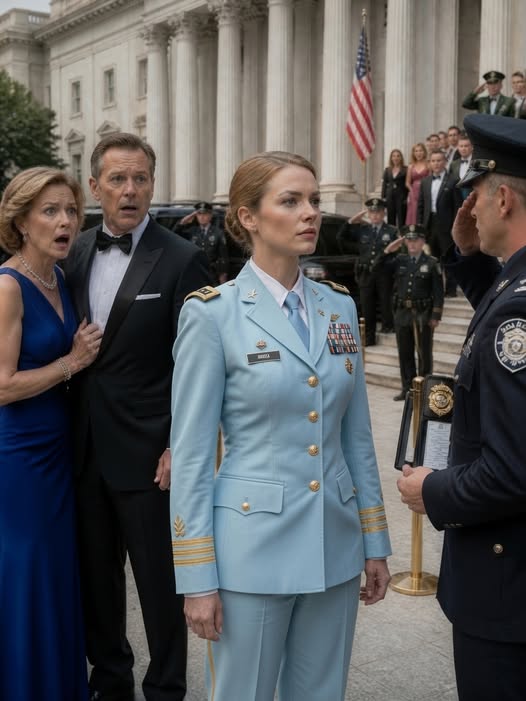
The guard’s flashlight did not move.
For one impossible second, the entire entrance seemed to freeze around that narrow beam of white light. It rested on the gold seal pressed into my identification card, catching the embossed eagle, the tiny ring of classified clearance numbers, and the name printed beneath my photograph.
CLAIRE ELIZABETH VALE.
Not “guest.”
Not “daughter.”
Not the invisible woman my mother had just tried to erase at the door.
The guard’s expression changed so quickly that even Marcus noticed. His stiff suspicion vanished, replaced by something much more unsettling—recognition, then respect, then a flash of alarm. He straightened his spine and lowered the flashlight.
“Ma’am,” he said, his voice suddenly formal. “My apologies.”
My mother’s practiced gala smile faltered.
Marcus stopped smoothing his cufflinks.
I stayed still, because sometimes the most powerful thing a person can do is nothing at all.
The guard stepped aside at once. “Director Vale, we weren’t informed you would be arriving through the main security entrance. Please forgive the delay.”
The word struck the marble around us like a dropped blade.
Director.
My mother blinked once. Twice.
Marcus turned his head slowly toward me, as if he had heard the guard incorrectly and expected the air to correct itself.
“Director?” my mother repeated, her voice thin and brittle. “No, that can’t be right. Claire works in administration.”
I looked at her then.
For years, that had been her favorite explanation for me. Administration. A neat, forgettable word. It allowed her to dismiss late-night calls, sudden travel, locked briefcases, and the way federal cars sometimes waited for me at corners instead of in front of the house. It allowed Marcus to brag louder, my mother to believe harder, and me to keep my distance from both of them.
The guard did not answer her. His gaze remained on me.
“Your escort is being notified,” he said. “The east corridor is secure.”
My mother let out a small laugh, the kind she used at charity luncheons when someone corrected her too publicly. “There has been some mistake. My son Marcus is the one connected to tonight’s program.”
Marcus swallowed. “Mom.”
But my mother had already stepped forward, lifting her chin. “We were invited because of him. He has been consulting with senior defense officials.”
The guard’s face remained professionally blank.
That blankness frightened Marcus more than anger would have.
“Mrs. Vale,” I said softly.
She turned on me with the offended dignity of someone who still believed embarrassment was the worst thing that could happen to her.
“Not now, Claire.”
A laugh almost escaped me. Not because anything was funny, but because those three words had followed me through my entire life.
Not now, Claire, when Marcus lied about wrecking the car.
Not now, Claire, when Marcus needed tuition money after losing his scholarship.
Not now, Claire, when my promotion threatened to make the family conversation uncomfortable.
Not now, Claire, because your truth is inconvenient.
But tonight, in front of armed guards and marble columns and the glowing doors of a military gala filled with people who knew exactly who I was, “not now” had finally expired.
The doors behind the guard opened from the inside.
A tall woman in a dark dress uniform stepped out. Her hair was silver at the temples, her posture severe, her medals arranged with mathematical precision. I knew General Adrienne Holt well enough to recognize that her calm face usually meant someone else’s life was about to become very difficult.
“Director Vale,” she said, approaching me. “We were expecting you fifteen minutes ago.”
“My apologies, General,” I replied. “There was some confusion at the gate.”
General Holt’s eyes slid toward my mother and Marcus. It was not a long look, but it was enough to make Marcus lower his gaze.
“I see,” she said.
My mother’s clutch creaked under her grip. “General, I’m Evelyn Vale. Marcus’s mother. Perhaps you’ve heard of him.”
General Holt did not blink. “I have.”
Marcus’s shoulders lifted, almost with relief.
Then the general added, “Though not for the reasons he may prefer.”
The air changed.
Behind us, another black SUV pulled to the curb. Two officers stepped out, followed by a man in a navy suit with an earpiece and an expression carved from stone. The gala music still drifted from inside—brass, strings, applause—but at the entrance, every sound sharpened. The click of shoes. The soft static from a radio. My mother’s breathing.
Marcus leaned closer to me. “Claire,” he whispered, “what is going on?”
I looked at him, and for the first time that night, I did not see my younger brother. I saw a man who had borrowed my money, stolen my reputation, and walked confidently into a building guarded by people who did not forgive false credentials.
“What did you do?” I asked.
His eyes flicked toward our mother.
That was answer enough.
General Holt gestured toward the doors. “Director, the Secretary is waiting. However, before we proceed, there is a security matter involving your guests.”
“They are not my guests,” I said.
My mother flinched.
The words were quiet, but they carried.
Only minutes earlier, she had said the same thing about me.
No, she’s only my guest.
Now the sentence returned to her in a form she could not polish, deny, or laugh away.
Marcus’s face drained of color. “Claire, please.”
General Holt’s aide stepped forward with a black folder. On its cover was the same gold seal as the one on my ID. He opened it and handed me a single page.
At first glance, it looked like any other internal security memo: dates, access attempts, flagged communications, unauthorized references to restricted programs. But halfway down the page, my stomach hardened.
My family email account.
My brother’s phone number.
My mother’s home IP address.
And beneath them, a phrase Marcus had apparently repeated in three separate conversations: My sister is involved in the review. I can get you early insight.
The line looked small on paper.
It felt enormous in my hand.
I raised my eyes to Marcus. “You used me.”
He shook his head too quickly. “No. Not like that.”
“Then how?”
“I only said your name because people respect it,” he whispered. “I didn’t know it was serious.”
General Holt’s mouth tightened slightly. “Mr. Vale, you represented yourself as an informal liaison to a classified procurement review. You accepted private meetings under false pretenses. You implied access to national defense material.”
My mother turned to him, horrified. “Marcus?”
He snapped at her, all polish gone. “I was trying to build something!”
“By stealing my clearance?” I asked.
“I didn’t steal anything!” His voice rose, then cracked under the attention of the guards. He lowered it quickly. “I just needed people to take me seriously. You don’t understand what it’s like, Claire. You never had to prove yourself.”
For a moment, the old reflex stirred in me—the instinct to protect him from his own collapse. I had done it so many times it felt almost physical, like reaching for a falling glass before knowing whether it deserved to break.
But then I remembered the ride over. My mother calling me “only my guest.” Marcus sitting beside her in the tuxedo I paid for. Both of them stepping through life on doors I had quietly opened, while telling everyone I was standing behind them.
“No,” I said. “I understand exactly what it means to prove yourself. You just never watched.”
My mother’s face crumpled, not from remorse yet, but from confusion. She had built her world carefully: Marcus was the rising son, I was the useful daughter, and all difficult truths could be folded away under family loyalty. Now the folds were tearing open.
“Claire,” she said, and there was something almost childlike in her voice. “Why didn’t you tell me?”
The question was so cruel in its innocence that I almost smiled.
“I did.”
Her lips parted.
“I told you when I left for Langley and you said Marcus’s internship mattered more. I told you when I couldn’t come home for Thanksgiving because of a security review and you accused me of being dramatic. I told you when I bought Marcus his first suit for a hearing he never admitted was disciplinary. I told you a hundred times. You just preferred the version where I was small.”
The silence afterward was not empty. It was crowded with every conversation she had ignored.
General Holt gave me a measured look. “Director, we can handle this discreetly.”
Discreetly.
The word tempted me. It would be easy to preserve appearances. Let Marcus be questioned in a side room. Let my mother sit at a back table pretending she had a headache. Let the gala continue swallowing the truth in music and champagne.
But that had always been the family tradition.
Hide the damage.
Praise the liar.
Thank the person who cleaned up the mess, but never too loudly.
Tonight, I was done cleaning.
“Proceed according to protocol,” I said.
Marcus stared at me. “You can’t mean that.”
“I do.”
“I’m your brother.”
“And I was your sister,” I replied. “Before I became your excuse.”
Two officers moved closer. They did not grab him. They did not need to. The authority around him had already narrowed into a cage.
My mother stepped between them and Marcus. “No. Wait. This is a family matter.”
General Holt’s voice was calm. “It stopped being a family matter the moment classified access was invoked.”
“He didn’t mean harm,” my mother pleaded. “He exaggerates sometimes. He wants people to like him.”
The words struck something old and tired inside me.
Exaggerates.
Wants people to like him.
Mistakes were always softened for Marcus. His lies became ambition. His debts became bad luck. His betrayals became misunderstandings. Meanwhile, my success had to be quiet, my sacrifices invisible, my pain convenient.
Marcus looked at me with panic spreading across his face. “Claire, tell them. Tell them I didn’t have access.”
I held the memo tighter. “Did you send anyone documents?”
“No.”
General Holt’s aide spoke. “We recovered one forwarded file from a private account. It was incomplete but marked with internal routing codes.”
My blood went cold.
Marcus’s eyes darted away.
My mother whispered, “What file?”
The aide handed me another page.
I recognized the formatting instantly. A briefing cover sheet. Not the contents, thank God. But enough metadata to identify the review. Enough to prove proximity. Enough to create a breach.
And then I saw the forwarding note.
C, this should help you understand why I need to be in the room. Don’t embarrass me tonight.
It had been sent to me from Marcus’s account two days earlier.
I had never received it.
Because beneath the forwarding trail was another address.
My mother’s.
I looked at her.
For the first time in my life, Evelyn Vale looked truly afraid of me.
“You saw this?” I asked.
She shook her head, but her denial arrived too late. “I didn’t understand what it was.”
“That wasn’t my question.”
Her eyes filled. “Marcus said you were being selfish. He said you were blocking him from opportunities. He said if we reminded you what family meant, you would help.”
I almost laughed again.
Family.
A word people like my mother used the way governments used flags: to cover whatever they did not want examined.
“So you opened my old account?” I asked.
“I still had the password from when you were in college,” she whispered.
The guards exchanged glances.
Marcus closed his eyes.
That was the moment my anger became something quieter and far more dangerous.
Not because my mother had betrayed me. That wound was familiar.
But because she had not even thought of it as betrayal.
She had thought of my privacy as another family resource, like my money, my patience, my silence.
General Holt stepped closer. “Director?”
Every eye waited.
Through the open doors, I could see the gala hall. Crystal chandeliers burned above polished floors. Officers, diplomats, and donors turned subtly toward the entrance, sensing disturbance the way birds sense a storm. Somewhere inside, a toast began, then faltered.
I had imagined this night differently.
I had imagined accepting the Secretary’s commendation, speaking briefly, leaving early, and perhaps finally telling my mother who I had become. A foolish part of me had hoped she might feel proud.
Instead, she had denied me at the door.
Maybe that was mercy. It spared me from mistaking recognition for love.
“Separate them,” I said.
Marcus’s head snapped up. “Claire!”
General Holt nodded.
One officer guided Marcus toward the security office. Another asked my mother to follow. She resisted for only a second, then looked back at me with trembling disbelief.
“You would do this to your own family?”
I met her eyes.
“No,” I said. “You did this. I’m only refusing to hide it.”
They led them away beneath the white marble columns.
And I stood alone at the threshold of the gala, holding the evidence of what my family had become.
For a few seconds, I could not move.
Then General Holt’s voice softened. “Claire.”
Not Director. Not ma’am.
Claire.
It almost undid me.
I inhaled carefully. “I’m ready.”
We entered the ballroom together.
The conversations quieted as we crossed the floor. Hundreds of faces turned toward us—uniformed generals, foreign attaches, senators, contractors, people who knew how to read power in posture and silence. I felt their curiosity like heat against my skin.
At the front of the room, the Secretary of Defense waited beside a podium draped in navy velvet. He was older than he appeared on television, with kind eyes that missed very little. When I approached, he extended his hand.
“Director Vale,” he said. “I understand there was trouble at the entrance.”
“Yes, sir.”
“Is the matter contained?”
“For now.”
He studied me for half a second, then nodded. “Then let’s give the room something else to remember.”
The applause began before I reached the podium.
At first, it sounded distant, like rain behind glass. Then it grew, filling the ballroom, rising beneath the chandeliers until the floor seemed to tremble with it. I stood beside the Secretary while he spoke of service, discretion, sacrifice, and courage carried out far from cameras.
He did not name everything I had done. He could not.
He spoke instead of “a critical interagency review,” “prevention of hostile exploitation,” and “leadership under extraordinary pressure.” The kind of phrases that hid danger inside polished language.
Then he turned to me with a medal case in his hands.
“Tonight,” he said, “we recognize Director Claire Vale for protecting not only national interests, but the integrity of the institutions entrusted with them.”
The medal was heavier than I expected.
As he pinned it near my shoulder, the room applauded again.
And in that applause, I felt something break loose inside me—not joy exactly, not triumph, but release. For years, I had waited for my family to see me. Now an entire room had stood to honor what they refused to notice.
But even as the applause continued, I saw movement near the side entrance.
General Holt’s aide appeared, face tense.
He did not interrupt the ceremony. He simply waited until I stepped away from the podium, then leaned in.
“Director,” he murmured, “we have a problem.”
I kept my expression still. “What kind?”
“The file Marcus forwarded wasn’t the only one.”
The medal against my chest suddenly felt cold.
“How many?”
“We’re still counting.”
I looked across the ballroom toward the security corridor where my mother and brother had disappeared.
The aide lowered his voice further. “And there’s another issue. The recipient wasn’t a contractor.”
My pulse slowed.
Trained calm took over, sharp and merciless.
“Who was it?”
He hesitated just long enough for dread to enter the space between us.
Then he said a name I had not heard in twelve years.
A name buried in an old family scandal.
A name my mother once swore never to speak again.
My father.
The room around me blurred at the edges. Applause still echoed. Glasses still glittered. The Secretary still smiled for photographs. But all I could see was my mother’s face when she had asked, “Why didn’t you tell me?”
Maybe she had known more than she admitted.
Maybe Marcus had not invented his lies alone.
Maybe the person who taught my family how to use me had been watching from the dark all along.
I turned toward the corridor.
For the first time that night, I was no longer thinking like a daughter.
I was thinking like a director.
And somewhere beyond those marble walls, the past had just opened a door.
…If you want to know what happened next, please type “YES” and like for more.