PART 3 — THE FATHER WHO WAS SUPPOSED TO BE DEAD
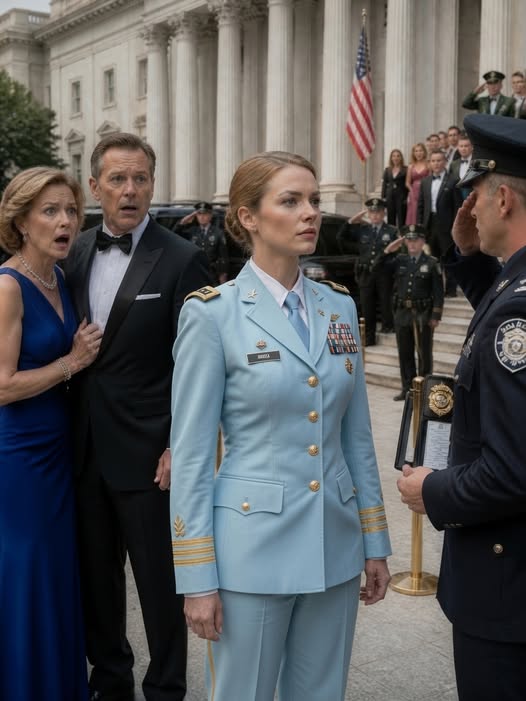
The name of my father hit me harder than any gunshot could have.
For twelve years, David Vale had existed in our family as a sealed wound. My mother said he was gone. Marcus said he had abandoned us. I learned not to ask, because every question made the house colder.
But now, in the glittering heart of a military gala, surrounded by chandeliers, generals, and secrets, his name had returned through a classified breach.
I turned to General Holt’s aide. “Say it again.”
His voice dropped. “The recipient account traces back to David Vale.”
My hands went still.
Across the ballroom, applause continued as if the world had not cracked open. The Secretary posed for photographs. Guests smiled over champagne. Somewhere, a violinist played a polished melody that suddenly sounded obscene.
“My father is dead,” I said.
The aide did not answer.
General Holt stepped beside me, her face unreadable. “Claire, we need to move.”
I looked toward the security corridor where Marcus and my mother had been taken. “No. First, I want to hear it from them.”
Holt hesitated. “Your judgment may be compromised.”
I met her eyes. “My judgment is the only reason this breach was contained before it became a disaster.”
She studied me, then nodded once. “Five minutes.”
The security room smelled of coffee, leather, and fear. Marcus sat at the table with his hands clasped so tightly his knuckles had gone white. My mother stood by the wall, looking smaller than I had ever seen her.
When I entered, Marcus started talking immediately.
“Claire, I didn’t know. I swear I didn’t know who was behind the account.”
I ignored him and looked at my mother. “Is he alive?”
Her lips parted.
That was enough.
A sound escaped me, not quite a laugh, not quite a sob. “You told me he was dead.”
“I said he was gone,” she whispered.
“You let me mourn him.”
Her eyes filled. “I thought it was kinder.”
“No,” I said. “You thought it was easier.”
Marcus stared at her. “Mom?”
She sank into a chair as if her bones had finally remembered their weight. “Your father didn’t abandon us. He was forced out. Years ago, before Claire joined the agency, David uncovered a private network inside defense contracting. Men selling access, influence, silence. He gathered proof. Then the proof disappeared, and he was accused of treason.”
I felt the room tilt.
“He ran,” she continued. “He contacted me twice. The last time, he said the network had reached people close to us. He told me to protect the children.”
I leaned forward. “So you protected Marcus by making him the golden son, and protected me by burying me alive?”
My mother flinched.
“I knew you were like him,” she whispered. “Quiet. stubborn. impossible to control. I was afraid if they noticed you, they’d destroy you too.”
Her words landed in me strangely—not as comfort, but as a new kind of pain. All those years of dismissal, comparison, silence. Had any of it been love twisted into cruelty? Or was that only the story she needed now?
Marcus shook his head. “This has nothing to do with me. I just wanted access. I just wanted a seat at the table.”
General Holt’s aide placed another printout before him. “You forwarded restricted metadata to an account labeled Meridian Consulting.”
Marcus stared at the page. “That was a recruiter.”
“No,” I said quietly. “That was Dad.”
His face collapsed.
My mother covered her mouth.
Then the room’s wall monitor flickered.
A secure call request appeared on the screen.
No caller name.
Only one line of text:
HELLO, CLAIRE.
PART 4 — THE CALL FROM THE GRAVE
Nobody moved.
The words glowed on the monitor like something alive.
HELLO, CLAIRE.
General Holt drew her sidearm, not because a screen could attack us, but because every trained instinct in the room understood one thing: someone had walked through our security like it was an unlocked kitchen door.
“Disconnect the network,” Holt ordered.
“No,” I said.
She turned sharply. “Director—”
“He reached us for a reason.”
Marcus made a broken sound. “Claire, don’t answer that.”
I looked at him. “You wanted to be in the room. Welcome.”
The technician patched the call through an isolated line. The monitor darkened, then cleared.
A man appeared.
Older. Thinner. Hair silver at the temples. A scar along his jaw I did not remember. But the eyes were mine.
My father looked at me through twelve stolen years and said, “You look like your grandmother.”
My throat closed.
I hated him for saying something tender first.
“You’re alive,” I said.
“Yes.”
“You let us believe you were dead.”
His face tightened. “No. Your mother did.”
My mother stood so quickly the chair scraped behind her. “David.”
He looked at her, and whatever history passed between them was too heavy for the room.
“I told you to protect them,” he said. “Not lie to them.”
“You disappeared,” she snapped. “You left me with two children and men watching the house.”
“I left because staying would have made them targets.”
I slammed my palm on the table. “Enough.”
Silence fell.
I leaned closer to the screen. “Did you receive restricted files from Marcus?”
“Yes.”
Marcus let out a whisper. “Oh God.”
My father’s gaze shifted to him. “You were reckless. But you also gave me the final trace I needed.”
“To do what?” I asked.
“To prove the Meridian network still exists.”
General Holt stepped in. “David Vale, you are wanted under sealed federal warrants.”
My father smiled faintly. “I know. Some of the men who signed them are in the ballroom tonight.”
The room went cold.
I stared at him. “Names.”
“I’ll give you everything. But not over this line. There is a device inside the gala. A black lapel pin shaped like an eagle. It contains the live ledger.”
“The ledger of what?”
“Payments, blackmail, manipulated contracts, false treason charges.” His eyes locked on mine. “And the name of the man who framed me.”
The ballroom music drifted faintly through the walls.
I thought of every decorated guest outside. Every smile. Every handshake. Every polite monster who might have built an empire on my father’s ruin.
“Who has the pin?” I asked.
My father’s expression changed.
“That is why I called you, Claire.”
My mother whispered, “David, no.”
He ignored her.
“The person carrying it is standing beside the Secretary of Defense.”
General Holt’s eyes sharpened. “That narrows the field.”
“No,” my father said. “It doesn’t.”
The monitor flickered. A burst of static tore across his face.
Then he spoke one final sentence before the call collapsed.
“Because the traitor is wearing your medal.”
The screen went black.
PART 5 — THE MEDAL THAT HELD A SECRET
For one second, I could not breathe.
Then I looked down at the medal pinned to my gown.
The silver edge gleamed beneath the security room lights. The ribbon lay flat against my chest, elegant, harmless, ceremonial.
The traitor is wearing your medal.
My fingers rose slowly.
General Holt’s hand caught my wrist. “Don’t touch it.”
I froze.
Her eyes moved over the medal with lethal focus. “Everyone back.”
Marcus stood so fast he nearly knocked over his chair. My mother whispered my name.
A bomb technician was called in under the cover of a “medical concern.” No alarms. No panic. No stampede through the gala. In our world, terror often arrived wearing etiquette.
The technician examined the medal through a portable scanner. His face hardened.
“What is it?” I asked.
“Micro-storage wafer embedded under the clasp,” he said. “Not explosive.”
Relief moved through the room like air returning to lungs.
Then he added, “But it’s broadcasting.”
General Holt cursed softly.
“To whom?” I asked.
“We’re tracing it.”
I thought back to the Secretary pinning it to me. His steady hands. His kind eyes. The applause. The photographers.
Had he known?
Or had someone placed the medal in his hands?
The technician removed it carefully and sealed it in a lead-lined case. The moment he did, the trace signal sharpened.
A location appeared on the monitor.
Inside the gala hall.
Table Seven.
My mother’s face drained. “That’s where Marcus was supposed to sit.”
Marcus looked sick. “What?”
The seating chart flashed onto the wall. Marcus Vale’s name appeared at Table Seven beside donors, consultants, and one retired general whose career had survived three scandals without a scratch.
General Charles Armitage.
I knew the name. Everyone did. A patriot in public. A kingmaker in private. He had recommended Marcus for “informal consulting circles.” He had praised my brother loudly enough for my mother to believe destiny was finally arriving.
And now he sat at Table Seven, waiting for a signal hidden in my medal.
I understood the shape of the trap.
“They didn’t want the medal on me,” I said. “They expected Marcus to stand near me, receive the attention, maybe even wear it for photographs.”
Marcus sank back into his chair.
For the first time, real shame crossed his face.
“I was bait,” he whispered.
“No,” I said. “You were willing.”
He flinched.
General Holt checked her weapon. “We take Armitage quietly.”
“No,” I said.
Everyone looked at me.
“If we pull him now, the network buries itself again. My father stays a traitor, the ledger disappears, and every person in that ballroom pretends shock.”
Holt’s eyes narrowed. “What are you proposing?”
I looked at Marcus.
He stared back, terrified.
For all his lies, all his vanity, all his weakness, he was still my brother. And now the people he had tried to impress had turned him into a disposable piece on their board.
“You wanted to prove yourself,” I said.
His voice shook. “Claire…”
I stepped closer. “Then help me destroy the men who used you.”
PART 6 — THE BROTHER WHO FINALLY TOLD THE TRUTH
Marcus looked as if I had handed him a loaded gun.
“I can’t,” he whispered.
“You can,” I said. “You’ve been pretending to be important for months. Tonight, pretend one more time.”
General Holt folded her arms. “This is dangerous.”
“So is letting Armitage walk out.”
Marcus stared at the table. “What do I do?”
“You go back into the ballroom,” I said. “You act offended. Humiliated. You tell Armitage I refused to help you and security is suspicious. If he thinks the operation is compromised, he’ll contact whoever holds the ledger.”
Marcus swallowed. “And if he knows I talked?”
“Then he’ll smile,” General Holt said, “and ruin you quietly.”
My mother stepped forward. “No. He’s not trained for this.”
I turned on her. “Neither was I when this family made me responsible for every disaster he caused.”
She recoiled.
Marcus rose unsteadily. “I’ll do it.”
For once, he did not sound dramatic. He sounded afraid, and perhaps that made him honest.
We placed a transmitter beneath his cufflink. The irony almost hurt. I had paid for the tuxedo. Now the cufflink might save us all.
When Marcus walked back into the ballroom, I watched from the surveillance feed.
He moved toward Table Seven with the stiff elegance of a man trying not to collapse. General Armitage stood to greet him, broad-shouldered, silver-haired, smiling like a grandfather in a campaign ad.
“Marcus,” Armitage said warmly. “There you are. We were wondering what happened.”
Marcus forced a laugh. “My sister happened.”
Armitage’s smile did not change, but his eyes did.
“Ah,” he said. “Director Vale is more complicated than expected.”
“You didn’t tell me she was that important,” Marcus muttered.
“Importance is often a costume,” Armitage replied.
Marcus leaned closer. “Security found something. I think Claire knows about Meridian.”
For a fraction of a second, Armitage’s hand stopped above his wineglass.
That was all we needed.
Then he smiled again. “Come with me.”
In the security room, General Holt whispered, “We have movement.”
Armitage guided Marcus toward a side balcony overlooking the Potomac. Two men followed at a distance. Not guards. Not guests. Clean suits, empty eyes.
My mother gripped the back of a chair. “Get him out.”
“Not yet,” I said, though my own heart was pounding.
On the balcony, winter air moved through Marcus’s hair. Armitage stood beside him and looked out over the dark river.
“You’re nervous,” he said.
Marcus laughed weakly. “Wouldn’t you be?”
“No,” Armitage said. “But then, I know the difference between a man and a boy wearing his brother-in-law’s borrowed importance.”
Marcus stiffened.
Armitage turned. “Did you really think we chose you because you were useful?”
Marcus said nothing.
“We chose you because envy is the easiest door into a family.”
The words struck even through the transmitter.
Armitage continued, “Your father had principles. Your sister has discipline. Your mother has fear. But you, Marcus, had hunger.”
Marcus’s face twisted.
Then, for the first time in his life, my brother did not defend himself.
“You’re right,” he said.
Armitage smiled.
Marcus lifted his eyes. “But hunger is not loyalty.”
The balcony doors burst open.
General Holt’s team moved in.
Armitage did not run.
He simply looked toward the camera hidden above the door and smiled directly at me.
Then he raised his glass and said, “Too late, Director.”
Below the balcony, a black boat sped away across the Potomac.
PART 7 — THE WOMAN WHO CHOSE HERSELF
The boat vanished beneath the bridge before our tactical team could reach the river.
Armitage was detained without resistance, which frightened me more than if he had fought. Men like him did not surrender unless surrender served them.
In the interrogation room, he sat with perfect posture and a faint smile.
“You have nothing,” he said.
“We have the signal trace,” I replied.
“To a medal you accepted. A brother who impersonated access. A fugitive father wanted for treason. A mother who illegally accessed a government official’s account.” He leaned back. “Tell me, Director Vale, which scandal would you like the public to enjoy first?”
I said nothing.
He smiled wider. “Families are such useful weapons.”
For years, I had believed my greatest weakness was loving people who kept disappointing me. But as I watched Armitage, I understood the truth.
My weakness had never been love.
It had been secrecy.
The men who framed my father survived because everyone they hurt carried shame in silence. My mother lied to protect us. Marcus lied to become someone. I hid my power to preserve peace.
And Armitage built a kingdom in all that quiet.
I stood.
“Release him,” I said.
General Holt stared. “Claire.”
Armitage’s smile faltered.
I leaned across the table. “You’re right. A closed investigation helps you. A silent arrest helps you. A classified scandal helps you.” I straightened. “So we’re going public.”
For the first time, Armitage looked genuinely annoyed.
“You wouldn’t dare.”
I smiled. “You should have studied my mother less and me more.”
Within one hour, the gala changed from celebration to reckoning.
The Secretary stood before the cameras, pale but steady, and announced an immediate emergency review of Meridian-linked contracts. General Holt released enough evidence to freeze accounts, detain intermediaries, and justify warrants. Marcus gave a sworn statement. My mother gave hers too, voice trembling, eyes red, finally telling the truth without dressing it in excuses.
And then my father appeared.
Not in person.
On every screen in the ballroom.
David Vale’s recorded testimony played before senators, generals, contractors, reporters, and the entire nation by morning. He spoke calmly of bribery, false charges, dead witnesses, altered files, and the man who had placed the first lie in motion.
General Charles Armitage.
The ballroom was silent when the recording ended.
Then my father looked into the camera and said, “My daughter Claire was never part of my disgrace. She is the reason the truth survived.”
My mother began to cry.
Marcus lowered his head.
I did not cry.
Not yet.
Because the final file had just arrived on my phone.
It was from my father.
One line only.
I’m sorry I couldn’t come home until you were strong enough to open the door.
Attached was an address.
A church outside Alexandria.
And a time.
Midnight.
PART 8 — THE DOOR AT MIDNIGHT
The church sat alone beneath a black winter sky, its white steeple rising like a quiet accusation.
I arrived without escort.
General Holt hated that decision, but I had spent my entire life surrounded by people deciding what I could survive. Tonight, I wanted one truth that did not arrive through a monitor, a memo, or a classified file.
The front door opened before I knocked.
My father stood inside.
For a moment, neither of us spoke.
He was older than the man in my childhood photographs. Thinner. More tired. But when he looked at me, I saw recognition so fierce it nearly broke me.
“Claire,” he said.
That was all.
I stepped forward, then stopped.
All the anger returned at once. Every birthday. Every school ceremony. Every night my mother stared through me because loving me reminded her of him. Every time Marcus received praise for being loud while I was ignored for being strong.
“You left,” I said.
His eyes filled. “Yes.”
“You should have fought harder.”
“Yes.”
“You should have trusted me sooner.”
“I know.”
The simplicity of his answers hurt worse than excuses.
He did not defend himself. He did not ask me to understand. He stood there and let the truth strike him.
“I thought saving you meant staying away,” he said. “I was wrong.”
My breath shook.
Behind him, in the candlelit church, stood my mother and Marcus.
I turned cold. “You called them?”
“No,” my mother said softly. “I came because I’m done hiding behind fear.”
Marcus stepped forward, his face bruised with shame. “And I came because I owe you the truth without asking you to fix me afterward.”
I looked from one to the other, wary of miracles.
My mother held out an envelope. “Your father sent me letters for twelve years. I kept them. I told myself I was protecting you. But really, I was protecting my version of the family. The one where I wasn’t a coward.”
Her voice broke.
“I made you invisible because your strength reminded me of everything I had failed to be.”
For years, I had imagined her apology. In my fantasies, it healed everything instantly. In reality, it simply opened the wound cleanly enough for air to reach it.
Marcus looked at me next. “I was jealous of you before I even knew what you had become. You were quiet, and people still trusted you. I was loud because I was terrified nobody would see me otherwise.” He swallowed. “I used your name. I used your money. I let Mom choose me because it felt good. I’m sorry, Claire.”
The church was silent except for the faint hiss of candles.
I wanted to forgive them.
I also wanted to walk away.
Then my phone rang.
General Holt.
I answered. “What is it?”
Her voice carried something I had never heard before.
Awe.
“Claire, you need to see the news.”
My father turned on a small television in the corner.
A national broadcast filled the screen.
Meridian arrests. Frozen accounts. Testimony confirmed. Armitage indicted. David Vale’s treason warrant vacated pending full exoneration.
Then the anchor said something that made the room go still.
“And in an extraordinary development, Director Claire Vale has been nominated to lead the newly formed National Integrity Commission, created to dismantle corruption inside defense procurement networks.”
My mother covered her mouth.
Marcus stared at me.
My father smiled through tears.
I looked at the screen, then at the three people who had shaped my pain.
For once, no one asked me to save them.
No one asked me to disappear.
No one called me a guest.
My mother stepped aside from the aisle, leaving the church doors open behind her.
It was such a small gesture.
But I understood it.
She was not blocking my way anymore.
Dawn began to pale beyond the stained glass windows. Soft gold light touched the floor, the pews, my father’s face, my brother’s bowed head, my mother’s trembling hands.
I did not know whether we would become a family again.
I did not know if forgiveness would arrive in weeks, years, or never fully at all.
But I knew this:
I was no longer the daughter waiting to be chosen.
I was the woman who had opened the door herself.
I walked outside as the first sunlight rose over Washington.
Behind me, my father followed. Then Marcus. Then my mother.
Not perfectly.
Not easily.
But honestly.
And for the first time in twelve years, the Vale family stood together without a lie between them.
The world would remember the scandal.
The nation would remember the arrests.
The powerful would remember the night a quiet woman at a gala brought an empire to its knees.
But I would remember something smaller.
A flashlight on a gold seal.
A mother’s smile vanishing.
A brother finally telling the truth.
A father returning from the dead.
And the moment I realized that being unseen had not made me weak.
It had made me impossible to stop.
THE END