Part 2: The Last Page in the Jewelry Box
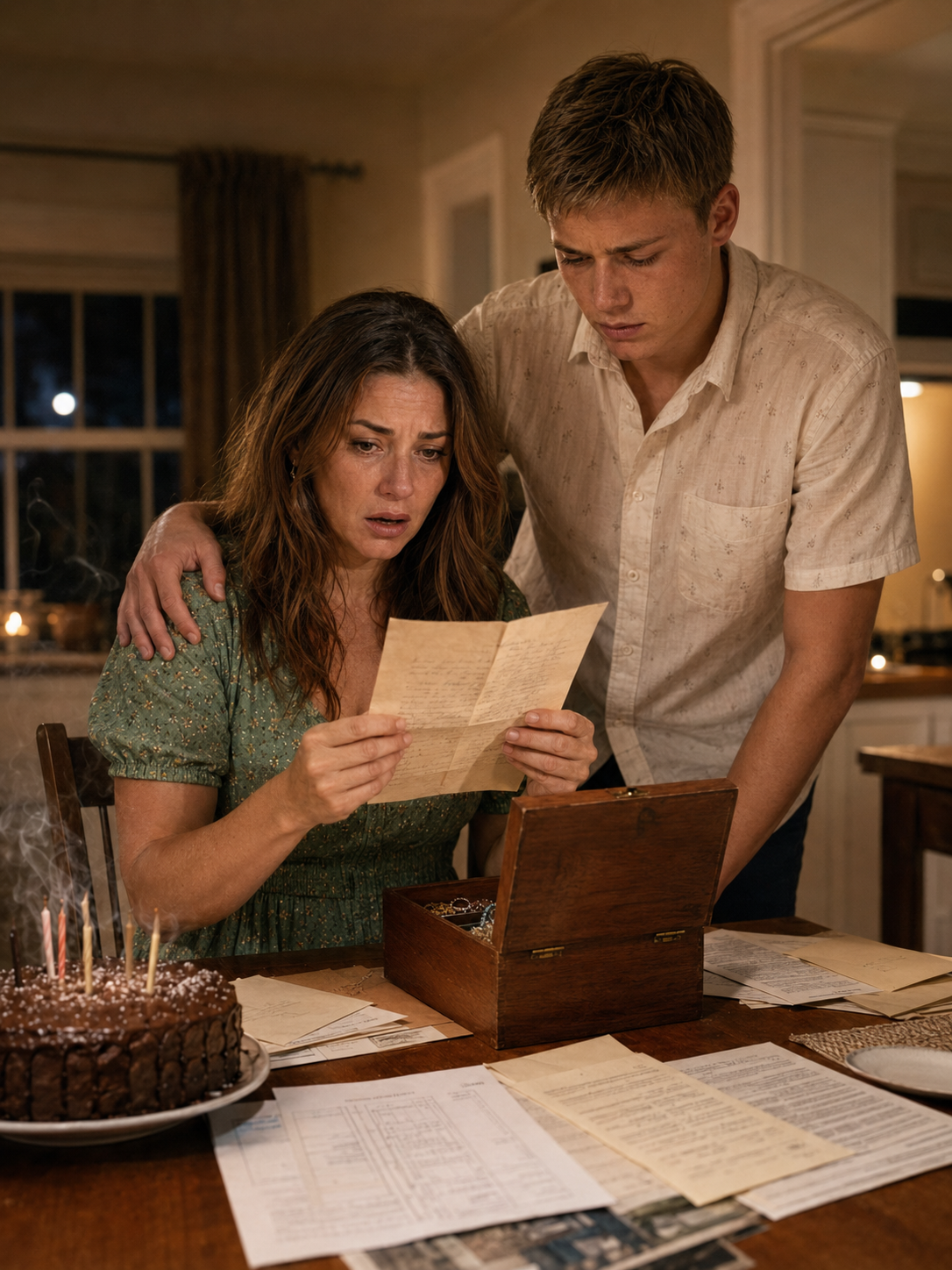
The night our aunt left, the house did not feel victorious.
It felt haunted.
Lucas and I stood in the living room long after the door clicked shut, staring at the papers spread across the coffee table like pieces of a life neither of us had fully understood.
The deed.
The bank statements.
The trust document.
Our mother’s letter.
Everything I had believed for eight years had shifted in one evening.
I had spent almost a decade thinking I was barely enough. Barely a guardian. Barely an adult. Barely keeping us above water.
But our parents had not left us helpless.
They had left us protected.
And somehow, I had been too tired, too broken, too busy surviving to know it.
Lucas sat on the floor beside the coffee table, his knees pulled up, his eyes fixed on the jewelry box.
“I thought you’d be angry,” he said quietly.
I looked at him. “At you?”
He nodded.
My heart cracked.
“Lucas, no.”
“I kept it from you.”
“You were trying to protect me.”
“That was your job,” he whispered.
The words hit harder than I expected.
Because he was right.
For eight years, I had been the one signing school forms, attending parent meetings, paying bills, fixing leaky sinks, buying groceries, checking homework, hiding my tears in the laundry room.
I had been his guardian.
But somewhere along the way, my little brother had started guarding me too.
I sat beside him and pulled the jewelry box closer.
“There might be more inside,” I said.
Lucas looked at me.
“I didn’t check everything.”
“You didn’t?”
He shook his head. “I read the letter, saw the documents, and stopped. I thought if I kept looking, I’d find something I couldn’t carry.”
I understood that too well.
I lifted the velvet cloth again.
Beneath it, in a narrow hidden compartment, was a small brass key taped to the bottom of the box.
Next to it was one folded page.
My name was written on the outside.
Not in my mother’s handwriting this time.
In my father’s.
My throat closed.
Dad had always written in short, careful lines. He had been the quiet one, the one who fixed things without announcing it, the one who would place a blanket over my shoulders if I fell asleep on the couch.
I unfolded the paper slowly.
My girl,
If your mother’s letter has found you, then you already know most of it. But not all.
I stopped reading.
Lucas leaned closer but did not speak.
I forced myself to continue.
The key belongs to a safe-deposit box at First Harbor Bank. Inside are copies of everything, plus evidence of the money your aunt took. We did not want you to carry this burden while grieving, but we needed to make sure that one day, if she came for you or Lucas, you could defend yourself.
Do not let guilt make you weak with people who use family as a weapon.
You were never meant to carry Lucas alone. We tried to leave you help. If you did carry him alone anyway, then I am sorry. That means we failed to make the path clear enough.
The words blurred.
I pressed my hand over my mouth.
For eight years, I had whispered into empty rooms, I’m sorry, Dad. I’m trying.
And here, across time, my father was apologizing to me.
Lucas took the page from my trembling hands and read the final lines aloud.
Take the key to Evelyn Hart. She is the attorney who prepared the trust. Trust her. Trust each other. And whatever your aunt says, remember this: we chose you because love had already made you strong.
Lucas stopped.
The silence after his voice felt enormous.
Then he whispered, “Evelyn Hart.”
I wiped my face. “Do you know her?”
“No. But there’s a business card in the envelope.”
He reached into the thick folder and pulled out a cream-colored card.
Evelyn Hart, Attorney at Law. Estate Planning and Family Trusts.
I stared at the name.
For the first time that night, I felt something besides shock.
I felt direction.
“We call her tomorrow,” I said.
Lucas nodded.
Then, after a moment, he said, “Do you think Auntie will come back?”
I looked toward the front door.
“No.”
I picked up our mother’s letter and folded it carefully.
“She’ll do worse.”
Chapter 2: The Morning After
By sunrise, my aunt had already begun.
My phone buzzed at 6:12 a.m.
Then again.
And again.
At first, I thought it was work.
Then I saw the messages.
Did you really cut Lucas out of the house?
Your aunt is heartbroken. How could you do this?
Family shouldn’t fight over money.
Lucas deserves his share.
Your mother would be ashamed.
I sat at the kitchen table in the same chair where I had helped Lucas with spelling homework, college essays, and heartbreaks from girls who never deserved him.
Now my phone was full of people who had not brought us one casserole after the funeral telling me what family meant.
Lucas walked in wearing pajama pants and an old school hoodie.
He saw my face.
“What happened?”
I handed him the phone.
He scrolled.
His expression changed slowly from confusion to anger.
“She posted something?” he asked.
“Probably.”
He opened his own phone.
Within seconds, his jaw tightened.
“She wrote that you manipulated Mom and Dad while they were alive. That you hid the will. That you’re refusing to give me my inheritance.”
I closed my eyes.
There it was.
Not a lawsuit yet.
A public trial first.
That was always her way.
Before she attacked your home, she attacked your character.
Lucas typed quickly.
“What are you doing?” I asked.
“Answering.”
“No.”
He looked up. “She’s lying.”
“I know.”
“Then why not say something?”
“Because anything we say angry will become proof that we’re unstable.”
He stared at me.
I hated how tired my voice sounded. I hated that I knew her methods so well.
Lucas set the phone down.
“I’m eighteen now. You don’t have to protect me from everything.”
I looked at him, really looked at him.
The boy I raised was still there, but so was someone new. Someone taller. Someone stronger. Someone who had already learned too much from watching me suffer quietly.
“I know,” I said. “But I’m still allowed to protect us.”
He softened.
“Us?”
“Always us.”
His anger broke for a moment.
He sat across from me.
“What do we do first?”
I held up Evelyn Hart’s card.
“We stop surviving and start fighting smart.”
Chapter 3: Evelyn Hart
Evelyn Hart’s office was above a bakery downtown.
It smelled faintly of coffee, paper, and cinnamon.
She was in her sixties, with silver hair cut sharply at her chin and eyes that looked kind but impossible to fool.
When I said our parents’ names, she removed her glasses.
“Oh,” she said softly. “I wondered when this day would come.”
That sentence made my stomach drop.
Lucas sat beside me, his hands clasped tightly.
Evelyn closed her office door and looked at both of us.
“Tell me what happened.”
I told her everything.
The birthday dinner.
The demand to sell the house.
The jewelry box.
The letter.
The online lies.
Evelyn listened without interrupting.
When I finished, she leaned back and exhaled slowly.
“Your parents were frightened of your aunt,” she said.
Hearing someone else say it made the room feel colder.
Lucas asked, “Why didn’t they go to the police?”
“They planned to,” Evelyn said. “But they wanted their evidence organized first. Your aunt had been taking money from family accounts, your grandmother’s medical fund, and a small business account your father helped manage.”
I felt sick.
“Grandma’s medical fund?”
Evelyn nodded. “Yes.”
Lucas whispered, “She stole from Grandma too?”
“I’m afraid so.”
My aunt had cried the loudest at our grandmother’s funeral.
She had worn black lace and accepted sympathy like a queen.
I remembered standing beside Lucas, holding his small hand, thinking our aunt looked so broken.
Now I wondered if grief had ever touched her at all.
Evelyn opened a file cabinet and pulled out a folder.
“Your parents brought me copies before their accident. The originals were placed in the safe-deposit box. Your father was very careful.”
I swallowed hard.
“Did they know they were going to die?”
Evelyn’s face softened.
“No. They knew your aunt would eventually try to use Lucas. They wanted to prevent that.”
Lucas looked at the floor.
“She always acted like she cared about me.”
Evelyn’s voice became gentle.
“People who want control often aim their kindness at the person easiest to influence.”
Lucas flinched.
I reached for his hand under the table.
He held on.
Evelyn turned to me.
“The house is legally yours. The trust is valid. Lucas’s education fund exists, but it is protected through you as trustee until he turns twenty-five, unless you choose to release funds earlier for school expenses.”
Lucas turned to me.
“There’s an education fund?”
“I didn’t know,” I whispered.
Evelyn nodded. “Your parents intended to ease your burden. Unfortunately, because the documents were hidden, you carried more than you should have.”
That was the sentence that broke me.
Not because it accused anyone.
Because it finally named the truth.
I had carried more than I should have.
I covered my face.
“I worked doubles,” I whispered. “I missed holidays. I sold Mom’s piano. Lucas needed braces, and I—”
Lucas grabbed my hand tighter.
“Stop.”
“I thought we had nothing.”
Evelyn leaned forward.
“You did not fail. You acted with the information you had.”
I tried to breathe, but the air felt too heavy.
Lucas’s voice was rough.
“She gave up everything.”
Evelyn looked at him.
“And now you both have a chance to stop giving her power over your life.”
She slid a document across the desk.
“This is a cease-and-desist letter. I can send it today. If your aunt continues spreading defamatory claims or attempts to challenge the estate without legal basis, we respond formally.”
Lucas asked, “Can she still sue?”
Evelyn gave a thin smile.
“Anyone can sue. Winning is different.”
For the first time that morning, I almost smiled.
Then Evelyn’s face turned serious again.
“There is one thing you need to prepare for.”
My stomach tightened.
“What?”
“Your aunt will not stop because she loses the legal argument. People like her usually change the battlefield.”
Lucas frowned.
“What does that mean?”
Evelyn folded her hands.
“It means she may try to divide you.”
Chapter 4: The Crack She Looked For
For two weeks, Evelyn’s warning sat in my mind like a stone.
At first, things seemed calmer.
The cease-and-desist letter went out.
Some relatives stopped texting.
A few even apologized, though their apologies sounded more like excuses.
We didn’t know the whole story.
Your aunt made it sound different.
You understand how convincing she can be.
I wanted to ask where their curiosity had been when Lucas and I were drowning.
Instead, I replied politely.
Because anger costs energy.
And I was tired of spending energy on people who never spent any on us.
Lucas went back to school. I went back to work. The house returned to its familiar rhythm.
Coffee in the morning.
Bills on the counter.
Laundry half-folded on the couch.
Lucas’s college acceptance letter pinned to the fridge.
For a little while, I allowed myself to hope the worst had passed.
Then Lucas came home one afternoon with his face pale and closed off.
I was making spaghetti because it was cheap, easy, and still the only dinner I could cook without thinking.
He dropped his backpack by the door.
“Lucas?”
He didn’t answer.
“Are you okay?”
He looked at me, and I knew.
She had gotten to him.
“What did she say?” I asked.
He laughed once, bitterly.
“You knew she’d contact me?”
“I guessed.”
He pulled a folded paper from his pocket and threw it onto the counter.
It was a photocopy of part of the trust.
Certain lines were highlighted.
Only my name.
My authority.
My control.
My power to approve or deny Lucas’s expenses.
“She said Mom and Dad didn’t trust me,” he said.
My heart sank.
“Lucas—”
“She said they gave everything to you because they thought I’d waste it.”
“That’s not true.”
“Isn’t it?”
I stepped toward him.
“She twisted it.”
“But the document says you control everything.”
“Until you’re older. For protection.”
“Protection from who? Me?”
His voice cracked.
That hurt worse than shouting.
“No,” I said. “From her.”
“She said you could decide not to pay for my college if you wanted.”
“I would never do that.”
“I know.”
But his face said he didn’t fully know.
Not because he doubted my love.
Because our aunt had placed a poison inside a fear he already carried.
The fear that he was still a child in my eyes.
The fear that I had sacrificed so much for him that maybe, secretly, I resented him.
He looked away.
“I don’t want your permission to live my life.”
“You don’t need my permission.”
“Then why does every important paper say I do?”
I had no answer ready.
Because legally, he was right.
Emotionally, he was wounded.
And I suddenly saw what our parents had not predicted.
They had protected him from our aunt.
But they had accidentally placed me in a position that could look like control.
Lucas wiped his eyes angrily.
“I’m sorry,” he said. “I know you didn’t do this.”
But the crack was there.
Small.
Painful.
Exactly where our aunt wanted it.
That night, Lucas did not eat dinner.
I sat alone at the kitchen table with two untouched bowls of spaghetti and realized something terrible.
Winning the house would mean nothing if I lost my brother’s trust.
Chapter 5: The Choice
The next morning, I called Evelyn.
“I want to release the education fund to Lucas.”
She was quiet for a moment.
“That is a significant decision.”
“I know.”
“He is young.”
“He is also not a weapon.”
Evelyn understood immediately.
“You’re afraid your aunt will use the trust structure to make him feel controlled.”
“She already has.”
Evelyn sighed softly.
“Your parents created that structure for good reasons.”
“I know. But they also trusted me to protect him. Right now, protecting him means letting him stand.”
“Are you sure?”
I looked down the hallway toward Lucas’s closed bedroom door.
No.
I was not sure.
I was terrified.
The money could be mismanaged. He could feel overwhelmed. Our aunt could still manipulate him.
But I had raised Lucas to become an adult, not to remain a child attached to my sacrifice.
“I’m sure,” I said.
That evening, I waited until Lucas came home.
He looked exhausted.
“I need to show you something,” I said.
He stiffened. “More papers?”
“Yes. But these are different.”
We sat at the kitchen table.
The same table where he had done science fair projects.
The same table where I had cried over unpaid bills after he went to bed.
The same table where our mother’s letter had changed everything.
I slid the papers toward him.
“What is this?” he asked.
“Your education fund. Evelyn is preparing the release. Tuition, housing, books, transportation. It will be yours to manage with financial guidance.”
He stared at the documents.
Then at me.
“You’re giving it to me?”
“It was always for you.”
“But you don’t have to release it now.”
“No,” I said. “I don’t.”
“Then why?”
“Because I don’t want you to feel like your future sits in my hands.”
His face twisted.
“I don’t think that.”
“Yes, you do a little. And that’s okay.”
He looked down.
I continued, “Lucas, I loved raising you. But love can become heavy if we never set each other free. I don’t want you to spend your life feeling like you owe me for surviving.”
His eyes filled.
“You gave up everything.”
“I gave up some things,” I said. “Not everything.”
“Yes, you did.”
“No.” My voice trembled. “I got you.”
That broke him.
He covered his face with both hands.
“I hate that she can still get in my head,” he whispered.
I moved beside him and held him the way I had when he was ten and nightmares woke him up.
“She knows where to cut,” I said. “That doesn’t mean we have to bleed forever.”
Lucas leaned into me like a tired child and a grown man at the same time.
“I don’t want to leave for college angry,” he said.
“Then don’t.”
“I don’t want you alone in this house.”
I smiled sadly.
“I’ll be okay.”
“That’s what you always say when you’re not.”
He knew me too well.
I touched his hair.
“Then I’ll learn.”
Chapter 6: The Courtroom
Three months later, my aunt filed anyway.
She challenged the trust.
She claimed our parents had been pressured.
She claimed I had isolated Lucas.
She claimed grief had made me unstable.
She used every soft word for every ugly accusation.
The hearing was held on a rainy Thursday morning.
I wore the only blazer I owned.
Lucas wore a navy suit that made him look too grown up.
Our aunt arrived in pearls, holding tissues she did not use.
She hugged relatives in the hallway and whispered loudly enough for us to hear.
“I only want what’s fair for Lucas.”
Lucas’s jaw clenched.
I touched his arm.
“Don’t.”
He breathed in.
Then Evelyn arrived.
She looked at my aunt once and smiled politely.
It was the kind of smile that made me grateful she was on our side.
Inside the courtroom, my aunt performed beautifully.
She cried at the right moments.
She spoke of family history.
She described herself as a grieving sister.
She said she had always worried for Lucas.
Then Evelyn stood.
Calmly, almost gently, she began placing documents into the record.
The deed.
The trust.
Bank records.
Copies from the safe-deposit box.
Transfers my aunt had made from accounts that did not belong to her.
Emails she had sent to our father.
One line made the entire room go silent.
You’ll regret cutting me out, Thomas. Family secrets don’t stay buried.
My aunt’s face lost color.
Evelyn read it aloud without emotion.
Then she asked, “Did you send this email to your brother-in-law four days before his death?”
My aunt’s lips trembled.
“I was upset.”
“Because he discovered unauthorized withdrawals?”
“I was under stress.”
“Because he asked you to repay funds taken from your mother’s medical account?”
My aunt began crying then.
Real tears, I think.
But not the kind that come from remorse.
The kind that come when consequences finally arrive.
Then Lucas stood.
The judge allowed him to speak.
He looked nervous, but his voice did not shake.
“My sibling raised me,” he said. “Not perfectly. No one could do that perfectly. But every meal I ate, every ride to school, every parent-teacher meeting, every birthday cake, every college application, every fever, every nightmare—she was there.”
My throat tightened.
Lucas looked at our aunt.
“You keep saying you want what’s fair for me. But you never asked what I wanted. You only wanted me when I became useful.”
My aunt looked away.
Lucas turned back to the judge.
“I don’t want the house sold. I don’t want my sibling accused of stealing from me. I don’t want my parents’ protection turned into another weapon. I want this to end.”
The room was quiet.
For the first time in eight years, someone else carried the truth out loud.
And I did not have to hold it alone.
The judge dismissed my aunt’s claim.
Evelyn said there could still be consequences for the financial records.
My aunt looked at me then.
Not with regret.
With hatred.
For one second, I saw the woman our mother had feared.
Then she walked out.
No dramatic apology.
No sudden change of heart.
No healing scene.
Some people do not become better just because the truth is revealed.
Some only become exposed.
Chapter 7: The Goodbye Room
Summer arrived too quickly.
Lucas packed for college in August.
His room became a battlefield of boxes, laundry, and memories.
I found old things everywhere.
A broken toy dinosaur.
His fifth-grade science medal.
The blue hoodie he wore for two years straight.
A photo of us at his middle school graduation, my smile too tired and his grin too big.
He caught me holding it.
“You okay?”
I nodded.
He laughed softly. “Liar.”
I sat on the edge of his bed.
“I don’t know how to do this part.”
“What part?”
“The part where you leave.”
His face softened.
“I’m only two hours away.”
“That’s very far when you’re used to someone being down the hall.”
He sat beside me.
“You taught me how to be okay,” he said. “Now you have to try it too.”
I smiled through tears.
“When did you become so wise?”
“Trauma and good parenting.”
I laughed, but then the laugh became a sob.
Lucas put his arm around me.
For a moment, I was twenty-six again, holding a ten-year-old boy after a funeral, promising things I did not know how to provide.
Then I was thirty-four, sitting beside an eighteen-year-old man who somehow still felt like my baby brother.
“I’m proud of you,” I whispered.
“I’m proud of you too.”
The morning he left, we loaded his bags into the car.
The house felt too bright.
Too quiet.
Too aware of what it was losing.
Before he got in, Lucas handed me something.
A small envelope.
“What’s this?”
“Open it after I go.”
“Lucas.”
“Please.”
I hugged him so tightly he laughed.
“I need air.”
“No.”
“Okay, fair.”
When he finally drove away, I stood in the driveway until his car disappeared.
Then I went inside.
The house was silent.
Not the peaceful kind.
The kind that asks who you are when your purpose leaves for college.
I sat at the kitchen table and opened the envelope.
Inside was a letter.
You once told me that raising me gave your life meaning. But I don’t want you to think your life only matters when someone needs you.
You are more than my guardian.
You are my sister.
You are your own person.
Please live now. Not because I’m gone, but because you deserve to.
I cried harder than I had cried in years.
Not because I was sad.
Because he was right.
Chapter 8: The Last Page
A week after Lucas left, I finally cleaned the jewelry box.
For years, it had smelled like dust and secrets.
I wiped the wood with a soft cloth.
I polished the clasp.
I placed Mom’s letter, Dad’s note, and Lucas’s college letter inside.
As I lifted the velvet lining one last time, my fingers brushed something thin.
Another page.
Hidden flat beneath the bottom panel.
I froze.
There was no name on it.
Only one sentence on the outside.
For the day both of you are free.
My hands shook as I opened it.
It was from Mom.
My dear children,
If this page has reached you, then perhaps the worst is over. Perhaps you have fought, cried, misunderstood each other, forgiven each other, and found your way back.
That is what family is. Not perfect agreement. Not pretending pain did not happen. Family is choosing love again after truth makes it difficult.
To my eldest child: You were never born to be only responsible. You were born to be loved too. Please do not spend your whole life proving you were strong enough. Rest. Laugh. Let people help you.
I pressed the letter to my chest.
Then I kept reading.
To Lucas: Your sibling did not raise you because you were a burden. She raised you because love recognizes its own duty. Do not carry guilt for being cared for. Grow well. That will be your thank-you.
My tears fell onto the page.
And to both of you: The house is not the inheritance. The money is not the inheritance. Even the truth is not the inheritance.
The inheritance is each other.
Protect that above all.
I sat there for a long time.
The kitchen light hummed softly.
Outside, the late summer sun touched the windows.
For once, the house did not feel like something I had to defend.
It felt like something I could finally live in.
Chapter 9: One Year Later
One year later, Lucas came home for his birthday.
Not with secrets this time.
With laundry, a terrible haircut, and a girlfriend he was nervous to introduce.
I made cake.
He complained it was too dry.
I threatened to revoke his education fund.
He laughed so hard he nearly dropped the plates.
We were still healing.
Some relatives never came back.
Our aunt never apologized.
The legal process continued quietly in the background, but I stopped letting her shadow sit at our table.
Lucas was doing well in school.
I had changed jobs.
Not because I had to.
Because I finally allowed myself to want more.
Sometimes, at night, I still walked past his empty room and felt the old ache.
But I also felt pride.
He had left home without leaving me behind.
And I had stayed home without staying stuck.
After dinner, Lucas helped me wash dishes.
Just like the morning everything began.
He handed me my travel mug from the drying rack and smiled.
“You still use this?”
“Every day.”
“You need a better one.”
“I like this one.”
He leaned against the counter.
“You okay?”
I looked around the kitchen.
At the repaired cabinet.
At the birthday candles on the counter.
At the jewelry box now sitting safely on the shelf.
At my brother, grown and laughing and free.
“I am,” I said.
This time, I meant it.
Lucas smiled.
“Good.”
Then he squeezed my shoulder, the way I used to squeeze his.
And I realized something.
For years, I had thought love meant holding on with both hands.
But sometimes love is opening the door.
Sometimes it is telling the truth.
Sometimes it is letting someone grow.
Sometimes it is finally allowing yourself to put down what was never meant to be carried forever.
That night, after Lucas went to bed in his old room, I sat alone at the kitchen table and opened Mom’s last letter again.
The inheritance is each other.
I read the line three times.
Then I closed the box.
Not because the story was over.
Because for the first time, it no longer needed to be a secret.
End of Part 2
5 Moral Lessons from Part 2
1. Family is proven by action, not by blood.
Their aunt used the word “family” to control, shame, and manipulate them. But the real family bond was shown through sacrifice, loyalty, protection, and truth between the siblings.
2. Secrets can protect people, but they can also create pain.
The parents hid the documents to protect the children from their aunt, but the hidden truth also caused years of unnecessary struggle. Protection should not become silence forever.
3. Love must eventually make room for freedom.
The older sibling raised Lucas, but had to learn that protecting him forever was not the same as helping him become an adult. Real love knows when to hold on and when to let go.
4. Manipulative people look for cracks between loved ones.
The aunt could not win with facts, so she tried to divide the siblings emotionally. This teaches us to communicate openly with the people we love before outsiders use silence against us.
5. Healing begins when you stop living only in survival mode.
The older sibling spent years working, sacrificing, and enduring. But after the truth came out, they had to learn how to live again, not just survive. Life is not only about carrying responsibility; it is also about allowing yourself peace.