PART 2: THE SIGNATURE THAT WAS NEVER MINE
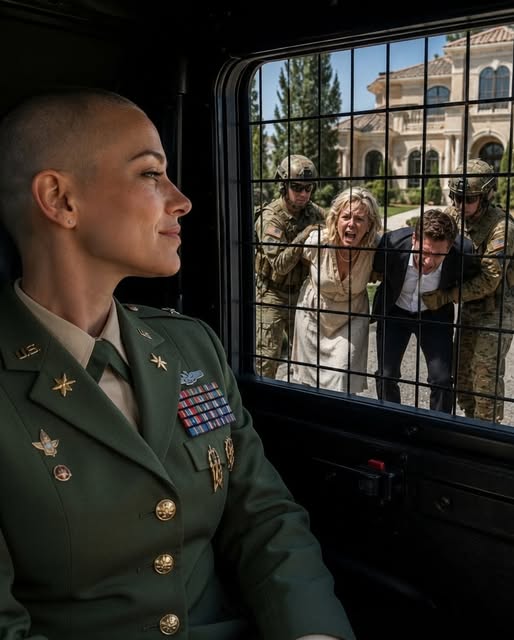
The message from my attorney contained six words that turned the room colder than the winter air outside.
Ryan filed a power of attorney.
I sat motionless at the kitchen table, the blue light from my laptop reflecting off the stainless-steel surface. Somewhere upstairs, Ryan snored peacefully beside the woman who had shaved my head while I slept. They believed they had broken me. They believed humiliation would make me obedient.
Instead, they had made a tactical error.
I opened the attachment.
The document granted Ryan authority over my bank accounts, retirement benefits, military compensation, real estate, medical decisions, and personal property. It even gave him permission to act on my behalf during deployments or periods of “mental incapacity.”
My name appeared at the bottom.
The signature looked almost perfect.
Almost.
I had signed thousands of official documents during twenty-two years in the Army. My handwriting was controlled, sharp, and slightly angled to the right. The forged signature curved too softly at the end. Someone had studied my writing, but not closely enough.
The document had been notarized three months earlier by a woman named Patricia Monroe.
Linda’s younger sister.
My pulse slowed.
That was what happened when I faced a serious threat. Fear disappeared. Emotion narrowed. Every detail became information.
I forwarded the document to my military legal adviser, my civilian attorney, and a secure personal account Ryan did not know existed. Then I photographed every page, recorded the time, and began building a timeline.
Three months earlier, I had been stationed overseas for a strategic assessment. During that week, Ryan had called several times asking where I kept the deed to the house. He claimed our insurance company needed a copy.
I had told him it was in the fireproof safe.
When I returned, nothing appeared missing.
Now I understood why.
I checked the safe.
The deed was still there, but the folder had been disturbed. The documents were arranged in the wrong order. To anyone else, that would have meant nothing.
To me, it meant someone had copied them.
I searched through our financial records and found three unfamiliar credit inquiries. Two had been made under my name. The third was connected to a company called Hawthorne Residential Holdings.
I had never heard of it.
At 4:18 in the morning, my attorney called.
“Colonel Mercer,” Daniel Price said, his voice tense, “do not confront your husband.”
“I wasn’t planning to.”
“I mean it. This is bigger than a forged power of attorney.”
“What did you find?”
“A preliminary title search suggests someone attempted to place a private lien against your property.”
My hand tightened around the phone.
“How much?”
“Four hundred and eighty thousand dollars.”
The house was worth slightly more than six hundred thousand.
Ryan had not simply wanted control over my finances.
He had been preparing to take everything.
Daniel continued, “The lien was never fully recorded because the lender requested additional identity verification. But the paperwork lists you as the borrower.”
“I never applied for a loan.”
“I know. The application claims you needed funds for a private security company.”
I looked toward the stairs.
Ryan had always complained that my military career embarrassed him. Yet he had apparently been using that career to make me appear credible to lenders.
“Can you freeze everything?”
“I’ve already contacted the bank’s fraud department. Your primary accounts should be secure within the hour. But you need to leave the house.”
“I’m leaving for headquarters.”
“Good. Take evidence of the assault.”
I glanced toward the bedroom, where strands of my hair still covered the bloodstained pillow.
“I have it.”
“And Colonel?”
“Yes?”
“Do not underestimate them.”
I nearly laughed, though there was no humor in me.
“They have been underestimating me for years.”
I packed the pillowcase, the clippers Linda had used, copies of the forged documents, and every financial record I could find. Then I showered carefully, avoiding the cuts on my scalp.
The water turned pink as it ran down my shoulders.
In the mirror, I barely recognized myself.
My head was completely shaved. Thin red lines marked the places where Linda had pressed too hard. Without my hair, my face looked sharper, older, and more severe.
But I did not look defeated.
I looked like someone who had finally stopped pretending to be harmless.
Before leaving, I returned to the bedroom.
Ryan slept on his back, one arm thrown across my side of the bed. Linda had moved to the guest room. Their confidence was almost impressive. They believed I would wake them in the morning, apologize for being difficult, and announce my resignation.
I placed my wedding ring on the dresser.
Then I took it back.
Not because I wanted it.
Because it was evidence of a contract they had violated long before I understood what was happening.
At headquarters, the guards saluted as I drove through the gate. Their eyes briefly moved toward my shaved head, but none of them asked questions.
By 6:45, I stood inside my office wearing my dress uniform.
The silver eagle insignia of a United States Army Colonel rested on my shoulders. Behind me hung the American flag and the colors of the intelligence unit I had been selected to command.
At precisely seven, Major General Thomas Grant entered.
He stopped when he saw me.
General Grant was not an emotional man. He had spent four decades in uniform and had the steady expression of someone who had heard every excuse, every lie, and every confession.
His gaze moved from my shaved head to the cuts along my scalp.
“What happened?”
“My mother-in-law assaulted me while I was sleeping.”
His jaw tightened.
“And your husband?”
“Defended her.”
The general closed the office door.
“Are you safe?”
“I am now.”
“Do you need time before assuming command?”
“No, sir.”
“That was not an order. It was a question.”
“My answer is still no.”
He studied me for several seconds.
Then he nodded.
“Understood.”
The change-of-command ceremony took place at nine.
Hundreds of soldiers and civilian intelligence professionals filled the auditorium. Cameras flashed as the unit colors were passed into my hands. I could feel people noticing my appearance, wondering why a newly promoted colonel had arrived with a freshly shaved head and visible cuts.
I did not explain.
I stood at the podium and delivered the speech I had prepared weeks earlier.
“Leadership,” I said, “is not authority over others. It is responsibility for them. It requires discipline when fear is loud, integrity when compromise is easy, and courage when silence would be safer.”
The words struck me differently now.
So did the applause.
At 9:16, my phone vibrated inside my pocket.
Ryan: My card was declined. What did you do?
At 9:22, another message arrived.
Ryan: Mom’s prescription payment failed. Fix it now.
At 9:31:
Ryan: You are behaving like a child.
At 9:40, he called for the seventeenth time.
I ignored him.
At ten, my executive officer entered my office carrying a red folder.
“Ma’am, there are two military police investigators waiting downstairs.”
“Send them in.”
The investigators were Captain Elena Ruiz and Chief Warrant Officer Marcus Bell. They photographed the injuries on my scalp, collected the clippers and pillowcase, and took my statement.
Captain Ruiz listened without interruption.
When I finished, she asked, “Has your husband ever assaulted you before?”
“No.”
“Threatened you?”
“Yes.”
“How often?”
I hesitated.
The honest answer embarrassed me more than the shaved head.
“Frequently.”
“What kind of threats?”
“He said he would contact my chain of command and claim I was unstable. He said he would tell people I drank excessively. He said he could destroy my reputation if I ever left him.”
Ruiz wrote carefully.
“Do you drink excessively?”
“No.”
“Any mental health diagnosis he could exploit?”
“No.”
“Any incidents in your record?”
“None.”
She looked up.
“Then why did you believe he could damage you?”
Because private humiliation is powerful.
Because even competent people can become prisoners when shame replaces reason.
Because I had commanded soldiers in combat zones but had spent years avoiding conflict inside my own home.
“I believed him because I had allowed his voice to become louder than the evidence,” I said.
Ruiz closed her notebook.
“That ends today.”
At 10:43, Ryan sent another message.
You embarrassed us. Fix this before I destroy your career.
I handed the phone to Captain Ruiz.
She read it, then looked at me.
“Save this.”
“I already did.”
For the first time that morning, she smiled.
“I thought you might.”
By noon, Daniel Price had uncovered more.
Hawthorne Residential Holdings had been registered eight months earlier. The official owner was a man named Derek Lawson, one of Ryan’s childhood friends.
Lawson had served eighteen months in prison for financial fraud.
The company’s mailing address was a rented office above a laundromat.
The proposed loan against my house was only one part of the scheme. Ryan had also tried to redirect a portion of my military retirement contributions into an investment account controlled by Hawthorne.
My husband had complained for years that my career consumed too much of my time.
All along, he had been calculating how much that career was worth.
At 1:15, I received a voicemail from Linda.
Her voice was furious.
“You selfish little witch. Ryan has done everything for you. He gave you a home. He tolerated your career. He waited while you ran around playing soldier. Now you’re punishing him because I cut some hair? Come home immediately and restore the accounts.”
I replayed the sentence.
He gave you a home.
The house had been purchased with my military housing allowance and savings. Ryan had contributed nothing to the down payment. For four years, I had paid the mortgage alone.
Yet in Linda’s mind, the house belonged to her son simply because he was a man.
I forwarded the voicemail to Daniel and the investigators.
At two, I briefed my new command staff on an overseas intelligence operation. At three, I reviewed personnel clearances. At four, I approved a security assessment that had been waiting for weeks.
The work steadied me.
Ryan had spent years accusing me of caring more about the Army than my family.
He had never understood the difference.
The Army did not ask me to surrender my identity. It demanded accountability, preparation, and service. My home demanded money, silence, and obedience.
At 5:30, Daniel called again.
“We have a problem.”
“What kind?”
“The kind that requires you to come to my office.”
I arrived twenty minutes later.
Daniel placed several documents on the conference table. Beside him sat a forensic accountant named Maya Chen.
Maya pointed to a transfer authorization dated six months earlier.
“This moved seventy-five thousand dollars from a joint emergency fund into an account associated with Hawthorne Residential Holdings.”
“I never approved that.”
“The authorization was made using your online banking credentials.”
“Ryan knew the password.”
“Did he know the security answers?”
“He knew most of them.”
Maya slid another page toward me.
“Someone also requested a replacement phone connected to your bank profile. It was activated for forty-eight hours, then canceled.”
Ryan had cloned access to my financial life.
But seventy-five thousand dollars should have been impossible. Our emergency fund had never held that much.
“Where did the money come from?”
Daniel and Maya exchanged a look.
“That is the second problem,” Daniel said.
He opened another folder.
The money had come from a military survivor benefit payment.
I stared at the page.
The benefit had been issued after the death of my younger brother, Captain Andrew Mercer, who had been killed eight years earlier during a training accident.
Andrew had named me as his primary beneficiary.
I had placed the money into a separate account because spending it felt like profiting from his death. I intended to use it someday for scholarships in his name.
Ryan knew that.
He knew exactly what the money meant to me.
“He stole my brother’s death benefit,” I said.
Maya’s expression softened.
“Yes.”
Something inside me went silent.
Not broken.
Not shattered.
Silent.
There are moments when pain becomes so complete that it stops feeling like pain. It becomes clarity.
“What was the money used for?”
“Most of it was transferred through several accounts,” Maya said. “But we traced twenty-five thousand to a luxury vehicle deposit.”
Ryan’s truck.
The truck he claimed the dealership had leased to him at an employee discount.
I had been making the monthly payments because he said the lease helped him build credit.
He had purchased it with Andrew’s money.
The rest went to gambling websites, private debt repayments, and a woman named Vanessa Cole.
“Who is Vanessa?”
Daniel pushed a photograph toward me.
She was young, blond, and smiling beside Ryan at a restaurant I recognized. The photograph had been posted publicly two months earlier.
Ryan’s arm was around her waist.
The caption read: Building our future.
I looked at the image for a long time.
I had expected to feel jealousy.
Instead, I felt relief.
The betrayal was no longer complicated. There was no marriage left to mourn. Only evidence to organize.
“Who is she?” I asked.
“An employee at Derek Lawson’s company,” Daniel said. “She also appears to be Ryan’s fiancée.”
I looked up.
“His what?”
Maya turned her laptop toward me.
Vanessa had posted photographs of an engagement ring. In one picture, Ryan’s hand rested over hers.
The date was six weeks earlier.
The caption read: Soon we won’t have to hide anymore.
I laughed.
The sound startled all three of us.
Daniel leaned back. “Colonel?”
“I’ve spent years wondering why I wasn’t enough for him.”
Neither of them spoke.
“I paid his bills. Supported his mother. Protected his pride. Made excuses for his laziness. I thought if I worked harder, gave more, became smaller, he might finally treat me like a partner.”
I tapped the photograph.
“But he never wanted a partner.”
“What did he want?” Maya asked quietly.
“An asset.”
Daniel closed the file.
“Then let’s make sure he loses access to it.”
By evening, the plan was simple.
I would return to the house accompanied by law enforcement to collect essential property and inform Ryan that he had to leave. Because the deed was solely in my name and the forged documents created an immediate fraud concern, Daniel had already requested an emergency protective order.
Two military police officers accompanied me, along with a civilian detective named Samuel Ortiz.
When we reached the house, Ryan stood in the driveway beside his truck. Linda watched from the front steps.
The moment Ryan saw the police vehicles, his face changed.
“You brought soldiers to threaten your own family?” he shouted.
“No,” I said as I stepped out. “I brought witnesses.”
Linda pointed at my uniform.
“You look ridiculous.”
I walked past her without responding.
Ryan followed me into the living room.
“What is this about?” he demanded. “You froze everything. The mortgage payment didn’t go through. Mom’s insurance was canceled.”
“Your mother assaulted me.”
“She cut your hair.”
“She cut my scalp.”
“It was an accident.”
“She used clippers while I was unconscious.”
Linda entered behind him.
“Oh, stop being dramatic. Women shave their heads all the time.”
“Not while they are sleeping.”
Ryan moved closer.
“You need to fix the accounts.”
“No.”
His face reddened.
“I am your husband.”
“Not for much longer.”
The words landed harder than I expected.
Ryan blinked.
Linda laughed.
“She won’t leave you. She doesn’t know how to live without this family.”
I looked at her.
“This family has lived without responsibility for years. You will learn quickly.”
Detective Ortiz stepped forward and presented Ryan with copies of the forged power of attorney and the attempted lien.
Ryan’s confidence flickered.
“I don’t know anything about that.”
“Your email address appears on the application,” Ortiz said.
“Someone must have used it.”
“Your phone number is listed.”
“That proves nothing.”
“The document was notarized by your aunt.”
Ryan’s eyes shifted toward Linda.
It lasted less than a second.
But everyone saw it.
Linda folded her arms.
“You can’t prove she signed anything,” she said.
Daniel, who had arrived behind us, answered calmly.
“We can prove Colonel Mercer did not.”
Ryan looked at me.
“You are destroying your own family over paperwork?”
“No,” I said. “You destroyed it when you forged my signature.”
He stepped closer, lowering his voice.
“You think your rank protects you?”
“No. Evidence protects me.”
His hand moved.
Perhaps he intended to grab my arm.
Perhaps he meant to strike me.
He never got the chance.
Captain Ruiz, who had entered behind Detective Ortiz, caught his wrist before he touched me.
“Do not,” she said.
Ryan froze.
The room became completely silent.
Then a car stopped outside.
A black sedan.
A nervous woman stepped out carrying a thick folder against her chest.
Patricia Monroe.
Linda’s younger sister.
The notary.
Linda rushed toward the door.
“What are you doing here?”
Patricia ignored her.
She walked directly to Detective Ortiz.
“I want immunity,” she said.
“No one promised you immunity,” Ortiz replied.
“Then I want a lawyer.”
“You should have one.”
Patricia’s hands trembled as she opened the folder.
“I signed documents for them. Ryan said Colonel Mercer had approved everything before deploying. Linda said it was only temporary.”
“You believed them?” I asked.
Patricia looked at me.
“No.”
The honesty surprised everyone.
She swallowed.
“I knew it was wrong. But Linda had records of money I took from our mother before she died. She threatened to expose me.”
Linda’s face twisted.
“You ungrateful coward.”
Patricia turned toward her sister.
“You told me no one would get hurt.”
“You were paid.”
“I was terrified.”
“You were weak.”
Patricia flinched, then pulled out several documents.
“These are copies of everything they asked me to notarize.”
Daniel took the pages.
There were loan applications, transfer authorizations, property agreements, and a draft petition claiming I was mentally unstable due to combat-related trauma.
The petition requested that Ryan be appointed temporary guardian over my finances.
My blood turned cold.
They had planned to declare me incompetent.
The shaved head had not been random cruelty.
It had been preparation.
Ryan could claim I had suffered a breakdown, shaved my own head, become aggressive, and threatened the family. Linda could support the story. Patricia could validate documents granting Ryan control.
If I had reacted violently that morning, they might have recorded it.
If I had gone to headquarters screaming and incoherent, they might have contacted my chain of command.
They had wanted me unstable.
Instead, I had become quiet.
Patricia removed one final envelope from the folder.
“This is the worst one.”
Daniel opened it.
Inside was a purchase agreement for my house.
The buyer was Hawthorne Residential Holdings.
The sale price was listed at three hundred thousand dollars below market value.
My forged signature appeared on every page.
But something else was attached.
A second contract showed that after Hawthorne acquired the house, it would sell the property to a private buyer for full market value.
I read the buyer’s name.
Major General Thomas Grant.
For several seconds, I could not breathe.
My commanding general.
The man who had promoted me.
The man who had asked whether I was safe.
The man who had stood beside me only hours earlier.
Ryan saw my expression and smiled for the first time.
“Now you understand,” he said.
I looked at him.
“Understand what?”
“You think this is just about me and Mom?”
Linda’s confidence returned.
“Your precious Army people know exactly what you are,” she said. “They have been using you longer than we have.”
Detective Ortiz took the contract from my hands.
“Colonel, did General Grant know your property was being sold?”
“I don’t know.”
Ryan laughed.
“He knew.”
“How?”
“Because he contacted us.”
Every person in the room turned toward him.
Ryan reached into his pocket and removed his phone.
“He wanted the house quietly. Said the land mattered more than the building.”
My house sat on eight acres outside Washington, close enough to several government facilities to be valuable, but far enough away to feel private.
I had purchased it because Andrew and I once dreamed of building homes beside each other there.
Ryan continued.
“Grant offered cash through Hawthorne. All we had to do was make sure you never learned until the transfer was complete.”
“You are lying.”
“Am I?”
He tapped his screen and played a recording.
A man’s voice filled the room.
Controlled. Deep. Familiar.
General Grant.
“Colonel Mercer cannot know about the property acquisition. If she discovers the purpose of the land, the entire operation is compromised.”
My stomach tightened.
The recording continued.
“Secure her legal consent by whatever domestic process is available. Do not involve military channels.”
Ryan stopped the audio.
Silence filled the living room.
Captain Ruiz looked at me.
Detective Ortiz looked at Daniel.
Even Linda seemed pleased by our shock.
Ryan leaned closer.
“You thought you were the smartest person in the house.”
I stared at his phone.
He had expected me to collapse.
Instead, I asked, “When was that recorded?”
“Three months ago.”
“Where?”
“A restaurant in Arlington.”
“Who arranged the meeting?”
“Derek.”
“Who else attended?”
Ryan hesitated.
That was enough.
“There was someone else,” I said.
His confidence faltered.
“No.”
“Who?”
Linda stepped between us.
“You’re finished asking questions.”
I looked past her toward Patricia.
Patricia had gone pale.
She knew.
“Tell me,” I said.
Patricia shook her head.
“Please.”
“Tell me who attended that meeting.”
Tears filled her eyes.
“It wasn’t General Grant.”
Ryan spun toward her.
“Shut up.”
Patricia backed away.
“The voice was fake.”
Daniel frowned.
“What do you mean?”
“Derek used an audio program. Ryan gave him recordings from public speeches. They created the conversation to frighten her if the plan failed.”
Ryan lunged forward.
Captain Ruiz restrained him.
“You stupid—”
Patricia screamed.
The officers forced Ryan against the wall and handcuffed him.
Linda began shouting that everyone was corrupt, that I had manipulated the police, that Patricia was a liar.
But Patricia kept talking.
“They needed Colonel Mercer to believe the Army was involved. Ryan said if she lost trust in her command, she would resign quietly.”
I looked at the contract again.
“Then why is General Grant’s name here?”
Patricia wiped her eyes.
“Because the property wasn’t meant for him.”
She reached into her bag and removed a small flash drive.
“This has the original contract.”
Daniel connected it to his laptop.
The document opened.
The real buyer was not General Grant.
It was Meridian Strategic Development, a private defense corporation under federal investigation for bribery, surveillance violations, and illegal intelligence collection.
My property bordered a communications corridor used by several government agencies.
They wanted access to the land.
Ryan had not merely tried to steal my house.
He had attempted to sell strategically valuable property to a company that might be working against the government I had sworn to protect.
The room seemed to tilt.
Detective Ortiz immediately called federal authorities.
Ryan stopped struggling.
For the first time, he looked genuinely afraid.
“You don’t understand,” he said. “It was just real estate.”
“No,” I replied. “It was treason disguised as real estate.”
Linda stared at her son.
“You said no one would know.”
Ryan’s face hardened.
“Be quiet.”
“You said Derek handled everything.”
“Stop talking.”
But it was too late.
The officers separated them.
As Ryan was led outside, he turned toward me.
“This isn’t over.”
“No,” I said. “It is finally beginning.”
Federal agents arrived less than an hour later.
They seized computers, phones, financial files, and the contents of Ryan’s truck. Hidden beneath the rear seat, they found classified maps showing underground communications lines near my property.
Maps I had never seen.
Maps Ryan could not legally possess.
At midnight, I stood alone in the kitchen while agents searched the house.
My scalp throbbed. My body felt heavy. I had assumed command of a major intelligence unit, uncovered financial fraud, exposed a criminal conspiracy, and ended my marriage in less than twenty-four hours.
Yet I felt no victory.
Only exhaustion.
General Grant entered quietly.
“I heard my name appeared on a fraudulent contract.”
“Yes, sir.”
“And a manufactured recording.”
“Yes.”
He placed a sealed folder on the table.
“There is something you need to know.”
I looked at him.
“About Meridian?”
“About your brother.”
My breath caught.
“Andrew?”
General Grant nodded.
“The accident that killed Captain Mercer eight years ago was not an accident.”
Every sound in the house disappeared.
“What are you saying?”
“Your brother discovered unauthorized surveillance equipment near the same communications corridor that crosses your property. He reported it through classified channels.”
I could barely speak.
“Who installed it?”
“We believed Meridian was involved, but we could never prove it.”
“And Andrew?”
“He was scheduled to testify before an internal investigative panel.”
The general’s expression darkened.
“He died forty-eight hours before the hearing.”
I gripped the edge of the table.
All these years, I had pictured Andrew’s final moments as a tragic failure of machinery. A training accident. A terrible, meaningless loss.
Now the loss had meaning.
A horrifying one.
“Why didn’t anyone tell me?”
“The investigation was classified. And we lacked evidence connecting his death to Meridian.”
“Until now.”
“Until now.”
He slid the folder toward me.
Inside was a photograph taken from a security camera outside the restaurant where Ryan had met Derek Lawson.
The image showed Ryan entering the building.
Derek followed.
Then a third man appeared.
I knew his face.
Every officer in military intelligence knew it.
He was a retired Army general who had become Meridian’s chief security adviser.
General Grant pointed to the photograph.
“This man was also the final officer to inspect the aircraft your brother flew before it crashed.”
My hands went cold.
Outside, federal agents placed Ryan into a black vehicle.
He looked toward the house and smiled.
Not nervously.
Not desperately.
Knowingly.
As if his arrest had always been part of the plan.
Then my phone vibrated.
A message appeared from an unknown number.
Your husband was never the target. You were.
A second message followed.
Ask General Grant why your promotion became available.
I slowly raised my eyes.
General Grant was watching me.
And for the first time that day, I could not tell whether the man standing beside me was an ally—
or the person who had placed me at the center of the battlefield.
If you want to know what happened next, please type “YES” and like for more.