PART 2
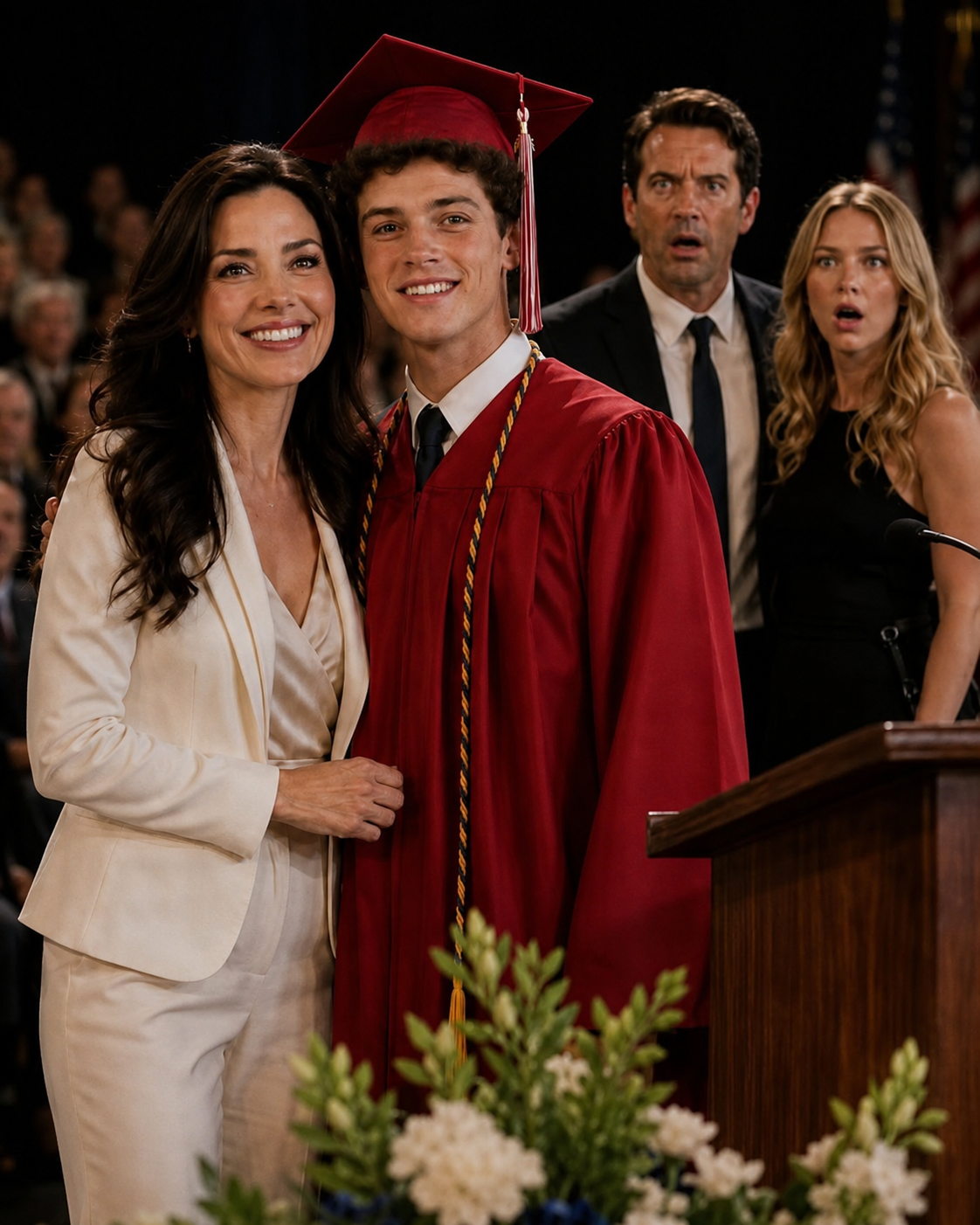
The envelope arrived on a Tuesday morning, when the world outside my apartment window looked as gray and tired as I felt.
Ethan was asleep in his crib, one tiny fist curled beside his cheek, his breath soft and uneven in that fragile newborn way that made me check him every five minutes just to make sure he was still here. I had not slept more than two hours at a time in weeks. My body still ached from the C-section. My scar burned when I bent down too quickly. My milk-stained robe hung loose around me, and the apartment smelled faintly of baby powder, cold coffee, and the laundry I had not had the strength to fold.
When the knock came, I thought it was the neighbor bringing back the casserole dish she had borrowed.
Instead, a man in a dark coat stood in the hallway holding a thick white envelope.
“Claire Whitmore?” he asked.
My stomach tightened before he said another word.
“Yes.”
He handed me the envelope with the blank expression of someone trained not to care about the damage he delivered.
“You’ve been served.”
The words seemed to hang between us like smoke.
I closed the door slowly and stood there, barefoot on the thin carpet, staring down at Richard’s name printed across the papers.
For a moment, I did not open it.
Some part of me, small and foolish, still wanted to believe there was a line Richard would not cross. Yes, he had left me. Yes, he had humiliated me. Yes, he had chosen a girl young enough to still need permission slips over the woman who had stood beside him through sixteen years of heartbreak.
But surely, somewhere beneath his cruelty, there had to be one remaining piece of the man I had married.
Then Ethan whimpered in his sleep.
I opened the envelope.
By the time I reached the third page, my hands were shaking.
Richard was not only asking for divorce.
He was asking to pay nothing.
No temporary support.
No medical assistance.
No child support until paternity was “confirmed through proper legal review,” as if Ethan were a stranger, as if he had not been present for every appointment, every scan, every desperate prayer.
And then I read the sentence that made the room go silent around me.
The petitioner has concerns regarding the respondent’s ability to parent due to age, emotional instability, and questionable physical recovery following childbirth.
I read it twice.
Then a third time.
Age.
Emotional instability.
Questionable physical recovery.
Richard had turned my pain into evidence. My surgery into weakness. My exhaustion into a weapon against me.
I sat down on the floor because my knees would not hold me.
Across the room, Ethan stirred, his tiny face wrinkling before he released a hungry cry. That sound pulled me back into my body. I crawled to him first, then forced myself to stand, lifting him carefully against my chest.
His warm little body settled beneath my chin.
And suddenly, something inside me changed.
It was not rage, not exactly.
Rage is loud.
This was quieter.
Colder.
Permanent.
I looked at my son and whispered, “He doesn’t get to decide who we become.”
That was the first promise I made to Ethan.
The second came two weeks later in court.
Richard arrived in a navy suit I had bought him for our tenth anniversary. Madison came with him, wearing a cream-colored dress and heels too high for someone trying to look innocent. She sat behind him with glossy lips and a bored expression, scrolling on her phone as if my life were nothing more than an appointment delaying her lunch.
Richard did not look at Ethan.
Not once.
I held my son against my chest while my attorney, a tired woman named Linda Mason who had taken my case at a reduced fee, argued that Richard was attempting to abandon financial responsibility through humiliation and delay.
Richard’s lawyer stood and painted me as fragile.
Overwhelmed.
Too old.
Too emotionally compromised.
At one point, he looked directly at the judge and said, “Mrs. Whitmore’s late maternal age raises legitimate concerns about the child’s long-term developmental expectations and the stress placed upon the mother.”
I felt the blood drain from my face.
My late maternal age.
As if love expired.
As if motherhood had a deadline.
As if Ethan’s future had already been written by the number on my birth certificate.
Richard sat there, expressionless, one ankle resting over his knee.
The judge asked him if he had held his son since leaving the marital home.
Richard hesitated.
“No, Your Honor.”
“Have you provided formula? Diapers? Medical expenses?”
Another pause.
“No, Your Honor.”
“Have you asked to visit the child?”
Richard’s jaw tightened.
“No.”
For the first time, Madison looked up from her phone.
The courtroom became painfully still.
The judge stared at Richard for a long moment, then said, “You may dislike your marriage, Mr. Whitmore. You may regret your choices. But you do not get to erase a newborn because responsibility no longer entertains you.”
Richard’s face hardened.
That day, the judge ordered temporary child support, medical contribution, and a paternity test to end Richard’s delay tactic. Three weeks later, the results came back exactly as I knew they would.
Richard was Ethan’s father.
But fatherhood, I learned, could exist on paper and still be absent from a child’s life.
The payments came late. Sometimes they came short. Sometimes they came with angry messages attached.
You got what you wanted.
Don’t expect more.
Hope the kid is worth it.
I kept every message.
I printed them, dated them, and placed them in a folder I stored in the bottom drawer of my desk. Not because I planned revenge. At least, not then.
I kept them because I needed proof.
Proof that I was not imagining the cruelty.
Proof that someday, if Ethan asked why his father was not there, I could tell him the truth without letting Richard rewrite history.
The first years were the hardest.
There were nights when Ethan had a fever and I sat awake until sunrise with one hand on his back, counting every breath. There were months when I paid rent and bought formula but let the electric bill wait until the final notice came. There were birthdays when I baked cupcakes from a boxed mix and pretended I had not cried while counting coins at the grocery store.
I worked from home doing medical billing because daycare cost more than I earned. I typed reports at midnight while Ethan slept in a laundry basket beside my desk because the crib was in the bedroom and I was afraid not to hear him breathe.
Sometimes I fell asleep with my fingers still on the keyboard.
Sometimes I woke to find a string of nonsense letters across the screen and Ethan staring up at me with wide, patient eyes, as if he already understood that we were surviving together.
He was a quiet baby.
Not sad.
Observant.
He watched the world as though it were a puzzle he intended to solve.
By the time he was two, he could point out letters on cereal boxes.
By three, he asked why the moon followed our car.
By four, he took apart a broken alarm clock with a butter knife while I was in the shower, then arranged the pieces in careful rows across the kitchen table.
I should have been angry.
Instead, I stood there in my towel and stared.
“Ethan,” I said slowly, “what are you doing?”
He looked up, serious as a doctor.
“It stopped ticking. I wanted to see where the time went.”
That was Ethan.
Always looking beneath the surface.
Always asking where the time went, where sound came from, why shadows moved, why people lied.
Especially why people lied.
The first time he asked about Richard, he was five.
It was Father’s Day at school. His teacher had helped the children make cards with handprints and crooked letters. Ethan came home holding his card by the corner, careful not to smudge the glue.
“Mom,” he asked, “do I have a dad?”
I had known the question would come.
I had practiced answers in the mirror.
Gentle ones.
Clean ones.
Answers that did not bleed.
Still, when he asked, the words caught in my throat.
I sat beside him on the sofa and took the card from his hand. It said, in uneven blue crayon, Happy Father’s Day.
“Yes,” I said softly. “You have a father.”
“Where is he?”
I looked into my son’s face and saw no anger there. Only curiosity. Innocence. A child reaching toward a locked door.
“He chose not to be part of our lives,” I said. “That was his choice. But it was never because of you.”
Ethan looked down at the card.
“Did he see me when I was a baby?”
“Yes.”
“Did he like me?”
The question almost broke me.
I touched his hair.
“Some people are too selfish to recognize a gift when it’s placed in their hands.”
Ethan thought about that for a long time.
Then he folded the card in half and put it in the trash.
He never made another Father’s Day card again.
Years passed in small victories.
Ethan learned to ride a bike in the cracked parking lot behind our building. I ran beside him until my lungs burned, and when he finally pedaled on his own, he looked back at me with a smile so bright it seemed to split the afternoon open.
He lost his first tooth at the kitchen table while eating corn on the cob and insisted on writing the tooth fairy a receipt.
He read everything: cereal boxes, street signs, instruction manuals, court notices, my old nursing textbooks, even the tiny printed warnings on medicine bottles.
At seven, his teacher asked me to come in for a meeting.
My heart sank as I sat across from her, hands folded tightly in my lap.
“Is something wrong?” I asked.
Mrs. Alvarez smiled.
“No, Mrs. Whitmore. Something is very right.”
She slid a stack of papers across the desk.
They were Ethan’s math tests.
Every one perfect.
Then she showed me his reading assessment.
Three grade levels ahead.
Then a science worksheet where he had not only answered every question but corrected one of the examples in the margin.
Mrs. Alvarez leaned forward.
“Your son is exceptional.”
I heard the words, but I did not trust them at first.
Exceptional.
Not broken.
Not doomed.
Not the child of an old woman who would never amount to anything.
Exceptional.
I cried in the parking lot afterward, silently, with both hands gripping the steering wheel.
That night, I made spaghetti, Ethan’s favorite, and bought a tiny chocolate cake from the grocery store clearance shelf.
“What’s this for?” he asked.
“For being you.”
He frowned, suspicious.
“Did I do something?”
“Yes,” I said. “You proved someone wrong without even trying.”
He did not understand then.
But one day, he would.
Richard saw Ethan only three times between birth and age ten.
The first was a court-mandated visit when Ethan was eighteen months old. Richard arrived twenty minutes late, complained about the parking, held Ethan like he was carrying a bag of groceries, and left after eleven minutes because Madison was waiting in the car.
The second was at a shopping mall when Ethan was six. We ran into Richard by accident near the escalators. Madison was gone by then, replaced by a woman named Vanessa with diamond earrings and a sharp laugh. Richard looked at Ethan as if trying to remember where he had seen him before.
“Is that him?” Vanessa asked.
Ethan stood behind my coat, clutching my hand.
Richard smiled thinly.
“He looks small for his age.”
I felt Ethan’s fingers tighten around mine.
“He is six,” I said.
Richard shrugged.
“I was taller.”
Then he walked away.
The third time was when Ethan was ten, at a regional science fair.
Ethan had built a low-cost water filtration model using charcoal, sand, gravel, and a hand-drawn pressure system he had designed himself. He won first place in his category. I was taking pictures beside his display when I saw Richard across the gym.
He had grayer hair now, but the same confidence.
The same expensive watch.
The same way of looking at people as if they were furniture he could choose to notice or ignore.
He was there with a business associate whose daughter had entered the fair.
For one wild second, I hoped he would come over.
Not for me.
For Ethan.
Just once, I wanted him to see what he had thrown away.
Richard’s eyes moved across the displays, landed on Ethan, lingered for half a second, then passed over him.
No recognition.
No curiosity.
Nothing.
Ethan noticed.
Of course he did.
He always noticed everything.
“Is that him?” he asked quietly.
I lowered the camera.
“Yes.”
He looked at Richard, then back at his project.
“He doesn’t know who I am.”
I wanted to lie.
Instead, I said, “No. I don’t think he does.”
Ethan nodded once.
His face did not change, but something in him went still.
That night, he stayed up later than usual. I found him sitting at his desk, the blue ribbon from the science fair beside his notebook.
“Are you okay?” I asked.
He tapped his pencil against the paper.
“Mom, when people underestimate you, is it better to prove them wrong or let them stay stupid?”
The question startled a laugh out of me, even though my eyes burned.
“I suppose that depends.”
“On what?”
“On whether proving them wrong helps you become who you’re meant to be.”
He thought about that.
Then he wrote one sentence at the top of the page.
I did not see it until years later.
It said: One day, he will know my name.
From that point on, Ethan changed.
He was still kind. Still gentle. Still the boy who carried spiders outside instead of killing them and saved the last cookie for me even when he wanted it.
But a fire had lit behind his eyes.
He studied before school. After school. On weekends. During summer vacation. He entered competitions I had never heard of and won certificates I could not afford to frame. He built small machines from discarded parts and taught himself coding from library books. He repaired our old microwave after watching three videos and reading the manual twice.
When our landlord threatened to raise the rent, Ethan made a spreadsheet comparing neighborhood rates and politely explained why the increase was not justified under our lease terms.
He was eleven.
The landlord lowered it by twenty dollars.
At twelve, Ethan received a scholarship to a private academic program for gifted students. I cried when the acceptance letter came because even the reduced tuition was more than I could manage.
Ethan found me at the kitchen table with the calculator in front of me and the letter folded beneath my hand.
“We can’t do it, can we?” he asked.
I looked up, ashamed.
“I’m trying.”
He sat across from me.
“Mom, you always say trying means not stopping yet.”
I laughed through tears.
“That sounds like something an exhausted woman would say.”
“It worked, though.”
The next day, I called the program director and asked if there were additional grants. I filled out forms until my wrist hurt. I wrote essays about Ethan’s potential and my income and the years I had spent choosing between bills.
Two weeks later, they offered him a full scholarship.
When I told him, Ethan did not shout.
He simply hugged me so hard I could feel his ribs.
“I’ll make it worth it,” he whispered.
“You already have.”
By fifteen, Ethan had become the kind of boy teachers spoke about in lowered voices, as if brilliance were something sacred.
He had sharp cheekbones, my dark eyes, and Richard’s height, though I hated admitting that last part. He wore thrift-store blazers over plain T-shirts and carried a notebook everywhere. He did not waste words. He listened more than he spoke.
And when he did speak, people listened.
That year, he entered the Massachusetts Young Innovators Challenge with a project he had been building for nearly eighteen months.
At first, he refused to tell me much about it.
“It’s not ready,” he would say.
His room became a maze of wires, circuit boards, handwritten notes, and diagrams taped to the walls. I would bring him sandwiches and find him hunched over his desk, eyes tired but alive.
“What does it do?” I asked one night.
He hesitated.
“It helps predict early complications after surgery using low-cost patient monitoring.”
I stared at him.
“Ethan.”
He looked embarrassed.
“It’s not a hospital machine. Not really. It just gathers patterns from basic vitals and flags risks sooner. It could help people who can’t afford constant care.”
My throat tightened.
“Why surgery?”
He looked down at the wires.
“Because after I was born, you were sick and alone.”
I could not speak.
He kept his eyes on the desk.
“You shouldn’t have had to wonder if you were going to survive while taking care of me.”
I covered my mouth with my hand.
All those years, I had thought he did not remember.
Of course he didn’t.
Not directly.
But children remember the shape of love.
They remember sacrifice even before they know its name.
The competition took place in a grand auditorium at a university Richard had once dreamed of attending but never did. The finalists were students from across the state—wealthy private school teams with polished presentations, expensive prototypes, and parents in tailored suits.
Ethan wore a borrowed black suit from a church donation closet.
I had hemmed the pants myself the night before.
“You look handsome,” I told him that morning.
He adjusted his cuffs.
“I look like a waiter at a funeral.”
“You look like a young man about to win something.”
He smiled faintly.
“Maybe.”
But there was something strange in his expression.
A secret.
I noticed it while we drove to the auditorium. His hands were calm in his lap, but his jaw was tight. Every few minutes, he touched the inside pocket of his jacket.
“What’s in there?” I asked.
“Nothing.”
“Ethan.”
He looked out the window.
“Just notes.”
I let it go.
I should not have.
The auditorium was already crowded when we arrived. Cameras stood near the stage. Judges sat behind a long table. Parents whispered and adjusted collars and took photos beneath banners announcing the state finals.
I found a seat near the middle.
Ethan disappeared backstage with the other finalists.
I was smoothing my dress when I heard a laugh behind me.
A laugh I had not heard in years but would have recognized in a storm.
Richard.
My spine stiffened.
I turned slowly.
He stood three rows back, wearing an expensive gray suit, his hair silver at the temples, his face fuller but still handsome in that practiced, arrogant way. Beside him was a woman I did not recognize, perhaps wife number three or four. With them stood a teenage boy in a school blazer, holding a competition badge.
Richard had another son.
I knew that, vaguely. Someone had once mentioned it. I had never looked him up. Never wanted to.
But there he was.
Richard’s replacement family.
Perfectly dressed.
Perfectly polished.
Perfectly unaware that the woman sitting three rows ahead had once nearly bled through her nightgown while his first son cried beside her.
Richard saw me.
For one second, his smile faltered.
Then he recovered.
“Claire,” he said, as if greeting an old coworker.
“Richard.”
His eyes moved over me, measuring the years.
“You look… well.”
That pause said everything.
“So do you,” I lied.
His wife smiled politely. “You two know each other?”
Richard cleared his throat.
“My ex-wife.”
Her eyes widened slightly, then moved to the stage.
“Oh.”
The teenage boy beside them looked bored.
“My son, Parker,” Richard said, placing a hand on the boy’s shoulder. “He’s presenting today. Robotics division.”
I felt the old wound stir.
“Congratulations.”
Richard’s smile sharpened.
“He takes after me.”
I wondered if he heard himself.
Then he glanced around.
“Are you here for someone?”
The question landed like a stone.
Fifteen years.
He still did not know.
Before I could answer, the lights dimmed.
The host stepped onto the stage, and applause filled the room.
I faced forward, my heart pounding so hard I could barely hear the first names called.
Student after student presented. Some were impressive. Some were clearly built with heavy parental help. Parker presented a sleek robotic sorting arm with expensive components and a confident smile. Richard clapped loudly, glancing around to make sure others noticed.
Then the host returned to the microphone.
“And now, our final student presenter in the medical innovation category… Ethan Whitmore.”
Behind me, the silence was immediate.
I did not turn around.
I could feel Richard’s shock like heat against the back of my neck.
Ethan walked onto the stage.
Tall. Calm. Serious.
In his borrowed suit, beneath the bright auditorium lights, he looked nothing like the helpless newborn Richard had dismissed.
He looked like judgment.
The screen behind him lit up with the title of his project.
Low-Cost Predictive Monitoring for Post-Surgical Risk in Underserved Patients.
Ethan began speaking.
His voice was steady, clear, and controlled. He explained the problem first: how patients discharged too early, especially low-income mothers and surgical patients, often missed early warning signs of infection, blood pressure complications, or internal distress. He described his prototype, his data model, his testing, his limitations, and his hope to make the technology affordable for clinics that could not access expensive monitoring systems.
The judges leaned forward.
The room became utterly still.
This was not a child reciting memorized lines.
This was a mind opening itself in public.
I pressed my hands together in my lap and tried not to cry.
Then came the questions.
A cardiologist on the judging panel challenged his algorithm.
Ethan answered without hesitation.
A biomedical engineer questioned his hardware constraints.
Ethan acknowledged the flaw, then explained the revision he was already testing.
Another judge asked what had inspired the project.
For the first time, Ethan paused.
His hand moved toward the inside pocket of his jacket.
My breath caught.
“Fifteen years ago,” he said, “my mother gave birth to me after major surgery. She was recovering, financially abandoned, and caring for a newborn alone.”
The auditorium went silent.
My vision blurred.
Ethan continued.
“She survived because she was stronger than anyone knew. But strength should never be a substitute for care.”
A murmur moved through the room.
Behind me, someone shifted sharply.
Richard.
Ethan reached into his pocket and pulled out a folded piece of paper.
“I was also inspired by a sentence I found in an old court document.”
My heart stopped.
No.
Ethan unfolded the paper.
His voice did not shake.
“It said my mother’s age and physical recovery raised concerns about her ability to parent me.”
The judges looked stunned.
The audience was motionless.
Ethan lifted his eyes from the paper.
“That statement was submitted by my father.”
A sound came from behind me. A chair creaked. A woman whispered, “Richard?”
I still did not turn around.
I could not move.
Ethan went on, calm as winter.
“He also once said a child born to an old woman probably wouldn’t accomplish much.”
The air left the room.
Then Ethan looked directly into the audience.
Not at me.
Past me.
At Richard.
“So I built this for every mother the world underestimates,” he said. “And for every child someone decided was finished before he began.”
For one suspended second, there was no sound.
Then the auditorium erupted.
People rose to their feet. Applause thundered against the walls. Judges stood. Cameras flashed. I covered my mouth as tears streamed down my face.
Behind me, Richard said nothing.
But Ethan was not finished.
The host returned to the stage, visibly shaken, and announced the awards after a brief recess.
Ethan won first place.
Then the grand prize.
Then a university research grant that made the audience gasp.
I thought that was the moment.
I thought that was the justice.
I thought Richard’s public humiliation was the climax Ethan had planned.
But as Ethan stepped back to the microphone to accept the final award, his face changed.
He looked at me.
And for the first time all day, I saw fear in his eyes.
Not fear of the crowd.
Not fear of Richard.
Fear of what he was about to reveal.
He unfolded a second paper from his pocket.
One I had never seen before.
“Before I accept this,” Ethan said into the microphone, “there’s something my mother doesn’t know.”
My hands went cold.
Richard stood abruptly behind me.
“Stop,” he said.
The microphone caught the word.
Every head turned.
Ethan looked at him.
Then he said, “You should have read the letter before you threw it away.”
Richard’s face turned white.
And in that moment, I realized my son had not only come to the stage to prove his father wrong.
He had come to expose what Richard had stolen from us.
…If you want to know what happened next, please type “YES” and like for more.