PART 2
The flash drive felt impossibly small in my palm.
After twenty-five years in uniform, I had carried weapons, classified documents, medals, folded flags, and letters from soldiers who never made it home. But that little black drive, warm from a frightened five-year-old girl’s hand, felt heavier than all of them combined.
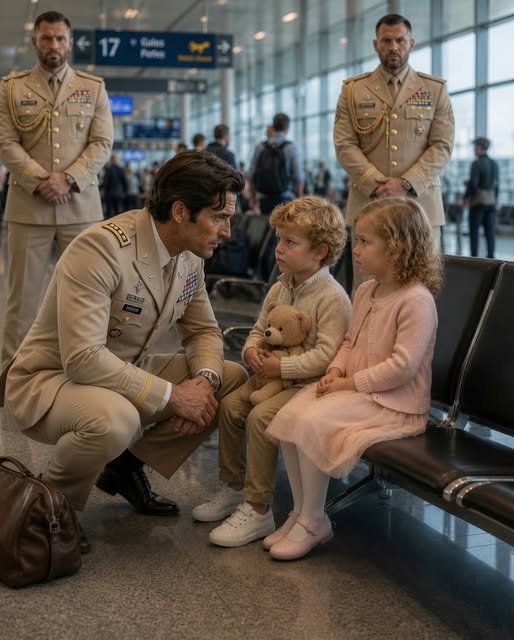
Lily stared up at me with eyes too old for her tiny face.
Owen stood beside her, still gripping his worn teddy bear by one limp arm. His mouth was pressed into a hard line, as if he had learned that crying only made adults angrier.
Across the terminal, Vanessa Whitmore was struggling against the airport police officers who had cuffed her wrists behind her back.
“This is outrageous!” she shouted. “I am their legal guardian. You have no right to hold me here. They’re confused children. Their father died in an accident.”
Lily flinched at the word accident.
That was enough for me.
I stepped between Vanessa and the twins.
“Lower your voice,” I said.
She looked me up and down, her eyes catching the silver eagles on my uniform. For a brief second, calculation flickered across her face. She wasn’t afraid yet. People like her rarely were at first. They were used to money smoothing sharp corners, used to charm turning suspicion into apology.
But I had seen that look before—in hostile interrogations, in corrupt officials, in people who believed they could rewrite reality if they spoke confidently enough.
“You don’t know who I am,” she hissed.
“No,” I said quietly. “But I know what you did.”
Her face tightened.
Behind me, Major Hayes spoke into his phone, coordinating with airport police, airline security, and Child Protective Services. The aircraft that Vanessa had planned to vanish on sat frozen at the gate, its passengers delayed, its crew confused, its escape route sealed.
A small crowd had formed, though security was doing its best to push people away.
Lily moved closer to my side.
“Colonel?” she whispered.
I crouched down again, blocking her view of Vanessa. “Yes, sweetheart?”
“Is she going to take us back?”
The question cut deeper than any accusation could have.
Owen’s face went pale. He didn’t ask the same thing, but his eyes did.
I looked at both of them, and in that moment, the terminal vanished around me. I didn’t see the uniforms, the officers, the passengers, the glass walls, or the blinking departure screens. I saw only two children who had been taught that safety was temporary and love could leave without saying goodbye.
“No,” I said. “Not today.”
Lily’s breath shook.
“Not ever?” Owen whispered, as if testing whether such a thing could be true.
I didn’t make promises lightly.
A careless promise was a dangerous thing. In war, in command, in life—words could become ropes or bridges. I had learned to choose mine carefully.
But there, under the cold airport lights, with two abandoned children watching me like I was the first solid ground they had found in years, I made one anyway.
“I’m going to stay with you until we know you’re safe,” I told them. “You have my word.”
Lily nodded once.
Owen’s grip on the teddy bear loosened by half an inch.
That was the first victory.
Child Protective Services arrived twenty minutes later.
The woman leading the team was named Dana Mercer, a sharp-eyed case supervisor with silver-threaded hair pulled into a bun and a voice that could soften without weakening.
She knelt in front of Lily and Owen, introduced herself, and asked if they were hurt.
The twins said no.
But I had seen enough wounded people to know that not all injuries left blood.
Dana stood and pulled me aside while another worker offered the children juice boxes and crackers from an emergency kit.
“Colonel Steel,” she said, “airport police briefed me. We’ll need formal statements from the children, but gently. If there’s a possible homicide allegation, we’ll coordinate with local detectives.”
“It won’t just be an allegation,” I said.
Dana studied me.
I held up the flash drive. “The girl said this contains their father’s secrets. The stepmother tried to grab it from her.”
Dana’s expression changed. “Do not plug that into any civilian device.”
“I know.”
“We need chain of custody.”
I nodded and handed it to the lead airport police officer, Lieutenant Briggs, who sealed it inside an evidence bag while documenting the transfer.
Vanessa saw it happen from across the gate area.
Her expression went from rage to fear so quickly that I almost missed it.
Almost.
“Colonel,” Major Hayes said quietly, stepping to my side. “There’s more.”
He showed me his phone.
On the screen was a preliminary background result for Vanessa Whitmore. Married to Daniel Whitmore, age thirty-eight, founder of a private aerospace cybersecurity firm outside Chicago. Deceased seven months earlier. Official cause: fatal fall down the stairs at home. Case closed as accidental.
Two children from Daniel’s first marriage: Lily and Owen Whitmore.
No living biological mother listed.
Estate transferred largely to surviving spouse: Vanessa.
I read the summary twice.
“What did his company do?” I asked.
“Government contracts,” Hayes said. “Defense-side cybersecurity. Not directly under us, but adjacent.”
My jaw tightened.
That explained the flash drive.
That explained why Vanessa had not simply abandoned the children at a police station or firehouse.
She hadn’t wanted them found immediately.
She had wanted distance.
Time.
A clean departure.
Maybe even a new country before anyone looked too closely at the twins’ words.
“Where was she flying?” I asked.
“Zurich connection through Frankfurt.”
Of course.
I looked back at Vanessa.
For the first time since she had been escorted off the aircraft, she wasn’t shouting. She was staring at the sealed evidence bag in Lieutenant Briggs’s hand like it was a live grenade.
Owen suddenly tugged my sleeve.
“Colonel Steel?”
“Yes, son?”
He swallowed hard. “Are we in trouble because we took it?”
“No,” I said. “You did the right thing.”
His eyes dropped to the teddy bear.
“Daddy gave it to me,” he whispered. “The bear.”
I waited.
Owen looked toward Lily, and she nodded, giving him permission in the silent language of twins.
“He told me if anything bad happened, I had to protect Lily,” Owen said. “He said I was brave.”
“You are brave.”
His chin trembled.
“I didn’t feel brave.”
“That’s how bravery usually feels,” I told him.
For the first time, Owen looked directly at me.
“Scared?”
“Terrified,” I said. “But you still do what’s right.”
He thought about that, then nodded with the grave seriousness of a soldier receiving orders.
Dana Mercer arranged for the children to be moved to a private airport security room where they could rest away from the crowd. I walked with them, one child on either side of me.
Lily carried my service jacket around her shoulders, the sleeves dangling almost to her knees. Owen refused to let anyone take his bear, and no one dared try.
Inside the room, the noise of O’Hare became a muffled hum behind thick walls.
There was a couch, a vending machine, a table, and a row of gray chairs bolted to the floor. It was not warm, exactly, but it was quiet.
The children sat together on the couch.
Dana gave them blankets.
Major Hayes brought sandwiches, fruit cups, milk, and bottled water from a nearby café. Lily stared at the food as if waiting for permission.
“You can eat,” I said gently.
She picked up half a sandwich with both hands.
Owen watched her take the first bite before he touched his own.
I noticed that, too.
He always let her go first.
Whatever had happened in that house, it had forced him to become older than five.
While they ate, a detective from Chicago police arrived. Detective Elena Ruiz introduced herself with calm professionalism, but her eyes sharpened the instant she heard the children’s names.
“I remember the Whitmore case,” she said softly to me outside the room. “The fall seemed clean. No signs of forced entry. Wife said she was in the shower when it happened. Kids were supposedly asleep.”
“Supposedly?”
Ruiz glanced through the small window in the door at Owen.
“The boy had night terrors afterward. According to Vanessa, he kept claiming he saw shadows. The medical examiner didn’t find enough to challenge the accident ruling.”
“And now?”
“Now we have a child saying she pushed him and a flash drive she tried to recover. That’s enough to reopen questions.”
“Questions won’t protect those children.”
“No,” Ruiz said. “Evidence will.”
I respected her immediately.
She wasn’t promising what she couldn’t deliver.
The forensic team arrived for the flash drive within the hour. Because Daniel Whitmore’s company had touched defense contracts, federal authorities were notified as well. The situation expanded faster than anyone in that terminal had expected.
Vanessa was taken to a secure interview room.
She demanded an attorney.
That was her right.
But fear had begun working on her. I saw it in the tightness around her mouth, in the way her eyes kept darting toward Lily and Owen, in the way she stopped claiming they had wandered away.
Guilty people often corrected their lies when they realized the first version would not survive daylight.
The twins were not formally interviewed right away. Dana insisted they needed food, rest, and a child advocate present before any serious questioning. Detective Ruiz agreed.
I did too.
But Lily, small as she was, had other plans.
While Dana stepped out to take a call and Hayes spoke with airport security at the far end of the hallway, Lily slid off the couch and walked to where I stood by the door.
“Colonel?”
I looked down. “Yes?”
“My daddy didn’t fall right away.”
Every muscle in my body locked.
I lowered myself slowly to one knee. “You don’t have to talk about it now.”
“I want to.”
I glanced toward Detective Ruiz through the glass. She saw my face and came in immediately, moving carefully, not rushing.
“Lily,” Ruiz said softly, “I’m Detective Elena. Is it okay if I listen?”
Lily nodded.
Owen stopped eating.
His sandwich remained in his lap.
Lily twisted the edge of my jacket between her fingers. “Daddy and Vanessa were fighting. She said he ruined everything. He said he was going to tell the truth.”
“What truth?” Ruiz asked.
Lily shook her head. “I don’t know. Then Daddy saw us at the top of the stairs. He told us to go back to bed.”
Her voice thinned.
“Owen went behind me. I dropped my bunny slipper. I went back to get it. I saw Vanessa push Daddy.”
Owen covered his ears.
Lily began to cry without making a sound.
I had seen soldiers break in silence just like that.
I wanted to gather her up, carry her out of that room, shield her from every question and every memory. But I knew the truth had to be handled carefully, or Vanessa would bury it again.
Detective Ruiz kept her voice steady.
“What happened after he fell?”
Lily wiped her cheeks with the back of her hand. “He didn’t move. Vanessa saw me. She told me if I ever said anything, Owen would have an accident too.”
Owen made a small choking sound.
I turned toward him. “Owen, look at me.”
He lowered his hands.
“She can’t hurt you in this room,” I said.
He whispered, “She said nobody believes kids.”
I felt something cold settle inside me.
A battlefield anger.
Not loud. Not reckless.
Precise.
The kind of anger that could wait, gather facts, and strike where it mattered.
“She was wrong,” I said.
Lily looked at me through tears. “Do you believe us?”
“Yes.”
The word came instantly.
Not because I had abandoned caution, but because everything about their fear carried the shape of truth.
Detective Ruiz closed her notebook. She did not push further. “That’s enough for now. You both did very well.”
Lily nodded, exhausted.
Owen climbed down from the couch and sat beside her on the floor, shoulder pressed against hers.
I noticed he had positioned himself between Lily and the door.
Still protecting her.
Always protecting her.
By evening, the airport had become a storm of agencies and sealed conversations.
Vanessa’s attorney arrived, all expensive wool and controlled irritation. He argued jurisdiction. He argued misunderstanding. He argued emotional distress, confusion, guardianship rights, procedural overreach.
Then Detective Ruiz informed him that the Whitmore death investigation was being reopened pending forensic evidence and witness statements.
The attorney stopped arguing so loudly after that.
The flash drive was taken to a secure digital forensic lab.
We expected to wait days.
We got the first emergency result in three hours.
Major Hayes found me in the hallway outside the children’s room, his face pale in a way I had rarely seen.
“Sir,” he said. “You need to hear this.”
He led me to a conference room where Detective Ruiz, Lieutenant Briggs, Dana Mercer, and two federal agents had gathered around a speakerphone.
A digital forensic analyst was on the line.
“The drive contains encrypted files,” the analyst said. “Most are still locked. But one folder was accessible. It appears Daniel Whitmore created a dead-man archive.”
“What kind of archive?” Ruiz asked.
“Video recordings. Financial ledgers. Emails. Contract files. Names.”
One of the federal agents leaned forward. “Names of whom?”
A pause.
Then the analyst said, “People inside his company. Private contractors. Possibly foreign intermediaries. There are references to stolen defense encryption protocols.”
The room went silent.
My eyes closed briefly.
Daniel Whitmore had not just discovered marital betrayal.
He had uncovered something far bigger.
And Vanessa had killed him for it.
Or helped someone who did.
“Anything on his death?” Ruiz asked.
“One video file is labeled: If I die, Vanessa knows.”
Dana inhaled sharply.
“Can you play it?” asked the agent.
“Not over this line. But I can summarize the opening. Daniel Whitmore recorded himself two days before his death. He says he discovered his wife was transferring classified-adjacent cybersecurity materials to a broker overseas. He says he copied evidence onto a drive and hid it where only his son would think to look.”
My mind moved back to Owen’s teddy bear.
The worn seams.
The white-knuckled grip.
The way Vanessa had lunged when Lily produced the drive.
“Where was it hidden?” I asked.
There was a rustle of papers over the speaker.
“In the teddy bear.”
Everyone turned toward the window looking into the children’s room.
Owen sat on the couch with the bear tucked against his chest.
But the flash drive had not come from the bear.
It had come from Lily’s coat pocket.
That meant the twins had removed it.
That meant they had known it mattered.
Ruiz whispered, “Those children have been carrying the motive for seven months.”
“No,” I said.
They all looked at me.
I stared through the glass at Lily and Owen.
“They’ve been carrying their father’s last act of protection.”
The federal agents requested immediate custody of the digital evidence, but Detective Ruiz pushed back. The homicide case was hers. Dana pushed back harder over the children’s welfare. Jurisdiction became a battlefield of clipped voices and legal boundaries.
I had no patience for ego.
“Enough,” I said.
The room quieted.
I was not in command there, not officially. But command is not always about rank. Sometimes it is about who speaks when everyone else has forgotten the mission.
“There are two priorities,” I continued. “Protect the children. Preserve the evidence. Everything else can be settled after.”
No one disagreed.
By then, the twins were falling asleep where they sat.
Lily’s head leaned against Owen’s shoulder. Owen fought sleep like it was an enemy, blinking hard every few seconds, refusing to surrender while adults still moved around them.
I stepped into the room and sat across from him.
“You can sleep,” I said.
He shook his head. “What if she comes back?”
“She won’t.”
“What if someone else comes?”
That question told me more than I wanted to know.
Maybe Vanessa had not acted alone.
Maybe the children had seen more adults, heard more voices, learned more fear than anyone realized.
I leaned forward.
“Major Hayes is outside that door. Two officers are in the hall. Detective Ruiz is here. Ms. Dana is here. And I’m here.”
Owen studied me.
“You don’t leave?”
“Not until you’re safe.”
He looked at Lily, then back at me.
“Daddy said soldiers keep promises.”
My throat tightened.
“The good ones do.”
That seemed to satisfy him.
A minute later, he fell asleep sitting upright, still holding the bear.
Lily curled against him.
Dana covered them both with a blanket.
For a while, none of us spoke.
There was something sacred in that silence.
They had survived a house full of secrets, a stepmother’s threats, their father’s death, and an abandonment so cruel it could have broken them. Yet there they were, asleep under fluorescent airport lights, trusting strangers because trust was the only road left.
Around midnight, arrangements were made to place them in an emergency foster home.
I objected before Dana finished the sentence.
She looked at me carefully. “Colonel, I understand your concern. But there are procedures.”
“I’m aware.”
“They need licensed placement.”
“Then place them somewhere guarded.”
“We don’t have a guarded foster home waiting on standby.”
“Then use mine.”
The room went still.
Dana blinked. “Excuse me?”
“My home,” I said. “I live alone. I have security clearance, a clean background, military housing off-post with controlled access, and a guest suite. Major Hayes can verify everything. Put an officer outside if needed.”
Dana’s face softened, but her answer remained firm. “That is not how emergency child placement works.”
“I’m not asking to adopt them tonight,” I said. “I’m asking you not to put two material witnesses in a murder and national security case into an unknown address with standard protections.”
Detective Ruiz crossed her arms. “He has a point.”
Dana exhaled. “A temporary protective placement would require authorization.”
“Get it.”
She looked at me for a long second.
Most people backed down when procedure appeared. I had spent my life respecting procedure. But I also knew procedure was supposed to serve people, not swallow them.
Dana finally pulled out her phone.
It took ninety minutes.
Calls were made. Supervisors woke other supervisors. Forms were sent. Background checks ran. My military records were confirmed. My home address was evaluated. A temporary protective kinship-style exception was discussed, argued, narrowed, and finally approved under emergency witness safety considerations—with Dana retaining custody oversight and police protection attached.
When she returned, she looked tired but satisfied.
“Twenty-four hours,” she said. “Emergency protective placement only. Reviewed tomorrow.”
I nodded. “Understood.”
“You will not make independent decisions regarding the children.”
“Understood.”
“You will not discuss case details with them unless they bring something up, and even then you document it.”
“Understood.”
“You will call me immediately if anything unusual happens.”
“Ms. Mercer,” I said, “I have commanded evacuation zones in collapsing cities. I can follow instructions.”
“For some reason, Colonel, I doubt that has always been true.”
Despite everything, I almost smiled.
The twins woke when we gently told them it was time to leave the airport.
Lily panicked first.
“Where are we going?”
Dana explained carefully. “You’re going to stay somewhere safe tonight. Colonel Steel will be there. So will people protecting you.”
Owen looked at me. “Your house?”
“Yes,” I said. “Just for tonight, unless Ms. Dana says otherwise.”
“Is Vanessa there?”
“No.”
“Does it have locks?”
“Yes.”
“Can Lily sleep where I can see her?”
“Yes.”
He nodded. “Okay.”
That was all.
A child deciding whether the world was safe based on locks and sightlines.
The drive from O’Hare to my home outside the city was quiet.
Major Hayes drove. Detective Ruiz followed in an unmarked car. A patrol unit trailed behind. Lily sat in the back seat beside Owen, wrapped again in my jacket. Owen held his bear in his lap and stared out the window.
Chicago passed in streaks of light and shadow.
At one point, Lily whispered, “Daddy used to drive us to see airplanes.”
I turned slightly. “He liked planes?”
“He said people look up when planes fly over because everyone wants to believe they can leave the ground.”
Owen added, “He said Lily would be an astronaut.”
Lily shook her head sleepily. “I said I wanted to be a bird.”
“That’s a good ambition,” I said.
Her eyes closed. “Birds don’t need tickets.”
No one spoke after that.
My house had never felt large until two small children walked into it.
It was a neat, quiet place with framed service photographs, bookshelves, polished floors, and too much silence. My wife, Anna, had died six years earlier. We had never had children. For years, I told myself the quiet was peaceful.
That night, it felt empty.
Lily paused in the entryway, looking at the folded flag displayed above the mantel.
“Who is that for?” she asked.
“My father,” I said. “He was a soldier too.”
“Did he die?”
“Yes.”
She considered this.
“Do you miss him?”
“Every day.”
She nodded as if that answer made sense.
Children understood grief more honestly than adults did. They didn’t decorate it with phrases. They simply asked where it hurt.
I showed them the guest room, then another room across the hall.
Owen immediately chose the floor between the two beds.
“I sleep here,” he said.
Lily frowned. “Owen, beds are softer.”
“I sleep here.”
I knew better than to argue. He needed to guard the door. He needed to feel useful. So I brought extra blankets and made a soft pallet on the floor between the beds.
“You’ll be able to see everything from there,” I said.
He looked relieved.
Lily climbed into one of the beds, almost disappearing under the blanket.
I placed a glass of water on the nightstand.
Before I could leave, she whispered, “Colonel Steel?”
“Yes?”
“If Daddy’s in heaven, can he see Owen was brave?”
I looked at Owen. His eyes were open, waiting for my answer.
“I believe he can,” I said.
Lily’s face softened.
“And I believe he would be very proud of both of you.”
Owen turned his face into the teddy bear.
I switched on the hallway light and left the bedroom door open.
Major Hayes remained downstairs. Detective Ruiz stationed officers outside. Dana checked in by phone one final time.
The house settled into cautious stillness.
I did not sleep.
At 3:17 a.m., my phone vibrated.
Unknown number.
I answered without speaking.
For three seconds, there was only breathing.
Then a man’s voice said, “Colonel Steel, you made a mistake taking those children.”
My grip tightened.
“Who is this?”
“You don’t need their story. You don’t need the drive. Walk away, and this remains manageable.”
I moved silently toward the window, pulling the curtain aside just enough to see the dark street and the patrol car parked near the curb.
“You’re threatening a United States Army officer,” I said.
“No, Colonel. I’m warning a widower who lives alone.”
My blood went cold.
He knew about Anna.
He knew about my house.
He knew enough to make it personal.
The voice continued, calm and almost bored. “Daniel Whitmore should have kept quiet. Vanessa should have disposed of the children properly. Everyone makes mistakes. The question is whether you intend to make yours permanent.”
Behind me, the stairs creaked.
I turned.
Owen stood halfway down, barefoot, pale, clutching his teddy bear.
His eyes were wide.
He had heard.
Into the phone, I said, “Listen carefully. I don’t scare easily.”
The man chuckled. “Everyone scares when the right door opens.”
Then the line went dead.
For a moment, the house held its breath.
Owen whispered, “That was the man from Daddy’s office.”
I slowly lowered the phone.
“What man?”
Owen lifted the teddy bear with trembling hands and turned it over.
For the first time, I saw that one seam along the back had been restitched poorly, as if opened and closed in a hurry.
“I didn’t tell them everything,” Owen said. “The flash drive wasn’t the only thing Daddy hid.”
He reached into the torn seam and pulled out a tiny silver key.
A key no one knew existed.
A key Vanessa had not found.
A key someone was willing to kill for.
…If you want to know what happened next, please type “YES” and like for more.