PART 2: THE MAN WHO SAVED WHAT RICHARD THREW AWAY
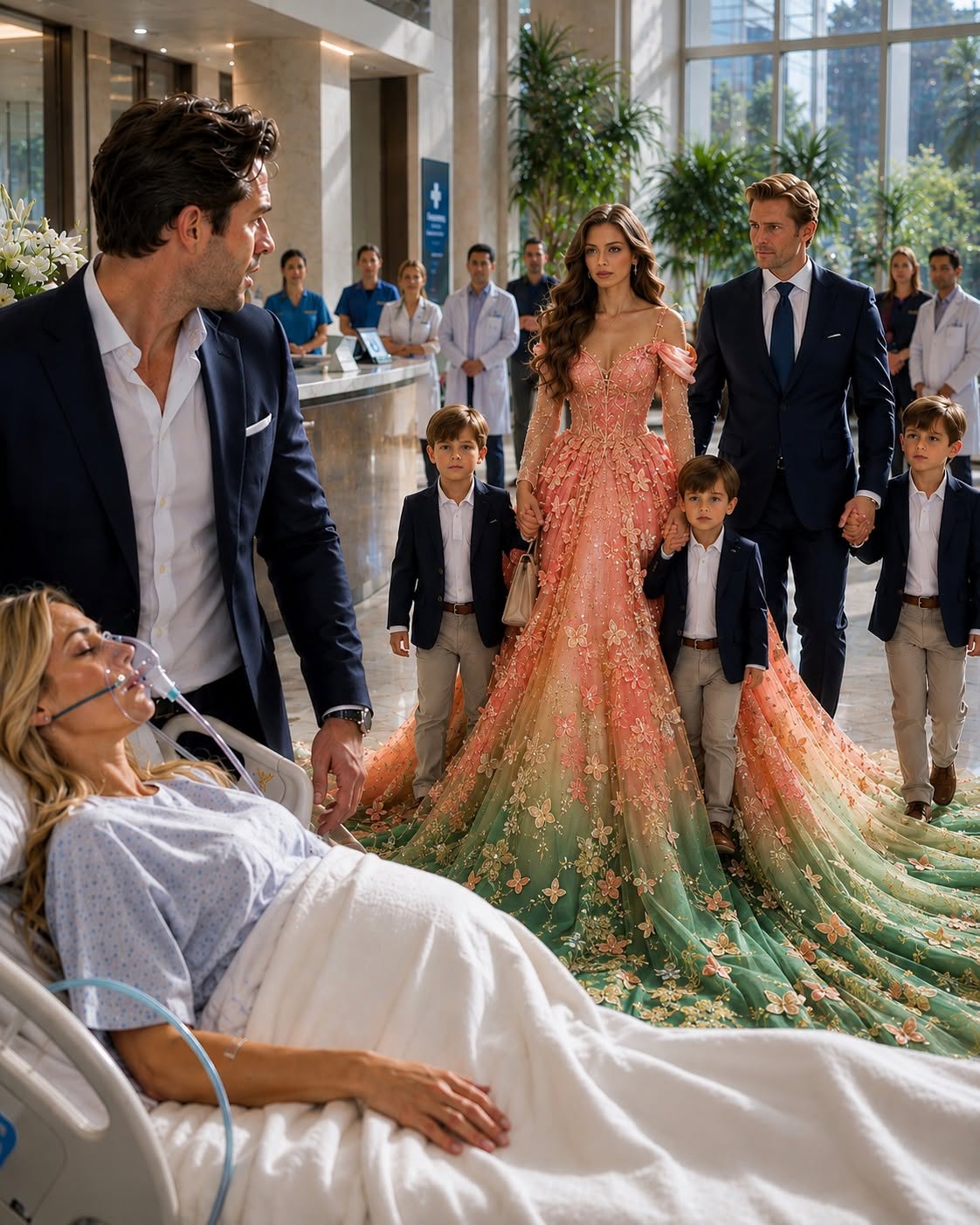
Alexander Vale did not ask me why I was crying.
That was the first thing I noticed about him.
Most people looked at tears and demanded an explanation, as if pain needed to present paperwork before being allowed to exist. But Alexander simply sat across from me in the hospital cafeteria, placed his untouched coffee on the table, and waited with the patience of a man who understood that some wounds were too fresh to be named.
I wiped my face quickly, embarrassed. “I’m sorry. I must look ridiculous.”
“No,” he said quietly. “You look exhausted.”
His voice was deep, calm, and almost painfully gentle. It made something inside me loosen, something I had been holding tight since Richard had walked out of my ICU room and left me with nothing but divorce papers and fear.
I looked away. “If you’re from billing, I already know I’m behind.”
A faint shadow crossed his face. “I’m not from billing.”
“Then why are you sitting here?”
“Because I recognized your name.”
I froze.
Alexander reached into the inside pocket of his dark coat and took out a business card. It was thick, cream-colored, printed with only his name and a number.
Alexander Vale.
Even in my exhausted state, I knew that name.
Vale Capital.
Technology. Real estate. Hospitals. Private equity. Charity foundations. A man whose face appeared on magazine covers under headlines about impossible deals and impossible wealth.
I stared at the card as if it might burn my fingers.
“You’re him,” I whispered.
“I am,” he said simply.
“Then you’re definitely at the wrong table.”
For the first time, his mouth softened, not quite a smile, but close. “I don’t think so.”
I almost laughed, but it came out like a broken breath. “Mr. Vale, unless you’re here to donate lungs to a newborn, solve hospital debt, and tell me how one woman with no family and three premature babies is supposed to survive, I promise you, I am not the person you’re looking for.”
His eyes did not move from mine.
“What is your son’s name?”
The question struck me so unexpectedly that my throat closed.
“Noah,” I said.
“And the others?”
“Liam and Emma.”
He repeated their names softly, as if they mattered.
That was when I broke.
I told him everything. Not all at once, not elegantly. The words came in jagged pieces between tears and humiliation. Richard. The ICU. The divorce papers. The five thousand dollars. The storm. The birth. Noah’s lungs. My remaining four hundred dollars. The terrifying knowledge that love did not pay medical bills, no matter how desperately I wished it did.
Alexander listened without interrupting.
When I finished, I expected pity.
Instead, he said, “Before you married Richard Hale, you were Sarah Bennett, senior data analyst at Meridian Systems.”
My head snapped up. “How do you know that?”
“Because three years ago, you submitted a logistics model to one of my portfolio companies. It was rejected by the executive committee.”
I swallowed. “I remember.”
“They were wrong.”
I stared at him.
“That model could have saved them twelve million dollars in one fiscal year,” he continued. “I reviewed it personally after the company collapsed under the same inefficiencies you warned them about.”
For a moment, the cafeteria noise faded—the clatter of trays, the hum of vending machines, the distant announcements over the hospital speakers. All I could hear was the sound of my own heart trying to believe him.
“I was good at my job,” I said, and hated how small my voice sounded.
“You were exceptional.”
No one had called me exceptional in years.
Richard had called me dramatic. Fragile. A burden. Defective by extension, as if carrying his children had made me less human, less worthy, less whole.
Alexander leaned forward.
“I need someone who can rebuild operational systems from the ground up. Remote work. Flexible hours. Full medical coverage. Salary paid weekly for the first six months.”
I stared at him, certain I had misunderstood.
“You’re offering me a job?”
“I’m offering you a contract. If you perform well, I’ll offer you a company.”
A sharp laugh escaped me. “That’s not funny.”
“I wasn’t joking.”
My fingers trembled around the business card. “You don’t even know me.”
“I know enough.”
“No, you don’t.” My voice rose before I could stop it. “You don’t know that I sleep in hospital chairs. You don’t know that I have three babies in incubators and one of them turns blue when he cries too hard. You don’t know that I am terrified every single second. You don’t know that my ex-husband left because he thought survival was too inconvenient.”
Alexander’s expression darkened.
“Then let me be clear,” he said. “I’m not offering this because I feel sorry for you. I don’t invest in pity. I invest in value. And Sarah, the mistake everyone else made was confusing your pain with weakness.”
I looked down at my hands.
For months, I had been treated like a woman who was falling apart. Maybe I was. But somewhere beneath the fear, beneath the exhaustion, beneath the stitches and hospital bracelets and overdue bills, a piece of the old Sarah Bennett was still breathing.
“What about Noah?” I whispered.
Alexander’s answer came without hesitation.
“My foundation has a neonatal care fund. I’ll make sure his treatment is covered.”
I shook my head immediately. “No. I can’t accept charity.”
“Then don’t call it charity,” he said. “Call it an advance on the future value you’re going to create.”
I wanted to refuse.
Pride is a strange thing when you are desperate. It stands beside you like a loyal friend while everything burns, whispering that accepting help is the same as admitting defeat.
Then I looked through the cafeteria windows toward the NICU hallway.
Noah was in there, fighting for breath.
Liam and Emma were waiting for a mother who could protect them.
And Richard’s voice echoed in my memory.
You were never strong enough for my world.
I folded Alexander’s card into my palm.
“All right,” I said. “Tell me what needs fixing.”
That was how my second life began.
The first year was not beautiful. People love to tell stories of triumph as if success arrives in a shining moment, but mine arrived in fragments, held together with caffeine, painkillers, baby formula, spreadsheets, and nights so long they seemed endless.
I worked from a small rented apartment near the hospital, with three cribs lined against one wall and a laptop balanced on a thrift-store desk. Liam cried whenever I left the room. Emma refused to sleep unless my hand rested on her back. Noah came home with oxygen tubes and a monitor that beeped so often I heard it in my dreams even when it was silent.
Alexander checked in twice a week at first.
Always professionally.
Always respectfully.
He never came empty-handed, though he never made the gifts feel like gifts. A better chair because “your posture affects productivity.” A second monitor because “your workflow is inefficient.” A grocery delivery because “malnutrition leads to poor decision-making.”
I accused him once of disguising kindness as business expenses.
He looked at the three babies sleeping in their swings and said, “Is it working?”
I laughed for the first time in months.
Slowly, I proved myself.
The first logistics system I rebuilt saved Alexander’s medical supply company almost nine million dollars. The second prevented a distribution shutdown during a flu-season emergency. The third exposed internal fraud that had been bleeding one of his companies for years.
By the time the triplets turned two, I was no longer just a contractor.
I was the founder of Bennett Analytics, with Vale Capital as my first investor.
By the time they turned three, I had employees.
By the time they turned four, I had clients who once would not have returned my calls.
And by the time they turned five, I had become the woman Richard said I could never be.
Not healed.
Not untouched.
But rebuilt.
Stronger in the broken places.
Richard never called.
Not when the divorce finalized. Not when the birth certificates were filed. Not when the hospital sent notices that listed him as the biological father and received no response. Not on birthdays. Not on holidays. Not when Noah underwent his final lung procedure at eighteen months old and I sat in the surgical waiting room with Alexander beside me, both of us silent and terrified.
After that surgery, when the doctor finally came out smiling, my knees buckled.
Alexander caught me before I hit the floor.
“He’s all right,” he said, his voice rough. “Sarah, he’s all right.”
I turned into his chest and sobbed like the world had finally given me permission.
His arms closed around me carefully, as if I were something precious and breakable.
That was the moment I realized Alexander Vale was no longer just the man who had helped me.
He had become the person I looked for when I was afraid.
Still, he never crossed a line.
He celebrated the children’s milestones from a respectful distance. He brought Liam model airplanes after discovering his obsession with flight. He listened seriously when Emma explained that she planned to become both a lawyer and a princess. He sat beside Noah on the floor for hours building block towers, pretending not to notice when my son climbed into his lap and stayed there.
One evening, after the triplets had fallen asleep on the couch during a cartoon, I found Alexander standing by the window, watching the city lights.
“You love them,” I said.
He turned slowly.
For once, he seemed caught off guard.
“Yes,” he admitted.
The honesty of it shook me.
“And me?” I asked, barely breathing.
His eyes softened with something I had been too afraid to name.
“Sarah,” he said, “I have loved you from the moment you chose courage over despair in that hospital cafeteria.”
Tears filled my eyes.
“I come with three children, medical scars, trust issues, and an ex-husband who once made me feel impossible to love.”
Alexander stepped closer.
“No,” he said. “You come with three miracles, a spine made of steel, and a heart that survived cruelty without becoming cruel.”
I wanted to believe him.
God, I wanted to.
But love, after Richard, felt like walking toward fire and trusting it not to burn.
So I asked the only question that mattered.
“What happens if things get hard?”
Alexander answered without hesitation.
“I stay.”
One year later, he was still there.
Not as a savior.
Not as a replacement father.
As family.
The triplets called him “Alex” until one morning Noah climbed into his lap at breakfast, pressed a sticky hand against his cheek, and asked, “Can I call you Dad when I feel brave?”
Alexander went completely still.
I watched his eyes shine.
“You can call me Dad whenever your heart wants to,” he said.
Noah nodded seriously. “Okay. Dad, can I have more pancakes?”
Alexander laughed, and I had to turn away before the children saw me cry.
Three months after that, Bennett Analytics received an invitation to the Whitmore Innovation Gala in Manhattan. It was the kind of event Richard had once worshipped—crystal chandeliers, champagne towers, billion-dollar deals disguised as polite conversation.
I almost declined.
Manhattan still held ghosts.
Alexander found the invitation on my desk and understood immediately.
“You don’t have to go,” he said.
“I know.”
“But?”
I touched the embossed lettering.
“But a part of me wants to walk into that room and know I don’t belong there because of anyone’s last name but my own.”
His smile was quiet and proud.
“Then we’ll go.”
The night of the gala, I stood before the mirror in a midnight-blue gown that skimmed my body like water. My hair was swept back. Diamonds glittered at my ears—not borrowed, not bought by Richard, not symbols of ownership, but gifts I had purchased for myself after my company’s first major acquisition.
Emma gasped when she saw me.
“Mommy, you look like the queen of the moon.”
Liam straightened his tiny bow tie. “Are there snacks at this queen party?”
Noah, wearing little suspenders, reached for my hand. “Will Dad be there?”
I looked toward the doorway.
Alexander stood there in a black tuxedo, watching us with an expression so tender it nearly undid me.
“Yes,” I said. “Dad will be there.”
The ballroom glittered like a world built for people who had never been abandoned.
For the first hour, everything went smoothly. Alexander introduced me to investors, hospital directors, technology founders, and journalists who wanted to know how a single mother had built one of the fastest-growing analytics firms in the country.
I answered every question with a steady voice.
Not because I had forgotten the woman crying into lukewarm tea in the hospital cafeteria.
But because I had brought her with me.
She deserved to see this.
The children stayed close, wide-eyed at the chandeliers and dessert tables. Emma charmed a senator by asking whether laws had expiration dates. Liam tried to calculate how many lights were in the ceiling. Noah held Alexander’s hand and leaned against his leg whenever the crowd became too loud.
Then the room shifted.
I felt it before I saw him.
That strange cold pressure of a past you thought had died.
Across the ballroom, near the champagne bar, stood Richard Hale.
He looked almost exactly the same—expensive suit, perfect hair, arrogant posture—but time had sharpened the meanness in his face. Beside him stood a blonde woman in a silver dress, laughing too loudly with her hand on his arm.
Then Richard saw me.
His smile vanished.
The glass in his hand tilted, spilling champagne onto his cuff.
His eyes moved over me with disbelief first, then recognition, then something uglier.
Regret.
No.
Not regret.
Calculation.
I had seen that look before.
It was the look Richard got when he realized something valuable had slipped out of his control.
He crossed the ballroom without excusing himself from the woman beside him.
“Sarah?”
My name sounded wrong in his mouth.
I turned fully, calm in a way that surprised even me.
“Richard.”
His gaze dropped to my dress, my diamonds, Alexander at my side, then the three children.
And there it was.
The moment the blood drained from his face.
Liam stood nearest to me, gray-eyed and serious.
Emma peered around my skirt, her mouth set in the same stubborn line Richard’s mother used to have.
Noah clutched Alexander’s hand, his dark hair falling over his forehead, his face a softer mirror of the man staring at him.
Richard whispered, “What is this?”
I almost smiled.
“This is my family.”
His mouth opened, then closed. “They survived?”
The words landed like a slap.
Alexander’s hand tightened slightly at his side.
I lifted my chin. “No thanks to you.”
Richard swallowed, staring at the children as if they were evidence rising from a grave.
“They’re mine.”
It was not a question.
Emma frowned. “Mommy, who is that man?”
Before I could answer, Richard took a step closer.
“I’m your father.”
Noah recoiled so quickly he bumped into Alexander’s leg.
Alexander moved in front of him—not aggressively, not dramatically, but with the quiet instinct of a man who had protected that child through fevers, surgeries, nightmares, and first steps.
Richard’s eyes flashed.
“And who the hell are you to stand between me and my children?”
The ballroom around us began to quiet.
People turned.
Phones lowered.
Conversations died mid-sentence.
Alexander looked at Richard with a coldness I had never seen from him before.
“I’m the man who was there.”
Richard laughed once, harshly. “Touching. But biology doesn’t disappear because someone rich decided to play hero.”
That was when something inside me went still.
For five years, I had imagined seeing Richard again. In some versions, I screamed. In others, I cried. In the darkest ones, I begged him to understand what he had done.
But standing there, with my children behind me and Alexander beside me, I realized Richard no longer had the power to break my voice.
“Biology?” I said. “You mean the biology you called defective?”
His face twitched.
“I was under pressure.”
“You left me in an ICU.”
“I was overwhelmed.”
“You divorced me while I was six months pregnant.”
“I made a mistake.”
“You abandoned three babies before they were born.”
Richard looked around, noticing the audience now. His expression shifted instantly into wounded dignity.
“I didn’t know they had survived. Sarah kept them from me.”
A murmur moved through the crowd.
My stomach turned.
There he was.
The Richard I remembered.
Not apologizing.
Rewriting.
Alexander’s voice cut through the noise.
“Careful.”
Richard glared at him. “Excuse me?”
“Choose your next lie carefully.”
The blonde woman in silver had reached us by then. “Richard, what is going on?”
He ignored her.
His eyes locked on the children again.
“If they’re mine, I have rights.”
Liam stepped forward before I could stop him.
“You don’t have rights to people you threw away.”
The room went dead silent.
Richard stared at him, stunned that a five-year-old could speak with such clean, devastating accuracy.
I placed a hand on Liam’s shoulder.
Richard’s jaw tightened. “You taught him that?”
“No,” I said. “You did.”
For a second, I thought he might lunge. Instead, he lowered his voice.
“You think this is over? I can take this to court. I can demand custody. I can expose whatever arrangement this is between you and Vale.”
Alexander smiled faintly, but there was no warmth in it.
“I was hoping you’d say that.”
Richard blinked.
Alexander reached into his jacket and removed a folded document.
My breath caught. I had not known he brought anything.
“What is that?” Richard demanded.
“A copy of the termination notice your attorney signed five years ago,” Alexander said. “The one confirming you waived all parental claims after refusing to participate in neonatal care decisions.”
Richard’s face changed.
Just slightly.
But enough.
I turned to him, stunned. “You knew?”
Richard’s silence answered before his mouth did.
I felt the room tilt.
“You knew they were alive?”
He looked away.
The betrayal I had survived years ago split open again, revealing a deeper wound underneath.
Richard had not disappeared because he believed the babies were gone.
He had known.
He had chosen absence with full knowledge.
Alexander’s voice was low and lethal.
“He was contacted three times during Noah’s NICU crisis. He declined responsibility in writing.”
The blonde woman stepped back from Richard as if he had become something contagious.
I could barely breathe.
“All these years,” I whispered. “You knew Noah might die.”
Richard’s lips parted. “Sarah—”
“No.” My voice cracked, but it did not break. “Say it. Say you knew.”
He looked at the cameras now pointed toward us, the investors, the donors, the board members, the hospital executives. His empire of appearances was collapsing in real time.
“I made a decision,” he said tightly.
Noah began to cry.
Not loudly.
Just one small, wounded sound.
Alexander immediately knelt before him. “Hey, little man. Look at me.”
Noah clutched the gold locket around his neck—the one I had given him with his NICU picture inside, so he would always know he had been a fighter from the beginning.
Richard noticed it.
“What is that?” he asked.
Noah hid it against his chest.
Alexander stood slowly.
“That,” he said, “belongs to the child you refused to save.”
Richard’s eyes narrowed. “You keep talking like you own them.”
“No,” Alexander said. “I love them. That’s the difference.”
Then Emma, my tiny fierce girl, stepped out from behind me.
“Are you the man who made Mommy cry in the hospital?”
Richard stared at her.
“She cried every night,” Emma continued, her voice trembling but clear. “But Dad made pancakes. And Noah got better. And Mommy built a company. So we don’t need you.”
The room seemed to hold its breath.
I knelt and pulled my children close.
For five years, I had tried to protect them from the ugliness of how they were abandoned. I had never wanted hatred to become their inheritance. But children understand more than adults think. They feel the shape of every absence.
Richard looked cornered now.
Desperate.
And desperate men reach for whatever weapon remains.
“You think Vale is some saint?” he snapped. “Ask him why he really helped you.”
The silence changed.
Alexander went still.
I looked up at him.
“What does he mean?”
For the first time since I had known him, Alexander did not answer immediately.
Richard saw it and smiled.
“There it is,” he said. “You didn’t know.”
My heart began to pound.
“Alexander?”
Alexander’s face softened with pain.
“Sarah,” he said quietly, “there is something I should have told you sooner.”
The ballroom blurred at the edges.
Richard laughed under his breath. “Go on, Vale. Tell her. Tell her why her name was already in your files before that cafeteria. Tell her why you were really at the hospital that day.”
I stood slowly.
The children pressed against me.
Alexander reached into his pocket again, but this time his hand was not steady.
He took out an old photograph.
The edges were worn.
The image showed a young woman with my eyes, standing beside a man I had only seen in faded family albums.
My father.
I stared at the photo, unable to understand.
“My father?” I whispered.
Alexander nodded.
“He saved my life twenty-eight years ago,” he said. “And before he died, he wrote to me. He asked me to look after his daughter if she ever needed help.”
My breath left me.
The room disappeared completely.
Richard’s face twisted with triumph, but he did not understand what he had revealed.
He thought he had exposed a manipulation.
Instead, he had uncovered a promise.
Alexander’s voice broke for the first time.
“I didn’t come to that hospital because of Richard. I came because your father’s letter finally reached me after years in a sealed legal file. I recognized your name, Sarah. And when I found you, you were alone.”
Tears spilled down my cheeks.
Not from betrayal.
From the sudden, impossible feeling that my father had reached through death to hold my hand.
Richard looked furious. “That’s convenient.”
Alexander turned to him.
“No,” he said coldly. “Convenient was abandoning your wife and children, then returning when they became valuable.”
Security had begun moving toward us, but Richard was unraveling too quickly to notice.
“They are my blood,” he shouted.
Noah lifted his tear-streaked face.
“No,” he whispered. “Dad is my blood.”
Alexander looked down at him, stunned.
Noah touched his own chest.
“Because he gave me some when I was a baby. Mommy told me.”
I closed my eyes.
It was true.
During Noah’s second surgery, a rare complication had required an emergency directed donation. Alexander had matched when no one else available did.
Richard stared at Noah, then at Alexander.
For once, he had no answer.
Then, from behind him, the blonde woman spoke.
“Richard… you told me Sarah cheated. You told me the babies weren’t yours.”
The room erupted in whispers.
Richard spun toward her. “Vanessa, not now.”
But Vanessa’s face had gone pale with disgust.
“You said she trapped you.”
I looked at Richard, and suddenly every cruel word, every abandonment, every lie stood naked beneath the chandelier light.
He had not only left me.
He had buried me alive in stories he invented.
Alexander stepped close enough that only we could hear him.
“Sarah, say the word, and we leave.”
But I shook my head.
“No,” I whispered. “I’m done leaving rooms because Richard Hale is in them.”
Then I faced the crowd, the cameras, the donors, the people who had once measured women like me by the men beside them.
“My children were not mistakes,” I said. “They were not burdens. They were not defective. They were born fighting, and they survived because love stayed when cruelty walked out.”
My voice strengthened.
“And whatever happens after tonight, let everyone here remember one thing: the man who abandons his family does not become a father again simply because the children grew into something worth claiming.”
No one spoke.
Then someone began to clap.
A woman near the front.
Then another.
Then the sound spread through the ballroom like rain becoming thunder.
Richard stood in the center of it, exposed, furious, and powerless.
I took Alexander’s hand.
Liam took mine.
Emma took Liam’s.
Noah reached for Alexander.
Together, we walked past Richard without another word.
But just before we reached the exit, my phone vibrated.
An unknown number.
I almost ignored it.
Then I saw the message preview.
Sarah, this is Victor—the Uber driver from the storm. I found something in my old car records you need to see. It proves Richard was outside the hospital the night your triplets were born.
I stopped so suddenly Alexander turned.
“What is it?” he asked.
My fingers tightened around the phone.
Behind us, Richard’s voice rose as security escorted him away.
“This isn’t over!”
I looked at the message again, and the world tilted into a darker mystery.
Because attached beneath Victor’s text was a grainy dashboard photo from five years ago.
Richard standing outside the maternity entrance in the snow.
Holding a document folder.
Beside him was a woman in a hospital administrator’s coat.
And in her arms was a newborn baby wrapped in a blue blanket.
Not Liam.
Not Emma.
Not Noah.
A fourth child.
…If you want to know what happened next, please type “YES” and like for more.