Part 1 — Mara Gets the Debt
My sister raised her champagne glass at Thanksgiving and announced, “The vineyard is mine. Mara gets the debt.”
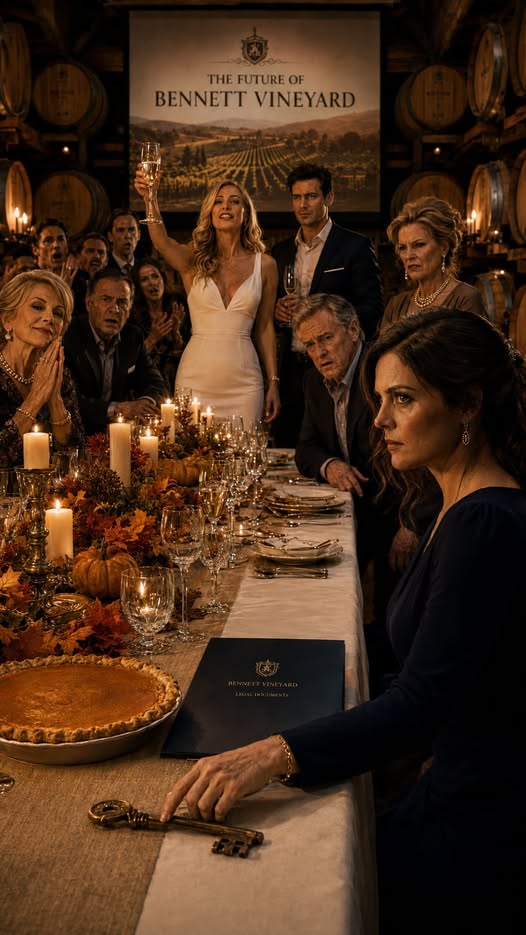
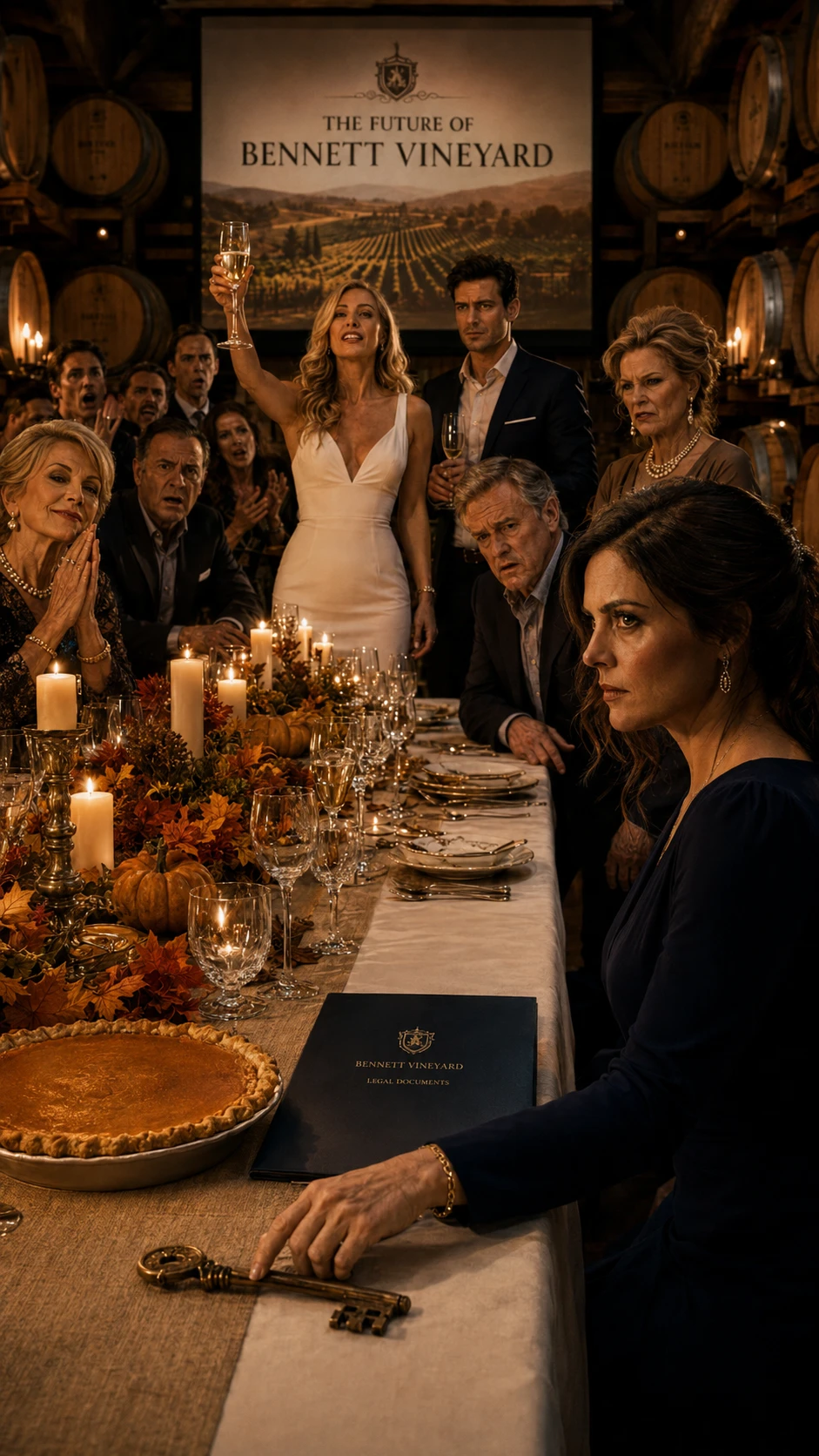
The whole family cheered—until I quietly placed one rusted brass key beside the pumpkin pie and asked, “Did anyone tell you who owns the water?”
For three full seconds, no one moved.
Then Brooke laughed.
Not a nervous laugh.
A loud, delighted laugh—the kind she had practiced since childhood whenever she wanted everyone else to know I had said something embarrassing.
“Oh, Mara.” She tilted her glass toward me. “You always have to make everything dramatic.”
Thirty-two members of my family were seated beneath strands of golden lights in the old barrel room of Bennett Vineyard.
Our parents had transformed it for Thanksgiving.
Long tables covered in white linen stretched between oak wine barrels. Candles flickered inside green glass bottles. A twelve-foot screen behind Brooke displayed a photograph of her standing between rows of grapevines at sunset.
Above her smiling face were the words:
THE FUTURE OF BENNETT VINEYARD
I had thought the screen was for family photographs.
I had thought the champagne was to celebrate my father surviving a stroke.
I had thought my mother’s unexpected invitation meant she wanted peace.
Instead, I had been seated at the far end of the table beside the kitchen door, between a broken serving cart and my cousin’s teenage son.
Brooke sat at our father’s right hand.
Her fiancé, Caleb Mercer, sat at his left.
My place card did not say Mara Bennett.
It said:
MARA — FINANCE
I had stared at it when I arrived.
My mother, Elaine, had noticed.
“It’s just a little family joke,” she said.
The family had been making the same joke for fifteen years.
Whenever the roof leaked, I was Finance.
Whenever the vineyard missed payroll, I was Finance.
Whenever Dad needed a specialist insurance would not cover, I was Finance.
But whenever family photographs were taken, I was the daughter who had “chosen work over family.”
Brooke tapped a spoon against her glass.
“As most of you know,” she began, “I stayed here when things got difficult.”
Several relatives nodded.
My aunt Linda reached across the table and squeezed Brooke’s hand.
“You sacrificed everything for this place.”
Brooke lowered her eyes modestly.
She had spent the previous spring in Italy with Caleb.
The spring before that, she had spent six weeks at a wellness retreat in Arizona while I covered the vineyard’s overdue property taxes.
But no one at that table knew that.
My mother had made sure of it.
Brooke continued.
“While some people left for the city and only came home when they wanted to criticize us, I was here with Mom and Dad. I worked the harvests. I protected Grandpa’s legacy. I kept this family together.”
My uncle Raymond looked directly at me.
“That’s what loyalty looks like.”
A few people murmured in agreement.
I felt my fingers tighten around my water glass.
My father stared down at his plate.
Since his stroke eight months earlier, his speech had returned, but he tired easily. His right hand still trembled when he lifted a fork.
He did not look at me.
Brooke smiled at him.
“So Mom and Dad have decided that when the transfer is finalized, Bennett Vineyard will belong to me.”
The screen changed.
A photograph appeared of Brooke and Caleb holding a large architectural rendering in front of the main house.
The drawing showed luxury cottages, a wedding pavilion and an infinity pool where our oldest vines currently grew.
At the bottom were the words:
BENNETT ESTATES — A MERCER DEVELOPMENT
My stomach turned cold.
Brooke had never mentioned a development.
My father looked up at the screen as though he had never seen it before.
Caleb stood and slipped an arm around Brooke’s waist.
“We’re going to protect the history of this property while bringing it into the modern era.”
“You’re tearing out the north field,” I said.
The north field contained vines planted by our grandfather in 1968.
Brooke rolled her eyes.
“There she goes.”
My cousin Denise whispered loudly, “She can’t stand not being in control.”
Caleb smiled toward the table.
“Mara has always had strong opinions.”
The family laughed.
I looked at my mother.
“You knew about this?”
Elaine folded her napkin carefully beside her plate.
“This is not the time for one of your interrogations.”
“You invited me to watch my sister announce she’s demolishing half the vineyard.”
“We invited you to celebrate her.”
Brooke lifted her glass higher.
“And don’t worry, Mara. They didn’t forget you.”
More laughter moved around the table.
My mother reached beneath her chair and pulled out a thin envelope tied with a green ribbon.
She passed it down to me.
Inside was a photocopy of the deed to the old equipment shed at the southern edge of the property.
The roof had partially collapsed two winters earlier.
The floor was contaminated with fuel from a leaking tractor tank.
A county notice attached to the deed estimated cleanup and repairs at approximately eighty thousand dollars.
Brooke leaned closer.
“It’s perfect for you.”
I looked at her.
She smiled sweetly.
“You’ve always said you wanted a piece of the vineyard.”
Aunt Linda covered her mouth, but she was smiling.
Uncle Raymond raised his glass.
“To Brooke, the daughter who stayed.”
Everyone around the table lifted their drinks.
My father did not.
Neither did I.
My mother looked at me as if my silence were proof of poor character.
“Do not ruin this moment.”
Brooke stood beside the screen, glowing in a white cashmere dress that probably cost more than the field crew earned in a month.
“I know this may be hard for Mara,” she said. “She’s used to solving problems with money. But family is about more than writing checks.”
That sentence drew the loudest applause of the night.
My ears rang.
I remembered wiring seventy-four thousand dollars to stop the bank from beginning foreclosure.
I remembered paying the surgery deposit the morning Dad collapsed.
I remembered telling my employees I could not give them bonuses that year because my parents’ vineyard could not make payroll.
I remembered my mother calling each payment a private family matter.
And now she sat beneath strings of golden light while thirty people applauded the daughter who had never made one.
Brooke turned toward me.
“The vineyard is mine,” she said. “You’re getting nothing except that shed and the debt attached to it.”
Someone at the middle table clapped.
Then another person joined.
Within seconds, almost everyone was applauding.
My mother smiled.
Caleb kissed Brooke’s cheek.
My father closed his eyes.
I reached beneath my chair and lifted my leather bag.
The applause continued as I removed a rusted brass key and placed it beside the pumpkin pie.
The sound slowly died.
Brooke stared at the key.
“What is that?”
“The main gate key to North Valley Mutual Water Company.”
Caleb’s smile faded slightly.
I opened my bag again and removed a dark blue folder.
My mother’s expression changed.
Only for a second.
But I saw it.
Brooke did not.
She laughed again and reached for the champagne bottle.
“Is this where Mara tells us she owns the rain?”
“No,” I said. “Just sixty-eight percent of the water shares legally assigned to this land.”
The bottle stopped halfway to her glass.
I looked at the photograph of Brooke’s future resort glowing behind her.
“You may have inherited the vines.”
I slid the folder across the table.
“But beginning January first, you do not have the legal right to irrigate them.”
Caleb sat down.
My mother whispered my name like a warning.
I looked at Brooke.
Her champagne glass was still raised, but her hand had begun to shake.
“Before you start tearing out Grandpa’s vineyard,” I said, “you should probably read page four.”
She opened the folder.
By the time her eyes reached the first highlighted paragraph, the color had disappeared from her face.
Because page four did not merely explain who owned the water.
It contained my father’s signature.
And directly beneath it was a sentence Brooke had never expected to see:
Any sale, gift, inheritance or transfer of Bennett Vineyard shall immediately trigger repayment of all secured advances made by Mara Bennett.
The current balance was printed in bold.
$642,811.37.
Brooke looked at our parents.
“You told me the property was debt-free.”
My father finally lifted his head.
“I never told you that.”
The room went silent.
Then my mother reached for the folder.
“Give me that.”
I placed my hand over it first.
“No.”
Her eyes hardened.
“Mara, not here.”
I looked around at the relatives who had just applauded while my sister humiliated me.
“You chose here.”
And at the far end of the room, Caleb quietly began deleting something from his phone.
Part 2 — The Daughter Who “Saved” the Vineyard
Brooke dropped into her chair.
“What does secured advances mean?”
Caleb answered before I could.
“It means she claims your parents borrowed money from her.”
“I do not claim it,” I said. “They did.”
My mother’s face tightened.
“We were family arrangements.”
“They became legal arrangements when the bank prepared to foreclose.”
Uncle Raymond frowned.
“Foreclose?”
He looked at Elaine.
“You said the vineyard survived because Brooke increased event bookings.”
Brooke had hosted three influencer dinners and one yoga retreat.
None of them had covered even a week of payroll.
I opened the folder to the first section.
“Three years ago, the vineyard was fourteen months behind on its agricultural loan. Property taxes had not been paid. The irrigation company was preparing to cancel the water shares for nonpayment.”
My aunt looked at Brooke.
“You said you handled that.”
Brooke swallowed.
“I handled operations.”
“No,” I said. “Daniel Ruiz handled operations. You photographed yourself beside him.”
Brooke slammed her glass onto the table.
“You don’t get to come in here and reduce everything I’ve done.”
“I’m not reducing it. I’m documenting it.”
I removed copies of bank transfers.
Every payment was marked with a date, amount and purpose.
Seventy-four thousand dollars to stop foreclosure.
Forty-one thousand in property taxes.
Ninety-eight thousand for water shares and irrigation repairs.
One hundred twenty-six thousand for payroll.
Medical bills.
Insurance premiums.
Roof repairs.
Equipment loans.
Each page bore my parents’ signatures.
Each agreement had been notarized.
My mother stared at the documents as though they were indecent photographs.
“You made your own parents sign loan papers.”
“The first time I helped you, you promised to repay me after harvest.”
“We had a bad year.”
“The second time, you said Brooke was arranging financing.”
“She was trying.”
“The third time, the bank called me because you had listed me as an emergency contact without telling me.”
Brooke looked at Elaine.
“You said Mara offered.”
My mother said nothing.
I turned to my sister.
“I offered to help once. After that, they called because every other lender had refused.”
Aunt Linda slowly put down her wine.
“Elaine, you told us Mara refused to help Robert after his stroke.”
I felt something inside me go still.
My mother had asked me to keep Dad’s medical expenses private because she did not want him to feel ashamed.
I had agreed.
“What exactly did you tell them?” I asked.
Elaine’s mouth tightened.
“This family does not need to account for every private conversation.”
Dad looked at her.
“What did you tell them?”
She turned toward him.
“Robert, you’re tired.”
“What did you tell them?”
Her expression softened instantly.
It was the expression she used whenever she wanted to make resistance look cruel.
“I said Mara had become distant.”
Uncle Raymond shook his head.
“You said she refused to pay for the rehabilitation center.”
I took out another page.
The room was quiet enough to hear it slide across the linen.
“Dad’s rehabilitation deposit was thirty-eight thousand dollars.”
Dad looked at the receipt.
My name was printed at the bottom.
Brooke stared at me.
“You paid that?”
“I also paid for the neurologist in Sacramento.”
My father’s eyes filled, but I looked away.
I was not ready for his gratitude.
Not after his silence.
Brooke pushed the folder back.
“Fine. She paid bills. That doesn’t mean she owns the vineyard.”
“I don’t own the vineyard.”
“Then stop acting like you do.”
“I own the water shares your resort depends on. I also hold a recorded lien against the property.”
Caleb leaned forward.
“A family loan agreement does not automatically create a valid lien.”
“It does when the deed of trust was recorded with the county.”
For the first time that evening, he looked frightened.
Only slightly.
But enough.
He stood.
“I need to call our attorney.”
“Which attorney?” I asked. “The one who prepared the resort documents, or the one whose license number you copied onto the financing application?”
His chair stopped moving.
Brooke looked at him.
“What is she talking about?”
“Nothing.”
I reached into my bag for a second folder.
My mother rose so abruptly that her chair fell backward.
“Enough.”
Every head turned toward her.
Her face was no longer calm.
“You came here prepared to attack your sister.”
“No. I came prepared to protect myself.”
“You knew this was her night.”
“I knew you were transferring a multimillion-dollar property without repaying me.”
Brooke stood too.
“You’ve been spying on us.”
“The county sends notice to secured creditors when a transfer is filed.”
Dad looked confused.
“What transfer?”
My mother froze.
Brooke’s anger disappeared.
Caleb said nothing.
I looked at my father.
“The transfer documents were filed six weeks ago.”
His trembling hand tightened around the edge of the table.
“I didn’t sign any transfer.”
Elaine moved toward him.
“You don’t remember everything you signed after the hospital.”
Dad stared at her.
“I remember signing nothing.”
I opened the second folder.
“The deed says you signed it on March fourteenth.”
He frowned.
“That was before I left the rehabilitation center.”
“Correct.”
I placed his medical schedule beside the deed.
“On March fourteenth, you were undergoing occupational therapy at ten in the morning.”
My aunt leaned over to read it.
The deed had supposedly been notarized at the county office at ten twelve.
Twenty-seven miles away.
Dad looked at the signature.
“That isn’t mine.”
Brooke stepped back from the table.
“Mom?”
Elaine’s face remained rigid.
“I did what was necessary.”
My father’s fork slipped from his hand and struck the floor.
No one bent down to pick it up.
Because my mother had not denied forging his signature.
Part 3 — The Plan to Make Me the Villain
Brooke stared at our mother.
“You forged Dad’s name?”
“Do not use that word.”
“What word would you prefer?” I asked.
Elaine turned on me.
“You think documents make you morally superior.”
“No. They make it difficult for you to rewrite what happened.”
She pointed toward the door.
“Leave.”
I looked at the relatives around us.
Minutes earlier, they had cheered as Brooke announced that I would receive nothing.
Now none of them met my mother’s eyes.
“I’m not finished.”
“This is my home.”
“It is also collateral securing a debt you have ignored for three years.”
Brooke grabbed Caleb’s arm.
“Did you know the signature was fake?”
He pulled away.
“Of course not.”
“You brought the deed to the lender.”
“Your mother gave it to me.”
Elaine stepped between them.
“Caleb was helping us.”
“With what?” Dad asked.
His voice was weak but clear.
Elaine looked at him.
“Saving the vineyard.”
I pointed toward the development rendering.
“You were not saving it. You were selling its name while destroying the land.”
Brooke shook her head.
“The resort would have paid off the debts.”
“What debts? You told everyone there were none.”
Her lips parted, but no answer came.
Caleb recovered first.
“This conversation is becoming emotional. The resort plan is financially sound. Once the entitlement approvals are completed—”
“They have not even been submitted.”
He looked at me sharply.
I continued.
“The county has no resort application from Bennett Vineyard. No zoning request. No environmental review. No approved well capacity.”
Brooke’s face changed.
“You told me preliminary approval was complete.”
Caleb gave her a patient smile.
“We have verbal support.”
“From whom?”
He did not answer.
I took out my phone.
My mother laughed bitterly.
“Another receipt?”
“A recording.”
Brooke’s head turned toward me.
I pressed play.
Her own voice filled the barrel room.
“Once the deed is ours, Mara will have two choices. She can give us the water, or she can shut it off and let everyone watch her kill Grandpa’s vineyard.”
No one moved.
Caleb’s voice followed.
“What if she shows them the loan agreement?”
Brooke answered:
“Mom has spent three years telling everyone Mara abandoned us. No one will believe her.”
The recording ended.
Brooke looked as though I had struck her.
Aunt Linda rose from her seat.
“You invited us here so we would pressure her?”
Brooke’s eyes filled with tears.
“That isn’t what I meant.”
“It is exactly what you meant,” I said.
She turned toward me.
“You recorded me?”
“I didn’t.”
A man near the service entrance stepped forward.
He was in his late twenties and had been helping the catering staff carry wine.
Caleb recognized him.
“What are you doing here?”
“Making sure she heard the whole thing,” he said.
His name was Evan Cole.
Until two months earlier, he had been Caleb’s project coordinator.
Evan had contacted me after discovering my company name in a financing package I had never authorized.
Brooke looked between us.
“Who is he?”
“The person who refused to falsify the final investor report.”
Caleb walked toward him.
“You stole confidential files.”
Evan did not move.
“I copied evidence after you used Mara Bennett’s financial statements to make investors believe she was backing the project.”
Brooke looked at Caleb.
“You said the investors were funding us because of the vineyard.”
“They were.”
“No,” I said. “They were funding you because the proposal implied I had guaranteed the loans.”
I handed Brooke another document.
At the bottom was an electronic signature bearing my name.
It was not mine.
Brooke sank into her chair.
“How much?”
Caleb loosened his collar.
“This can be explained.”
“How much money did you take?”
I answered.
“One point three million dollars in bridge financing.”
Several people gasped.
“And five hundred twelve thousand dollars in deposits from couples promised weddings at a resort that does not exist.”
Aunt Linda covered her mouth.
Uncle Raymond swore.
Brooke looked sick.
“That money is in the development account.”
Caleb said nothing.
“Caleb.”
He glanced toward the exit.
Evan stepped in front of it.
Brooke’s voice dropped.
“Where is the money?”
I slid one final page toward her.
It showed a series of transfers from the development account to a holding company registered in Nevada.
The company belonged to Caleb alone.
Attached was a flight reservation.
One passenger.
Caleb Mercer.
A one-way ticket to Belize, departing two days after the property transfer was scheduled to finalize.
Brooke read the destination twice.
Then she looked at him.
“You were leaving me.”
He gave her the same reassuring smile he had used throughout dinner.
“Brooke, listen to me.”
She slapped the papers against his chest.
“You were leaving me with the loans.”
“It was temporary.”
“You put them in my name.”
“We were partners.”
“No. I was the signature.”
Caleb reached for her wrist.
Dad pushed himself up from the table.
“Do not touch her.”
His legs shook, but he remained standing.
Caleb released her.
My mother moved to Brooke’s side immediately.
“My darling, you didn’t know.”
Brooke looked at her.
“You knew he was using Dad’s forged signature.”
“I knew we had to act quickly.”
“You told me everything was legal.”
“I was protecting your future.”
Elaine wrapped both hands around Brooke’s face.
“You made a mistake because you trusted the wrong man. We will fix it.”
I watched them.
Even now, my mother was comforting Brooke.
Brooke had mocked me, lied about me and planned to use our family as a weapon against me.
But she was the one being held.
I was still standing alone at the far end of the table.
I heard myself ask the question I had avoided for most of my life.
“What about me?”
Elaine turned.
“What?”
“You forged Dad’s signature. You hid the debts. You let Brooke use my money to build a reputation. You told everyone I abandoned you.”
My voice remained calm.
That made the words hurt more.
“What exactly were you protecting me from?”
Her expression hardened.
“You have always been able to take care of yourself.”
The room went completely silent.
There it was.
The family rule finally spoken aloud.
Brooke deserved protection because she created disasters.
I deserved punishment because I survived them.
Part 4 — The Bill for Being the Strong Daughter
Dad looked at my mother as though he were seeing her clearly for the first time.
“You lied about Mara paying for my care.”
Elaine crossed her arms.
“I protected your pride.”
“You let me believe insurance covered it.”
“You were recovering.”
“You let the family call her selfish.”
“She did not need their approval.”
I almost laughed.
Not because it was funny.
Because my mother genuinely believed competence made a person immune to pain.
Dad reached for his wedding ring.
His damaged hand could not pull it free.
He tried again.
I saw frustration cross his face.
Then he used his left hand and slowly removed it.
Elaine stared at him.
“Robert, don’t be ridiculous.”
He placed the ring beside his plate.
“You forged my name.”
“I saved our property.”
“You gave it to Brooke.”
“She stayed.”
Dad looked at me.
“No. Mara stayed. We just kept sending her away after every check cleared.”
My throat tightened.
It was the first honest thing he had said all night.
Maybe the first honest thing he had said in years.
He faced Elaine again.
“I’m leaving.”
She laughed.
“You can barely walk down the stairs without help.”
“I would rather need help from a stranger than spend another night with someone who signs my name when I cannot hold a pen.”
My mother’s face finally broke.
Not into guilt.
Into rage.
“This is her doing.”
She pointed at me.
“She came here with folders and recordings and ruined this family.”
“No,” I said. “I brought records of what this family had already done.”
She swept her arm across the table.
A wine glass fell and shattered against the floor.
Several relatives moved back.
“You wanted revenge.”
“I wanted repayment.”
“You wanted to humiliate Brooke.”
“She put my name on a place card marked Finance and asked thirty people to cheer while she gave me a contaminated shed.”
Brooke looked down.
My mother continued.
“You could have handled this privately.”
“I tried.”
For three years, I had sent statements.
For three years, she had called them cruel.
For three years, I had asked for a repayment plan.
For three years, she had insisted family did not keep score.
Apparently, family only kept score when Brooke was winning.
Caleb tried to slip through the service entrance.
Two county investigators were waiting outside with the attorney for the water cooperative.
Evan had sent them the financing records that morning.
They did not arrest Caleb at the table.
Real life was rarely that theatrical.
But they informed him that he was required to surrender the company laptop and that the accounts connected to the development project were being frozen.
For the first time that night, Caleb had nothing clever to say.
He left between them without looking at Brooke.
My sister remained beside the development rendering.
Her smiling face still towered over the room.
THE FUTURE OF BENNETT VINEYARD
She walked toward the screen and unplugged it.
The image vanished.
Darkness filled the wall.
Then Brooke came to me.
Her cheeks were wet.
“You knew he was leaving.”
“I learned yesterday.”
“Why didn’t you call me?”
I stared at her.
“Would you have answered?”
She opened her mouth.
Then closed it.
“You could have warned me before tonight.”
“You were going to announce that I deserved nothing before tonight.”
She wiped her face angrily.
“I didn’t know everything you paid.”
“You knew enough to ask what would happen if I showed the loan agreement.”
Her eyes dropped.
“I was angry.”
“You built an entire celebration around that anger.”
“I thought you were trying to control us.”
“No. I was trying not to lose six hundred thousand dollars because you wanted applause.”
That landed.
Brooke looked around the barrel room.
The relatives who had cheered were gathering coats and avoiding her eyes.
Aunt Linda paused beside me.
“I’m sorry.”
I looked at her.
“For what part?”
She had no answer.
One by one, they left.
Not because they had suddenly become loyal to me.
Because staying would require admitting how eagerly they had believed the worst.
Part 5 — What the Vineyard Was Really Worth
The transfer was suspended the next morning.
Within two weeks, the county confirmed that Dad’s signature had been falsified.
Caleb’s accounts were frozen.
The resort investors filed claims.
Several couples demanded their deposits back.
Brooke hired an attorney and learned that most of the contracts had been placed in her name.
Caleb had made sure he appeared only as a consultant.
My mother insisted we could still save the vineyard.
By “we,” she meant me.
She called five times during the first week.
I did not answer.
Then she sent a message.
Whatever happened between us, the workers should not suffer.
She knew exactly which wound to press.
Twenty-three families depended on the harvest.
So I met with Daniel Ruiz, the vineyard manager, not with my mother.
The water shares remained active under my company.
I authorized enough irrigation to protect the vines while the property’s future was decided.
I also paid the workers directly for the final harvest.
Not as another secret family loan.
As part of a written operating agreement that gave me access to the books.
The numbers were worse than I expected.
Brooke’s events had lost money.
Elaine had taken personal withdrawals from the business account.
Caleb had pledged future harvest revenue to secure one of his loans.
The vineyard was valuable.
The business was not.
Dad moved into a furnished apartment near his rehabilitation center.
For the first month, he sent me one message every Sunday.
Not requests.
Not apologies.
Updates.
Walked to the lobby without the cane today.
Made eggs. Burned the first two.
I told the therapist the truth about who paid.
I did not answer every message.
But I read them.
Brooke moved out of Caleb’s condo after discovering the rent had not been paid in three months.
She stayed with our mother.
They blamed each other constantly.
Then, six weeks after Thanksgiving, Brooke asked to meet me at a coffee shop.
She arrived without makeup, designer sunglasses or a camera-ready smile.
“I’m going to testify against Caleb,” she said.
“That is probably wise.”
“I also need to correct some things with the family.”
“That is your responsibility.”
She stared at her coffee.
“Mom told me you resented me from the day I was born.”
“I resented cleaning up your messes while being told you were the loving daughter.”
She flinched.
“I believed her.”
“You also benefited from believing her.”
She nodded slowly.
That was the first thing she said that sounded real.
Then she looked at me.
“What happens to the vineyard?”
“It has to be sold.”
Her eyes filled.
“No.”
“The operating debt is too high. The investor claims must be settled. Dad needs his share protected. I need to be repaid.”
“We can rebuild.”
“With whose money?”
She looked away.
There was the answer.
Mine.
Again.
“I spent my whole life there,” she whispered.
“No. You spent your whole life being photographed there.”
Her eyes flashed with anger.
For a moment, the old Brooke returned.
Then the anger disappeared.
“What would Grandpa think?”
I leaned back.
“Grandpa believed land should feed the people caring for it. He would not recognize a family using it to starve one daughter and reward another.”
Brooke began to cry.
I did not comfort her.
But I did not leave.
Some boundaries do not require cruelty.
They only require refusing to rescue someone from the truth.
Part 6 — The Last Harvest
The vineyard was eventually sold to a regional agricultural cooperative.
They agreed to preserve the Bennett name on the original winery building, retain the workers and protect the oldest vines from development.
The sale price was four million eight hundred thousand dollars.
Less than Brooke had imagined.
More than my mother deserved.
After taxes, debt and legal claims were paid, my secured balance was repaid in full.
Dad’s share was placed in a protected account that Elaine could not access.
The remaining equity was divided according to the original estate plan.
Equally between Brooke and me.
Brooke called after the closing.
“Equal?” she demanded. “After I gave my entire adult life to that place?”
“You tried to give it to Caleb.”
“That isn’t fair.”
“No,” I said. “It isn’t. Equal is more generous than fair.”
She hung up.
Ten minutes later, she called back.
“I’m sorry.”
It was not a complete apology.
But it was the first one without an excuse attached.
Our mother refused to attend the final harvest dinner.
She moved into a small rental house across town and told anyone who listened that her daughters had conspired to steal the vineyard.
Fewer people listened now.
Dad attended the dinner.
He walked into the barrel room with a cane and no wedding ring.
The long tables were gone.
So was Brooke’s enormous screen.
Workers and their families filled the room instead.
Daniel Ruiz gave a short speech about the cooperative and the next season.
No one mentioned inheritance.
No one mentioned legacy.
They spoke about wages, irrigation schedules and keeping the vines alive.
Real things.
Before leaving, Dad handed me the rusted brass key.
“The cooperative changed the locks,” he said. “They gave this back.”
I turned it over in my palm.
For years, I had thought the key represented power.
The power to stop the water.
The power to force repayment.
The power to prove that my family needed me.
Now it only felt heavy.
“It belonged to Grandpa,” Dad said. “It should be yours.”
I placed it back in his hand.
“No.”
He looked hurt, but he waited.
“That key belongs to the life I kept rescuing,” I said. “I don’t want it anymore.”
The following spring, I bought twelve acres two hours north.
No grapes.
No banquet room.
No luxury development drawings.
Just an old farmhouse, a neglected apple orchard and a narrow creek that ran along the eastern fence.
I paid for it with part of the money the vineyard finally returned to me.
The deed carried only my name.
The water rights carried only my name.
And no one had asked me to save it before I was allowed to love it.
Dad visited during the first harvest.
He moved slowly between the trees, filling a wooden crate with apples.
Brooke came later.
She brought coffee and worked for three hours without taking a single photograph.
We were not healed.
We were not suddenly the kind of sisters who called every morning.
But when one crate broke, she did not ask me to fix it.
She found a hammer and repaired it herself.
As the sun began to set, Dad placed three apples on the farmhouse table.
“One for each Bennett woman,” he said.
Brooke picked up hers.
I left my mother’s apple where it was.
Not because I hated her.
Because forgiveness was not the same as pretending she still had a place at my table.
Dad looked toward the creek.
“You always did know how to keep things alive.”
For years, I would have accepted that sentence as love.
This time, I shook my head.
“I knew how to keep everyone else alive.”
I picked up the apple I had grown on land no one could take from me.
“I’m learning something different now.”
Brooke looked at me.
“What?”
I took a bite.
“How to grow a life that doesn’t need rescuing.”