PART 3: THE LETTER MY FATHER BURIED FOR TWELVE YEARS
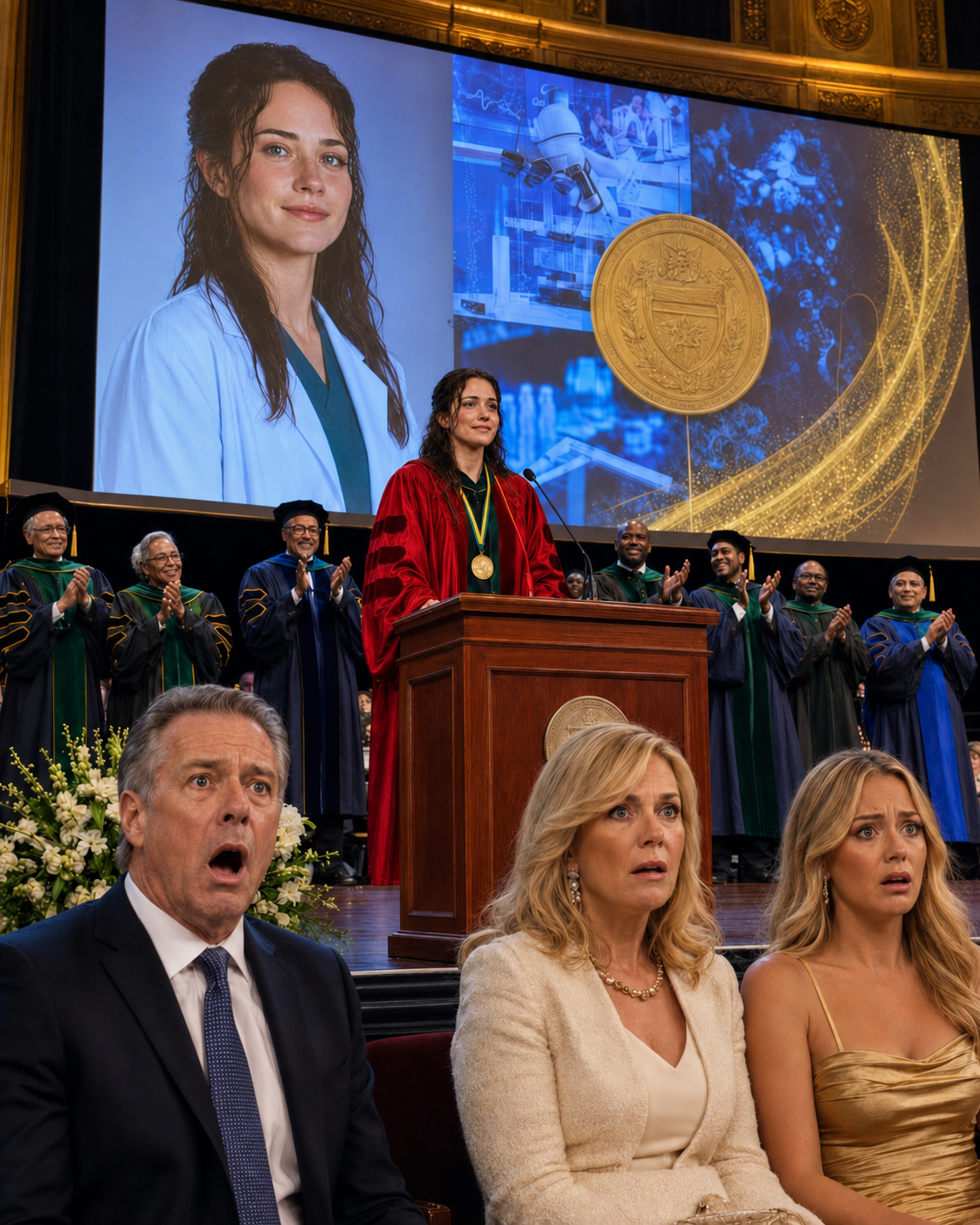
My father was halfway across the street when Eleanor Vale pushed the leather folder into my hands and whispered, “Do not give this to him under any circumstance.”
For a moment, the entire world narrowed to three things: the folder against my chest, my father’s furious footsteps on the wet pavement, and my mother’s handwriting on the sealed letter inside.
Clara.
Just my name.
But written in the soft, elegant curves I remembered from birthday cards, lunchbox notes, and the little paper stars she used to leave beside my bed when I was scared of thunderstorms.
My father reached us breathless, his face still flushed from the humiliation of being escorted out of my graduation.
“Clara,” he said sharply, then glanced at Eleanor. “Step away from my daughter.”
Eleanor did not move.
“I no longer take instructions from you, Mr. Hensley.”
His eyes hardened. “This is a family matter.”
“No,” Eleanor said calmly. “This is a legal matter. And after today, I strongly suspect it may become a criminal one.”
The word criminal cut through the air like a blade.
My father’s mouth tightened. “You have no idea what you’re talking about.”
Eleanor opened her leather briefcase and removed a business card. “I represented Margaret Hensley for nine years before her death. I prepared her trust. I witnessed her final amendment. And I have documentation proving that Clara was the sole beneficiary of the estate.”
My heartbeat slammed against my ribs.
Sole beneficiary.
Estate.
Trust.
The house.
The accounts.
Everything.
My father laughed once, but it was brittle. “Margaret changed her mind before she died.”
“No,” Eleanor said. “She did not.”
He stepped closer. “Clara, give me the folder.”
The way he said it carried twelve years of command. Twelve years of me lowering my eyes. Twelve years of obedience trained into my bones.
But I was not the girl he left in the rain anymore.
I held the folder tighter.
“No.”
His face changed.
Not sadness. Not shame.
Rage.
“You ungrateful little—”
“Careful,” Eleanor warned. “There are cameras everywhere today.”
My father glanced toward the auditorium doors. Several faculty members were watching from the steps. A security officer stood near the entrance.
He forced his expression into something that looked almost gentle.
“Clara,” he said, lowering his voice, “you’re emotional. It’s been a big day. That woman is trying to confuse you.”
I looked at him. Really looked.
This was the man who had taken my ticket, thrown me into the rain, then tried to claim my success in front of hundreds of people. And somehow, even now, he expected me to believe him over the evidence in my hands.
“What happened to Mom?” I asked.
For the first time, his eyes flickered.
“She was sick.”
“That’s what you told me.”
“Because it was true.”
Eleanor’s voice turned cold. “Margaret’s medical records say otherwise.”
My fingers went numb around the folder.
My father’s head snapped toward her. “Enough.”
Eleanor met his stare without fear. “Margaret had been recovering. Her cardiologist expected improvement. But in the final two weeks before her death, she became suddenly disoriented, weak, and unable to sign documents. Conveniently, that was when you claimed she verbally approved transferring control of her accounts to you.”
The ground seemed to shift beneath me.
“Verbal approval?” I whispered.
My father reached for my arm.
I stepped back.
“No,” I said. “Don’t touch me.”
Something in my voice stopped him.
Eleanor turned to me. “Your mother suspected someone was pressuring her. She left instructions that if anything happened to her before your eighteenth birthday, the documents were to be sealed until you completed medical school.”
“Why medical school?” I asked, my voice breaking.
Eleanor’s expression softened. “Because she believed you would understand the records by then.”
My breath caught in my throat.
Understand the records.
Not just inherit.
Investigate.
My mother had known.
Or feared.
Or both.
My father’s voice dropped to a dangerous whisper. “You are making a mistake, Clara.”
I looked down at the folder, then back at him.
“No,” I said. “I think I finally stopped making one.”
Eleanor guided me toward her car. “We need to go.”
My father followed two steps.
Security moved closer.
He stopped, but his eyes burned into me.
“You open that folder,” he said, “and you destroy this family.”
I looked at the man who had destroyed me quietly for years and called it parenting.
Then I opened the passenger door.
“No,” I said. “I think I save myself.”
As Eleanor drove away, I turned back once.
My father stood in the middle of the sidewalk, soaked by rainwater dripping from the trees, staring after me with a look I had never seen before.
Fear.
That night, in Eleanor’s office, I opened my mother’s letter with shaking hands.
My darling Clara,
If you are reading this, then you became what I always knew you would be: strong enough to seek the truth.
I am sorry I could not protect you longer.
I am sorry I trusted the wrong person beside me.
And I am sorry that the man you call father may have stolen more from you than money.
My vision blurred.
Eleanor sat across from me in silence.
I forced myself to continue.
There is a blue notebook hidden behind the loose panel in the upstairs library. Inside are dates, names, bank records, and notes about the medication changes I never authorized. If I am gone before I can explain, find Dr. Samuel Reed. He knows what happened. Trust no one in the house.
My hand flew to my mouth.
The upstairs library.
The room my father had locked after Mom died.
The room he said was “too painful” to open.
At the bottom of the letter, my mother had written one final line.
And Clara, if your father ever tells you that you were unwanted, remember this: you were the only reason I fought to stay alive.
I broke.
Not quietly.
Not gracefully.
I folded over the letter and sobbed so hard Eleanor came around the desk and held me like I was still that nine-year-old girl who had lost her mother without understanding she had also lost her inheritance, her home, and possibly the truth.
When I could breathe again, Eleanor placed another document before me.
“This is the court order I filed this afternoon,” she said. “It freezes the remaining trust assets until we complete the investigation.”
I stared at her.
“You already filed?”
She nodded. “After what happened at graduation, I believed there was immediate risk.”
“Risk of what?”
Before she could answer, her office phone rang.
She looked at the caller ID and went still.
“Eleanor?” I whispered.
She answered on speaker.
A man’s voice came through, low and urgent.
“This is Dr. Samuel Reed. If Clara Hensley has the letter, tell her not to go back to that house alone.”
My blood turned cold.
Then he added, “Because her father knows where the notebook is too.”
PART 4: THE BLUE NOTEBOOK BEHIND THE WALL
By midnight, the house I had grown up in no longer felt like a home. It felt like a crime scene waiting to confess.
Eleanor wanted to call the police immediately, but Dr. Samuel Reed begged us to wait until he arrived.
“He won’t run,” Dr. Reed said over the phone. “Not yet. Richard is too arrogant for that. He’ll try to destroy whatever is left first.”
Richard.
My father.
Hearing someone say his name with disgust instead of respect felt strangely validating.
Two hours later, Dr. Reed arrived at Eleanor’s office. He was older than I expected, with silver hair, tired eyes, and hands that trembled slightly when he took my mother’s letter from me.
“I should have done more,” he said.
The sentence was so heavy I felt it land in the room.
“What happened to my mother?” I asked.
He closed his eyes.
“Margaret had a cardiac condition, yes. But it was controlled. She was careful. Disciplined. The sudden decline before her death did not make sense.”
“Medication changes,” I whispered.
He nodded slowly. “She told me she felt strange after drinking tea your father brought her at night. Confusion. Dizziness. Weakness. I advised immediate testing.”
“Did she get tested?”
“She tried.” His jaw tightened. “But Richard canceled the appointment.”
The room went silent.
My stomach twisted.
Dr. Reed continued, “Your mother called me the night before she died. She was frightened. She said she had hidden records in the library. She said if anything happened, I had to help you. But by the time I arrived the next morning…”
His voice broke.
“She was gone.”
I stared at the floor.
For twelve years, I had believed my mother died peacefully in her sleep.
Now every memory had teeth.
My father crying at the funeral.
My stepmother arriving six months later.
The locked library.
The sudden disappearance of my mother’s jewelry.
The way my father sold her medical equipment, her books, her car, then told me we were “starting over.”
“Why didn’t you go to the police?” I asked, and I hated how wounded I sounded.
Dr. Reed looked at me with shame. “I did. But Richard had paperwork. Statements. A death certificate. He claimed Margaret had been confused due to illness. Without the notebook, without toxicology, without her direct testimony, it became suspicion.”
Eleanor leaned forward. “And now?”
“Now Clara is a doctor,” he said. “And Margaret’s records may mean something they did not mean twelve years ago.”
I stood.
“Then we get the notebook.”
Eleanor shook her head. “Not alone.”
So we went with two private investigators Eleanor trusted, one retired detective, and a security officer from the university who volunteered after hearing what happened at graduation. I sat in the back of the car with my mother’s letter pressed to my chest, watching the city lights blur past the windows.
When the house appeared at the end of the street, my breath stopped.
The porch lights were off.
But the upstairs library window glowed.
My father was inside.
The front door was locked, but Eleanor had paperwork proving my legal claim to the property. The retired detective, Mr. Alvarez, knocked once, announced himself, and waited.
No answer.
Then something crashed upstairs.
We entered.
The house smelled exactly as it always had—lemon polish, old wood, Marlene’s expensive candles—but now everything felt staged, like a beautiful mask over rot.
We rushed upstairs.
The library door, locked for twelve years, stood open.
Inside, my father was pulling books from shelves and throwing them onto the floor.
He spun when he saw us.
“You have no right to be here!”
Eleanor held up the court order. “Actually, she does.”
His gaze found me.
The hatred in his face nearly stole my breath.
“You stupid girl,” he hissed. “You have no idea what your mother was really like.”
I stepped into the room.
For the first time since I was nine, I smelled her there.
Lavender.
Paper.
A faint trace of the rose hand cream she always used.
“You don’t get to talk about her,” I said.
He laughed bitterly. “She was going to leave me with nothing. Nothing. After everything I gave her.”
“You mean after everything she had?”
His hand twitched.
Mr. Alvarez moved closer.
My father looked toward the wall behind the mahogany desk.
I saw it.
A loose panel near the bottom shelf.
My mother had written behind the loose panel.
I ran.
My father moved at the same time.
He grabbed my wrist, but the university security officer pulled him back before he could twist it.
“Let go of me!” he shouted.
I dropped to my knees and pressed along the wood.
The panel shifted.
Behind it was a narrow hollow space filled with dust, old envelopes, and a faded blue notebook tied with white ribbon.
My mother’s notebook.
I lifted it out with both hands.
My father stopped struggling.
His face went gray.
That was when I knew.
Whatever was inside could ruin him.
Eleanor opened the notebook carefully on the desk.
The first pages were financial records. Transfers. Account numbers. Signatures. Notes in my mother’s handwriting.
Then came the medical entries.
Tea at 9 p.m. Bitter taste.
Richard insisted I take new supplements.
Dizziness worse after evening drink.
Asked about Clara’s trust. He became angry.
Hid samples in bathroom drawer.
My body went cold.
“Samples?” Eleanor said.
Dr. Reed, who had followed us in, looked sharply toward the hallway. “Bathroom drawer.”
We ran to my mother’s old bedroom.
The room had been turned into a guest room, stripped of nearly everything that made it hers. But in the bathroom, behind a false back panel in the vanity drawer, Alvarez found three small sealed vials wrapped in tissue.
Dr. Reed stared at them.
“My God,” he whispered.
“What are they?” I asked.
He looked at me with sorrow.
“Possibly the evidence I needed twelve years ago.”
Behind us, my father began shouting downstairs.
Then the front door slammed.
“He’s running!” someone yelled.
We rushed to the staircase just in time to see him bolt across the lawn toward his car.
But before he could reach it, headlights flooded the driveway.
A black SUV blocked his path.
Two officers stepped out.
And behind them stood Haley.
Her makeup was gone. Her hair was wet. Her face looked haunted.
My father froze.
Haley lifted a trembling hand and pointed at him.
“I’ll testify,” she said, her voice breaking. “I heard him tell my mother he should have burned the notebook years ago.”
PART 5: THE STEPSISTER WHO BROKE THE SILENCE
Of all the people I expected to save me, Haley was the last.
She stood in the driveway shaking so hard one of the officers had to steady her. This was the same girl who had waved my VIP ticket like a trophy, who had laughed while I stood in the rain, who had spent years treating my life like background noise.
But now she looked nothing like the polished, smug stepsister I knew.
She looked terrified.
My father stared at her as if she had slapped him.
“Haley,” he said slowly, “get in the car.”
She flinched, but she did not move.
“No.”
Marlene appeared beside the SUV, wrapped in a coat, her face pale and ruined. For once, she was not performing elegance. She looked small. Human. Afraid.
“Richard,” she whispered, “it’s over.”
My father turned on her. “You stupid woman.”
That did it.
Something in Haley’s face changed.
“She is not stupid,” Haley said. “You made her scared. You made all of us scared.”
The officers moved toward my father.
He backed away. “This is absurd. Clara is manipulating everyone because she’s bitter.”
I stepped onto the porch with the blue notebook in my hands.
For a heartbeat, he looked at me the way he had looked when I was a child and spilled juice on the carpet—as if punishment was inevitable and love was conditional.
But I was not a child.
Not anymore.
“You don’t get to blame me for your secrets,” I said.
The officers arrested him in the driveway while rain began to fall again, soft and cold. He shouted for a lawyer. He shouted that the notebook was fake. He shouted that my mother had been unstable.
But no one reached for him.
No one defended him.
Not even Marlene.
At the police station, Haley gave her statement first.
I sat in a waiting room with Eleanor, holding a paper cup of coffee I did not drink. Through the glass, I could see Haley crying as she spoke to the detective. Marlene sat beside her, one hand over her mouth, nodding occasionally.
Hours passed.
When Haley finally came out, her eyes were swollen.
She stopped in front of me.
For a long moment, neither of us spoke.
Then she said, “I’m sorry.”
The words were small.
Not enough for years.
But real enough to be a beginning.
“I hated you,” she confessed. “Not because you did anything. Because my mom made me feel like if you succeeded, I disappeared. And your dad… Richard… he always said you were dramatic. Ungrateful. Weird. I believed him because it was easier.”
I looked at her.
“What changed?”
She swallowed. “At graduation, when they played that video of him pushing you, I saw his face. He wasn’t embarrassed because he hurt you. He was embarrassed because people saw.”
Her voice broke.
“And then tonight, I heard him telling my mom that if Clara opens that folder, we lose everything. Not he. We.”
Marlene approached slowly.
“I married your father because he made me feel safe,” she said, and her voice trembled. “Then I stayed because I was afraid of what would happen if I admitted he wasn’t.”
I did not know what to say to that.
Part of me wanted to rage at them both. They had lived in my mother’s house. Spent my mother’s money. Watched me work myself to exhaustion while they enjoyed everything that should have been protected for me.
But another part of me saw the truth.
My father had not only stolen wealth.
He had built a kingdom of fear.
The investigation moved quickly after that.
The vials from the bathroom were sent for testing. My mother’s notebook was authenticated. Old financial transfers were traced. Eleanor found forged signatures, altered trust documents, and payments made from my mother’s accounts into companies tied to my father.
The newspapers called it “The Graduation Scandal.”
I hated that name.
To them, it was dramatic. A viral story. A brilliant young doctor humiliated by her family, then vindicated on stage.
To me, it was my life cracked open for strangers.
For two weeks, I stayed with Eleanor in her guest room. I read my mother’s letters one by one. She had written twelve, one for every birthday she feared she might miss. Some made me laugh. Most made me cry. One simply said:
If no one else tells you today, I am proud of you. I have always been proud of you.
I taped that one above my desk.
Meanwhile, the court froze the estate.
The house legally returned to my control pending final judgment.
My father remained in custody after investigators discovered he had tried to move money overseas the day after graduation.
Then came the toxicology report on the preserved samples.
Dr. Reed called me himself.
His voice was shaking.
“Clara,” he said, “your mother was right.”
I closed my eyes.
“What was in them?”
“A compound that could worsen cardiac symptoms, cause confusion, and mimic natural decline in a patient with her condition.”
The room tilted.
I sat on the floor because my legs stopped trusting me.
“Can they prove he gave it to her?”
There was a pause.
“Not from the samples alone.”
My hope cracked.
“But,” Dr. Reed continued, “the notebook, the financial motive, the forged documents, and witness statements create a powerful case.”
“Witness statements?”
“Haley found something.”
I sat up.
“What?”
“An old video.”
That evening, Haley came to Eleanor’s office with a flash drive in her hand.
“I used to record everything when I was little,” she said. “Vlogs, house tours, stupid dance videos. My mom saved them all.”
She looked at me with wet eyes.
“This was from the week before your mom died. I didn’t understand what I recorded.”
Eleanor plugged in the drive.
The screen flickered.
A younger Haley appeared, maybe eight years old, sneaking through the upstairs hallway with a camera, whispering about making a “secret mansion tour.” She giggled, pushed open the library door slightly, and froze.
My father’s voice came from inside.
“You sign it, Margaret, or Clara gets nothing.”
Then my mother’s voice, weak but clear.
“If anything happens to me, Richard, Samuel has records.”
A crash.
Then my father, colder than I had ever heard him.
“By the time anyone listens, you’ll just be another sick woman who got confused.”
The video cut off as young Haley ran.
No one in Eleanor’s office moved.
Haley covered her face and sobbed.
I stared at the screen until the image blurred.
For twelve years, my mother’s last truth had been buried inside a child’s forgotten video.
And now it had finally learned how to speak.
PART 6: THE TRIAL THAT TURNED MY FATHER PALE
The courtroom was colder than I expected, but my father still managed to sweat.
He sat at the defense table in an expensive suit, his hair neatly combed, his expression carefully wounded. To anyone who did not know him, he looked like a respectable man falsely accused by an ungrateful daughter.
But I knew the mask.
I had lived under it.
The charges were not simple. Financial fraud. Forgery. Evidence tampering. Coercion. And a separate investigation into my mother’s death that prosecutors described carefully, avoiding promises they could not yet prove.
The media filled the back rows.
I kept my eyes forward.
Eleanor sat beside me, steady as stone. Dr. Reed sat behind us. Haley and Marlene sat two rows away. Haley had asked if I wanted her there.
I had told her the truth.
“I don’t know.”
She came anyway.
The prosecutor began with the money.
Documents appeared on the screen: forged signatures, unauthorized transfers, trust amendments never filed properly, accounts drained under false authority. My father’s lawyers objected often. The judge allowed most of the evidence.
Then came the graduation video.
I thought I was prepared.
I was not.
Watching myself get shoved into the rain in front of a courtroom hurt differently than experiencing it. In real time, I had been too shocked to feel the full weight of it. But on the screen, I saw how small I looked beside him. How easily he pushed me aside. How practiced the cruelty was.
The prosecutor paused the video on my father’s hand gripping my arm.
“Mr. Hensley,” she asked during cross-examination, “is this how you typically treated your daughter?”
My father smiled sadly.
“Clara was emotional that day. She had always struggled with attention.”
A murmur moved through the courtroom.
The prosecutor clicked to the next image: the program listing me as valedictorian and award recipient.
“Attention she had earned?”
His smile faltered.
“She hid things from us.”
The prosecutor tilted her head. “Did she hide them, or did you fail to ask?”
He said nothing.
Then came Haley.
She walked to the witness stand with trembling hands but a lifted chin. My father would not look at her.
She testified about the night after graduation, about hearing him tell Marlene they could lose everything, about the notebook, about the old video.
The defense tried to tear her apart.
“Isn’t it true,” my father’s attorney asked, “that you were jealous of Dr. Hensley after discovering her success?”
Haley swallowed.
“Yes.”
The attorney smiled.
“And isn’t it true you benefited from Mr. Hensley’s support?”
“Yes.”
“So perhaps your testimony is motivated by guilt?”
Haley looked toward me.
Then back at the attorney.
“It is motivated by guilt,” she said. “Because I helped him hurt Clara without knowing how much he had already stolen from her.”
The courtroom went silent.
“And I am telling the truth because guilt is not an excuse to keep lying.”
For the first time, I felt something inside me loosen.
Not forgiveness.
But recognition.
Haley had chosen the truth when lying would have protected her.
Then Dr. Reed testified.
His voice shook as he described my mother’s symptoms, her fear, the canceled appointment, the strange decline. He admitted his regret. He admitted the case had been dismissed years ago.
The defense attacked him too.
“You are asking this court to believe a dead woman’s suspicion?”
Dr. Reed leaned toward the microphone.
“No. I am asking the court to consider medical records, preserved samples, financial motive, forged documents, a recorded threat, and a pattern of coercive control.”
The defense attorney sat down.
Finally, I was called.
The walk to the witness stand felt longer than the graduation stage.
I placed my hand on the Bible and swore to tell the truth.
Then I looked at my father.
He stared back with a strange expression—not hatred now, but calculation.
As if even here, even now, he was searching for the right pressure point.
The prosecutor was gentle.
She asked about my childhood. My mother. The locked library. The way my father dismissed my education. The ticket. The rain.
I answered everything.
Then the defense rose.
My father’s attorney approached slowly.
“Dr. Hensley, you are clearly accomplished. Brilliant, even. But would it be fair to say you resented your father?”
“Yes,” I said.
The courtroom shifted.
The attorney’s eyes brightened.
“You admit resentment?”
“I resent what he did. I resent the years he stole. I resent that my mother died afraid. I resent being treated like a burden in a house paid for by the woman who loved me.”
The attorney paused.
“But you want revenge.”
I looked at my father.
He leaned forward slightly.
Waiting.
Hoping I would sound angry. Unstable. Bitter.
“No,” I said quietly. “I wanted a father.”
The courtroom fell still.
My father’s face changed so quickly most people might have missed it.
But I saw it.
For one second, he looked exposed.
Then I continued.
“I wanted him to ask why I was tired. I wanted him to show up. I wanted him to read my name on the invitation before giving it away. I wanted him to love me without needing an audience first.”
My voice cracked, but I did not stop.
“But he taught me something important. Blood can give you a name, but it cannot give you character. And today I am not here to punish him. I am here because my mother left me the truth, and I refuse to bury it for him.”
The prosecutor rested.
The trial lasted nine days.
On the tenth, the verdict came.
Guilty on fraud.
Guilty on forgery.
Guilty on evidence tampering.
Guilty on coercion.
The investigation into my mother’s death remained open, but the judge made one thing clear during sentencing: my father had stolen from the dead, manipulated the living, and exploited a child’s grief for profit.
He received years in prison.
When they led him away, he turned back once.
“Clara,” he said.
For the first time, I did not feel afraid.
I felt finished.
After court, I expected reporters.
Instead, I found Haley waiting near the steps with a cardboard box.
“What’s that?” I asked.
She held it out.
“Everything of your mother’s that my mom kept.”
Inside were photographs, scarves, a silver bracelet, a recipe book, and a small velvet pouch.
I opened the pouch.
Inside was my mother’s wedding ring.
A note was folded around it.
For Clara, when she becomes the woman I know she will be.
I held it against my heart.
Then Haley said the words that changed the ending of our story.
“There’s one more thing in the box,” she whispered. “And Clara… I think your mother knew you had a sister.”
PART 7: THE SISTER NO ONE KNEW EXISTED
I thought Haley meant herself.
For one stunned second, I looked at her, confused by the strange softness in her voice.
Then she reached into the box and pulled out a photograph.
It was old, slightly faded, bent at one corner.
My mother stood in a hospital garden, thinner than I remembered, but smiling. Beside her stood a young woman with dark hair and a newborn wrapped in a yellow blanket.
On the back, in my mother’s handwriting, were four words:
Clara deserves the truth.
Below that was a name.
Lily.
My hands began to shake.
“Who is Lily?” I whispered.
Haley shook her head. “I don’t know. My mom found it in your father’s locked cabinet after he was arrested. She said she had never seen it before.”
Eleanor took the photograph carefully.
For the first time since I had known her, she looked truly startled.
“I know that hospital,” she said. “It’s St. Agnes.”
Dr. Reed, standing beside us, went very still.
I turned to him. “You know something.”
He closed his eyes.
“Not enough. But… your mother once mentioned a child.”
My heart slammed.
“What child?”
He looked at me with deep regret.
“Before she married Richard, Margaret helped a young patient who had no family. The girl was pregnant, very sick, and terrified. After the birth, your mother arranged care for the baby.”
“That doesn’t make Lily my sister.”
“No,” he said. “It doesn’t.”
But his face said there was more.
Eleanor unfolded another paper from the box.
A hospital consent form.
My mother’s signature.
And beside it, in a line marked Emergency Guardian, was my father’s name.
Richard Hensley.
The air left my lungs.
“What does that mean?”
Eleanor read silently, her expression darkening with every line.
“It means your father was legally involved in the child’s placement.”
Dr. Reed whispered, “Margaret must have discovered something.”
Eleanor turned the page.
There, clipped behind the form, was a DNA report from twelve years ago.
Not complete.
Not official by modern standards.
But clear enough.
Probability of paternal relationship: 99.81%.
My father had another daughter.
Lily.
My half-sister.
The truth was so unexpected, so strange and sharp, that I almost laughed.
Not because it was funny.
Because my life had become a locked room, and every door we opened revealed another one behind it.
My father had spent years making me feel unwanted while hiding another child he had abandoned completely.
“Where is she?” I asked.
Eleanor’s voice was careful. “If this placement record is accurate, she was adopted through a private arrangement. But some pages are missing.”
“Of course they are,” Haley muttered.
For the first time, I almost smiled at her.
The search took three weeks.
Three weeks of calls, sealed records, court petitions, and dead ends. During that time, I moved back into my mother’s house.
Not my father’s house.
My mother’s.
Mine.
The first thing I did was unlock every room.
The second was remove every portrait of my father.
The third was turn the library into a place of light.
I kept my mother’s desk by the window. I placed her letters in a glass case. I put the blue notebook in a secure evidence archive after the prosecutors finished copying it. And above the fireplace, I hung one photograph: my mother holding me at age five, both of us laughing with our faces turned toward the sun.
Haley visited once with Marlene.
It was awkward.
Painfully awkward.
Marlene stood in the foyer, unable to meet my eyes.
“I don’t deserve to be here,” she said.
“No,” I replied honestly. “You don’t.”
She nodded, accepting it.
Then she placed a check on the table.
“It isn’t enough. It will never be enough. But it’s what I can return immediately from what I spent.”
I stared at it.
The amount was large.
Not full justice.
But not nothing.
Haley looked at me. “I’m getting a job. A real one. I’m also moving out.”
“Where?”
“With my aunt. Then maybe school again.” She hesitated. “Not for photos this time.”
Something in me softened despite myself.
“Good.”
As they left, Haley paused at the door.
“If you find Lily,” she said, “tell her I’m sorry too. Even if I never knew about her.”
That night, Eleanor called.
“We found a likely match.”
I gripped the phone.
“Where?”
“Portland.”
“What’s her name?”
A pause.
“Lily Reed.”
I stopped breathing.
“Reed?”
Eleanor’s voice softened.
“Dr. Samuel Reed adopted her.”
The next morning, Dr. Reed came to the house before I could call him.
He looked older than ever.
“I wanted to tell you,” he said immediately. “But Margaret made me promise to protect Lily until the truth could not endanger her.”
I stared at him, wounded and bewildered.
“You raised my sister?”
He nodded.
“Richard never wanted her. Margaret found out when the girl’s mother died after childbirth. She wanted Lily safe. She planned to tell you when you were older. But then she became ill.”
“Does Lily know?”
“She knows she was adopted. She knows her biological father was dangerous. She does not know about you.”
I sank into my mother’s chair.
All my life, I had felt alone in that house.
And somewhere, alive in the world, was a sister who had also been hidden from the same man.
“Can I meet her?”
Dr. Reed’s eyes filled.
“She already asked to meet you.”
Lily arrived two days later.
She was twenty-one, with my father’s dark eyes but my mother’s determined chin somehow, as if love could leave fingerprints even where blood did not. She stood in the doorway of my mother’s house, nervous and brave, holding a small suitcase.
“I’m Lily,” she said.
I tried to answer, but my voice failed.
She smiled shakily. “I know this is weird.”
A laugh broke through my tears.
“Yes,” I said. “Very.”
Then she stepped forward, and I hugged the sister I never knew I had.
At first, it was careful.
Then it became fierce.
Two strangers bound by a dead woman’s courage and a cruel man’s lies.
Later, in the library, I showed Lily my mother’s letters. She showed me a small gold locket Dr. Reed had given her when she turned eighteen.
Inside was a tiny photograph of my mother.
On the back were engraved the words:
You were loved before you were named.
Lily cried then.
So did I.
That evening, as the sun set over the garden, Lily looked around the house and whispered, “It feels like she’s still here.”
I touched the desk.
“Maybe she is.”
My phone buzzed.
A message from the prosecutor.
New evidence had been found in my father’s prison intake belongings: a hidden bank key, taped behind his watch.
The deposit box had already been located.
Inside was a confession.
Not written for police.
Written for himself.
And in it, my father had named one final person involved in my mother’s death.
Someone none of us had suspected.
PART 8: THE FINAL TRUTH AND THE LIFE MY MOTHER SAVED
The confession was only four pages long, but it rewrote my entire childhood.
Eleanor, Lily, Dr. Reed, Haley, and I sat together in the library while the prosecutor read the authenticated copy aloud.
My father had written it years ago, not out of remorse, but arrogance. A private record of what he believed he had gotten away with.
He admitted to manipulating my mother’s medication.
He admitted to forging documents.
He admitted to hiding Lily because a second daughter meant another possible claim to his money.
His money.
Even in confession, he could not call it hers.
But the final paragraph made Eleanor go pale.
I did not act alone.
Marlene knew Margaret was being weakened. She did not prepare the compound, but she saw the bottles. She heard the threats. She helped me remove documents after Margaret died because I promised her security and a place in the house.
Haley made a wounded sound.
“No,” she whispered.
I closed my eyes.
Marlene.
My stepmother had not been merely afraid.
She had been complicit.
Not in every act.
But in enough.
The happy ending I had begun to imagine cracked open again.
Haley stood abruptly. “I need air.”
I followed her onto the porch.
She gripped the railing, shaking.
“I thought she was a coward,” she said. “I thought she was weak. I didn’t think she…”
Her voice broke.
I stood beside her in silence.
For years, Haley had been the favorite daughter in my stolen home. Now she was discovering the cost of that favoritism.
It had been built on another woman’s grave.
“I’m sorry,” she whispered.
I believed her.
That did not make it easier.
Marlene was arrested the next morning.
She confessed faster than anyone expected.
According to Eleanor, guilt had been eating her alive for years. She admitted she had suspected my father was harming my mother. She admitted she helped destroy letters. She admitted she accepted jewelry, money, and comfort in exchange for silence.
But she also revealed something that turned the case one final time.
“The night Margaret died,” Marlene told investigators, “Richard panicked because Clara came into the room.”
I froze when Eleanor told me.
“I did?”
“You were nine,” Eleanor said gently. “You may not remember clearly.”
But I did.
Not fully.
Only fragments.
Thunder.
My mother’s bedroom door half open.
My father whispering harshly.
A glass on the bedside table.
My mother’s hand hanging over the edge of the mattress.
And then Marlene in the hallway, turning me away.
“She’s sleeping, Clara. Don’t bother her.”
I had believed her.
For twelve years, I had believed everyone.
The final hearing was closed to the public, but I gave a victim impact statement.
This time, I did not speak only for myself.
I spoke for my mother.
For Lily.
For the child I had been.
For every year stolen by lies.
“My mother left behind evidence because she believed truth could outlive fear,” I told the court. “She was right. My father tried to erase her voice. Marlene helped him. But neither of them understood that love is also a kind of record. It remains in letters, in memories, in the people who refuse to stop searching.”
My father refused to look at me.
Marlene cried the entire time.
Both received additional charges. The investigation into my mother’s death finally became what it should have been years earlier: a murder case supported by motive, records, witness testimony, preserved samples, and confession.
Justice did not bring my mother back.
But it changed the shape of her absence.
She was no longer a tragedy whispered about in vague terms.
She was Margaret Hensley.
A mother.
A protector.
A woman who fought until her final breath to save her daughters.
Months passed.
The estate was restored legally to me, with a portion set aside for Lily after I insisted. She cried when I told her.
“I don’t want money,” she said.
“I know,” I replied. “That’s why you deserve it.”
We turned the house into something new.
The Clara Hensley Pediatric Heart Initiative opened its first office in the old east wing, the same part of the house where my father used to host parties with money he stole. Now families came there for help. Children ran through the garden. Doctors volunteered. Donors returned, not because of scandal, but because the work mattered.
The library became the Margaret Hensley Memorial Reading Room.
On the wall, beneath my mother’s portrait, we placed her final words from the letter:
You were the only reason I fought to stay alive.
But Lily added a second plaque below it:
And because you fought, we found each other.
Haley changed too.
Not overnight. Not magically.
But honestly.
She sold most of the designer things bought with stolen money and donated the proceeds to the foundation. She enrolled in community college to study social work. Sometimes she came by the office and helped families fill out forms.
The first time I saw her kneeling beside a frightened little girl in the waiting room, speaking softly and patiently, I paused in the doorway.
Haley looked up, embarrassed.
“What?”
I shook my head.
“Nothing.”
But it was not nothing.
It was proof that people could choose differently once the truth stripped them bare.
One year after graduation, the university invited me back to speak again.
This time, I did not stand backstage alone.
Lily adjusted my hood.
Haley handed me my speech cards.
Dr. Reed hugged me and whispered, “Your mother would be unbearable with pride today.”
I laughed through tears.
And in the front row, where my stolen VIP ticket had once started everything, sat the family I had built from truth instead of blood.
Lily.
Eleanor.
Dr. Reed.
Haley.
Families from the foundation.
Children with repaired hearts.
People who had seen me, believed me, and stayed.
When I stepped onto the stage, the applause rose like sunlight.
I looked out at the auditorium, no longer searching for my father’s approval.
That hunger had left me.
In its place was something stronger.
Peace.
I began my speech with a story.
“Once,” I said, “I stood outside this building in the rain while someone else walked in with my name.”
A hush fell.
“But that was not the worst thing that ever happened to me. The worst thing was believing, even for a moment, that their cruelty defined my worth.”
I looked at Lily, who smiled through tears.
“Today, I know better.”
My voice steadied.
“Your worth is not decided by the people who fail to love you. Your future is not canceled by those who underestimate you. And sometimes, the door slammed in your face is only forcing you toward the entrance meant for you.”
The applause began before I finished.
Afterward, a little boy from the foundation ran onto the stage and hugged my knees. His mother apologized, but I only laughed and lifted him into my arms.
“What’s your name?” I asked.
“Micah,” he said proudly. “I have a brave heart.”
The audience laughed softly.
“Yes,” I whispered. “You do.”
That evening, back at the house, we gathered in the garden under strings of warm lights. Lily played music. Haley burned the first tray of cookies. Dr. Reed pretended they were edible. Eleanor opened champagne. Children chased fireflies across the lawn.
For the first time, the house sounded alive.
Not with secrets.
With laughter.
Later, I slipped into the library alone.
My mother’s portrait glowed in the lamplight.
I stood before it, holding the gold locket Lily had let me borrow for the evening.
“I found her,” I whispered. “I found Lily. I found the truth. I found myself.”
Outside, someone called my name.
Not as an order.
Not as an accusation.
As an invitation.
I turned to the window and saw Lily waving from the garden, Haley beside her, both laughing beneath the lights.
For years, I thought my story began with everything I lost.
But I was wrong.
It began with what my mother saved.
The truth.
The house.
My sister.
My future.
And finally, my own heart.
THE END