PART 3 — THE HUSBAND WHO VANISHED
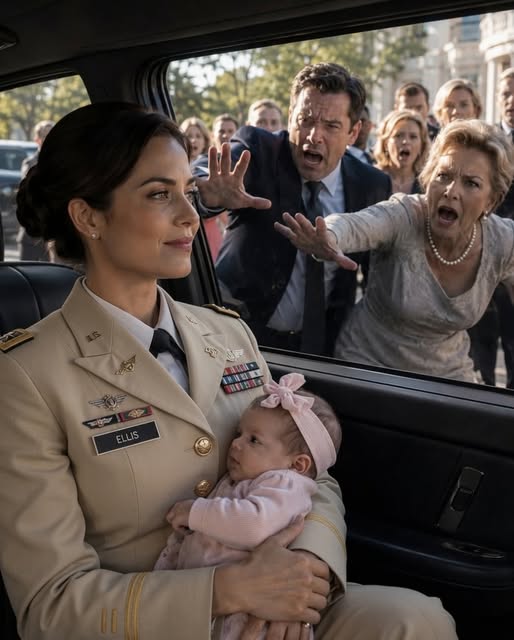
The screen went black, but the final sentence remained inside my head like a gunshot.
“Your husband has been working with us for eleven months.”
For several seconds, no one moved.
Emergency lights painted the sunroom blood-red. Guests crouched behind furniture. Somewhere in the hall, an injured investigator groaned while Agent Shaw shouted orders into her radio.
I held June against my chest, shielding her face beneath my jacket.
My father knelt beside me.
“Nora, look at me.”
I forced my eyes toward his.
“Is Wesley one of them?”
“I don’t know yet.”
“That man said—”
“I heard him.”
His voice was firm, but I saw something unfamiliar beneath his control.
Fear.
Not for himself.
For me.
Agent Shaw crossed the room and picked up the abandoned phone with gloved hands.
“The video was prerecorded,” she said. “No active signal.”
Richard Pembroke stared at the empty chair where his son had been sitting.
“That’s impossible. Wesley was here.”
“He left during the blackout,” Caroline whispered.
“No,” I said.
Everyone looked at me.
“He disappeared before the lights failed.”
I remembered glancing at his chair after the video showed him beside Margaret. It had already been empty.
Agent Shaw turned sharply. “How long before?”
“Maybe ten seconds.”
My father’s expression hardened.
“He knew the blackout was coming.”
Richard staggered backward and gripped the mantel.
“My son is not a traitor.”
“Then where is he?” Agent Shaw asked.
No one answered.
A tactical team swept the estate. Every door, window, basement corridor, and service exit was searched. Margaret was nowhere inside.
Neither was Wesley.
Security footage from the western gate showed a black utility vehicle leaving the property forty-three seconds after the lights failed. The plates belonged to a delivery truck reported stolen two days earlier.
Someone had planned every second.
Agent Shaw led us into Richard’s library, where thick curtains were drawn and communication devices were placed inside signal-blocking bags.
“You and June are being relocated,” she told me.
“I’m staying involved.”
“You are a target.”
“I’m also the only person in this room who knows Wesley well enough to recognize whether he is lying.”
My father stepped closer.
“Nora—”
“No. For years, I defended him. I explained his weakness. I forgave his silence. If he betrayed me, I need to hear it from him.”
Agent Shaw studied me.
“Your judgment may be compromised.”
“My judgment is the reason we know he disappeared before the blackout.”
She said nothing.
Then my phone vibrated inside the evidence pouch.
Every person in the library went still.
The device had been powered down.
Yet the screen glowed through the transparent material.
A message appeared from Wesley.
DO NOT TRUST THE VIDEO. FIND THE APRON.
I stared at the words.
“What apron?” Agent Shaw asked.
My mouth went dry.
“The Christmas gift.”
The apron embroidered with KNOW YOUR RANK.
Margaret had humiliated me with it two years earlier. I had never worn it. I had shoved it into a storage trunk in the attic.
At our compromised house.
Agent Shaw ordered the search team to retrieve it.
Forty minutes later, a live video feed showed an investigator opening the attic trunk.
The apron lay folded beneath old blankets.
Inside the hem, they found a tiny memory card.
Agent Shaw inserted it into a secure computer.
A recording appeared.
Wesley sat alone in his office, looking exhausted.
“If Nora is watching this,” he began, “then everything has gone wrong.”
My knees weakened.
“I was approached eleven months ago by a man calling himself Adrian Cole. He claimed he had evidence that someone inside Pembroke Financial was laundering money through military contractors. He said Nora could be implicated unless I cooperated.”
Richard whispered, “Dear God.”
Wesley continued.
“I agreed to meet him because I thought I was protecting my wife. Then I realized he knew details no civilian investigator should know. I contacted federal authorities.”
Agent Shaw’s face changed.
I turned to her.
“You knew?”
“No,” she said. “Not my division.”
On-screen, Wesley leaned toward the camera.
“I have been working undercover with a counterintelligence task force. Margaret knew nothing. Nora knew nothing. Even my father knew nothing. Adrian believes I am helping him identify military personnel vulnerable to pressure.”
My heart pounded.
Wesley had not betrayed me.
But he had lied to me for nearly a year.
He had watched his mother humiliate me while hiding an operation beneath our marriage.
The recording continued.
“Adrian is not interested in Nora’s files alone. He is looking for something called Project Nightglass. I don’t know what it is, but he believes Nora has access.”
My father went completely still.
Agent Shaw noticed.
“So do you,” she said.
He did not answer.
The video ended with Wesley looking directly into the camera.
“Nora, if they take me, do not follow the first location they send. It will be a trap. Remember our first chess game.”
The screen went dark.
I closed my eyes.
Our first chess game had been on our third date. Wesley had sacrificed his queen to hide an attack from the corner.
“The obvious piece is a distraction,” I whispered.
My father nodded.
“And the real threat?”
I looked down at June.
“The piece no one notices.”
At that exact moment, the baby monitor inside June’s diaper bag began to crackle.
A voice came through the speaker.
Margaret’s voice.
Faint.
Terrified.
“Nora… he wants your father.”
Then a man whispered close to the microphone:
“Bring Colonel Ellis to the old Belmont rail station before midnight—or Wesley dies first.”
PART 4 — THE SECRET MY FATHER BURIED
The old Belmont rail station had been abandoned for twenty years.
Its broken platforms stood beyond the edge of town, surrounded by rusted tracks and warehouses no longer listed on commercial maps.
It was the perfect place for an ambush.
Which meant we were not going there.
At least, not the way Adrian expected.
Agent Shaw established a command center inside Richard’s library. Satellite maps covered the central table. Tactical teams prepared three false convoys while technicians traced the transmission from June’s monitor.
My father stood near the window, silent.
I had known him all my life.
I knew the way he folded his hands when angry. The way he pressed his tongue against his cheek when calculating risk. The way he avoided my eyes only when the truth would hurt me.
“What is Project Nightglass?” I asked.
The room quieted.
He turned toward me.
“Not here.”
“Wesley was abducted because someone believes I know about it.”
“You don’t.”
“Then tell me.”
Agent Shaw stepped between us.
“Colonel Ellis, if you possess information connected to this threat, we need it now.”
My father exhaled slowly.
“Nightglass was an intelligence operation created eighteen years ago to identify foreign financial networks buying access to defense personnel.”
Richard frowned. “Financial networks?”
“Banks, shell companies, private equity firms, charitable foundations. Money that appeared legitimate but was used to pressure, recruit, or compromise people with security access.”
I looked toward Richard.
“Pembroke Financial?”
His face paled.
My father continued.
“One institution appeared repeatedly in the transactions. Pembroke Financial was never formally charged because investigators believed someone inside the bank was secretly helping us.”
Richard stared at him.
“Who?”
My father looked directly at Margaret’s empty chair.
“Margaret Pembroke.”
Silence fell.
I almost laughed from disbelief.
“Margaret?”
“She was not always the woman you know,” my father said. “Before she married Richard, she worked in international compliance. She discovered irregular transactions and began passing information to federal investigators.”
Richard sank into a chair.
“You knew her before me?”
“No. I knew her case name.”
“What case name?”
My father’s answer came quietly.
“Nightglass.”
The room seemed to tilt.
The project had not been named after a device.
It had been named after Margaret.
“She helped expose three foreign networks,” he continued. “Then an operation collapsed. Two agents were killed. Margaret’s identity was nearly revealed. She left the program, married Richard, and demanded that her records be sealed.”
I thought of the woman who gave me cleaning supplies and mocked my family.
The woman who tried to place a collar on my daughter.
“You’re telling me she was an intelligence asset?”
“Years ago.”
“That doesn’t excuse what she became.”
“No,” my father said. “It explains why Adrian chose her.”
Agent Shaw crossed her arms.
“He appealed to her fear of infiltration.”
“And her pride,” I said.
My father nodded.
“Adrian likely knew pieces of her history. He convinced her that Nora was dangerous, knowing she would investigate on her own.”
Richard looked sick.
“She never told me.”
“She was forbidden to.”
“So our entire marriage—”
“Was real,” my father said. “But built around one buried secret.”
A technician called from across the room.
“We traced the baby monitor transmission. It bounced through three repeaters, but the original signal came from north Charlotte.”
“Not Belmont,” Agent Shaw said.
“The rail station is the distraction,” I replied.
Wesley’s message returned to me.
Remember our first chess game.
Sacrifice the queen.
Hide the corner attack.
I stared at the city map.
“What is near north Charlotte that connects to Pembroke Financial?”
Richard leaned over the table.
“Our disaster-recovery center.”
The facility stored backup servers, physical transaction archives, and emergency banking systems.
Agent Shaw looked at him.
“Could Adrian access international transfer records there?”
“Yes.”
“Could he move money?”
“With the right authorization.”
Richard’s face changed.
“He would need two executive codes.”
“Whose?”
“Mine and Wesley’s.”
Now the abduction made sense.
Wesley was not taken because of me alone.
He was taken because his credentials could unlock the bank’s financial network.
“What about Margaret?” Caroline asked.
Richard closed his eyes.
“She still has legacy authorization.”
Adrian had captured three keys.
Wesley.
Margaret.
And the secret she had buried.
Agent Shaw began issuing orders. Tactical units redirected toward the disaster-recovery center while one decoy convoy continued toward Belmont.
I adjusted June in my arms.
My father looked at me.
“You are not going.”
“I know.”
His surprise lasted only a second.
“I need to protect my daughter,” I said. “And I cannot do that by walking into every trap designed for me.”
Pride flickered in his eyes.
Then a secure line rang.
The command center screen lit up.
Adrian appeared wearing a black mask.
Behind him, Wesley and Margaret sat tied to metal chairs.
Wesley’s face was bruised. Margaret’s pearl necklace was broken, one strand hanging across her collarbone.
Adrian tilted his head.
“Colonel Ellis, you disappointed me.”
My father stepped toward the camera.
“They are not part of this.”
“Everyone is part of this.”
Adrian dragged Margaret’s chair forward.
“Tell them who you are.”
She stared at the floor.
He struck the back of her chair.
“Tell them.”
Margaret lifted her head.
Tears streaked her makeup.
“My name was Evelyn Glass.”
Richard whispered, “Evelyn?”
“It was my operational identity.”
Adrian laughed.
“The great Nightglass. The woman who destroyed my father’s network and then hid in mansions while his children starved.”
My father’s jaw tightened.
“Your father sold military personnel to hostile governments.”
“My father built an empire.”
“He built graves.”
Adrian’s composure cracked.
He raised a pistol and pressed it against Wesley’s temple.
“Bring me the original Nightglass ledger.”
My father said nothing.
I watched his face.
There was a ledger.
A physical record powerful enough to frighten Adrian.
“Midnight,” Adrian said. “Belmont station.”
The screen went dark.
Agent Shaw turned to my father.
“Where is the ledger?”
He looked at me.
“In the last place anyone would search.”
I knew before he said it.
“The collar.”
My father nodded.
“The gold bell.”
Back in the sunroom, the black pet collar still rested on the table.
Agent Shaw cut open the tiny bell.
Inside was a rolled strip of microfilm.
Margaret had not brought the collar merely to humiliate June.
She had hidden the Nightglass ledger inside it.
And somehow, she had known she might need it.
PART 5 — THE WOMAN BEHIND THE CRUELTY
The microfilm contained hundreds of coded transactions.
Names.
Accounts.
Dates.
Payments linked to compromised officials, illegal arms brokers, and private intelligence contractors operating across four continents.
Adrian wanted it because it was not simply evidence against his father.
It was evidence against him.
His real name was Adrian Volkov, the son of a financier killed during the original Nightglass operation. For years, he had rebuilt the network under consulting firms and technology companies.
Now he intended to erase the past and steal enough money to disappear forever.
But one question remained.
Why had Margaret hidden the ledger inside a collar meant for June?
Agent Shaw asked the same thing.
My father stared at the opened bell.
“Because she expected Nora to take it.”
I understood.
Margaret knew I would reject the insult publicly.
But she also knew the collar would leave the estate with me if I took it as evidence.
“She was trying to pass the ledger to me,” I said.
Richard shook his head.
“No. Margaret wanted to humiliate you.”
“Both can be true.”
The realization hurt more than I expected.
Margaret had been cruel.
Deliberately, repeatedly, unforgivably cruel.
But beneath that cruelty, she had also been terrified.
Perhaps Adrian had already threatened her. Perhaps the welcome party had been the only place crowded enough for her to transfer the ledger without revealing what she was doing.
My father examined the bell.
“She could have contacted me.”
“She did not trust you,” Richard said bitterly.
“No. She did not trust anyone.”
I looked at the frozen image of Margaret on the screen.
For years, she had measured people by wealth, class, and obedience. Maybe that arrogance had begun as armor. Maybe secrecy had hardened into control, and control into cruelty.
Understanding her did not absolve her.
But it changed the shape of the truth.
A new message appeared on the secure line.
BRING THE LEDGER OR THE FIRST BODY WILL BE YOUR HUSBAND.
Attached was a photograph of Wesley tied beneath the old station clock.
Agent Shaw studied the shadows.
“This one may be live.”
A tactical analyst enlarged the image.
“The clock reads eleven twenty-three.”
We had thirty-seven minutes.
The disaster-recovery center had been searched and found empty.
Adrian had anticipated our deduction.
Belmont was no longer a distraction.
Or perhaps it had never been one.
“He is forcing us to divide resources,” Agent Shaw said.
My father rolled the microfilm back into the bell.
“We give him what he wants.”
“You cannot hand over the ledger,” I said.
“We don’t.”
He smiled faintly.
It was the expression he used when teaching me chess.
“We give him the queen.”
A duplicate reel was created in minutes. It contained enough authentic data to survive a quick inspection but embedded a tracking compound and corrupted code.
My father would carry it into the station.
Agent Shaw’s teams would surround the area.
I would remain at the command center with June.
That was the plan.
Then Richard’s phone rang.
A blocked number.
He answered on speaker.
Margaret whispered, “Richard?”
He gripped the phone.
“I’m here.”
“I’m sorry.”
His face broke.
“Where are you?”
“I don’t know. Somewhere underground.”
That contradicted the photograph of Wesley at the station.
They had been separated.
Margaret continued.
“Adrian knows the ledger from the collar is false.”
Every person froze.
My father looked down at the duplicate reel.
“What does he mean?” Richard asked.
“The bell contained a copy.”
I stared at the opened collar.
“Where is the original?”
Margaret began sobbing.
“I hid it eighteen years ago.”
“Where?”
“In Nora’s father’s house.”
My father’s face changed.
“That’s impossible.”
“I put it inside the wooden chess set.”
I stopped breathing.
The chess set my father had used to teach me strategy as a child.
The set now displayed in his study.
Margaret spoke faster.
“I never trusted the agency after the operation failed. Thomas was the only officer I believed would protect it without using it. I entered his house during a retirement reception and replaced one of the white rooks.”
My father closed his eyes.
For eighteen years, the real Nightglass ledger had been hidden inside his home.
Inside the piece I always chose first.
Adrian’s voice came through the phone.
“Thank you, Evelyn.”
Margaret screamed.
The call ended.
Agent Shaw immediately sent a team to my father’s house.
But I already knew what they would find.
Nothing.
Because three weeks earlier, my father had given June the old wooden rook as a keepsake.
It was inside the diaper bag beside me.
My hands shook as I pulled it out.
The white paint was worn at the base from years of play.
My father stared at it.
“Nora, don’t open it.”
“Why?”
“Because once we confirm it, Adrian will know where it is.”
“How?”
He pointed toward the gold bracelet in the evidence bag.
“The transmitter may not be the only device.”
Technicians swept the diaper bag.
They found a second listening chip hidden beneath the lining.
Adrian had heard everything.
Including Margaret’s confession.
Including the location of the original ledger.
The command center alarms sounded.
A security officer shouted from the hallway.
A vehicle had breached the estate gate.
Gunfire erupted outside.
My father pulled me behind the stone fireplace.
Agent Shaw drew her weapon.
Through the window, a black van raced toward the house.
The side door opened before it stopped.
Two armed men jumped out.
But they were not coming for my father.
They were coming for the diaper bag.
They were coming for June.
PART 6 — THE NIGHT THE HOUSE BECAME A BATTLEFIELD
The first bullet shattered the library window.
Glass exploded across the carpet.
I dropped behind the fireplace, wrapping my body around June as my father returned fire beside Agent Shaw.
Richard dragged Caroline and Lydia behind the desk.
Guests screamed from the adjoining rooms.
The estate, once designed to display wealth and control, became a battlefield in seconds.
“East corridor!” Agent Shaw shouted.
Federal officers rushed toward the intruders.
One man fired through the doorway while the second moved low along the wall, eyes fixed on the diaper bag.
He knew exactly what he wanted.
I removed the wooden rook and slipped it inside my jacket.
Then I pushed the diaper bag across the floor.
The intruder saw it and lunged.
My father struck him from the side before he reached it.
They crashed into the table.
The black collar fell to the floor, its empty bell rolling beneath a chair.
The second attacker raised his weapon toward my father.
I saw the movement before anyone else.
With June secured against me, I grabbed the heavy brass fireplace tool and hurled it across the room.
It struck the man’s wrist.
The shot went into the ceiling.
Agent Shaw fired once.
He dropped.
The first attacker shoved my father away and seized the diaper bag.
He ran toward the shattered window.
“Let him go!” I shouted.
My father understood immediately.
The bag was empty.
The attacker escaped into the van, believing he had the ledger.
Federal vehicles pursued it through the gates.
For one breathless minute, the house fell silent.
Then June began crying.
The sound cut through everything.
I held her close, whispering against her hair.
“You’re safe. Mommy has you.”
But I was not certain that was true.
Agent Shaw checked the fallen attacker. He was alive but unconscious.
My father looked at the wooden rook beneath my jacket.
“We must move.”
“Where?”
“Somewhere Adrian cannot anticipate.”
Richard stepped forward.
“I know a place.”
Thirty minutes later, we were inside an armored vehicle traveling beneath the city through an old private banking tunnel built during the Cold War.
The passage led to a sealed underground vault beneath Pembroke Financial’s original headquarters.
Richard had not used it in decades.
“No electronic network,” he explained. “No wireless signal. No external access.”
The vault contained emergency supplies, analog telephones, and walls thick enough to survive an explosion.
For the first time that night, I allowed myself to breathe.
Agent Shaw’s team confirmed that the van had been intercepted.
The attackers carried only the empty diaper bag.
Adrian now believed he had failed.
That gave us an advantage.
But Wesley and Margaret were still captive.
My father placed the wooden rook on a steel table.
With a narrow blade, he loosened the base.
A cylinder of microfilm slid into his palm.
The original Nightglass ledger.
Richard stared at it.
“That tiny thing destroyed our family.”
“No,” I said. “Secrets did.”
My father looked at me.
He knew I was not speaking only about Margaret.
“You should have told me,” I said.
“I was protecting you.”
“Wesley said the same thing.”
He flinched.
“All of you made decisions about my life without trusting me with the truth.”
“Nora—”
“You taught me never to confuse silence with surrender. But you also taught me discipline means knowing your duty. My duty is to protect my people. How can I do that when everyone hides the battlefield from me?”
His shoulders lowered.
For the first time, Colonel Thomas Ellis did not look like a commanding officer.
He looked like my father.
“You’re right,” he said.
The admission softened something inside me, but there was no time to answer.
An analog phone rang.
Richard picked it up.
Adrian’s voice filled the vault.
“You gave my men an empty bag.”
Agent Shaw signaled technicians to trace the call.
I stepped toward the receiver.
“And you threatened my child.”
He laughed.
“You are finally becoming interesting.”
“Let Wesley and Margaret go.”
“Bring the rook.”
My eyes moved to the table.
“How do I know they are alive?”
A video feed activated on an old security monitor.
Wesley appeared chained to a support beam inside the rail station.
Blood darkened his shirt.
Margaret knelt beside him, pressing both hands against his wounded side.
“Mom,” Wesley whispered, “stop the bleeding.”
“I’m trying.”
Adrian stepped into view.
“Midnight passed eight minutes ago.”
He raised his pistol.
I forced my voice to remain steady.
“You kill him, and the ledger burns.”
He paused.
“Then come alone.”
“No.”
“Nora,” Wesley called weakly, “don’t—”
Adrian struck him.
Margaret screamed.
Something inside me turned to steel.
“I will bring the rook,” I said. “But my father comes with me.”
Adrian tilted his head.
“Why?”
“Because only he knows the decryption key.”
It was a lie.
But Adrian believed it.
“Twenty minutes.”
The screen went black.
Agent Shaw grabbed my arm.
“You are not walking into that station.”
“Yes, I am.”
“You have a newborn child.”
“That is exactly why I will finish this.”
My father shook his head.
“I’ll go alone.”
“He wants me. If you arrive without me, Wesley dies.”
Richard stepped forward.
“Then I’m coming too.”
“No,” I said.
“He is my son.”
“And June is your granddaughter.”
I placed her carefully in his arms.
Richard looked stunned.
“Protect her,” I said. “Not as a Pembroke. As a child who deserves better than all of us gave her.”
He held June close.
“I swear.”
Before leaving, I leaned down and kissed her forehead.
Every instinct screamed not to walk away.
But motherhood was not only holding your child.
Sometimes it was walking into the darkness so the darkness could never reach her again.
PART 7 — THE LAST MOVE ON THE CHESSBOARD
The Belmont station rose from the fog like a corpse.
Broken windows stared across the tracks. Weeds pushed through cracked concrete. The old station clock had stopped at 12:04, though the real time was 12:19.
My father and I approached from the south platform.
Agent Shaw’s tactical teams waited beyond the surrounding warehouses, out of sight.
The wooden rook rested inside my coat.
My father carried no visible weapon.
Neither did I.
Adrian’s voice came through hidden speakers.
“Stop beneath the clock.”
We obeyed.
Floodlights snapped on.
Wesley sat tied to a chair near the tracks.
Margaret knelt beside him, her hands bound. His face was pale, but his eyes found mine instantly.
“Nora.”
The way he said my name nearly broke me.
Adrian stood behind them wearing a dark coat.
Four armed men surrounded the platform.
“Throw down the rook,” he ordered.
My father removed it from his pocket.
Adrian smiled.
“Eighteen years of failure inside a toy.”
“Your father chose his path,” my father said.
“You murdered him.”
“He reached for a weapon.”
“You always tell the clean version.”
Adrian’s face twisted.
“This ledger contains names of men who abandoned my family after his death. Politicians. Bankers. Officers. I will expose them, empty their accounts, and leave them with nothing.”
“You will start wars,” I said.
“I will correct history.”
“No. You will repeat it.”
He pointed his pistol at Wesley.
“The rook.”
My father tossed it onto the concrete.
It rolled between them.
One of Adrian’s men picked it up and opened the base.
The microfilm was inside.
Adrian examined it under a small reader.
His smile widened.
“Finally.”
I looked at Wesley.
He gave the smallest possible shake of his head.
Something was wrong.
Adrian inserted the film into a portable scanner.
The device displayed encrypted account records.
Then red text flashed across the screen.
DATA CORRUPTION DETECTED.
His expression changed.
He looked at my father.
“What did you do?”
“Nothing.”
Adrian tore the film from the machine.
“You gave me another copy.”
“No,” my father replied. “That is the original.”
Adrian pointed his weapon at me.
“Then why is it corrupted?”
A voice spoke from behind him.
“Because the ledger was never complete.”
Margaret rose slowly.
Her hands were no longer bound.
Adrian turned.
She struck him across the wrist with the broken chain.
The gun fired into the roof.
Wesley kicked the nearest guard’s knee.
My father lunged toward Adrian.
The platform erupted.
Tactical teams stormed the station from both sides.
Gunfire cracked through the fog.
I dropped behind a concrete bench as Wesley threw himself toward me.
A bullet struck the ground inches from his hand.
“Stay down!” he shouted.
“I thought you were wounded.”
“I am.”
He had reopened the injury protecting me.
Margaret fought with a ferocity I had never imagined. She grabbed Adrian’s fallen weapon and held it on him while Agent Shaw’s officers disarmed the remaining men.
Within seconds, it was over.
Adrian lay face down on the platform, wrists secured.
My father stood over him.
“You lost.”
Adrian laughed against the concrete.
“No. The ledger transmitted the moment it entered my scanner.”
Agent Shaw checked the device.
Her face tightened.
“He’s right. A data burst went out before we blocked it.”
“Where?” I asked.
“Multiple servers.”
Adrian turned his head enough to look at me.
“By sunrise, every name will be public.”
Panic spread through the officers.
The ledger contained not only criminals but undercover agents, protected witnesses, and foreign informants.
Exposure would kill innocent people.
Then Margaret began laughing.
Everyone stared at her.
Adrian’s smile faded.
“What is funny?”
“You believed I would preserve the real names?”
His face changed.
Margaret stepped closer.
“The ledger you spent eighteen years chasing was designed as bait.”
My father stared at her.
“What did you do?”
“I replaced every protected identity with the names of the people funding Volkov’s network.”
Agent Shaw examined the scanner output.
“That means the upload exposes Adrian’s organization.”
“And every account he controls,” Margaret said.
Adrian’s face collapsed.
“No.”
“You rebuilt your father’s empire with the same arrogance that destroyed him. You believed the ledger was power. It was a confession.”
His scream echoed through the station.
Federal officers dragged him away.
I turned toward Margaret.
She looked exhausted, bruised, and suddenly much older.
“You knew he would come for the rook?”
“I hoped he would.”
“You used us.”
Her eyes filled.
“Yes.”
The answer struck harder because she did not defend herself.
“You humiliated my daughter as part of a plan?”
“No.” Her voice broke. “The collar was meant to transfer the copy. The cruelty was mine.”
Wesley stared at her.
“Why?”
Margaret looked at June’s pink blanket folded inside the carrier Agent Shaw had brought from the vault.
“Because I had become the kind of woman who believed love was weakness and control was protection.”
She faced me.
“I hated that you did not fear me. I hated that Wesley loved you without needing my permission. And I hated that your daughter made me feel something I had buried years ago.”
“What?”
“Shame.”
The station fell silent.
Margaret’s tears came freely now.
“I called it a joke because admitting cruelty would have meant seeing myself clearly.”
I wanted to hate her without complication.
It would have been easier.
But the woman before me had saved Wesley, destroyed Adrian’s network, and finally told the truth.
That did not erase what she had done.
It only made forgiveness a choice instead of a verdict.
Wesley collapsed before I could respond.
His knees struck the platform.
Blood spread beneath his coat.
“Wesley!”
I caught him as he fell.
His eyes struggled to focus.
“I’m sorry,” he whispered.
“Save your strength.”
“I should have told you.”
“Yes.”
“I thought protecting you meant carrying it alone.”
“You were wrong.”
“I know.”
His fingers closed weakly around mine.
“Don’t let June learn that love means silence.”
Then his eyes closed.
PART 8 — THE CHILD WHO CHANGED THEM ALL
Wesley survived surgery.
The bullet had passed beneath his ribs and missed his heart by less than an inch. Doctors said the blood loss should have killed him before he reached the hospital.
What saved him was Margaret.
For nearly forty minutes in captivity, she had pressed her hands against the wound and refused to stop, even when Adrian threatened her.
The woman who had once demanded to hold June because I was “making her nervous” had kept her son alive with blood-soaked hands.
Adrian Volkov’s network collapsed within seventy-two hours.
The corrupted ledger exposed shell companies, bribed officials, hidden accounts, and private contractors linked to espionage operations across several countries.
Dozens of arrests followed.
Project Nightglass, buried for eighteen years, finally became public—but Margaret’s name remained sealed under an immunity agreement negotiated in exchange for her testimony.
She was not allowed to escape all consequences.
She pleaded guilty to unauthorized access, unlawful disclosure of restricted information, and obstruction.
Her cooperation reduced the sentence, but the court still imposed eighteen months in a federal facility, followed by supervised release.
When the judge asked whether she wished to speak, Margaret stood without pearls, without makeup, and without the armor of wealth.
“I spent my life believing status could protect me from accountability,” she said. “It cannot. I harmed my daughter-in-law, endangered my granddaughter, deceived my husband, and nearly destroyed my son. I accept the sentence.”
She looked toward me.
“I do not ask for forgiveness.”
I believed her.
Richard stepped away from Pembroke Financial.
He transferred control to an independent board and donated a large portion of his personal wealth to organizations supporting military families and victims of financial exploitation.
Caroline and Lydia publicly apologized for participating in the humiliation at June’s party.
Their apologies did not heal everything.
But they were a beginning.
My father retired six months later.
Not because he was forced to.
Because he finally understood that duty could become another hiding place.
On his last day in uniform, he came to our home carrying the old chessboard.
The white rook was missing.
“I thought June should have this one day,” he said.
I smiled.
“Without secret microfilm?”
“Without secret anything.”
That promise mattered more than the gift.
Wesley returned home after weeks of rehabilitation.
The first night, we sat in the nursery while June slept between us.
He looked thinner. A scar crossed his side. His confidence had changed too.
For the first time since I had known him, he was not trying to avoid discomfort.
“I betrayed your trust,” he said.
“You were working undercover.”
“I still betrayed your trust.”
I looked at him.
He continued.
“I used the operation to excuse every other silence. I told myself I couldn’t defend you too strongly because Adrian might become suspicious. But the truth is, I was afraid of my mother long before he appeared.”
June shifted in her crib.
Wesley lowered his voice.
“I don’t expect you to stay.”
That was the old Wesley speaking—the man who waited for other people to decide his life.
So I answered carefully.
“I am not staying because you were wounded.”
He nodded.
“I am not staying because we have a child.”
His eyes lowered.
“And I am not leaving because your mother hurt me.”
He looked up.
“I will stay only if our marriage becomes something new.”
“What does that mean?”
“No secrets disguised as protection. No silence disguised as peace. No allowing cruelty because confrontation is uncomfortable.”
“I can do that.”
“Not once. Every day.”
He reached for my hand.
“Every day.”
We began again.
Not with grand declarations.
With therapy.
With difficult conversations.
With separate finances, new boundaries, changed locks, and a rule that no family member entered our home without invitation.
Love did not erase damage.
It required repair.
Margaret wrote from prison every month.
At first, I did not answer.
Her letters never asked for sympathy.
She wrote about the women she met, the shame of being searched, the loss of privacy, the way privilege disappeared when a steel door closed.
In her sixth letter, she wrote only one paragraph:
I once gave you an apron that said KNOW YOUR RANK. I understand now that rank without character is emptiness. You outranked me long before I knew your title.
I read the letter twice.
Then I placed it in a drawer.
When Margaret was released, June was nearly two years old.
We met in a public garden.
Margaret arrived alone, wearing a simple gray dress. Her hair had grown silver at the temples.
She stopped several feet away from us.
June held my hand and stared at her curiously.
Margaret knelt.
“Hello, June.”
June looked up at me.
I nodded.
She stepped forward and offered Margaret a yellow flower she had picked near the gate.
Margaret took it with trembling fingers.
“Thank you.”
June touched her cheek.
“Why are you crying?”
Margaret smiled through her tears.
“Because you are kinder than I deserve.”
June did not understand.
Children rarely understand the histories adults carry into a room.
She simply hugged Margaret.
For one second, Margaret remained frozen.
Then she wrapped her arms around my daughter and wept.
Wesley stood beside me.
“Are you all right?” he asked.
“I don’t know yet.”
That was the honest answer.
Forgiveness did not arrive like lightning.
It came slowly, in cautious meetings, kept promises, and moments when Margaret chose humility over control.
She never again called cruelty a joke.
She never entered our home uninvited.
And on June’s third birthday, she brought a velvet box.
The room went silent when she placed it on the table.
For a moment, I was back beneath the crystal chandelier, holding my five-week-old baby while sixty people laughed.
Margaret opened the box.
Inside was a small gold necklace with a single white rook.
She looked at June.
“This belonged to a game your mother was always better at than I was.”
June picked it up.
“What does it mean?”
Margaret glanced at me.
“It means the smallest piece can change everything when everyone else underestimates it.”
I felt tears sting my eyes.
June asked me to fasten the necklace.
As I secured it around her neck, Margaret reached into her bag and removed the old black collar.
The bell had been taken apart. The leather was cracked.
“I kept it because I thought punishment meant carrying the worst thing I had done forever,” she said.
Then she handed it to me.
“But perhaps accountability means choosing what happens to it next.”
That evening, we drove to the lake behind my father’s house.
Richard, Wesley, Caroline, Lydia, my father, and Margaret stood beside me as the sun sank over the water.
I removed the tiny bell from the collar.
The bell had once announced humiliation.
Then it had carried evidence.
Now it was only metal.
I dropped it into a small furnace my father used for woodworking tools.
The gold melted.
Months later, a jeweler shaped it into six tiny stars.
One for each person who had nearly lost everything.
One for Margaret.
One for Richard.
One for Wesley.
One for my father.
One for me.
And one for June.
Margaret held hers in her palm.
“I don’t deserve this.”
“No,” I said. “You earned the chance to become someone who might.”
She nodded.
Years passed.
June grew into a fearless child who asked difficult questions and refused to laugh when others were humiliated.
At school, when a classmate mocked a new girl’s secondhand clothes, June stood between them and said, “Being expensive doesn’t make something valuable.”
When she told me the story that evening, Wesley nearly choked on his coffee.
My father laughed until tears filled his eyes.
Margaret quietly left the room.
I found her outside beneath the porch light.
“She learned that from you,” she said.
“No,” I replied. “She learned it from all of us.”
Margaret looked toward the window, where June was teaching Richard how to play chess.
“I once believed family meant protecting the name.”
“And now?”
“Family means protecting the people—even from the worst parts of ourselves.”
On June’s fifth birthday, we held another welcome party.
Not for a newborn.
For the foster child we were adopting.
Her name was Maya.
She was six years old, shy, observant, and convinced that every kindness came with a hidden price.
The entire family gathered in our backyard.
There were no chandeliers.
No silver vases.
No guests selected for status.
Only paper lanterns, homemade cake, and people who had learned how fragile trust could be.
Margaret approached Maya with a velvet box.
My chest tightened despite everything.
She opened it carefully.
Inside was a white wooden rook.
Maya looked confused.
“What is it?”
Margaret knelt.
“A reminder.”
“Of what?”
“That no one gets to tell you where you belong.”
Maya stared at the piece.
“Not even you?”
Margaret smiled.
“Especially not me.”
Maya took the rook.
Then she looked at June.
“Do you know how to play?”
June grinned.
“I know how to win.”
The girls ran toward the chessboard beneath the oak tree.
Wesley slipped his hand into mine.
My father stood nearby, older now, but peaceful.
Richard cut the cake unevenly while Caroline and Lydia argued over decorations.
Margaret watched the children.
There was still regret in her face.
Perhaps there always would be.
But regret no longer controlled her.
It guided her.
I thought about the day she had lifted the black collar and told my newborn daughter she should learn her place.
She had been right about one thing.
June did need to learn her place.
But her place was never beneath the Pembrokes.
It was not beneath wealth, power, tradition, fear, or anyone else’s expectations.
Her place was wherever she stood with courage.
Her place was beside those she loved.
Her place was in a family rebuilt not by blood or status, but by truth.
June moved a chess piece and shouted in triumph.
“Checkmate!”
Everyone laughed.
This time, no one was being humiliated.
This time, the laughter meant freedom.
I looked at my daughters beneath the paper lanterns and understood that the most surprising victory had never been defeating Adrian.
It had been refusing to let hatred decide what our family became afterward.
The collar had been destroyed.
The secrets had been exposed.
The cycle had ended.
And in its place, we built something stronger than power.
We built trust.
THE END