A real-life drama story about kindness, pride, love, and the human world
Part 1: The Man on the Sidewalk
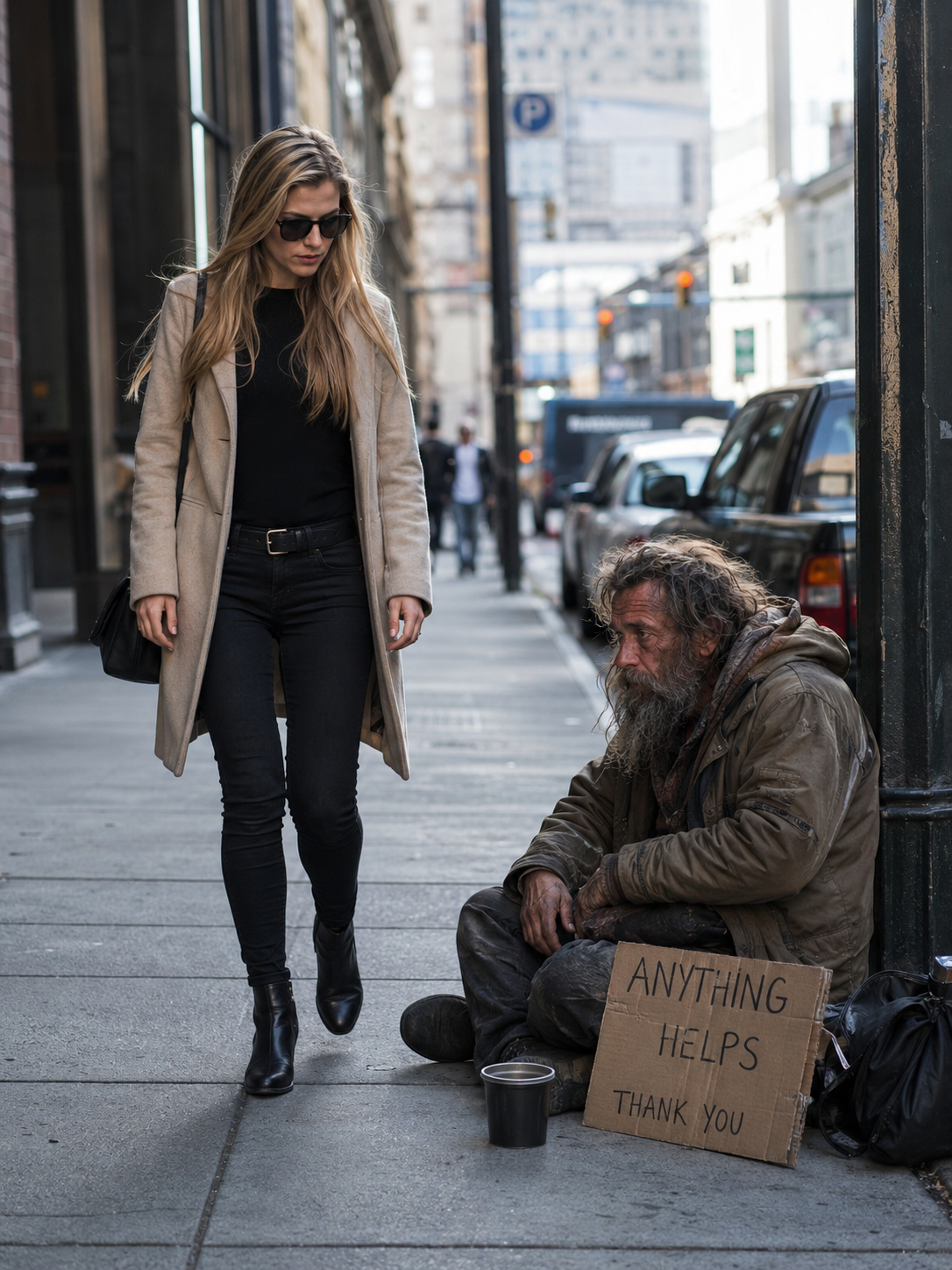
Every morning at exactly 8:10, Isabella Whitmore walked down 34th Street with her head high, her sunglasses on, and the world quietly moving around her like it was afraid to touch her.
She was beautiful in the kind of way people noticed before they even meant to. Long blonde hair. Clear blue eyes. Soft skin. Expensive coat. Black boots that clicked against the sidewalk like each step had been planned by someone who had never known hunger.
People looked at her and saw money.
They saw elegance.
They saw a woman who probably had drivers, assistants, private doctors, and a family name strong enough to open doors before she even knocked.
And they were right.
Isabella came from one of the richest families in Boston. Her father, Charles Whitmore, owned hotels, office buildings, and restaurants across three states. Her mother, Margaret, ran charity events where wealthy women wore diamonds and talked about helping the poor while drinking wine that cost more than someone’s rent.
Isabella had grown up in marble hallways, private schools, quiet cars, and dinner tables where people smiled without warmth.
She had everything.
But somehow, she always felt like she was walking through life inside a glass box.
Everyone could see her.
No one could reach her.
And every morning, as she walked toward the tall glass building where she worked, she passed the same man sitting against the wall near an old coffee shop.
He was a Black man in his early thirties, but hardship had made him look older. His hair was messy, his beard untrimmed, his coat torn at the sleeve. His hands were rough and cracked from cold weather. Beside him sat a cardboard sign:
ANYTHING HELPS. THANK YOU.
Most people walked past without looking.
Some looked for one second, then quickly looked away, as if poverty was something contagious.
Some dropped coins without stopping.
Some whispered cruel things.
But the man never shouted.
Never begged loudly.
Never chased anyone.
He simply sat there, quiet, with a paper cup near his feet and tired eyes that seemed to carry too many winters.
His name was Marcus Reed.
But to the city, he was just another homeless man on the sidewalk.
To Isabella, at first, he was barely even that.
He was part of the street.
Like a lamp post.
Like a trash bin.
Like something she saw so often that she stopped seeing it.
That morning, the wind was sharp. People walked fast, shoulders tight, coffee cups in hand. Isabella was late for a meeting, and her phone kept vibrating inside her purse.
Her mother.
Again.
Isabella ignored it.
Then a message appeared.
Mother:
Dinner tonight. Adrian will be there. Please dress properly.
Isabella stopped walking for half a second.
Adrian.
Of course.
Adrian Blackwell was rich, handsome, educated, and exactly the kind of man her parents wanted her to marry.
He had perfect teeth, perfect manners, and eyes that never smiled unless someone important was watching.
Isabella hated how everyone acted like her future had already been signed.
She kept walking, angry now, her steps faster.
As she passed Marcus, her purse slipped from her shoulder. A small black wallet fell out and hit the sidewalk.
She didn’t notice.
Marcus did.
He looked at the wallet.
Then at Isabella.
For a moment, he could have done what many desperate people might have done. Inside that wallet could be cash, cards, maybe enough money to eat well for a week. Maybe enough to get a room for the night.
His stomach was empty.
His hands were cold.
His shoes had holes.
But Marcus picked up the wallet and stood.
“Miss,” he called.
Isabella didn’t turn.
“Miss!”
She stopped, annoyed, and looked back.
Marcus walked toward her slowly, holding the wallet out.
“You dropped this.”
Isabella stared at him.
Then at the wallet.
Her face changed from irritation to surprise.
“Oh.”
She took it quickly.
For one second, her fingers brushed his. His hand was freezing.
“Thank you,” she said.
Marcus nodded and started to turn away.
Isabella opened the wallet, checked quickly, and saw that everything was still there.
Cards.
Cash.
Even the diamond bracelet receipt she had forgotten about.
She looked back at Marcus.
“You didn’t take anything.”
He turned around.
His expression did not change.
“No.”
The answer was so simple that Isabella felt embarrassed for checking.
“I didn’t mean—”
“Yes, you did,” Marcus said calmly.
His voice wasn’t angry.
That made it worse.
Isabella swallowed.
“I’m sorry.”
Marcus nodded again.
“You have a good day.”
He went back to his spot, sat down, and pulled his torn coat tighter around himself.
Isabella stood there for a moment, holding her wallet.
Then she reached inside, pulled out a hundred-dollar bill, and walked back toward him.
“Here,” she said.
Marcus looked at the money.
Then at her.
“I didn’t return your wallet for a reward.”
“I know. But you helped me.”
He looked at the bill again.
A hundred dollars.
To Isabella, it was nothing.
To Marcus, it was food, socks, maybe a warm place for one night.
Still, he didn’t take it right away.
“You always carry money like that?” he asked.
She blinked. “What?”
“Hundreds. In your wallet.”
“I guess.”
Marcus gave a sad little smile.
“Must be nice to guess about money.”
Isabella felt heat rise in her cheeks.
“I didn’t mean it that way.”
“I know.”
There it was again.
That calm voice.
That dignity.
It made her uncomfortable because he didn’t act like someone beneath her.
He acted like a man who had lost things but not himself.
Finally, he took the bill.
“Thank you,” he said.
Isabella nodded.
She wanted to leave.
But something kept her standing there.
“What’s your name?” she asked.
He looked surprised.
“Marcus.”
“I’m Isabella.”
“I know.”
Her eyebrows lifted. “You know?”
“You pass here every morning.”
She looked away.
Of course he noticed.
She had passed him for weeks and never once asked his name.
“I’m sorry,” she said again.
Marcus looked at her, this woman with expensive clothes and guilty eyes.
“For what?”
“For not seeing you.”
The words came out before she could stop them.
Marcus was quiet.
Then he said, “Most people don’t.”
That sentence followed Isabella into her office.
It stayed with her during the meeting.
It sat beside her while men in suits discussed profit margins and expansion plans.
It whispered in her mind when Adrian texted:
Adrian:
Looking forward to dinner tonight. Your father says we should talk about the future.
The future.
Everyone wanted to talk about her future.
But no one ever asked what kind of future she wanted.
That evening, Isabella sat at a long dining table under a chandelier that looked like frozen rain.
Her father sat at the head of the table.
Her mother sat beside him.
Adrian sat across from her, wearing a navy suit and a confident smile.
“You look tired,” Adrian said.
“I am.”
“Work?”
“Life.”
He laughed softly, as if she had said something cute.
Her father looked up from his wine.
“Your mother tells me you were late to the office this morning.”
Isabella stared at him.
“How would Mom know that?”
Margaret smiled calmly.
“Your assistant mentioned it.”
“My assistant reports to you now?”
“Don’t be dramatic,” her father said.
Isabella looked down at her plate.
Adrian leaned closer.
“Your father only worries because you matter.”
“No,” Isabella said quietly. “He worries because I don’t obey fast enough.”
The table went silent.
Charles set down his glass.
“Excuse me?”
Margaret’s smile disappeared.
“Isabella.”
Adrian shifted uncomfortably.
Isabella stood.
“I’m not hungry.”
Her father’s voice hardened.
“Sit down.”
She looked at him.
For twenty-six years, those two words had controlled her.
Sit down.
Smile.
Dress properly.
Speak softly.
Marry well.
Be grateful.
But that morning, a man with nothing had returned her wallet without taking a single dollar.
And somehow, that small act made her realize how much her own family had taken from her while pretending it was love.
“I said I’m not hungry,” she repeated.
Then she walked out.
The next morning, Isabella did something unusual.
She bought two coffees.
One black.
One with cream.
She didn’t know how Marcus liked it.
When she reached the sidewalk, he was there, sitting in the same spot, hands tucked under his arms for warmth.
She stopped in front of him.
“Coffee?”
He looked up slowly.
“You buying coffee for every homeless man now?”
“Only the honest ones.”
He almost smiled.
“That’s a dangerous standard.”
She handed him the black coffee.
“I didn’t know how you take it.”
“Hot is enough.”
He wrapped his hands around the cup like it was something precious.
Isabella sat on the edge of the low stone wall nearby.
Marcus looked at her strangely.
“Your coat will get dirty.”
“It’s just a coat.”
“You sure?”
She looked at him.
“No. But I’m trying to become sure.”
That made him smile for real.
It changed his whole face.
For the first time, Isabella noticed he was younger than he looked. There was warmth under the tiredness. There was intelligence in his eyes. There was a quiet sadness, but also something strong.
“What happened to you?” she asked.
As soon as she said it, she regretted it.
Marcus looked down at his coffee.
“People always ask that like life breaks in one moment.”
“I’m sorry. You don’t have to answer.”
He took a slow sip.
“No. It’s okay.”
He looked at the cars moving along the street.
“I used to work in a restaurant kitchen. I wanted to become a chef. Not famous. Just good. I was saving money. Taking night classes. My mother was sick, so most of what I earned went to her medicine.”
Isabella listened quietly.
“She died anyway,” he said.
His voice didn’t break.
That made it hurt more.
“After that, I fell behind on rent. Lost the room. Lost the job because I kept missing shifts. Then I slept in shelters, then on friends’ couches, then there were no friends left who could help. One bad month became two. Two became a year.”
He looked at her.
“That’s what happened. Not one big dramatic thing. Just life pushing and pushing until I couldn’t push back.”
Isabella felt something tighten in her chest.
“I’m sorry.”
“People say that a lot.”
“I mean it.”
“I know.”
They sat in silence for a while.
Then Marcus asked, “What happened to you?”
Isabella frowned. “Me?”
“Yeah.”
“I’m not homeless.”
“No,” he said. “But you look trapped.”
She stared at him.
No one had ever said it so directly.
“Maybe I am,” she whispered.
Marcus nodded.
“Different kind of cold.”
That morning changed something.
Isabella began stopping every day.
Sometimes for two minutes.
Sometimes for twenty.
She brought coffee.
Then sandwiches.
Then gloves.
Marcus accepted food and coffee, but he refused anything that felt like pity.
One day she brought him a new coat.
He looked at it and shook his head.
“No.”
“It’s freezing.”
“I said no.”
“Why?”
“Because you don’t get to dress me like a project.”
The words hit her hard.
“I wasn’t trying to.”
“I know you weren’t. But kindness without respect can still feel like control.”
Isabella sat beside him, hurt but listening.
“What should I do then?”
Marcus looked at her.
“Ask.”
She nodded slowly.
“Do you need a coat?”
He looked away.
Then, quieter, he said, “Yes.”
She handed it to him again.
This time, he took it.
That was the first lesson Marcus taught her:
Kindness is not just giving what you want to give.
Kindness is giving in a way that lets the other person keep their dignity.
Weeks passed.
People began noticing them.
A rich woman sitting with a homeless man on the sidewalk was not something the city ignored.
Some people took photos.
Some whispered.
One morning, Isabella’s mother called before she reached Marcus.
“Are you out of your mind?” Margaret snapped.
“Good morning to you too.”
“Do not joke with me. There is a picture of you online sitting next to some filthy man on the street.”
Isabella stopped walking.
“He has a name.”
“I don’t care what his name is.”
“I do.”
“Your father is furious.”
“Of course he is.”
“People are talking, Isabella. Do you understand how this looks?”
Isabella looked ahead.
Marcus sat under the coffee shop window, reading an old newspaper someone had left behind.
“Yes,” she said. “It looks like I’m talking to a human being.”
Her mother went quiet.
Then her voice became cold.
“You are embarrassing this family.”
Isabella watched Marcus turn a page carefully, as if even a newspaper deserved respect.
“No,” she said. “I think this family has embarrassed itself for years.”
She hung up.
That evening, her father waited for her in his study.
The room smelled like leather, expensive cigars, and power.
He held his phone up.
On the screen was a photo of Isabella and Marcus sitting together.
“Explain this.”
“There’s nothing to explain.”
“You are sitting on a sidewalk with a beggar.”
“His name is Marcus.”
Charles laughed without humor.
“You know his name. Wonderful. Should I invite him to dinner?”
“Yes.”
Her father’s smile vanished.
“Do not test me.”
“I’m serious.”
“So am I. You will stop this immediately.”
“No.”
Charles stood.
“You forget who you are.”
Isabella looked at him with tired eyes.
“No, Dad. I think I’m finally remembering.”
He walked closer.
“That man does not belong in your world.”
“Maybe my world is the problem.”
“He wants money.”
“He returned my wallet with all the money inside.”
“He wants access.”
“He didn’t even ask for help.”
“Then he wants sympathy.”
Isabella’s voice rose.
“And what do you want? Control?”
Charles stared at her.
Margaret stood near the doorway, pale and angry.
Adrian was also there, of course. Somehow he always appeared when her family wanted to remind her of the life they had chosen for her.
Adrian stepped forward gently.
“Isabella, your father is only trying to protect you. People like that can be dangerous.”
Isabella looked at him.
“People like what?”
Adrian hesitated.
“Unstable. Desperate.”
She smiled sadly.
“I’ve met desperate rich people too. They’re just better dressed.”
Charles slammed his hand onto the desk.
“Enough.”
Isabella didn’t flinch.
For the first time, she saw her father clearly.
Not as a giant.
Not as a king.
Just a man who was terrified of losing control.
“You will not see him again,” Charles said.
“I will decide who I see.”
“You live under my roof.”
“Then maybe I shouldn’t.”
The room went silent.
Margaret’s hand flew to her chest.
“Isabella.”
But Isabella was already walking out.
That night, she packed a suitcase.
Not because she had nowhere to go.
But because she finally understood that a beautiful cage was still a cage.
She rented a small apartment downtown.
It had old floors, noisy pipes, and a kitchen barely big enough for one person.
But when she closed the door behind her, she cried.
Not from sadness.
From freedom.
The next morning, she found Marcus gone.
His spot was empty.
The cardboard sign remained, folded against the wall.
ANYTHING HELPS. THANK YOU.
Her heart dropped.
She asked the coffee shop owner.
He shrugged.
“Haven’t seen him today.”
She checked nearby streets.
Shelters.
Soup kitchens.
The small park near the train station.
Nothing.
For three days, Marcus disappeared.
On the fourth day, Isabella found him outside a church basement where volunteers served dinner.
His face was bruised.
His lip was split.
One eye was swollen.
She ran to him.
“Marcus!”
He turned away.
“What happened?”
“Nothing.”
“That is not nothing.”
“I’m fine.”
“No, you’re not.”
He looked embarrassed.
More than hurt.
“I got jumped.”
Her stomach twisted.
“By who?”
“Three guys. They wanted my shoes.”
“Your shoes?”
He laughed bitterly.
“Yeah. Funny, right? Even when you have almost nothing, someone still thinks you have too much.”
Isabella’s eyes filled with tears.
“Come with me.”
“No.”
“Marcus.”
“No.”
“You need a doctor.”
“I need people to stop looking at me like I’m broken.”
She stepped back.
His words were sharp, but his pain was sharper.
“I’m not trying to hurt you,” she said softly.
“I know.”
“Then let me help.”
He looked at her for a long time.
“Why?”
She didn’t understand.
“Why what?”
“Why do you care so much?”
The question was simple.
But Isabella had no simple answer.
Because he returned her wallet?
Because he saw she was trapped?
Because he made her feel human?
Because when she sat beside him, she didn’t feel like a rich man’s daughter or Adrian’s future wife or a family symbol?
She felt like herself.
“I don’t know,” she whispered. “But I do.”
Marcus looked away.
“You shouldn’t.”
“But I do.”
That night, Marcus went with her.
Not to a hospital.
He refused that.
But to a free clinic Isabella found after calling six places.
He sat silently while a tired doctor cleaned his wounds.
Isabella waited beside him.
When the doctor left, Marcus said, “You don’t have to stay.”
“I know.”
“You keep saying that.”
“Because I keep meaning it.”
He looked at her, and something changed in his eyes.
A wall cracked.
Just a little.
Not enough for love.
Not yet.
But enough for trust.
Days became weeks.
Isabella helped Marcus get replacement documents. A state ID. A social security card. A phone with a cheap plan. A safe place at a transitional housing center.
She did not do it by throwing money at him.
She sat with him in waiting rooms.
She filled forms only when he asked.
She listened when he got angry.
She stayed when he got ashamed.
And Marcus, slowly, began to stand again.
He got a job washing dishes at a small diner.
The first night after work, he showed Isabella his hands.
They were red and cracked from soap and hot water.
But he was smiling.
“I earned eighty-six dollars,” he said.
Isabella smiled back.
“You sound proud.”
“I am.”
“You should be.”
He looked at her.
“You don’t understand how good it feels to be tired from work instead of tired from surviving.”
She did understand, not fully, but enough to be quiet.
Marcus started saving.
Small amounts.
Ten dollars.
Fifteen.
Twenty.
He bought secondhand boots.
Then clean shirts.
Then a haircut.
But he refused to become someone else.
“I’m not ashamed of where I came from,” he told Isabella one evening.
They were sitting at a cheap American street food stand, eating hot dogs and chili fries.
“I’m ashamed of how people treated me there.”
Isabella nodded.
“I was ashamed too.”
“Of what?”
“Being rich.”
Marcus shook his head.
“Don’t be ashamed of having money. Be ashamed only if it makes you blind.”
She looked at him.
There it was again.
That quiet wisdom from a man the world had stepped over.
“You should write a book,” she said.
He laughed.
“Title: Advice from a Man Who Slept Behind a Laundromat.”
“I’d read it.”
“You’d be the only one.”
“No,” Isabella said. “I think more people need to hear you.”
Marcus looked down at his food.
“I don’t need people to hear me. I just need them to see people like me before we become invisible.”
Their friendship became something deeper before either of them named it.
It happened in small ways.
The way Marcus walked Isabella home even when he was tired.
The way Isabella remembered he hated onions.
The way he made her laugh when her family made her cry.
The way she looked at him not with pity, but with belief.
One night, outside her apartment, snow began falling.
Isabella stood under the doorway.
Marcus pulled his coat tighter.
“You should go inside,” he said.
“So should you.”
“I have a place now.”
“I know. I just like hearing it.”
He smiled.
Then silence.
Soft snow.
Cold air.
Streetlights glowing.
Isabella looked at him and whispered, “I’m proud of you.”
Marcus looked away.
“Don’t say things like that.”
“Why?”
“Because I might start needing to hear them.”
She stepped closer.
“Maybe that’s okay.”
His eyes met hers.
For a moment, the city disappeared.
Then he kissed her.
Not like a movie.
Not dramatic.
Just a gentle, scared, honest kiss between two people who had both been lonely in different worlds.
When he pulled away, he looked terrified.
“I’m sorry.”
“I’m not,” Isabella said.
“Your family will hate this.”
“They already hate most things I choose.”
“I’m serious.”
“So am I.”
Marcus shook his head.
“You don’t know what this will cost you.”
Isabella touched his face.
“I know what it costs to live without choosing myself.”
He closed his eyes.
“Isabella…”
“Don’t run.”
He opened his eyes.
She saw the fear there.
Not fear of love.
Fear of being rejected after believing in it.
“I’m not your charity,” he said.
“No.”
“I’m not a story you tell rich people to prove you’re kind.”
“No.”
“I’m not someone you fix.”
“No,” she whispered. “You’re someone I love.”
The words stunned them both.
Marcus stepped back.
Pain crossed his face.
“I can’t.”
Her heart dropped.
“Can’t what?”
“I can’t be loved by you.”
“Why?”
“Because one day you’ll wake up and realize I don’t belong beside you.”
“That is not your decision.”
“It is if I’m the one who leaves first.”
And just like that, he walked away.
For the first time, Isabella understood something painful.
Sometimes the world hurts people so deeply that love feels like danger.
Marcus did not leave because he didn’t care.
He left because he cared too much and believed he wasn’t worthy.
The next day, he avoided her.
Then the next.
On the third day, she found him behind the diner taking out trash.
“Marcus.”
He sighed.
“I’m working.”
“Then listen while working.”
“I don’t want to fight.”
“Good. Because I came to tell you something, not fight.”
He looked at her.
She stood there in a simple coat, no sunglasses, no jewelry, no rich-girl mask.
“You don’t get to decide that you are too poor for love,” she said. “You don’t get to punish me for what other people did to you. And you don’t get to call yourself unworthy just because the world was cruel.”
His jaw tightened.
“You don’t understand.”
“Then explain.”
“I was nothing when you met me.”
“No,” she said. “You had nothing. That’s different.”
He froze.
She stepped closer.
“You were honest when you could have stolen. You were kind when no one was kind to you. You protected your dignity when the world tried to strip it away. That is not nothing, Marcus. That is everything.”
His eyes turned wet, but he looked away.
“I’m scared,” he admitted.
“So am I.”
“What if I fail?”
“Then we learn.”
“What if your family destroys me?”
“They tried to destroy me too. I’m still here.”
“What if love isn’t enough?”
Isabella took his hand.
“Then kindness will help us carry what love cannot.”
That was the day Marcus stayed.
But peace did not come easily.
When Charles Whitmore learned his daughter was in love with Marcus Reed, the city felt too small for his anger.
He sent men to investigate Marcus.
He found old records, unpaid debts, shelter addresses, every piece of Marcus’s pain that could be twisted into shame.
Then he invited Isabella to lunch.
She knew it was a trap.
She went anyway.
Her father sat across from her in an expensive restaurant where every plate looked like art and no one ever seemed full.
“I know about him,” Charles said.
“His name is Marcus.”
“He has no education.”
“He has intelligence.”
“He has no family.”
“He has character.”
“He has no money.”
“He has dignity.”
Charles leaned forward.
“Dignity will not protect you from a hard life.”
“No,” Isabella said. “But money didn’t protect me from an empty one.”
Her father’s face darkened.
“You think this is love? This is rebellion.”
“Maybe at first,” she admitted. “But not anymore.”
“He will use you.”
“He had the chance before he even knew my name. He didn’t.”
“You are naive.”
“And you are cruel.”
Charles stared at her as if she had slapped him.
Isabella stood.
“I spent my whole life watching you donate money to poor people in public and insult them in private. I thought that was normal. Then I met a man on the street who had more honesty in his empty pocket than you had in your whole bank account.”
Charles stood too.
“Do not speak to me that way.”
“Then become someone I can speak to with respect.”
She left him there.
That night, Marcus found out what had happened.
He was angry.
Not at Charles.
At himself.
“I’m making your life harder.”
“No. My father is.”
“Because of me.”
“Because of his pride.”
Marcus sat on the edge of her sofa, head in his hands.
“I don’t want to be the reason you lose your family.”
Isabella sat beside him.
“A family that only loves me when I obey is not love. It’s management.”
He laughed despite himself.
“You talk like you’ve been waiting to say that for years.”
“I have.”
He looked at her.
“You sure about this?”
“No.”
That surprised him.
She smiled softly.
“I’m not sure about anything. But I know I don’t want a life built on fear.”
Marcus took her hand.
“Then we go slow.”
“We go honest.”
“Honest,” he agreed.
For a while, they were happy.
Not perfect.
But real.
Marcus worked.
Isabella started volunteering at a housing nonprofit, not for photos, not for charity events, but because she wanted to understand the system that had swallowed people like Marcus.
She learned that homelessness was not laziness.
It was medical bills.
Lost jobs.
Family abuse.
Addiction.
Rent increases.
Mental health.
Bad luck.
Pride.
Shame.
A thousand doors closing one by one.
She also learned that kindness could open doors, but kindness without action was only a warm feeling.
So she acted.
She used her money, quietly, to fund job training.
She helped create a program for people leaving shelters.
She asked Marcus to advise them.
At first, he refused.
“I’m not some success story.”
“No,” Isabella said. “You’re a human story. That’s better.”
The first time Marcus spoke at the center, only six people came.
He stood in front of them wearing a clean shirt, nervous hands, and the same eyes that had once stared at the sidewalk.
“I don’t have magic advice,” he said. “I still wake up scared sometimes. I still check my pocket like everything might disappear. But I know this: don’t let the world make you believe you are what happened to you. You are not your lowest day.”
One woman in the back started crying.
Marcus stopped.
Then continued.
“If someone helps you, take the help. But don’t let them own you for it. And if someone looks down on you, remember, they are only looking from the height of their pride, not the height of truth.”
Afterward, Isabella found him outside.
“You were amazing.”
He laughed nervously.
“I almost threw up.”
“Still amazing.”
He looked at her.
“You did this.”
“No,” she said. “You did.”
Marcus shook his head.
“You saw me when I didn’t know how to see myself.”
Isabella smiled.
“You returned my wallet.”
He smiled back.
“You returned my life.”
But the human world is complicated.
Not everyone loves kindness.
Some people hate it because it exposes them.
Charles Whitmore began losing business.
Bad investments.
A lawsuit.
A partner who betrayed him.
For years, Charles had believed money made him untouchable.
Then money began leaving.
Fast.
Banks called.
Investors pulled out.
Hotels lost contracts.
The family name, once powerful, became fragile.
Margaret called Isabella one night.
Her voice was shaking.
“Your father is in trouble.”
Isabella closed her eyes.
“What kind of trouble?”
“The business. It’s bad.”
“I’m sorry.”
“We need you to come home.”
“Why?”
Margaret hesitated.
“Adrian’s family may help. But he wants to speak to you.”
There it was.
The price.
Isabella felt cold.
“You want me to marry Adrian to save Dad’s company.”
Margaret cried softly.
“I don’t know what else to do.”
For a moment, Isabella said nothing.
She thought of her father’s cruelty.
His pride.
His threats.
His disgust toward Marcus.
Then she thought of her mother, who had never truly been free either. A woman trained to protect a family image until she forgot how to protect her own daughter.
“I’ll come,” Isabella said. “But not for Adrian.”
When she arrived at the mansion, it looked the same.
Tall gates.
Bright windows.
Perfect garden.
But inside, fear had changed the air.
Charles looked older.
Margaret looked smaller.
Adrian stood near the fireplace with a glass in his hand, calm as a man shopping for something he already believed belonged to him.
“Isabella,” he said.
She ignored him and looked at her father.
“What happened?”
Charles would not meet her eyes.
Adrian answered instead.
“Your father made some unfortunate decisions. My family can help.”
“I asked him.”
Adrian smiled.
“Still sharp.”
Isabella turned to him.
“What do you want?”
Adrian looked amused.
“Direct. I like that.”
“I don’t care what you like.”
His smile faded.
“I want what was promised before you got distracted by your sidewalk romance.”
Margaret flinched.
Charles closed his eyes.
Isabella stared at Adrian.
“You want marriage.”
“I want partnership.”
“You want ownership.”
Adrian stepped closer.
“I can save your family.”
“Then do it because you’re decent.”
He laughed.
“Decency is not a business plan.”
Isabella nodded slowly.
“Thank you.”
“For what?”
“For reminding me that wealth and worth are not the same thing.”
She turned to leave.
Charles finally spoke.
“Isabella, please.”
She stopped.
His voice was broken.
Not commanding.
Not powerful.
Just afraid.
She turned back.
“I will help you if I can. But I will not sell my life to fix your mistakes.”
Charles looked at her then.
Really looked.
Maybe for the first time.
And shame entered his face.
“You sound like him,” he said quietly.
“Good.”
She walked out.
That night, she told Marcus everything.
He listened silently.
Then he stood, put on his coat, and grabbed his keys.
“Where are you going?” she asked.
“To see your father.”
“No.”
“Yes.”
“Marcus, he humiliated you.”
“I know.”
“He doesn’t deserve your help.”
“I know.”
“Then why?”
Marcus looked at her.
“Because kindness isn’t real if we only give it to people who deserve it.”
Isabella had no answer.
Marcus went to Charles Whitmore’s office the next morning.
The receptionist almost refused to let him in until Charles came out and saw him.
The two men stood facing each other.
Once, Charles had looked at Marcus like dirt.
Now Marcus stood clean, calm, and steady, while Charles looked like a man watching his empire burn.
“What do you want?” Charles asked.
“To help.”
Charles gave a bitter laugh.
“You?”
“Yes.”
“I suppose my daughter sent you.”
“No. She told me not to come.”
That surprised him.
Marcus placed a folder on the desk.
“I know a nonprofit investor group that buys distressed property and turns part of it into affordable housing. Your old East Harbor hotel is failing. Sell it to them before the bank takes it. You won’t save everything, but you’ll stop the bleeding.”
Charles stared at the folder.
“Why would you help me?”
Marcus looked at him calmly.
“Because if you collapse, Isabella suffers. And I love her more than I dislike you.”
Charles lowered his eyes.
That sentence hit harder than any insult.
“What do you want in return?”
Marcus smiled sadly.
“That question is why you lost so much.”
He turned to leave.
Charles spoke behind him.
“I was wrong about you.”
Marcus stopped.
For a moment, the room was quiet.
Then Marcus said, “No. You were wrong about people.”
Charles sat down slowly.
Marcus left.
The deal saved part of the Whitmore business.
Not all.
But enough.
More importantly, it changed something in Charles.
For the first time, he began visiting the housing center Isabella supported.
At first, everyone knew he was uncomfortable.
He wore expensive suits and didn’t know how to talk to people who didn’t want anything from him except respect.
One day, he saw a man sitting alone with a cardboard sign.
The same words:
ANYTHING HELPS.
Charles stood there for a long time.
Then he sat beside him.
Not above him.
Beside him.
“What’s your name?” Charles asked.
The man looked suspicious.
“Robert.”
Charles nodded.
“I’m Charles.”
Robert looked at his suit.
“You lost?”
Charles smiled sadly.
“For many years, yes.”
Months later, Isabella and Marcus married.
Not in a cathedral.
Not in a five-star hotel.
They married in a small public garden near the street where they first met.
The guests were a strange mix of people.
Former shelter residents.
Kitchen workers.
Business people.
Volunteers.
A nervous mother.
A humbled father.
And one man named Robert who cried openly during the vows.
Marcus wore a simple suit.
Isabella wore a white dress that moved softly in the wind.
Her blue eyes shone not because she had found a perfect life, but because she had found a true one.
When it was time for Marcus to speak, he looked at her and said:
“When you first saw me, I was sitting on a sidewalk with a sign that said anything helps. I thought I needed money. Food. A warm place. And I did. But what helped me most was being seen. You saw me when the world stepped around me. You gave without making me small. You loved without making me your project. I promise to spend my life giving that same kindness back to you and to anyone life leaves on the sidewalk.”
Isabella wiped her tears.
Then she said:
“I thought I had everything before I met you. But I had comfort without courage, money without meaning, and family without freedom. You taught me that a person’s value is not in their clothes, their house, their job, or their bank account. Their value is in their heart. I choose you, Marcus, not because I saved you, but because loving you saved the best part of me.”
Charles cried.
Margaret held his hand.
After the ceremony, they served hot dogs, chili fries, coffee, and simple food from the street stand where Marcus and Isabella had first eaten together.
Some guests laughed.
Some called it unusual.
Isabella called it perfect.
Years later, the sign was framed and hung inside the housing center.
ANYTHING HELPS. THANK YOU.
Under it, Marcus added one sentence:
But respect helps most.
Moral Life Lesson
In the real human world, people often judge by clothes, money, beauty, race, job, or status. But none of those things show the full truth of a person.
A poor man can have a rich heart.
A rich person can live with an empty soul.
A small act of kindness can change someone’s whole life.
And respect is more powerful than pity.
Kindness does not always win quickly. Sometimes it is mocked. Sometimes it is rejected. Sometimes it looks weak in front of money and pride. But in the end, kindness wins because it heals what power cannot touch.
Never step over someone just because life has pushed them down. One day, the person you ignored may be the person who teaches you what it really means to be human.