PART 3: THE PROMOTION THAT CAME FROM A GRAVE
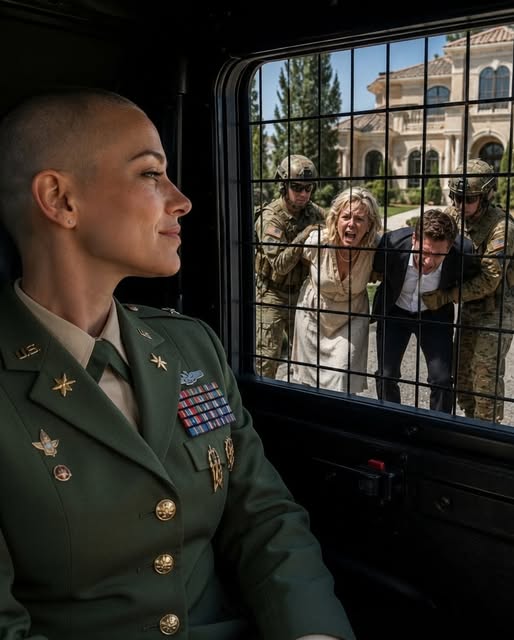
The anonymous message glowed on my screen.
Your husband was never the target. You were.
Then the second line appeared.
Ask General Grant why your promotion became available.
I looked up slowly.
General Thomas Grant stood across the kitchen table, his hands resting beside the sealed folder containing evidence about my brother’s death. Around us, federal agents moved through my house, photographing documents, sealing computers, and carrying boxes through the front door.
Yet the entire room seemed to narrow until only the general and I remained.
“What does this mean?” I asked, turning the phone toward him.
He read the messages without blinking.
Then he exhaled.
“It means they know we found the file.”
“Who are they?”
“Meridian.”
“You said my brother uncovered their surveillance operation.”
“He did.”
“And now someone claims my promotion was connected to his death.”
Grant’s jaw tightened.
“The position you assumed today belonged to Colonel Stephen Vale.”
“I know.”
Vale had been a respected intelligence officer with twenty-seven years of service. Six weeks earlier, he had supposedly suffered a fatal heart attack while jogging.
Grant opened the folder and removed another photograph.
It showed Vale entering Meridian headquarters two days before his death.
“What was he doing there?” I asked.
“Investigating a leak inside Army intelligence.”
My pulse quickened.
Grant continued, “Vale believed Meridian had recruited someone with access to classified communications. Before he could identify the source, he died.”
“And you promoted me into his command.”
“I recommended you because your record was clean.”
“Or because of Andrew?”
“Both.”
The answer struck me harder than a lie.
“You used me.”
“I positioned you where you could finish what your brother began.”
“You let me walk into a command already compromised.”
“I gave you security support.”
“My own husband sold access to my land.”
Grant’s expression darkened. “I did not know Ryan was involved.”
“You knew Meridian wanted the property.”
“Yes.”
“And you said nothing.”
“Because the moment you knew, your reactions could be monitored.”
I stared at him.
“My brother is dead. Vale is dead. My husband forged my signature. My mother-in-law assaulted me. And you decided I was safer ignorant?”
“No,” he said quietly. “I decided you were safer angry at the wrong people than afraid of the right ones.”
The words silenced me.
Before I could respond, a federal agent entered.
“General, Colonel, we found something.”
He led us to the basement.
Behind a wall panel near the electrical box, agents had discovered a small transmitter connected to the house’s internet system. It had recorded audio from nearly every room.
My marriage had not merely been abusive.
It had been under surveillance.
Agent Ortiz held up a plastic evidence bag containing the device.
“This is professional equipment,” he said. “Your husband could not have installed it alone.”
A sound came from upstairs.
Glass shattered.
Then the lights went out.
“Everyone down!” an agent shouted.
A sharp crack tore through the darkness.
Gunfire.
General Grant pulled me behind the concrete stairwell as agents rushed toward the first floor. Another shot struck the basement door.
Ryan had already been taken away.
Linda was in custody.
So who was attacking my house?
A figure moved near the basement window.
I saw the brief flash of metal.
I grabbed the fire extinguisher from the wall and hurled it through the glass. The attacker recoiled. Grant lunged forward, seized the man’s arm, and dragged him against the window frame.
Agents swarmed him.
When they removed his mask, Grant went still.
I recognized the man from command photographs.
Lieutenant Colonel Aaron Pike.
My new deputy commander.
The officer who had welcomed me that morning with a salute and a smile.
Pike looked directly at me.
“You should have resigned when they shaved your head.”
“Were you the leak?” I asked.
He smiled through blood on his lip.
“I was one of them.”
Before agents could search him, his body convulsed.
Foam appeared at his mouth.
Poison.
Within seconds, he was dead.
Inside his jacket, they found a Meridian identification card, a microdrive, and a folded note addressed to me.
The handwriting belonged to Ryan.
I tried to protect you. You never listened.
By dawn, I was seated inside a secure federal operations center beneath Washington. General Grant, Agent Ortiz, Captain Ruiz, and three intelligence officials stood around a glass table.
The microdrive contained encrypted files from my unit.
Pike had been sending Meridian classified information for six years.
But the worst discovery was a personnel list.
At the top were three names:
Captain Andrew Mercer.
Colonel Stephen Vale.
Colonel Evelyn Mercer.
Beside Andrew and Vale was one word.
Resolved.
Beside my name was another.
Active.
I stared at it until the letters blurred.
Grant placed a hand on the table.
“We need to remove you from command temporarily.”
“No.”
“Colonel—”
“They want me gone. Removing me gives them exactly what they want.”
“They may try again.”
“They already did.”
Ortiz leaned forward.
“The microdrive also contains payment records. Ryan received money from Meridian.”
“How much?”
“Two hundred thousand dollars.”
I felt something tear inside me.
“Then he knew.”
“We don’t know how much.”
I stood.
“Bring him to me.”
Two hours later, Ryan sat behind reinforced glass in a federal interview room.
His wrists were shackled.
The arrogance was gone.
For the first time since I had known him, he looked small.
“You said you tried to protect me,” I began.
His eyes lifted.
“I did.”
“You forged my signature.”
“They threatened to kill you.”
“So you stole my brother’s money?”
“I needed a way out.”
“You became engaged to another woman.”
“That was part of the cover.”
I almost laughed.
“Do not insult me with that.”
Ryan leaned closer to the glass.
“Meridian approached me a year ago. They knew about your property. They knew about your brother. They said if I helped transfer the land, they would leave you alone.”
“And you believed them?”
“No. But I believed they could destroy us.”
“So you joined them.”
“I tried to control the damage.”
“You let your mother shave my head.”
His face twisted.
“That was not supposed to happen.”
“But declaring me mentally unstable was?”
He lowered his eyes.
“I thought if you resigned, Meridian would stop seeing you as a threat.”
“You could have told me.”
“You are a soldier. You would have fought.”
“Yes.”
“And they would have killed you like Andrew.”
The room became still.
Ryan’s voice broke.
“I knew about Andrew.”
My hands flattened against the table.
“How?”
“Derek showed me the flight records. Meridian sabotaged his aircraft because he refused to surrender evidence.”
“Where is that evidence?”
“I don’t know.”
“You expect me to believe that?”
“Andrew hid it before he died. Meridian has spent eight years searching.”
“Then why target me?”
“Because they think he gave it to you.”
I remembered Andrew’s last visit before the crash. He had brought me a small wooden box containing childhood photographs, medals, and letters from our father.
I had never found anything unusual.
Ryan leaned toward the glass.
“They believe your promotion gives you access to the system where Andrew hid the proof.”
“What system?”
He swallowed.
“Operation Lantern.”
General Grant, watching from behind the observation window, suddenly entered.
“Who told you that name?”
Ryan’s face drained of color.
“Derek.”
Grant turned to me.
“Lantern was an abandoned intelligence archive. Your brother helped design its encryption.”
“Where is it?”
Grant’s voice dropped.
“No one knows.”
Ryan began shaking his head.
“You’re wrong.”
“What do you mean?” I asked.
He stared at me.
“Andrew told me where it was the week before he died.”
“Why would he tell you?”
“Because he thought I loved you.”
That sentence hurt more than anything else he had done.
Ryan whispered, “He said the key was hidden in the one place only you would understand.”
“What place?”
His answer made my breath stop.
“The house where you learned to obey.”
PART 4: THE HOUSE BENEATH THE HOUSE
There was only one place Andrew could have meant.
Our childhood home in Virginia.
Our father had ruled it with military discipline even after retiring from the Army. Every meal had been scheduled. Every mistake punished. Every emotion treated as weakness.
It was the first place Andrew and I learned obedience.
It was also the place we promised never to become like him.
The property had been abandoned since our father’s death.
By noon, General Grant and I were traveling there under federal protection.
The house appeared smaller than I remembered. White paint peeled from the siding. Weeds swallowed the front steps. One upstairs window hung open like a dark eye.
Inside, dust covered everything.
The living room still held our father’s heavy chair. The wall clock had stopped at 3:17, the time paramedics declared him dead.
Andrew and I used to hide beneath the staircase when arguments became violent.
I knelt beside the wooden paneling.
One board was newer than the others.
Grant helped remove it.
Behind the wall sat a metal box.
Inside were two objects.
A photograph of Andrew and me as children.
And a brass key.
On the back of the photograph, Andrew had written:
Evelyn, obedience kept us alive. Truth will set us free. Look beneath the place where he made us stand.
Our father had forced us to stand for hours on a square of black tile in the basement whenever we disobeyed him.
We descended.
The tile remained in the center of the concrete floor.
Beneath it, we found a hidden hatch.
A narrow staircase led underground.
At the bottom was a reinforced room filled with servers, cables, and sealed equipment.
Operation Lantern.
Andrew had built a secret archive beneath our childhood home.
When Grant inserted the brass key into the main console, the system came alive.
A recorded image of Andrew appeared on the screen.
He looked tired, but he smiled.
“If you are watching this, Evie, then I failed to come home.”
My knees nearly gave way.
Grant stepped back, giving me space.
Andrew continued.
“Meridian is not merely a corporation. It is a network of former military officers, contractors, politicians, and private investors. They have been stealing intelligence, manipulating defense contracts, and eliminating anyone who discovers the truth.”
Files began opening across the monitors.
Payment records.
Audio recordings.
Names.
Hundreds of names.
Then Andrew said something neither of us expected.
“General Grant is not part of Meridian.”
Grant exhaled.
“But someone close to him is.”
A photograph appeared.
Major General Thomas Grant stood beside a woman in civilian clothing.
His wife, Dr. Rebecca Grant.
“She founded Meridian’s behavioral research division,” Andrew said. “She used military families as pressure points, identifying spouses who could be manipulated to compromise service members.”
I turned toward Grant.
His face had gone gray.
“You knew?” I asked.
“No.”
“She left me twelve years ago.”
“She didn’t leave,” Andrew’s recording continued. “She disappeared into Meridian.”
Another image appeared.
Rebecca stood beside Linda.
My mother-in-law.
The photograph had been taken fifteen years earlier.
Linda was not an accidental participant.
She had been recruited long before Ryan married me.
The marriage itself had been arranged.
I stepped backward.
“No.”
Grant stared at the screen.
Andrew’s voice softened.
“Evie, I am sorry. Ryan was introduced to you because Meridian knew you were my sister. They believed he could monitor you.”
The room spun.
Every anniversary.
Every apology.
Every supposedly accidental meeting.
All of it had begun as an operation.
But then Andrew added, “Ryan tried to withdraw after your wedding. He may have loved you in his own damaged way. Meridian threatened his mother and forced him back into the network.”
Grant looked at me.
“That does not excuse what he did.”
“No,” I whispered. “It explains why he was afraid.”
The archive contained enough evidence to dismantle Meridian.
But before we could transmit it, the lights flickered.
Grant checked his phone.
“No signal.”
A mechanical lock engaged above us.
We were trapped underground.
Then Rebecca Grant’s face appeared on the screen.
She was older now, elegant and composed.
“Hello, Thomas,” she said.
Grant went rigid.
“Rebecca.”
“And Colonel Mercer. You look remarkably like your brother when you are angry.”
“You killed him.”
“I ordered a problem resolved.”
Grant stepped toward the camera.
“You manipulated my officers. You corrupted families.”
Rebecca smiled.
“Governments manipulate people every day. I merely became more efficient.”
On another monitor, live footage appeared.
Ryan sat bound to a chair in a warehouse.
Linda stood beside him, also restrained.
Rebecca said, “Give me the Lantern archive, and I will release them.”
I looked at Ryan.
He was bruised, terrified, and still alive.
“Why should I save them?” I asked.
“Because despite everything, you are not like us.”
She was right.
That was the cruelty of the choice.
I could let Ryan and Linda die and still be justified.
But I would never be free of the knowledge that I had chosen revenge over life.
“What guarantee do I have?” I asked.
“None.”
Grant whispered, “Do not trust her.”
“I don’t.”
I moved to the console.
Then I entered the transmission command.
Rebecca smiled.
“You finally learned obedience.”
“No,” I said. “I learned from Andrew.”
Instead of sending the archive to Meridian, I activated Lantern’s emergency broadcast.
Every file began uploading simultaneously to federal investigators, international oversight agencies, military prosecutors, and major news organizations.
Rebecca’s expression changed.
“What did you do?”
“I made secrecy impossible.”
Alarms exploded through the underground room.
Grant found the manual release.
We reached the surface as black smoke began rising from the servers. Lantern was destroying itself after transmission.
Outside, federal vehicles surrounded the house.
Rebecca’s signal had been traced.
Her warehouse was less than twenty miles away.
We arrived just as agents breached the building.
Ryan was rescued.
Linda was found unconscious but alive.
Rebecca escaped through a service tunnel.
Inside the warehouse, agents discovered files identifying dozens of Meridian operatives.
One name had been highlighted in red.
Colonel Evelyn Mercer: recruit if possible, eliminate if necessary.
Beneath it was a handwritten note.
She will choose mercy. Use that against her.
I read it twice.
Then I turned to General Grant.
“They think mercy makes me weak.”
He shook his head.
“They are about to learn the difference between mercy and surrender.”
PART 5: THE WOMAN WHO BUILT THE MONSTER
Within forty-eight hours, Meridian began collapsing.
Executives were arrested at airports. Defense contracts were suspended. Accounts were frozen across four countries. Three senators resigned before investigators reached their offices.
The Lantern files exposed everything.
But Rebecca Grant remained free.
And free people could still kill.
Ryan was placed under federal protection in exchange for cooperation. Linda was hospitalized under guard. Patricia entered a witness program.
I returned to command with a shaved head, visible scars, and the full support of the Army.
No one asked me to hide what had happened.
Instead, soldiers began approaching me privately.
One confessed that her husband controlled her salary.
Another admitted his wife threatened to destroy his career.
A civilian analyst told me she had been living in fear for six years.
My humiliation became something I had never expected.
A signal.
Evidence that survival did not require silence.
Then, one week later, a package arrived at headquarters.
Inside was a lock of dark brown hair.
Mine.
A note read:
You looked better obedient.
Rebecca.
Security footage showed the package had been delivered by a courier who disappeared before questioning.
That evening, General Grant entered my office.
“We located her.”
“Where?”
“An abandoned Meridian research facility in Maryland.”
“Then arrest her.”
“We cannot.”
“Why?”
He placed photographs on my desk.
The facility sat beneath a medical laboratory surrounded by civilian buildings. Rebecca had taken hostages.
Among them were twelve military spouses enrolled years earlier in a Meridian “resilience program.”
She had spent decades studying how fear controlled families.
Now she intended to erase the witnesses.
Grant’s voice hardened.
“She asked for you.”
“Of course she did.”
“She wants to speak alone.”
“No.”
“I wasn’t going to permit it.”
“I mean no civilians die because she wants me afraid.”
I wore body armor beneath civilian clothing and entered the facility with a hidden transmitter.
Rebecca waited in a glass-walled laboratory.
She looked almost kind.
“You have Thomas’s stubbornness,” she said.
“I have my own.”
“Your brother said that too.”
“Before you killed him?”
“He was offered a place beside me.”
“He refused.”
“He lacked imagination.”
Behind the glass, the hostages sat restrained.
“What do you want?”
“You.”
“You already had Ryan watching me.”
“Ryan was weak. He fell in love.”
“You arranged our marriage.”
“I arranged an introduction. Human beings arrange their own disasters.”
I moved closer.
“Why me?”
“Because your brother built Lantern around your psychological profile. The system responded to choices only you would make.”
Andrew had not merely trusted me.
He had made me the final key.
Rebecca continued, “I spent years studying you. Your discipline. Your loyalty. Your inability to abandon people, even those who betray you.”
“You mean mercy.”
“I mean predictability.”
She pressed a control.
Gas began flowing into the hostage room.
“You have five minutes,” she said. “Unlock the final Lantern partition, or they die.”
“What is inside it?”
“The identities of every intelligence operative Meridian placed overseas.”
“You want to protect them.”
“I want to preserve my life’s work.”
I approached the terminal.
The screen requested a biometric scan and a verbal answer.
A question appeared:
What did Father teach us?
Rebecca smiled.
“Obedience.”
I remembered the black tile.
The hours of punishment.
Andrew holding my hand in the darkness.
I leaned toward the microphone.
“He taught us what not to become.”
The system unlocked.
Rebecca’s smile vanished.
A final video appeared.
Andrew again.
“Evie, if Rebecca is watching this, she believes she understands you.”
Rebecca stepped toward the screen.
Andrew continued, “She does not understand love because she mistakes it for leverage.”
The terminal released the identities of Meridian operatives—but not to Rebecca.
It transmitted them to allied intelligence services worldwide.
At the same moment, the hostage-room ventilation reversed.
Fresh air flooded inside.
Rebecca reached for a weapon.
I was faster.
I struck her wrist, drove her against the console, and pinned her to the floor.
She laughed even with my knee against her shoulder.
“You think this ends with me?”
“No.”
“You cannot destroy an idea.”
“I’m not destroying an idea.”
Agents burst through the doors.
“I’m exposing a crime.”
As they handcuffed her, Rebecca looked toward General Grant.
“You always loved your soldiers more than me.”
Grant’s face held no anger.
“I loved the woman I believed you were.”
For the first time, Rebecca’s composure broke.
Not because she had been arrested.
Because she had become irrelevant.
As agents led her away, she turned toward me.
“Ryan will betray you again.”
I watched her disappear through the doors.
“Then he will face the consequences again.”
That night, I received a handwritten letter from Ryan.
He did not ask me to forgive him.
He wrote:
I was assigned to watch you. Then I loved you. Then I became afraid. Somewhere between those truths, I turned into the man you should have left years ago.
At the bottom, he had added:
There is one thing Meridian never knew. Andrew gave me a second key. I hid it where my mother would never look.
The letter included a small map.
It pointed to Linda’s church.
PART 6: THE SECRET UNDER THE ALTAR
Linda had attended Saint Matthew’s Church every Sunday for twelve years.
She donated publicly, judged everyone privately, and loved being seen in the front pew.
Ryan knew she would never search beneath the altar because she considered herself entitled to stand above everyone.
With a federal warrant, we entered the church basement.
Behind a loose stone, agents found a waterproof case.
Inside was a second Lantern key and a letter from Andrew addressed to Ryan.
Ryan had never opened it.
The seal remained intact.
I broke it carefully.
Ryan, if you are reading this, then you have finally chosen Evelyn over fear. Do not ask her to forgive you. Help her survive you.
My throat tightened.
Andrew had known Ryan was connected to Meridian.
Yet he had also believed Ryan might change.
The second key opened a hidden Lantern partition.
It contained financial accounts holding nearly nine hundred million dollars stolen by Meridian over twenty years.
But Andrew had programmed the funds to transfer only after two authorized individuals agreed on their destination.
One was me.
The other was Ryan.
Meridian had needed him alive.
So did the government.
Ryan was brought into a secure facility.
He looked thinner than before. The bruises had faded, but shame had aged him.
The transfer screen offered three choices:
Return the money to government agencies.
Distribute it among military victims and surviving families.
Destroy the accounts permanently.
Ryan looked at me.
“What would Andrew choose?”
“He did choose.”
A message appeared beneath the options.
Give it to those who paid the true price.
We selected the victims’ fund.
The money would support wounded service members, families of compromised personnel, survivors of domestic coercion, and scholarships in Andrew’s name.
Ryan signed first.
Then I signed.
The transfer completed.
Nine hundred million dollars disappeared from Meridian’s hidden network.
Ryan stared at the screen.
“That is the first honest thing I have done in years.”
“It does not erase the rest.”
“I know.”
He looked at my shaved head.
“I should have protected you.”
“You should have respected me.”
His eyes filled.
“I did love you.”
“I believe you.”
Hope flickered across his face.
Then I removed my wedding ring and placed it between us.
“Love without courage becomes another kind of prison.”
He lowered his head.
“I understand.”
Our divorce was finalized months later.
Ryan pleaded guilty to fraud, conspiracy, identity theft, and unlawful possession of classified materials. His cooperation reduced his sentence, but did not eliminate it.
Linda faced charges for assault, conspiracy, and financial fraud.
During her hearing, she looked at my growing hair and whispered, “You ruined my son.”
I answered quietly.
“No. I stopped allowing him to ruin me.”
She had no response.
Rebecca Grant’s trial became one of the largest national security prosecutions in American history.
General Grant testified against her.
So did I.
When the prosecutor asked why Meridian had failed to control me, I looked directly at Rebecca.
“Because they confused obedience with loyalty. I was loyal to my oath, my soldiers, and the truth. I was never loyal to fear.”
The courtroom remained silent.
Rebecca was convicted on every major charge.
But before sentencing, she asked to speak with me privately.
I agreed only with guards present.
She sat behind glass, stripped of influence and dressed in prison gray.
“Do you feel victorious?” she asked.
“No.”
“Why not?”
“Because victory would mean Andrew came home.”
For once, she had no clever answer.
Then she leaned closer.
“He left something else for you.”
“What?”
“A daughter.”
My heart stopped.
Rebecca smiled faintly.
“Your brother had a child.”
I stared at her.
“Andrew was not married.”
“He had a relationship with one of my researchers. She disappeared after his death.”
“What was her name?”
“Dr. Leah Morgan.”
“Where is she?”
“I do not know.”
“Why tell me?”
“Because the child is the only person who may still have access to the last Lantern archive.”
Even imprisoned, Rebecca was still playing games.
But the possibility would not leave me.
I contacted federal investigators.
They found Leah Morgan’s death certificate within hours.
She had died five years earlier in a car accident.
No child was listed.
Then a sealed adoption record surfaced.
A girl named Anna had been placed with a family in Colorado.
She was nine years old.
Andrew’s daughter.
My niece.
And she had no idea who she really was.
PART 7: THE CHILD AND THE EAGLE
I met Anna in a small park outside Denver.
Her adoptive parents, Michael and Sarah Bennett, sat nearby. They had raised her with love, protected her, and agreed to the meeting only after genetic testing confirmed the truth.
Anna had Andrew’s eyes.
Gray-green, serious, and curious.
She wore a yellow jacket and held a sketchbook against her chest.
“Are you really my aunt?” she asked.
“Yes.”
“Was my father a soldier?”
“Yes.”
“Was he brave?”
The question nearly broke me.
“He was the bravest person I ever knew.”
Anna opened her sketchbook.
Inside were dozens of drawings of lanterns.
Some hung from trees. Some floated over water. Some surrounded a bald woman wearing an Army uniform.
My skin prickled.
“Why do you draw these?”
“I dream about them.”
Sarah explained that Leah had left Anna an old music box. Whenever it played, a tiny lantern rotated inside.
Anna handed it to me.
On the bottom was Andrew’s handwriting.
For the light that comes after me.
Inside the music box, we discovered a memory card.
The final Lantern archive did not contain classified identities or stolen money.
It contained messages.
Hundreds of video recordings from service members who had discovered Meridian and feared they would not survive.
They spoke to their spouses.
Their children.
Their parents.
Andrew had preserved their final words so no family would be left wondering whether they had been forgotten.
His own message was last.
He appeared on the screen holding a newborn baby.
Anna.
“If Evelyn finds this,” he said, “tell her I am sorry I kept Anna secret. Leah and I believed secrecy would protect her.”
Anna sat beside me, tears running silently down her face.
Andrew continued.
“Evie, do not let my death become the center of your life. Build something from it. Protect people, yes—but live, too.”
I covered my mouth.
For years, grief had been a closed room inside me.
Now Andrew was opening the door.
Anna whispered, “He knew you would find me.”
“Yes.”
“Do I have to leave my parents?”
“No.”
The answer came instantly.
Michael and Sarah looked relieved.
“You have a family,” I told her. “I would never take that away.”
“Can you still be my aunt?”
I smiled through tears.
“I would be honored.”
The final archive transformed the public understanding of Meridian’s crimes.
Families received messages they had waited years to hear.
Children learned that their parents had fought to protect them.
Widows and widowers discovered that silence had not meant abandonment.
The Army established the Mercer Center for Family Security, providing confidential support to service members facing coercion, financial abuse, or threats at home.
I was asked to lead it.
Accepting would mean leaving operational intelligence.
For the first time in my career, I hesitated.
General Grant visited my office.
“You have spent your life fighting enemies,” he said. “Perhaps now you can protect people before they become casualties.”
“What about command?”
“Someone else can command this unit.”
“And the Center?”
“No one understands its purpose better than you.”
I looked at the silver eagle insignia on my uniform.
My promotion had once seemed like the highest point of my career.
Now it felt like a doorway.
I accepted.
On the Center’s opening day, hundreds gathered in the auditorium.
Anna sat between her parents in the front row.
My hair had grown into a short, dark crop. The scars remained faintly visible near my temple.
I no longer hid them.
During my speech, I told the truth.
Not every classified detail.
But enough.
“I once believed strength meant enduring pain without allowing anyone to see it,” I said. “I was wrong. Strength is recognizing when silence protects the person hurting you instead of the people you love.”
The audience rose.
Among them stood soldiers, spouses, survivors, and families.
Then I saw Ryan at the back of the room.
He wore prison transport clothing and stood between two federal officers.
My body tensed.
General Grant approached.
“He requested permission to attend as part of his cooperation agreement.”
Ryan did not come closer.
He simply watched.
After the ceremony, an officer handed me a folded note.
You built the thing I should have helped you build. I am sorry I stood beside the people trying to destroy you.
There was no request for forgiveness.
No claim that he had changed.
Only truth.
I folded the note and put it away.
Some apologies did not repair relationships.
They simply marked the place where denial ended.
That evening, Anna and I stood outside beneath rows of hanging lanterns.
She looked up at me.
“Do you miss my dad every day?”
“Yes.”
“Does it always hurt?”
“No.”
She considered that.
“What happens to the hurt?”
“It changes shape.”
“Into what?”
I looked at the Center glowing behind us.
“Sometimes into purpose.”
Anna slipped her hand into mine.
For the first time in years, I did not feel alone.
Then General Grant approached holding a sealed envelope.
His expression was uneasy.
“This arrived from Rebecca.”
Inside was a single photograph.
It showed Andrew standing beside Leah and newborn Anna.
Behind them stood another man.
My father.
The photograph had been taken three years after my father’s supposed death.
PART 8: THE MAN WHO TAUGHT US TO OBEY
My father was alive.
Or he had been long after we buried an empty coffin.
The date on the photograph was unmistakable.
General Grant launched an immediate investigation.
The man known as Colonel James Mercer had staged his death and entered Meridian under another identity.
He had not merely been a harsh father.
He had helped build the system that controlled military families.
Andrew discovered the truth years later.
That was why he created Lantern beneath our childhood home.
The house where we learned obedience had belonged to the man who designed Meridian’s methods.
The final search led us to a private care facility in Vermont.
James Mercer was eighty-two years old, partially paralyzed, and living under federal protection established through a forgotten intelligence program.
When I entered his room, he looked exactly as I remembered—only smaller.
His eyes sharpened when he saw my uniform.
“Colonel,” he said.
“Do not call me that.”
“You earned it.”
“You lost the right to speak about what I earned.”
Anna waited outside with her parents. I would not let him near her until I understood the truth.
My father stared toward the window.
“I created Meridian as a defensive program.”
“You trained people to control their spouses.”
“We studied vulnerability.”
“You manufactured it.”
“The country faced threats you could not imagine.”
“You became one.”
His hand trembled on the blanket.
“I tried to stop Rebecca.”
“After Andrew discovered you?”
He closed his eyes.
“Andrew came to me with evidence. He demanded I expose everything.”
“And you refused.”
“I needed time.”
“He died because you needed time.”
My voice cracked on the last word.
For the first time, my father looked ashamed.
“I warned him not to fly.”
“You knew the aircraft was sabotaged?”
“I suspected.”
“You let him go.”
“I thought the threat would frighten him.”
“You always believed fear created obedience.”
He began to cry.
I had never seen my father cry.
Not when my mother died.
Not when Andrew deployed.
Not even at the funeral he staged for himself.
“I spent my life believing discipline could prevent chaos,” he whispered. “Instead, I taught monsters how to disguise cruelty as order.”
“Why are you alive?”
“Rebecca preserved me because I knew where Meridian’s original charter was hidden.”
“Where?”
He looked directly at me.
“In your memory.”
I almost walked away.
Then he said, “The pledge.”
As children, Andrew and I were forced to recite a strange pledge every morning.
Order above comfort.
Duty above blood.
Silence above doubt.
The final line had always confused me.
The eagle returns where the river divides.
Federal analysts traced the phrase to a decommissioned military site beside a fork in the Potomac River.
Beneath an abandoned monument, they found Meridian’s original charter, signed by senior officials decades earlier.
The document proved the organization had begun as a secret government project before being privatized and corrupted.
It also contained something extraordinary.
A termination clause.
If Meridian violated its founding restrictions, every remaining asset would be forfeited to a public trust supporting affected military families.
The clause required validation by the last surviving founder.
My father.
He signed.
With one stroke, billions in property, patents, and investments were transferred into the Mercer Center’s national trust.
Rebecca’s empire became the foundation of the people she had harmed.
It was the ending no one expected.
Not destruction.
Transformation.
My father died three weeks later.
I did not call him a hero.
I did not forgive what he had done.
But I sat beside him at the end.
Before his final breath, he whispered, “You were always stronger than obedience.”
I answered, “I had to be.”
Ryan remained in prison for six years.
He used his time to assist investigators and teach financial-abuse prevention courses under supervision. When he was released, he did not contact me.
Years later, I learned he worked at a nonprofit helping families recover from identity theft.
I hoped he had changed.
But his redemption was no longer my responsibility.
Linda served her sentence and moved away after release. Patricia rebuilt her life under a new name.
General Grant retired and became chairman of the Mercer Center’s oversight board.
Anna grew.
At thirteen, she announced she wanted to become an engineer like her mother.
At sixteen, she built a secure communications system for emergency shelters.
At eighteen, she stood beside me at Andrew’s memorial wearing the silver eagle pendant that had once belonged to him.
By then, I had become Brigadier General Evelyn Mercer.
But the rank mattered less than it once had.
The Center had opened offices across the country. Thousands of military families received legal aid, financial protection, counseling, and emergency housing.
No spouse had to choose between a career and survival.
No soldier had to fear that admitting abuse would destroy a command.
No child had to confuse obedience with love.
On the tenth anniversary of the night Linda shaved my head, Anna asked me to speak at the Center’s annual gathering.
I stood backstage, looking at my reflection.
My hair had grown long again.
For years, I had kept it short because the scars reminded me of who I had become.
That morning, I made a different choice.
I cut one lock and placed it inside a glass case beside Andrew’s Lantern key.
The display read:
What was taken in cruelty became the beginning of freedom.
When I stepped onto the stage, the audience rose.
I saw survivors holding hands.
Soldiers sitting beside spouses who respected them.
Children wearing scholarship medals bearing Andrew’s name.
In the front row sat Anna, Sarah, Michael, and General Grant.
I began with the truth.
“Ten years ago, I woke with blood on my pillow and believed the worst thing that could happen to me had already happened.”
The room became silent.
“I was wrong. The betrayal went deeper than I imagined. My marriage was manipulated. My brother’s death was concealed. My career became a battlefield.”
I paused.
“But I was also wrong about something else.”
Anna smiled at me.
“I believed losing control of my life meant someone else had won. It did not. Because control can be stolen for a night. Dignity can be attacked. Trust can be shattered. But the decision to rise still belongs to us.”
The applause began quietly, then grew.
I looked toward the lanterns hanging above the stage.
For a moment, I imagined Andrew standing beneath them.
Not as a ghost.
As a memory finally at peace.
After the ceremony, Anna found me outside.
“You never told me whether you forgave everyone,” she said.
“I forgave myself.”
“For what?”
“For staying too long. For not seeing sooner. For believing strength meant never needing help.”
She nodded thoughtfully.
“Was that enough?”
I looked at the building behind us, at the families walking through its doors, and at the life that had emerged from everything meant to destroy me.
“Yes.”
That night, I returned home to a quiet house.
Not the house Ryan had tried to steal.
Not the childhood home where fear had ruled.
A new house.
Mine.
On the wall hung a photograph of Andrew holding baby Anna.
Beside it was my promotion portrait, taken the morning after my head was shaved.
I had once hated that image.
Now I understood what it captured.
Not humiliation.
The exact moment obedience ended.
I opened the window.
Outside, lanterns glowed along the garden path.
Anna had placed them there as a surprise.
Each light represented a family helped by the Center that year.
There were hundreds.
My phone rang.
It was Anna.
“Did you see them?” she asked.
“I did.”
“Dad would have liked them.”
“Yes,” I said, my voice softening. “He would have loved them.”
I stood there long after the call ended, surrounded by light.
The people who wanted to control me had believed they understood power.
They thought power was money, secrecy, rank, fear, or ownership.
They were wrong.
Power was telling the truth after being ordered to remain silent.
Power was walking away from love that demanded surrender.
Power was choosing mercy without abandoning justice.
And sometimes, power was waking with blood on your pillow, looking into a mirror, and deciding that the person staring back at you would never again ask permission to exist.
I touched the silver eagle at my collar.
Then I switched off the lights inside the house.
Outside, the lanterns remained.
They would burn until morning.
And for the first time in my life, I did not stand guard against the darkness.
I simply watched the light.
THE END