PART 2
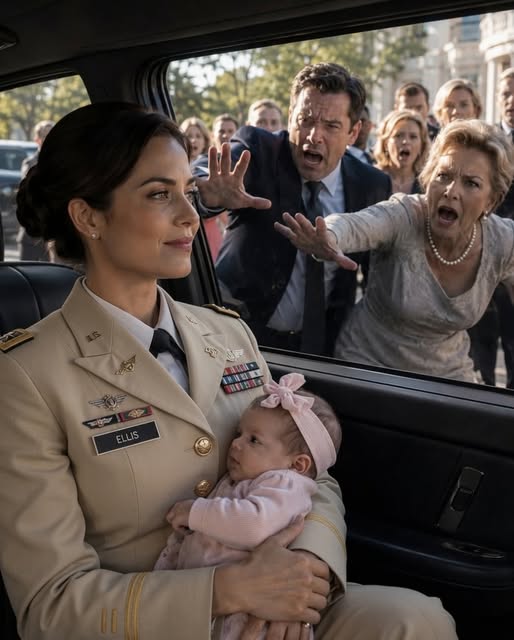
At eleven fifty-eight the next morning, Wesley drove through the wrought-iron gates of the Pembroke estate with both hands locked around the steering wheel.
He had barely spoken since telling me that his father had ordered the entire family to return to the estate. The silence inside the car felt heavier than anger. It was the silence of a man who knew something had already changed but had not yet decided whether he was brave enough to face it.
June slept in the back seat, bundled in a soft pink blanket. Her tiny chest rose and fell beneath the fabric, peaceful and untouched by the cruelty surrounding her.
I watched her reflection in the mirror and reminded myself why I had come.
Not for Margaret.
Not for Wesley.
Not even for revenge.
I had come because one day June would ask what I had done when someone tried to teach her that she was less valuable than everyone else in the room.
I wanted to be able to tell her the truth.
I had stood up.
The circular driveway was crowded with the same luxury vehicles that had been there the previous afternoon. Apparently, every guest who had witnessed Margaret’s “joke” had been ordered to return.
Several people stood near the entrance whispering nervously. No one laughed when they saw me step out of the car.
Wesley opened the rear door and reached for June’s carrier.
“I’ll take her,” he said.
I tightened my grip on the handle.
“I have her.”
His hand remained suspended between us for a second before falling to his side.
“Nora,” he said quietly, “whatever happens in there, please remember that I didn’t know Mom was going to do that.”
“You knew what she was capable of.”
“That isn’t the same thing.”
“No,” I replied. “It’s worse.”
He flinched.
For years, Wesley had treated his silence as neutrality. He believed that because he did not actively insult me, he was not participating in the humiliation. But every time he laughed weakly, changed the subject, or told me not to overreact, he gave his family permission to continue.
Silence was not always surrender.
Sometimes it was consent.
The front doors opened before we reached them.
A housekeeper named Beatrice stood inside. She had worked for the Pembrokes for more than twenty years and had quietly slipped me a bottle of water after Margaret’s Christmas apron incident.
Her eyes lowered toward June.
“I’m sorry about yesterday, ma’am,” she whispered.
“Thank you.”
Then she looked toward Wesley.
“Your father is waiting in the sunroom.”
The same room had been transformed overnight.
The white roses were still arranged in silver vases, but the pastries and decorations had been removed. Chairs formed two rows facing the fireplace, giving the elegant room the atmosphere of a tribunal.
The black pet collar sat in the center of a polished table.
Its tiny gold bell was still attached.
Every person who had laughed the day before was present.
Margaret stood beside the fireplace in a cream-colored suit, pearls resting at her throat. Her posture was perfect, but the tension in her jaw revealed what her expression tried to hide.
Her daughters, Caroline and Lydia, sat together near the window. Caroline avoided my eyes. Lydia stared at her phone until her father ordered her to put it away.
Richard Pembroke stood near the center of the room.
At seventy-one, Wesley’s father still carried the authority of the banking empire he had built. He rarely raised his voice because he had never needed to.
When we entered, he looked first at June, then at me.
“Nora,” he said, “thank you for coming.”
Margaret’s head turned sharply.
“Thank her?” she snapped. “She humiliated this family by storming out of a celebration we organized for her child.”
Richard looked at his wife.
“The celebration became a humiliation long before Nora left.”
Margaret’s face hardened.
“Oh, please. It was a harmless joke.”
Several guests stared at the floor.
Richard picked up the collar.
The bell jingled.
June stirred in her carrier.
“That sound,” he said, “will likely be remembered longer than anything else our family has done this year.”
Margaret crossed her arms.
“You are all behaving as if I committed a crime.”
No one answered.
Then the front doors opened again.
The sound of measured footsteps moved through the hallway.
My father entered the sunroom in his Army dress uniform.
Colonel Thomas Ellis had always seemed tall to me, even before I understood what authority looked like. His silver hair was neatly trimmed, his shoulders squared beneath the dark blue fabric, and every ribbon on his chest represented years of service he rarely discussed.
Three people walked behind him.
Brigadier General Helen Ward, the first officer who had recommended me for advanced command training.
Major Daniel Reyes, a military attorney.
And a serious-looking woman in a charcoal suit carrying a locked black case.
The room fell completely silent.
My father did not look at Margaret first.
He came directly to me.
His expression softened when he saw June.
“May I?”
I lifted my daughter from the carrier and placed her in his arms.
My father had commanded soldiers in combat zones and negotiated under circumstances that would have terrified most people. Yet when June wrapped her tiny fingers around one of his, his eyes shone with quiet emotion.
“Hello, little warrior,” he murmured.
Then he kissed her forehead and returned her to me.
His gaze met mine.
“Are you certain you want to remain for this?”
“Yes.”
“Then I need your permission to speak.”
“You have it.”
He turned toward the room.
“My name is Colonel Thomas Ellis. Yesterday, my daughter and granddaughter were publicly degraded in this house. Several people participated. The rest watched.”
Margaret gave a short laugh.
“I’m sorry, Colonel, but this is a family disagreement. Your daughter clearly inherited your flair for drama.”
My father remained calm.
“The video shows otherwise.”
A ripple of unease passed through the guests.
Margaret’s eyes narrowed.
“What video?”
I removed my phone from my bag.
“The one I recorded after you tried to place a pet collar on my child.”
For the first time, genuine fear flickered across her face.
“You recorded us without permission?”
“In North Carolina, only one party to a conversation needs to consent to a recording,” Major Reyes said.
Margaret turned toward him.
“And who are you?”
“Major Daniel Reyes, Judge Advocate General’s Corps.”
“This is absurd.”
“No,” Richard said. “What happened yesterday was absurd.”
My father nodded to the woman with the case.
She placed it on the table, entered a code, and lifted the lid.
Inside were printed photographs, screenshots, and several documents sealed in transparent evidence sleeves.
She spread them across the polished surface.
The first photograph showed Margaret holding the collar at the party.
The second showed me backing away while June cried.
The third had been taken from across the room and captured Wesley standing beside his mother, doing nothing.
Beneath each photograph was a screenshot from a private social media group used by wealthy women in Charlotte.
Margaret had posted the images before I even left the driveway.
One caption read:
Training the next generation early.
Another said:
You can marry into class, but breeding always shows.
Someone near the window inhaled sharply.
Caroline covered her mouth.
Lydia whispered, “Mom, what did you do?”
Margaret’s cheeks flushed.
“It was private.”
My father’s expression did not change.
“Nothing is private once it is posted online.”
“I deleted it.”
“After it was shared more than two hundred times.”
Margaret looked around the room, searching for support.
None came.
Even those who had laughed the loudest now seemed desperate to distance themselves from her.
The woman in the charcoal suit spoke for the first time.
“My name is Special Agent Rebecca Shaw. I work with the Department of Defense.”
The room shifted.
Richard’s face tightened.
Wesley went still beside me.
Margaret stared at the agent.
“The Department of Defense? Over a joke?”
“No,” Agent Shaw said. “Over the information included with your posts.”
“I didn’t include any information.”
Agent Shaw slid another screenshot forward.
Underneath one photograph, Margaret had written that her daughter-in-law worked in “some secret Army office,” that I had recently returned from an overseas assignment, and that I lived in a specific neighborhood near Charlotte.
She had also posted the date of the party, the location of the estate, and a photograph in which part of my identification badge was visible inside my open diaper bag.
The room became cold.
I stared at the screenshot.
My breathing slowed.
Operational details.
Location data.
Personal identification.
The exact things I had spent my career protecting.
Margaret waved one manicured hand.
“I didn’t know any of that mattered.”
“You were repeatedly told that Nora’s work required discretion,” my father replied.
“She was always so secretive. I was curious.”
“Curiosity does not excuse recklessness.”
Margaret’s gaze moved to me.
“You brought military people into my home to frighten me?”
“I sent the video to my father,” I said. “Nothing more.”
“That is a lie.”
“It isn’t.”
Wesley spoke beside me.
“Mom, stop.”
She turned on him.
“You should be defending this family.”
“I am trying to understand what happened.”
“What happened is that your wife weaponized her job because she cannot take a joke.”
The words hung in the room.
Something inside me that had been tight for years finally loosened.
I stepped forward.
“You gave me cleaning supplies while your daughters opened diamonds.”
Margaret rolled her eyes.
“You’re still upset about Christmas?”
“You gave me an apron that said Know Your Rank.”
“It was humorous.”
“You introduced me to your friends as Wesley’s charity project.”
“I never said that.”
“You told the country club board I was ‘government help.’ You changed my seat at Caroline’s wedding because you said people in photographs should be arranged by social importance. You asked whether my father had learned table manners in the military.”
My father’s eyes shifted toward her.
Margaret’s face paled, but I continued.
“I accepted those insults because Wesley asked me to keep the peace. But yesterday you reached toward my newborn daughter with a pet collar. You looked at her and decided she needed to be taught inferiority before she could even hold up her own head.”
The room was silent enough to hear the clock above the fireplace.
“I will never allow that again.”
Margaret’s expression twisted.
“You think a uniform makes you superior to us?”
“No,” I said. “Character does.”
Richard lowered his head for a moment.
Wesley stared at me as though he had never truly seen me before.
Agent Shaw gathered several screenshots into a neat stack.
“The online posts are only part of the concern.”
My father’s shoulders stiffened.
I looked toward him.
“What else?”
Agent Shaw removed a sealed document from the case.
“This morning, a routine security review found that files connected to Colonel Nora Ellis-Pembroke’s assignment history had been accessed from an unauthorized device.”
Wesley’s face drained of color.
Margaret blinked.
“I don’t understand.”
“The files were not classified at the highest level,” Agent Shaw continued, “but they contained restricted information, including travel dates, office locations, and names of personnel associated with national-security operations.”
My heartbeat changed.
Not faster.
Sharper.
“Where did the access originate?” I asked.
Agent Shaw looked directly at Wesley.
“From an internet connection registered to your home.”
Every face turned toward him.
Wesley stared at the agent as though she had struck him.
“That’s impossible.”
“Is it?”
“I’ve never accessed Nora’s work files.”
“You maintain a private office in the residence?”
“Yes, but—”
“Who has access?”
“Only Nora and me.”
I thought of the office upstairs in our home.
The locked desk.
The home computer Wesley used for financial records.
The spare key he kept behind a framed photograph in the kitchen cabinet.
My gaze moved slowly toward Margaret.
Wesley saw it.
“No,” he said. “Mom wouldn’t—”
Margaret’s chin lifted.
“I only went into the office once.”
The room erupted.
Richard’s voice cut through the noise.
“You did what?”
Margaret stepped back.
“I was looking for documents.”
“What documents?” Wesley demanded.
“Information about Nora.”
My hands tightened around June.
Wesley looked horrified.
“You entered our house while we were away?”
“You gave me a key.”
“For emergencies.”
“This was an emergency.”
“How?”
“She was hiding things from us!”
My father took one controlled step forward.
“What exactly did you remove?”
“Nothing.”
Agent Shaw opened another evidence sleeve.
“Security footage from a neighboring property shows your vehicle outside their home three times during the past two months.”
Margaret’s lips parted.
“There must be some mistake.”
“The footage is time-stamped.”
She looked toward Wesley.
“I was trying to protect you.”
“From my wife?”
“From what she might be involved in.”
I felt something colder than anger move through me.
“You searched my home because you believed my career embarrassed you.”
Margaret’s eyes flashed.
“You married into a public family. We have a reputation.”
“And you thought breaking into my office would protect it?”
“I did not break in.”
“You entered without permission.”
“With a key.”
“That distinction may matter socially,” Major Reyes said. “It may not matter legally.”
Richard leaned against the table as if the weight of the revelation had suddenly aged him.
“Margaret,” he said, “tell them everything.”
She looked at him.
“I have.”
“No. You haven’t.”
For the first time in their marriage, at least in front of others, Margaret seemed afraid of her husband.
Richard pointed toward the collar.
“You turned a celebration for your granddaughter into a spectacle. You published photographs. You entered your son’s home. Now federal agents are standing in this room. Tell them everything.”
Margaret’s composure cracked.
“I found a folder.”
My breath caught.
“What folder?” Agent Shaw asked.
“It was inside Wesley’s desk.”
Wesley shook his head.
“There were no Army files in my desk.”
“There was a blue folder beneath the financial documents.”
I remembered it.
My temporary travel authorization.
Emergency contact protocols.
A list of secure numbers I was required to destroy after returning from an assignment.
The documents should have remained locked in my own case, but I had given them to Wesley during June’s difficult delivery when I was taken unexpectedly into surgery.
“Where is the folder now?” I asked.
Margaret looked at the floor.
“I photographed some pages.”
Wesley made a sound of disbelief.
“You photographed them?”
“I wanted to show someone.”
“Who?”
She did not answer.
Agent Shaw stepped closer.
“Mrs. Pembroke, who did you send the images to?”
Margaret’s hands trembled.
“A consultant.”
“What consultant?”
“A man who helps families manage reputational concerns.”
Richard stared at her.
“We do not have a reputational consultant.”
“I hired him privately.”
“What is his name?”
“He called himself Adrian Cole.”
Agent Shaw and my father exchanged a look.
It lasted less than a second, but I saw it.
Recognition.
“Show me your phone,” Agent Shaw said.
Margaret clutched her handbag.
“No.”
“Mrs. Pembroke—”
“You cannot take my property.”
“We can request voluntary access now, or seek a warrant.”
Margaret’s breathing quickened.
Wesley stepped toward her.
“Give her the phone.”
“You don’t understand.”
“Then explain it.”
“I was trying to learn whether Nora was using this family.”
I almost laughed.
Not because anything was funny, but because the accusation was so perfectly Margaret.
Even while surrounded by evidence of her own wrongdoing, she still needed me to be the villain.
“Give her the phone,” Richard repeated.
Margaret looked from her husband to her son.
Then she slowly removed the device from her handbag.
Agent Shaw placed it inside a signal-blocking pouch.
“We will need the passcode.”
Margaret hesitated.
Richard’s voice was flat.
“Give it to her.”
She whispered the numbers.
Agent Shaw handed the pouch to another investigator who had entered quietly through the doorway.
Only then did I notice there were two federal officers outside the sunroom.
This was no longer a family confrontation.
It was an investigation.
June stirred against my chest and began to fuss.
I moved toward a chair near the window, rocking her gently.
Wesley followed.
“I swear I didn’t know,” he whispered.
I looked at him.
“Did you know your mother had entered our home before?”
His silence answered before his mouth did.
My stomach dropped.
“How many times?”
“Nora—”
“How many?”
“Twice. Maybe three times.”
The room around us seemed to fade.
“You knew?”
“She said she was checking on the house.”
“While we were away?”
“I told her not to do it again.”
“But you didn’t tell me.”
“I didn’t want another argument.”
I stared at the man I had married.
That sentence had governed our entire relationship.
He did not tell me when Margaret criticized my career because he did not want an argument.
He did not defend me when she mocked my family because he did not want an argument.
He did not admit that she had entered our home because he did not want an argument.
Peace, to Wesley, meant ensuring that the most unreasonable person was never challenged.
And the cost of that peace had always been paid by me.
“You left my security vulnerable,” I said.
“I didn’t realize—”
“That is the problem. You never realized anything because realizing would have required you to choose.”
“I choose you.”
“No. You say that after the damage is done.”
His eyes filled with panic.
“Please don’t do this here.”
I looked down at June.
“Here is exactly where it needs to be done.”
Across the room, Agent Shaw’s associate returned holding a tablet.
He whispered something in her ear.
Her expression changed.
“What did you find?” my father asked.
Agent Shaw turned toward Margaret.
“Your messages with Adrian Cole have been deleted.”
Margaret exhaled shakily.
“I told you, I ended the arrangement.”
“But deleted messages can often be recovered.”
“I did nothing wrong.”
The investigator handed Agent Shaw the tablet.
She studied the screen.
Then she looked at me.
“We have recovered one image from a cloud backup.”
She turned the tablet around.
It showed a photograph of the blue folder open on Wesley’s desk.
Several names were visible.
So were dates, office addresses, and a coded identification number linked to one of my previous assignments.
Below the photograph was a message from Margaret.
Tell me whether she is dangerous to this family.
Adrian Cole had replied:
She may be more valuable than dangerous.
I felt the blood drain from my face.
My father’s expression became lethal.
“When was that message sent?”
“Six weeks ago,” Agent Shaw said.
Six weeks.
Before June was born.
Before the welcome party.
Before the collar.
Margaret had not simply acted out of social cruelty.
Someone had been studying me.
“Did you meet this man?” Agent Shaw asked.
Margaret nodded reluctantly.
“Once.”
“Where?”
“At a restaurant.”
“Which restaurant?”
“The Belmont.”
“When?”
“About a month ago.”
“Did you give him physical documents?”
“No.”
“Did he ask questions about Nora’s schedule?”
Margaret looked toward me.
“He asked whether she traveled often.”
“What did you tell him?”
“That she had been home because of the pregnancy.”
“Did you tell him where she lived?”
“He already knew.”
The words silenced the room.
Agent Shaw’s voice sharpened.
“How did he already know?”
“I assumed he had researched her.”
My father stepped between Margaret and me.
“You invited an unknown man to investigate a senior Army officer, gave him restricted information, and continued communicating after he demonstrated knowledge of her private residence.”
“I didn’t know it was restricted.”
“You knew it was hidden in a locked office.”
Margaret’s face began to collapse.
For the first time, the arrogance left her.
“What is happening?”
Agent Shaw did not answer immediately.
She looked toward the investigator near the doorway.
“Contact the team at the residence. Full sweep. Nobody enters until it is cleared.”
My heart stopped.
“Our home?”
My father turned to me.
“You and June will not return there.”
“Why?”
“Because Adrian Cole may not be a consultant.”
Wesley gripped the back of a chair.
“Who is he?”
“We do not know yet,” Agent Shaw replied. “But the telephone number he used was routed through multiple encrypted services. His photograph does not match any licensed security or public-relations professional in the state.”
Richard closed his eyes.
Caroline began crying quietly.
Lydia whispered, “Oh my God.”
Margaret looked around the room.
“I didn’t mean for this to happen.”
I stood.
June had fallen asleep again, her cheek warm against my chest.
“You did not care what happened,” I said. “You only cared whether you could control me.”
Margaret shook her head.
“I was protecting Wesley.”
“From what?”
“From being overshadowed by you.”
The confession came out so softly that I almost missed it.
Wesley stared at his mother.
“What?”
Her eyes filled with tears.
“You were supposed to be the successful one. You were supposed to lead this family after your father. Then you married a woman who refused to discuss her work, who disappeared for assignments, who made everyone in the room wonder whether she was more important than us.”
The truth was uglier than the collar.
Margaret had not hated me because I came from a working-class family.
She hated me because she suspected I had power she could not measure.
And because she could not measure it, she had tried to expose it.
Humiliate it.
Control it.
“You risked my wife’s life because you felt insecure?” Wesley asked.
“I was trying to help you.”
“No,” he said. “You were trying to keep me weak.”
Margaret recoiled.
It was the first time I had ever heard him speak to her without apology.
But the moment came years too late.
Agent Shaw’s phone rang.
She answered, listened, and walked toward the window.
Her posture changed after the first few words.
“What is it?” my father asked.
She ended the call.
“The team entered Nora and Wesley’s home.”
My arms tightened around June.
“They found a listening device inside the nursery.”
The room blurred.
For one terrible second, I could not breathe.
“Where?”
“Inside the base of the rocking chair.”
I pictured the nursery at night.
The dim lamp.
June sleeping in her crib.
My whispered conversations.
My calls with my father.
Every private moment of my daughter’s first weeks.
Observed.
Recorded.
Stolen.
Wesley dropped into a chair.
Margaret covered her mouth.
Agent Shaw continued.
“They also found a second device in Wesley’s office and signs that the exterior security system had been accessed remotely.”
My father’s voice was low.
“Was the house entered recently?”
“We believe so.”
Wesley looked at me.
“Nora, I’m sorry.”
I felt no comfort in the words.
Only exhaustion.
An investigator entered the sunroom carrying a clear evidence bag.
Inside was a small gold object.
At first, I thought it was the bell from the black collar.
Then I looked down at June’s wrist.
The delicate gold bracelet Margaret had given her at the hospital was gone.
I had removed it that morning because it had left a faint red mark on her skin and placed it in the side pocket of the diaper bag.
The investigator held up the evidence bag.
“This was found beneath the passenger seat of Mrs. Pembroke’s car.”
Margaret stared at it.
“That belongs to the baby.”
Agent Shaw examined the bracelet.
“No,” she said. “It belongs to whoever installed the transmitter hidden inside it.”
A sound escaped my throat.
I opened the diaper bag and searched the side pocket.
Empty.
Margaret’s face turned gray.
“I didn’t know.”
“Who gave you the bracelet?” Agent Shaw demanded.
“Adrian.”
The answer shattered what remained of the room’s composure.
“He said it was a peace offering,” Margaret whispered. “He said if I gave Nora something expensive, she might finally understand how our family handles conflict.”
“When did you place it on the baby?”
“At the hospital.”
June had worn the bracelet for nearly five weeks.
Five weeks of movements.
Five weeks of locations.
Five weeks of someone knowing exactly where my newborn daughter was.
My father stepped closer to me, shielding us with his body.
Agent Shaw reached for her phone.
“We need immediate protective relocation.”
Richard ordered the gates locked.
Guests began speaking at once, frightened voices rising beneath the crystal chandelier.
Then the lights went out.
The sunroom plunged into darkness.
Someone screamed.
Glass shattered near the fireplace.
My military training took over before fear could.
I dropped behind the heavy sofa, shielding June with my body.
“Stay down!” I shouted.
My father moved beside us.
Agent Shaw drew her weapon.
Emergency lights flickered on, washing the room in dim red.
The front doors stood open.
One of the investigators lay in the hallway, conscious but bleeding from the forehead.
And Margaret was gone.
On the table where the black collar had rested was a phone none of us recognized.
Its screen lit up.
A video began playing.
Margaret appeared on-screen, seated in what looked like a dark vehicle. Her face was pale, her hands bound in front of her.
A man’s distorted voice spoke from behind the camera.
“Colonel Ellis-Pembroke, your mother-in-law made a serious mistake.”
I stared at the screen, holding June close.
The voice continued.
“But she was never the target.”
The camera turned.
For one brief second, it showed another person sitting beside Margaret.
A man in a dark suit.
Wesley.
I looked across the room.
The chair where my husband had been sitting was empty.
Then the voice said the words that changed everything.
“Your husband has been working with us for eleven months.”
The screen went black.
…If you want to know what happened next, please type “YES” and like for more.