PART 2: THE NAME THEY NEVER EXPECTED TO HEAR
The moment Dean Bradley said, “Come with me, Doctor,” something inside me shifted.
Not healed.
Not forgiven.
Just shifted.
For years, I had carried my silence like a second skin. I had worn it at the dinner table while my father praised Haley for posting edited photos online and ignored the scholarship letters addressed to me. I had worn it during holidays when my stepmother introduced me as “the quiet one” or “the helper” while telling strangers Haley was “destined for greatness.” I had worn it through night shifts, through anatomy exams, through mornings when I came home smelling of antiseptic and exhaustion, only to be ordered to scrub pans in the kitchen.
But standing in the rain, with the Dean of the medical board holding an umbrella above my head and calling me Doctor, I realized silence had not protected me.
It had only protected them.
Dean Bradley guided me through a side entrance reserved for faculty and honored guests. The corridor was warm and golden, lined with framed photographs of past graduates who had become surgeons, researchers, hospital directors, and global health leaders. My soaked shoes squeaked softly against the polished floor, and every step felt unreal.
A young staff member gasped when she saw me.
“Dr. Hensley! We’ve been calling your phone.”
I blinked. “My phone?”
I reached into my coat pocket and found it dead. Of course. After my father shoved me backward, it must have hit the wet stone steps. The screen was black, cracked in a thin silver web across the corner.
The staff member’s face tightened with concern. “The ceremony starts in six minutes. Your seat is empty, the trustees are asking questions, and the press team needs you backstage.”
“The press team?” I repeated.
Dean Bradley turned to me gently. “Clara, today is not just graduation. You are being formally recognized for your research fellowship. The children’s cardiac trial you helped design has been approved for national expansion.”
My breath caught.
I knew about the approval. I had received the email three days ago at 2:17 in the morning while sitting in a hospital break room with vending-machine coffee cooling beside my laptop. I had read it six times. I had cried silently in a plastic chair because I wanted so badly to call someone.
Anyone.
But the only family I had would have either ignored me or asked why I had not folded the laundry.
So I closed the email, wiped my face, and went back to rounds.
Now Dean Bradley was watching me as if he understood more than I wanted him to.
“You should have had people with you today,” he said quietly.
I swallowed. “I thought I did.”
His jaw tightened, but he said nothing.
Backstage was chaos. A woman with a headset rushed toward me with a towel. Another staff member appeared with a garment bag. Someone else handed me a printed program and whispered, “You’re after the president’s opening remarks, then the award presentation, then your speech.”
I stared down at the program.
There it was.
DR. CLARA HENSLEY
Valedictorian Address
Recipient of the Hargrove Medical Research Award
Keynote Speaker, College of Medicine
My name looked too beautiful to belong to the girl my father had just thrown into the rain.
A woman from the faculty office helped me remove my soaked coat. My black graduation gown was damp around the edges but still presentable. She pinned a gold stole over my shoulders, then carefully adjusted the hood around my neck. Another person dried my hair with paper towels and a small emergency hair dryer that sounded like a swarm of bees.
I should have been embarrassed.
Instead, I felt strangely calm.
Through a narrow gap in the curtain, I saw the auditorium.
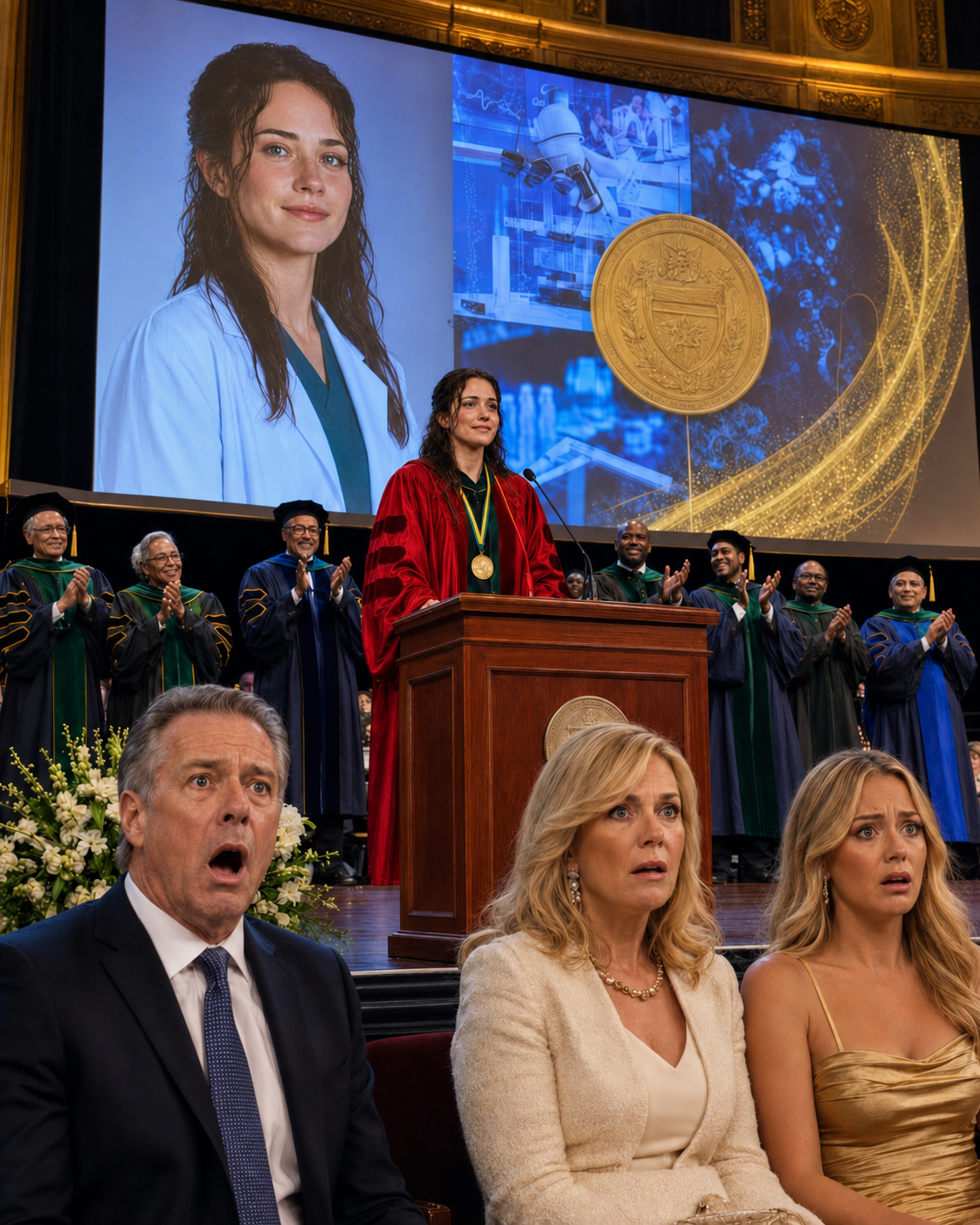
It was enormous—three levels of velvet seats beneath a cathedral ceiling, every balcony filled. White floral arrangements stood beside the stage. Cameras waited near the aisles. Faculty members in colorful academic robes sat in formal rows. Families leaned over railings, searching proudly for their graduates.
And there, in the front VIP section, sat my father, my stepmother, and Haley.
My father wore the navy suit he saved for important occasions. He sat with his shoulders squared, chin lifted, looking around as if the attention in the room naturally belonged to him.
My stepmother, Marlene, had chosen a cream dress and pearls. She was smiling at the women beside her, probably pretending she had raised a daughter worth celebrating.
Haley sat in my reserved seat.
My seat.
The one with the small gold card that read: RESERVED FOR DR. CLARA HENSLEY’S FAMILY.
Except Haley had placed her designer purse over the name card and was taking selfies.
The sight should have broken me.
Instead, it sharpened me.
A stage manager leaned close. “Dr. Hensley, do you need a minute?”
I looked at Haley laughing into her phone.
“No,” I said. “I’m ready.”
The lights dimmed.
The orchestra began.
A wave of silence moved through the auditorium as the university president stepped to the podium. His voice filled the hall, polished and warm.
“Good morning, distinguished faculty, honored trustees, graduates, families, and friends. Today, we gather not only to celebrate achievement, but to recognize the resilience, sacrifice, and extraordinary dedication that define the calling of medicine.”
Applause rose.
I stood behind the curtain, my hands folded around my speech cards. My fingers still trembled slightly, but not from fear anymore.
The president continued, “Every graduating class gives us reason to hope. But once in a generation, a student arrives whose work changes the future before her career has even officially begun.”
My father did not react.
He was looking at his watch.
Marlene whispered something to Haley. Haley angled her phone again, lips parted in a practiced smile.
The president smiled toward the audience. “This year, that student is a physician, researcher, advocate, and scholar whose humility has matched her brilliance at every step.”
I heard Dean Bradley inhale beside me.
“Ladies and gentlemen,” the president said, “please rise as we honor the valedictorian of this graduating class, recipient of the Hargrove Medical Research Award, and today’s keynote speaker—Dr. Clara Hensley.”
For one second, there was silence.
Then the auditorium exploded.
The applause hit me like thunder.
People stood. Professors clapped above their heads. Students turned toward the curtain, cheering. Cameras swung toward the stage.
And in the front row, Haley’s phone slipped from her hand.
It landed against the floor with a sharp crack.
Marlene’s smile vanished.
My father slowly turned his head toward the stage, his expression collapsing piece by piece. Confusion first. Then disbelief. Then something close to panic.
I stepped out.
The light was blinding.
For a moment, I could not see anything but brightness. Then the faces came into focus—hundreds of them, standing for me.
Not for Haley.
Not for my father’s pride.
For me.
I walked to the center of the stage, each step steady beneath the weight of my gown, my stole, my name, my truth. My father stared as if he had never seen me before. Perhaps he had not. Not really.
The president shook my hand.
“Congratulations, Dr. Hensley,” he said warmly.
“Thank you,” I whispered.
He gestured for me to stand beside him while a trustee carried a glass award onto the stage. The cameras flashed.
“This award,” the president announced, “recognizes exceptional research with measurable humanitarian impact. Dr. Hensley’s work in pediatric cardiac intervention has already influenced treatment protocols across three hospitals, and her upcoming fellowship will expand that work nationwide.”
Another wave of applause.
I dared to look at my family again.
Haley’s face had gone pale beneath her makeup. Marlene was whispering quickly, angrily, into my father’s ear. My father sat motionless, his hands gripping the arms of his chair.
Then the president turned toward me.
“Dr. Hensley, the podium is yours.”
The applause faded.
The hall quieted.
I placed my speech cards on the podium.
The first line I had written was safe. Polished. Grateful.
Thank you to the faculty, my mentors, my classmates, and my family.
I stared at the word family.
Then I looked at my father.
He gave me the smallest warning shake of his head.
Even from the stage, I understood it.
Do not embarrass us.
After everything, he still believed he could command me with one look.
I picked up the cards.
Then I set them aside.
A murmur moved through the front row.
I leaned toward the microphone.
“My journey into medicine did not begin with confidence,” I said. “It began with doubt. Not my own, at first, but the doubt other people placed on me so often that I nearly mistook it for truth.”
The auditorium became still.
“I was told I was ordinary. I was told I was not special. I was told not to take up too much space. Some people in my life believed that if they refused to see me, then I would eventually disappear.”
My father’s face tightened.
Marlene looked down.
Haley stared at me with her mouth slightly open.
“But medicine teaches us something remarkable,” I continued. “It teaches us that the most critical signs are often the ones people overlook. A faint pulse. A small change in breathing. A quiet symptom no one else thinks matters.”
I paused.
“And sometimes, a quiet girl.”
A soft laugh moved through the graduates. Then applause began, gentle at first, then stronger.
I let it pass.
“For years, I studied in borrowed time. I worked hospital shifts before exams. I learned anatomy while the rest of the house slept. I wrote research proposals between chores. I kept my achievements hidden, not because I was ashamed, but because I had learned that some people only respect success when they can claim it.”
My father stood suddenly.
Marlene grabbed his sleeve.
Every camera in the room noticed.
I did not stop.
“So today, I am grateful to the people who believed in me before I had proof. My professors. My classmates. The nurses who taught me compassion. The patients who trusted me with their fear. And especially the children whose courage made my research matter.”
My voice softened.
“To every graduate here today who has ever felt unseen, I want you to remember this: being underestimated is painful, but it can also become a kind of shelter. While they are busy dismissing you, you are free to become someone they never prepared for.”
The hall erupted.
Students stood. Faculty stood. Even the trustees clapped.
Only the VIP row remained frozen.
I finished the speech with a breath I had been holding for years.
“My name is Clara Hensley. I am a doctor. I am a researcher. I am not invisible. And neither are you.”
The applause was deafening.
I stepped back from the podium, trembling now. Not from fear, but release. Something heavy had cracked open in my chest.
The president returned, beaming.
“Thank you, Dr. Hensley, for those unforgettable words.”
I thought it was over.
But then Dean Bradley rose from his seat near the faculty section and walked to the microphone.
“Before Dr. Hensley leaves the stage,” he said, “there is one more announcement.”
My stomach tightened.
I had no idea what he was about to say.
He held a sealed envelope in his hand.
“As many of you know, the Hargrove Foundation not only funds medical research, but also supports physicians whose work demonstrates extraordinary ethical commitment. This year, after reviewing Dr. Hensley’s research, service record, and personal history, the board has voted unanimously to establish the Clara Hensley Pediatric Heart Initiative.”
The room gasped.
I turned toward him, stunned.
Dean Bradley smiled at me.
“This initiative will provide funding for low-income families seeking pediatric cardiac care and will be directed, upon completion of her fellowship, by Dr. Hensley herself.”
For a moment, I could not breathe.
An initiative.
In my name.
A name my own family had treated like an inconvenience.
The applause returned, louder than before, but beneath it I heard another sound—a chair scraping sharply against the floor.
My father had risen.
His face was no longer pale. It was red with anger.
“That’s my daughter,” he said loudly.
The nearest guests turned.
Marlene hissed, “Sit down.”
But he did not.
“That is my daughter,” he repeated, louder. “There must be some mistake with the family seating. We were not properly informed.”
Every camera swung toward him.
Dean Bradley’s expression hardened.
The president looked uncomfortable.
I stood very still.
My father walked toward the aisle with the confidence of a man who had never been denied access to anything he wanted. “Clara,” he called, forcing a laugh. “Honey, there’s clearly been a misunderstanding.”
Honey.
The word crawled over my skin.
He had not called me that since I was nine years old, before my mother died, before he remarried, before my place in the house became smaller than Haley’s closet.
Security shifted near the wall, but the president lifted a hand, unsure whether to intervene during a live ceremony.
My father continued toward the stage.
“I’m her father,” he announced to the people around him. “Obviously, we’re very proud. Very proud. Clara has always been shy about sharing things.”
A murmur moved through the audience.
Shy.
That was what he called years of neglect.
I gripped the podium.
Marlene stood too, smiling nervously now, trying to salvage the scene. Haley scrambled to pick up her phone, her face burning.
My father reached the bottom of the stage steps.
“Come down here,” he said through his smile. “Let’s take a proper family photo.”
There it was.
Not an apology.
Not shock.
Not regret.
A photo.
A way to own what he had just discovered he could not ignore.
I looked at him for a long second.
Then I stepped back to the microphone.
The entire auditorium went silent again.
“Before I take any photos,” I said, “I would like to thank the person who made sure I got into this building today.”
My father’s smile widened, as if he expected his name.
I turned toward Dean Bradley.
“Dean Bradley found me outside in the rain after my VIP ticket was taken from me.”
A ripple of shock passed through the hall.
My father’s smile died.
“He found me,” I continued, “because the people seated in my reserved family section entered with my invitation and left me outside.”
Marlene’s mouth fell open.
Haley shook her head quickly. “That’s not true.”
But the words were useless.
Everyone had seen her in the seat.
Everyone had seen the purse covering my name card.
And then, as if fate wanted to be cruelly precise, the large screen above the stage shifted from the ceremony feed to a side camera angle of the VIP entrance from earlier that morning.
The auditorium watched my father step out of the taxi.
Watched Haley wave the gold ticket.
Watched me approach.
Watched my father grab my arm.
Watched him shove me backward into the rain.
A collective gasp filled the room.
My blood turned cold.
I had not known there were cameras outside.
My father staggered back from the stage steps.
Marlene covered her mouth.
Haley whispered, “Oh my God.”
The video stopped on the image of me standing alone in the storm.
Then the screen went black.
No one clapped.
No one spoke.
Dean Bradley’s voice cut through the silence, calm and devastating.
“The university takes the safety and dignity of its graduates seriously. Mr. Hensley, you and your party will be escorted out.”
Two security officers moved toward my father.
For the first time in my life, he looked afraid of consequences.
“Clara,” he said, but his voice cracked. “Tell them this is a misunderstanding.”
I looked at him.
For years, I had imagined this moment. I thought I would scream. I thought I would cry. I thought I would finally list every cruel word, every missed birthday, every unpaid fee, every night I had been made to feel like a guest in my own home.
But when the moment came, I felt only a strange, quiet sadness.
“No,” I said. “It is not a misunderstanding.”
The security officers guided him away from the stage.
Marlene tried to argue, but her voice shook too badly for anyone to take her seriously. Haley followed with tears streaking through her makeup, still clutching the stolen VIP ticket like evidence she did not know how to hide.
As they were led up the aisle, hundreds of people watched them in silence.
My father looked smaller with every step.
When the bronze doors closed behind them, the auditorium remained still.
Then someone began clapping.
It was a nurse from the hospital where I had trained. She stood with tears in her eyes, clapping slowly, fiercely.
Then my classmates joined.
Then the faculty.
Then the entire auditorium rose.
I stood on that stage, shaking beneath the weight of it all, and for the first time in my life, I did not feel abandoned.
After the ceremony, everything moved like a dream. People hugged me. Reporters asked questions. Professors cried. Former patients’ parents approached me with trembling hands and whispered thank you. A little boy named Mason, one of the first children enrolled in our cardiac study, handed me a paper heart he had colored red and gold.
“You fixed my heart,” he said.
I knelt in my gown and tried not to sob.
“You were very brave,” I told him.
His mother touched my shoulder. “So were you.”
Those words nearly undid me.
By late afternoon, the storm had passed. Sunlight broke through the clouds and turned the wet campus silver. I stood outside the auditorium, watching graduates pose with families who loved them loudly.
I expected to feel empty.
Instead, I felt free.
Then a black car pulled up near the curb.
For one terrible second, I thought my father had returned.
But the door opened, and a woman stepped out.
She was older, elegant, with silver hair pinned neatly at the back of her neck. She wore a dark coat despite the warm afternoon, and in her hand she carried a leather folder.
“Dr. Clara Hensley?” she asked.
“Yes.”
Her eyes softened.
“My name is Eleanor Vale. I was your mother’s attorney.”
The world seemed to tilt.
“My mother?” I whispered.
She nodded. “I have waited a long time to meet you.”
My pulse began to hammer.
“My mother died when I was nine.”
“I know,” Eleanor said. “And before she died, she left instructions that certain documents were to be delivered to you only after you graduated from medical school.”
I stared at the folder in her hands.
“My father never told me that.”
“No,” Eleanor said quietly. “I do not imagine he would have.”
A cold wind moved through the courtyard.
Inside the folder, I saw the edge of a sealed letter. My name was written across it in handwriting I recognized from childhood birthday cards and old recipe notes.
Clara.
My knees nearly gave way.
Eleanor reached out to steady me.
“There is more,” she said. “Your mother did not only leave you a letter.”
I could barely speak. “What did she leave?”
Eleanor glanced toward the street, where my father’s car was suddenly parked half a block away.
He was watching us through the windshield.
Her expression darkened.
“She left you the house,” Eleanor said. “The accounts. The trust. Everything your father has been using for the past twelve years.”
My heart stopped.
Across the street, my father opened his car door.
Eleanor tightened her grip on the folder and lowered her voice.
“And Clara, there is one more thing you need to know before he reaches us. Your mother’s death was not as simple as he told you.”
…If you want to know what happened next, please type “YES” and like for more.