Part 3: The Debt in Lucas’s Name
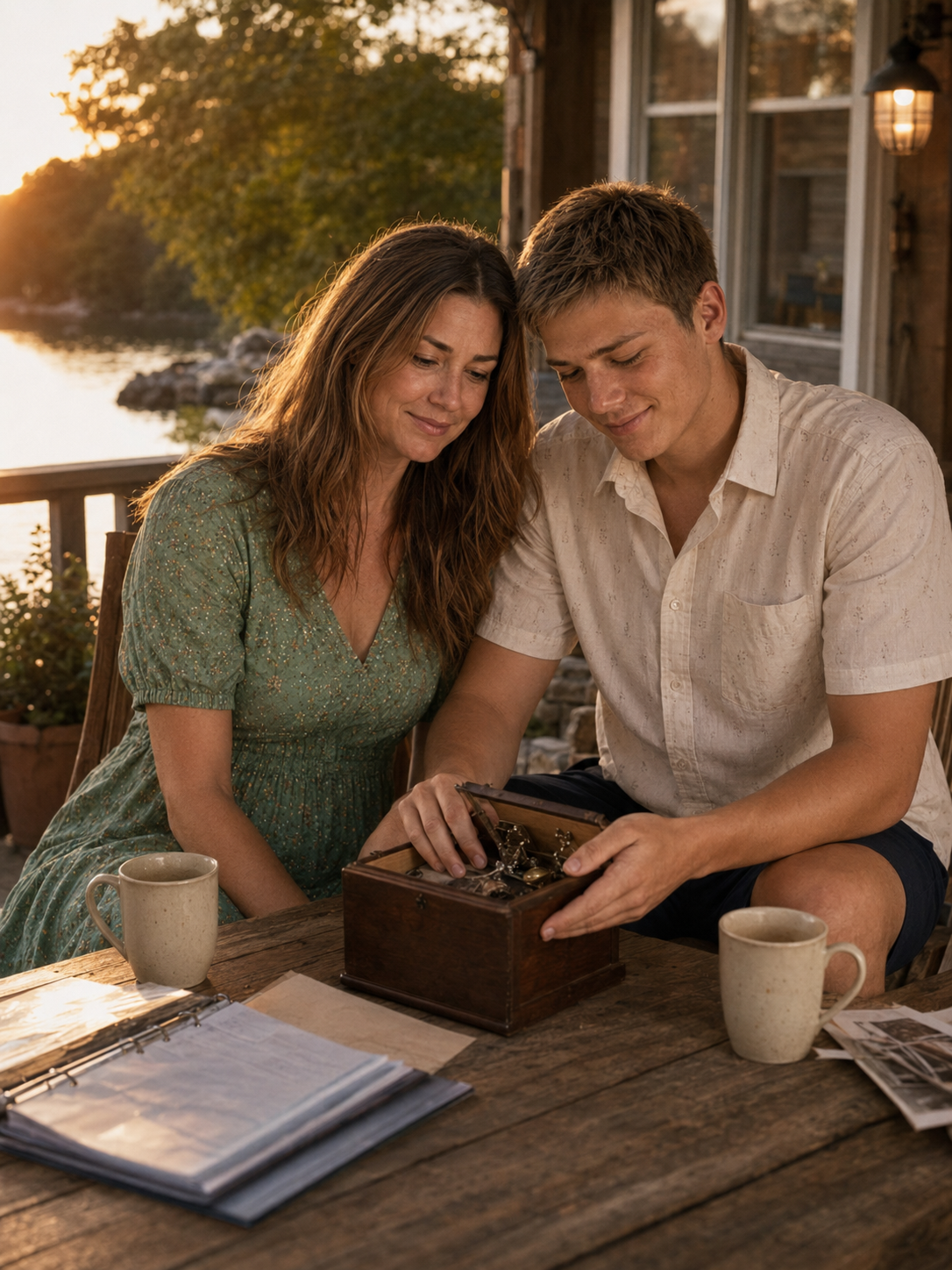
Chapter 1: Peace Has a Sound
For the first time in nearly ten years, I knew what peace sounded like.
It sounded like the coffee machine breathing in the morning.
It sounded like rain tapping against the kitchen window while no one cried in the next room.
It sounded like Lucas calling me from college every Sunday night, pretending he only called because he needed help with laundry, even though we both knew he missed home.
“Do I wash dark blue with black?” he asked one evening.
“Lucas, you have been alive for nineteen years.”
“That doesn’t answer the question.”
“Yes,” I said, laughing. “You can wash dark blue with black.”
“What about gray?”
“Still yes.”
“What about white?”
“No.”
There was a pause.
“Too late.”
I closed my eyes. “Lucas.”
He laughed, and the sound filled my little kitchen like sunlight.
After everything we had survived, his laughter still felt like proof that I had not failed.
A year had passed since the truth came out of our mother’s jewelry box.
The house was still ours.
Lucas was in college.
Our aunt had lost her claim.
Evelyn Hart, our attorney, had helped us protect the trust and the house. Some relatives disappeared from our lives after the court hearing. Some apologized. Some acted as if nothing happened.
Our aunt did neither.
She did not apologize.
She did not explain.
She did not ask for forgiveness.
She simply vanished.
For a while, I thought that was the closest thing to mercy she was capable of giving us.
I was wrong.
Peace, I later learned, is sometimes only silence before the next doorbell rings.
Chapter 2: The Letter
The letter arrived on a Tuesday.
It was folded inside a plain white envelope, the kind that looks harmless until it ruins your day.
I almost threw it into the pile with grocery coupons and insurance notices.
Then I saw Lucas’s name.
Lucas Everly
Final Notice Before Legal Action
My stomach tightened.
Lucas had been careful with money. Too careful, maybe. He checked his bank account every morning. He called me before buying anything more expensive than a winter coat. He still used the same cracked phone case from high school because, as he put it, “It technically still works.”
He would never ignore a debt.
I opened the letter.
The words blurred at first.
Outstanding balance: $42,870.19
I read it again.
Then again.
The kitchen seemed to tilt.
It was from a private lending company I had never heard of. The letter claimed Lucas had taken out a personal loan three years earlier.
Three years earlier, Lucas had been sixteen.
Sixteen.
He had been worried about prom tickets and college essays. He had been asking me if he should join the robotics club because “it looks good on applications.” He had still been sleeping with the bedroom light on whenever storms came through.
He had not taken a loan.
My hands went cold.
I called him immediately.
He answered on the fourth ring.
“Hey. I’m heading to class. Can I call you—”
“Lucas, did you take out a loan?”
Silence.
“What?”
“A personal loan. Forty-two thousand dollars.”
“What are you talking about?”
His confusion was real. I heard it before fear entered his voice.
“I got a letter,” I said. “A collection notice. It says you owe money.”
“That’s impossible.”
“I know.”
“I never signed anything.”
“I know.”
“When was it opened?”
“Three years ago.”
He went silent again.
Then he said quietly, “I was sixteen.”
“I know.”
His breathing changed.
That was when I felt it too.
The old fear.
The one with our aunt’s fingerprints all over it.
Lucas whispered, “She did this.”
I looked at the letter again.
“No,” I said, though I did not believe myself.
Lucas’s voice cracked. “She used my name.”
My knees felt weak, so I sat down at the kitchen table.
The same table where our mother’s letter had revealed the first truth.
The same table where Lucas had told me I was enough.
The same table where our aunt had tried to take our home.
Now another secret had arrived.
And somehow, it had Lucas’s name written on it.
Chapter 3: The Boy Who Felt Guilty for Being Robbed
Lucas came home that weekend.
He looked older when he stepped through the door.
Not grown-up older.
Tired older.
The kind of older life forces onto people before they are ready.
He dropped his bag by the staircase and hugged me without speaking.
I held him tightly.
For a moment, I remembered him at ten years old, standing beside me at our parents’ funeral, his fingers digging into my coat sleeve.
Back then, I had promised him I would protect him.
Now I was staring at another wound I had not seen coming.
“I’m sorry,” he whispered.
I pulled back. “For what?”
He shook his head, eyes red. “I don’t know. For this. For always being the reason something happens.”
“That is not true.”
“It feels true.”
“Lucas.”
“No.” His voice sharpened, not at me, but at himself. “Every major disaster in your life connects to me. Raising me. Fighting for the house. Protecting the trust. Now this.”
I gripped his shoulders.
“Listen to me. You were a child. You are not responsible for adults who used you.”
“But if I wasn’t here—”
“Don’t finish that sentence.”
He looked away.
I softened my voice.
“If you weren’t here, I would have lost everything that mattered after Mom and Dad died.”
His face crumpled.
I hated our aunt for this more than anything.
Not the money.
Not the lies.
Not even the court case.
I hated her for making Lucas feel like love had been a burden.
That night, we spread the collection letter, old trust papers, bank statements, and our parents’ letters across the table.
Lucas sat with his laptop open, searching the lending company.
“It looks real,” he said.
“That doesn’t mean the loan is.”
He rubbed his eyes. “What if they come after me? What if this ruins my credit? What if I can’t get an apartment next year? What if my financial aid—”
“We call Evelyn.”
“It’s Saturday.”
“Then we call her Monday.”
Lucas looked at the paper.
“There’s a settlement option.”
I already knew.
The letter offered to reduce the debt if paid within thirty days.
$19,000.
Still too much.
But possible if I took from savings, delayed house repairs, and emptied the emergency fund.
Lucas saw my face.
“No,” he said.
“I didn’t say anything.”
“You thought it.”
“I thought many things.”
“You thought about paying it.”
I did not answer.
His expression hardened.
“No.”
“Lucas—”
“No. You don’t get to bleed yourself dry again because someone hurt me.”
“I’m not bleeding myself dry.”
“You always say things like that right before doing exactly that.”
I looked down.
He was right.
Survival had trained me badly.
For years, every emergency meant one answer: I would sacrifice something.
Sleep.
Food.
Money.
Joy.
My own future.
I had become so good at giving pieces of myself away that peace felt selfish.
Lucas reached across the table and touched my hand.
“We fight this the right way.”
“And if fighting takes too long?”
“Then it takes too long.”
“If it affects your school?”
“Then we deal with it.”
“You have worked so hard.”
“So have you.”
His voice softened.
“You taught me not to let fear make decisions.”
I almost laughed.
“I taught you that?”
“You tried.”
For the first time all weekend, we both smiled.
But the letter sat between us like a loaded gun.
Chapter 4: Evelyn’s Face
When Evelyn Hart read the collection notice, she did not look surprised.
That scared me more than if she had looked shocked.
We were in her office again, the same place above the bakery, where the smell of cinnamon always seemed too gentle for the kind of conversations we had there.
Lucas sat beside me, one knee bouncing.
Evelyn set the letter down.
“I was afraid something like this might surface.”
My throat tightened. “You knew?”
“I suspected your aunt may have used more than estate pressure.”
Lucas leaned forward. “She stole my identity?”
“We need proof before saying that formally,” Evelyn said. “But yes, it appears possible.”
Lucas went pale.
Evelyn opened a folder and removed copies of old bank records.
“During the original estate review, your parents had found suspicious withdrawals. But there were gaps. Accounts they could not fully trace. Your father believed your aunt had access to personal information from family records.”
“Like Social Security numbers?” I asked.
“Yes.”
Lucas looked sick.
“She had mine?”
“She may have had access to old tax documents, school records, insurance paperwork. Families often trust relatives with information without thinking how dangerous that can be.”
Lucas stood abruptly and walked to the window.
He pressed his hands against the sill.
“I feel dirty,” he said.
I stood, but Evelyn gently raised a hand, telling me to wait.
Lucas continued, “It’s my name. My birthday. My identity. She took something that makes me me.”
Evelyn’s voice softened.
“Identity theft feels personal because it is personal.”
Lucas turned around.
“What happens now?”
“We dispute the debt. We request validation. We freeze your credit. We file an identity theft report. Then we determine whether the signature, IP address, bank destination, and records connect to your aunt.”
“And if they do?”
Evelyn removed her glasses.
“Then you must decide how far you are willing to go.”
I felt my stomach drop.
“What does that mean?”
Evelyn looked at me, then Lucas.
“There is the quiet route. Dispute the debt, clear Lucas’s name, and avoid a criminal complaint unless necessary.”
Lucas asked, “And the other route?”
“The full route,” Evelyn said. “Police report. Financial crimes investigation. Possible criminal charges.”
The room went very still.
My aunt had been cruel.
Manipulative.
Greedy.
But criminal charges were different.
Court had been painful enough.
A criminal investigation would drag everything into the open again. Family records. Our grandmother’s stolen medical money. Our parents’ fears. Lucas’s identity. My years of struggle.
Every wound would become evidence.
Lucas sat slowly.
“What would you do?” he asked Evelyn.
She gave a sad smile.
“I can advise legally. I cannot choose morally.”
I hated answers like that.
Because they were true.
Chapter 5: The Call from Her
Our aunt called three days later.
Her number appeared on my phone just after midnight.
I stared at it until the screen went dark.
Then it rang again.
Lucas was asleep in his old room.
I stood in the kitchen, phone buzzing in my hand, feeling like the past had found a way to breathe through plastic and glass.
On the third call, I answered.
“What do you want?”
A soft laugh came through the speaker.
“So cold now.”
My grip tightened.
“Did you take out a loan in Lucas’s name?”
Silence.
Not denial.
Just silence.
That told me enough.
“You used him when he was a child.”
Her voice changed. Less sweet. More tired.
“You always make things dramatic.”
“Answer me.”
“I did what I had to do.”
My blood turned cold.
“You admit it?”
“I admit nothing. I said I survived.”
“With a child’s identity?”
“You have no idea what pressure looks like.”
I almost laughed.
The sound that came out of me was sharp and ugly.
“No idea? I raised your nephew while working double shifts because you were stealing from the family.”
“I was owed.”
“You were not owed Lucas.”
“He was my blood too.”
“You never wanted him.”
“I wanted what your parents promised me before your mother turned your father against me.”
There it was.
The story she had told herself until theft became justice.
I lowered my voice.
“You are going to fix this.”
She laughed again, but this time it shook.
“You don’t understand. If you push this, it won’t only hurt me.”
“What does that mean?”
“It means your precious brother may have to explain why loan documents show payments deposited into an account connected to your family address.”
My heart kicked.
“You used our address?”
“Don’t sound so shocked. You lived there.”
“I didn’t know.”
“Can you prove that?”
My mouth went dry.
She continued, softer now, more dangerous.
“Think carefully before you make this public. Investigations are messy. People ask questions. Schools hear things. Financial aid offices freeze accounts. Employers hesitate. Reputations stain.”
I felt the old fear rise.
She knew exactly where to press.
Lucas’s future.
My credibility.
Our stability.
“What do you want?” I asked.
“Meet me.”
“No.”
“Then enjoy court again.”
I closed my eyes.
“Where?”
“The diner off Route 12. Tomorrow. Alone.”
Then she hung up.
For a long moment, I stood there in the dark kitchen, listening to the silence.
I wanted to handle it alone.
That instinct rose immediately.
Do not wake Lucas.
Do not worry him.
Do not add weight to his heart.
Then I heard my mother’s last hidden letter in my memory.
The inheritance is each other.
So I walked down the hallway and knocked on Lucas’s door.
He opened it half-asleep.
“What happened?”
I held up my phone.
“She called.”
His face changed.
“I’m coming with you.”
For once, I did not argue.
Chapter 6: The Diner
The diner off Route 12 looked exactly like places people choose when they want to pretend ugly things are normal.
Red booths.
Chrome edges.
Old coffee smell.
A waitress with tired eyes.
Our aunt sat in the back booth wearing sunglasses indoors.
She looked smaller than I remembered.
Not weaker.
Just less polished.
There were lines around her mouth that expensive lipstick could not hide. Her hands shook slightly when she lifted her coffee cup.
Lucas noticed too.
For one second, I saw pity cross his face.
Then he remembered what she had done.
We sat across from her.
Her eyes flicked to Lucas.
“I said alone.”
Lucas’s voice was calm.
“You don’t get alone with her anymore.”
Her jaw tightened.
“Still letting her speak for you?”
He leaned forward.
“No. I’m speaking for both of us.”
She looked annoyed, but beneath it, I saw fear.
Good.
I wanted her afraid.
Then I hated myself for wanting it.
She removed her sunglasses.
“I can make the debt go away.”
I stared at her.
“How?”
“I know people.”
Lucas laughed coldly.
“You mean the people you borrowed from?”
She ignored him.
“You pay the settlement. I sign something saying it was a misunderstanding. Everyone walks away.”
I shook my head.
“Why would we pay a debt you created?”
“Because if you don’t, it becomes a fight.”
“It already is.”
Her eyes sharpened.
“You think Evelyn Hart can save you from everything? She saved you from the house claim because your parents signed papers. This is different. This has your address. Your family records. Your name tied to documents.”
Lucas’s face went pale, but his voice stayed steady.
“I was sixteen.”
“And courts love tragic children,” she said bitterly. “But life is not a fairy tale.”
That was when I saw it.
Not remorse.
Not shame.
Only resentment.
She did not regret hurting Lucas.
She regretted losing control of the story.
I leaned closer.
“Why did you do it?”
For the first time, her face flickered.
“What?”
“The truth. Not your performance. Why?”
She looked away toward the window.
For a moment, I thought she would refuse.
Then she said quietly, “Because your parents ruined me.”
Lucas whispered, “They caught you stealing.”
“They humiliated me.”
“They tried to stop you.”
“They were going to expose me.” Her voice cracked. “Your mother always acted so perfect. Perfect wife. Perfect mother. Perfect little home. Everyone loved her. Everyone trusted her. Do you know what it feels like to be compared to someone like that your whole life?”
I sat back.
There it was.
Not need.
Not survival.
Jealousy.
A lifetime of it.
Our mother had been dead for almost ten years, and our aunt was still fighting her.
“You hated Mom,” I said.
“I hated being invisible beside her.”
Lucas’s eyes filled with anger.
“So you stole from her children?”
She looked at him.
“You were supposed to be mine too.”
I felt something cold move through me.
“What does that mean?”
Her expression closed.
“Nothing.”
“No,” I said. “What does that mean?”
She stood quickly.
“This meeting is over.”
Lucas stood too.
“You used my name. You don’t get to decide when this ends.”
Our aunt grabbed her purse.
“Then burn it all down,” she snapped. “But don’t cry when you choke on the smoke.”
She walked out.
Lucas and I stood in the diner while the waitress pretended not to look at us.
When we got to the car, Lucas was shaking.
“Did you hear what she said?” he asked.
“Yes.”
“You were supposed to be mine too.”
I nodded slowly.
A terrible thought formed between us.
One we did not want.
One that had been waiting inside the family story like another hidden page.
Lucas whispered, “What if this is bigger than money?”
Chapter 7: The File Called Adoption
Evelyn found the old file two days later.
She called us into her office without explaining over the phone.
That told me enough to be afraid.
When we arrived, there was a blue folder on her desk.
Lucas stared at it.
“What is that?”
Evelyn folded her hands.
“Your parents briefly considered naming your aunt as Lucas’s secondary guardian.”
My chest tightened.
“What?”
“Not primary,” Evelyn said quickly. “Secondary. Only if something happened to you or if you declined guardianship.”
“I would never decline him.”
“I know. Your parents knew too.”
Lucas looked confused.
“Then why her?”
“Because at the time, she was the closest adult relative. Before they fully understood her financial behavior.”
I looked at the folder.
“What changed?”
Evelyn opened it.
“Your mother discovered your aunt had consulted an attorney about guardianship rights shortly before your parents confronted her.”
Lucas looked sick.
“She wanted me?”
Evelyn’s expression was grave.
“She wanted access to what might come through you.”
Lucas stood and walked away.
I wanted to go to him, but my own body felt frozen.
Evelyn continued gently.
“Your parents removed her from all documents. They placed everything in your name instead.”
I whispered, “That’s why she hated me.”
“She saw you as the obstacle.”
Lucas turned around.
His face was pale.
“So my whole childhood after the accident… every birthday visit, every fake hug, every time she said she was looking out for me…”
His voice broke.
“She was looking at me like a key.”
No one spoke.
There are sentences that do not need response because they are already complete heartbreak.
Lucas grabbed his coat.
“I need air.”
He left the office.
I started to follow, but Evelyn touched my arm.
“Give him one minute.”
I sat back down slowly.
“I thought Part 2 was the truth,” I said.
Evelyn’s face softened.
“Sometimes families hide truths in layers. Not because they are endless, but because each one protects the next.”
“I don’t know how much more he can take.”
“What about you?”
I laughed once.
“I’m not the one whose identity was stolen.”
“No,” Evelyn said quietly. “You’re the one whose life was shaped around being the wall between him and harm.”
That sentence stayed with me.
Because walls do not get to cry when storms hit them.
Walls only stand.
But I was tired of standing.
Chapter 8: The Fight in the Parking Lot
I found Lucas behind Evelyn’s building.
He was sitting on the curb, elbows on knees, staring at traffic.
I sat beside him.
For a while, we said nothing.
Then he whispered, “Was any of it real?”
I knew who he meant.
Our aunt.
Family dinners.
Birthday cards.
Forced hugs.
Her voice saying sweetheart.
“I don’t know,” I said honestly.
He laughed bitterly.
“That’s worse than no.”
“I know.”
He looked at me.
“Did Mom and Dad want you to take me because they trusted you or because they didn’t trust her?”
The question hurt.
“Both can be true.”
“But which one mattered more?”
I swallowed.
“I think they trusted love more than blood.”
He looked away.
“I feel stupid.”
“You were a child.”
“I believed her sometimes.”
“I know.”
“I believed her when she said you were controlling. I believed her for a second when she said you liked having power over the trust.”
His eyes filled.
“I hated myself for it, but I believed her.”
“I know.”
His face crumpled.
“You knew?”
“I saw it.”
“Why didn’t you get angry?”
“Because I knew she planted it.”
He shook his head.
“You should have been angry.”
“I was.”
“At me?”
“No.” I paused. “Maybe a little. For a minute.”
He flinched.
I hated that, but I kept going because the truth deserved the room now.
“I was angry that after everything, she could still make you doubt me. And then I felt guilty for being angry because you had every right to question things that affected your life.”
Lucas looked at me.
“So we were both hurt and pretending not to be.”
“Yes.”
He wiped his face with his sleeve.
“We’re really bad at peace.”
I laughed, and then he laughed too, but both sounds were broken.
Then he said, “I don’t want to pay quietly.”
My heart tightened.
“You’re sure?”
“No.”
I appreciated the honesty.
He continued, “I’m scared. I’m scared it’ll ruin school. I’m scared relatives will choose sides again. I’m scared she’ll twist it. I’m scared I’ll be known as the guy whose aunt stole his identity.”
I nodded.
“And?”
“And I’m more scared of becoming someone who lets her keep doing it.”
I looked at him.
There he was.
The child I raised.
The man he became.
Soft-hearted, terrified, and brave anyway.
“We file the report,” I said.
He exhaled shakily.
“Together?”
“Together.”
Chapter 9: The Investigation
The investigation did not move like it does in movies.
There was no dramatic raid the next morning.
No detective with instant answers.
No miracle phone call.
There were forms.
So many forms.
Identity theft reports.
Credit freezes.
Police statements.
Bank affidavits.
Loan validation requests.
Copies of Lucas’s ID.
Proof he had been a minor.
Proof of school attendance at the time.
Proof of our address.
Proof of everything except the pain, because pain never comes with proper documentation.
Lucas had to tell the story again and again.
To the police.
To the loan company.
To the credit bureau.
To his financial aid office.
Each time, his voice became flatter.
Less emotional.
More practiced.
That scared me.
One night, after a long call with an investigator, I found him standing in the backyard in the dark.
“Lucas?”
He didn’t turn.
“I don’t feel like myself,” he said.
I stepped beside him.
“What do you mean?”
“I keep giving strangers my name, my birthdate, my Social Security number, the same information she used. It makes me feel like none of it belongs to me anymore.”
I did not know what to say.
So I stood with him.
Sometimes love is not an answer.
Sometimes it is only refusing to let someone stand alone in the dark.
After a while, he said, “I want to change something.”
“What?”
“My last name.”
I looked at him.
His face was serious.
“I know it’s Mom and Dad’s name too. But every document, every debt notice, every court paper—Everly feels like a battlefield.”
My heart squeezed.
“What name would you choose?”
He looked at me.
“Mom’s middle name. Hale.”
I smiled sadly.
“Lucas Hale.”
“Does that hurt you?”
“No,” I said. “It sounds like someone choosing himself.”
His eyes shone.
“I don’t know if I’ll really do it.”
“You don’t have to decide tonight.”
He nodded.
“But I want to know I can.”
“You can.”
The smallest freedom can feel like breathing after years underwater.
Chapter 10: The Cousin Who Knew
The next crack in the case came from someone I did not expect.
Our cousin Rebecca.
She had been at Lucas’s eighteenth birthday dinner. She was the one who studied her napkin when our aunt demanded the house be sold. She had avoided us after the court hearing, sending only a stiff message that said, Hope things calm down soon.
Now she stood on our porch holding a paper bag of muffins.
“I didn’t know what to bring,” she said.
I stared at her.
“Muffins?”
She looked ashamed. “I panicked.”
Lucas was home for spring break and appeared behind me.
Rebecca’s eyes filled with tears when she saw him.
“I’m sorry,” she said.
He did not answer.
I stepped aside.
She came in.
We sat in the living room, the muffins untouched between us.
Rebecca twisted her wedding ring.
“She asked me to lie.”
My body went still.
Lucas leaned forward.
“About what?”
“The loan.” Rebecca swallowed. “She told me if anyone asked, I should say you knew about it. That she had discussed it with both of you. That the money was for house expenses after your parents died.”
I felt cold all over.
Lucas’s voice was barely controlled.
“Why would you agree?”
“I didn’t agree,” she said quickly. “But I didn’t refuse loudly enough either.”
“What does that mean?” I asked.
Rebecca began to cry.
“She helped me years ago. Or I thought she did. My husband lost his job, and she gave us money. Later I found out it might have been from the same accounts. When your case started, she reminded me.”
“She threatened you,” I said.
Rebecca nodded.
“She said if she went down, she’d take everyone who benefited.”
Lucas stood and walked to the window.
Rebecca looked at him.
“I’m sorry. I was scared.”
He turned around.
“So you let us be scared instead.”
She closed her eyes.
“Yes.”
It was not a noble confession.
It was messy.
Late.
Cowardly.
Human.
Rebecca pulled a flash drive from her purse.
“I recorded her yesterday. She called me again. She told me exactly what to say if investigators contacted me.”
I stared at the flash drive.
“Why now?”
Rebecca looked at Lucas.
“Because my son is sixteen. And yesterday I imagined someone using his name like that.”
Lucas’s expression shifted.
Not forgiveness.
Not yet.
But recognition.
Rebecca handed him the flash drive.
“I should have come sooner.”
Lucas took it.
“Yes,” he said quietly. “You should have.”
Chapter 11: The Arrest
Our aunt was arrested on a Thursday morning in May.
Evelyn called me first.
“She has been charged with identity theft, fraud, and financial exploitation connected to multiple family accounts,” she said.
I sat down slowly.
Multiple family accounts.
So it had not been only Lucas.
Not only our parents.
Not only our grandmother.
There were others.
Cousins.
An elderly uncle.
A deceased relative’s estate.
A pattern, hidden under perfume and pearls.
I called Lucas.
He was quiet after I told him.
“Are you okay?” I asked.
“I don’t know.”
“That’s fair.”
“I thought I’d feel happy.”
“Do you?”
“No.” He sounded confused. “I feel sad.”
“For her?”
“For us. For everyone. For all the years this thing was sitting under the family and nobody wanted to look.”
That was Lucas.
Still soft enough to grieve even when he had every right to rage.
The news spread through relatives faster than any apology ever had.
This time, my phone filled with different messages.
Did you know she did this to Uncle Ray too?
I’m so sorry.
We should have believed you.
Can we talk?
Your aunt needs help, not jail.
That last one came from a distant cousin who had once called me selfish for keeping the house.
I deleted it.
Some people only discover mercy when consequences reach the person they defended.
Chapter 12: The Visit
Three weeks after her arrest, our aunt asked to see us.
I said no.
Lucas said nothing at first.
Then he said, “I think I need to go.”
I hated the idea.
“No.”
“You said I’m an adult.”
“I changed my mind.”
He almost smiled.
“I don’t need closure from her,” he said. “I need to see her without the performance.”
I understood.
He did not want an apology.
He wanted reality.
So we went together.
The county visiting room smelled like bleach and old air.
Our aunt sat behind glass wearing plain gray clothes.
Without jewelry, makeup, or control of the room, she looked strangely ordinary.
That disturbed me.
I had built her into a monster in my mind.
But monsters are easier when they look like monsters.
She picked up the phone.
Lucas picked up ours.
I sat beside him.
For a moment, no one spoke.
Then she said, “You came.”
Lucas’s voice was quiet.
“Not for you.”
Her mouth tightened.
“Of course.”
I waited for tears.
An apology.
A performance.
Instead, she looked at Lucas and said, “You look like your father.”
Lucas flinched slightly.
She smiled, but it was sad.
“I loved him once, you know. My brother-in-law. Not romantically. Don’t look like that. I loved the way he made everyone feel safe. Then your mother married him, and everything good in the family moved toward her.”
I said nothing.
She continued, “Your mother never had to fight to be loved.”
I leaned toward the phone.
“That is not an excuse.”
Her eyes moved to me.
“I know.”
Those two words surprised me.
She looked back at Lucas.
“I told myself I was borrowing. Then I told myself I was owed. Then I told myself everyone would have abandoned me anyway, so I might as well take what they valued.”
Lucas’s hand tightened around the phone.
“Why my name?”
For the first time, her face changed.
Maybe shame.
Maybe exhaustion.
Maybe just defeat.
“Because it was easy.”
Lucas closed his eyes.
That answer was worse than a dramatic confession.
Not because she hated him.
Not because he had done anything.
Because it was easy.
She had wounded his life because the door was unlocked.
Lucas opened his eyes.
“I wanted you to say you were desperate.”
She swallowed.
“I was.”
“But that wasn’t the only reason.”
“No.”
“You wanted to hurt her too.” He meant me.
Our aunt looked at me.
“Yes.”
The honesty felt like a slap.
I forced myself not to look away.
Lucas asked, “Do you regret it?”
She looked down.
“I regret getting here.”
“That’s not what I asked.”
She did not answer.
Lucas nodded slowly.
“Okay.”
He placed the phone back on the receiver.
I stared at him.
“We’re done,” he said.
Our aunt tapped the glass once.
Lucas paused.
She said something we could barely hear through the barrier.
“I’m sorry.”
Lucas looked at her for a long moment.
Then he said, “I believe you’re sorry now. I don’t know if you’re sorry for us.”
He turned away.
I followed him out.
In the parking lot, he stood under the gray sky and took a deep breath.
“Did that help?” I asked.
He thought about it.
“Yes.”
“How?”
He looked at me.
“I kept waiting for her to become big again. The way she was in my head. But she’s just a person who made cruel choices.”
I nodded.
“And?”
“And I don’t have to carry her like a mystery anymore.”
Chapter 13: Lucas’s Choice
Lucas did change his name.
Not fully.
He kept Everly as his middle name and became Lucas Hale Everly.
“It’s not about erasing Mom and Dad,” he told me. “It’s about adding myself back.”
We celebrated with takeout Chinese food and a cake from the bakery below Evelyn’s office.
Evelyn joined us, pretending she had only stopped by for legal paperwork.
She ate two slices.
Lucas’s credit was eventually repaired.
The fraudulent debt was removed.
The lending company sent a formal letter confirming he was not responsible.
He kept that letter in a folder labeled Proof I Am Not My Worst Day.
I teased him for the dramatic title.
He said, “You wrote Part 1 and Part 2 of our trauma. Let me have a folder name.”
Fair.
But the investigation changed him.
Not in a ruined way.
In a deeper way.
He switched his major from engineering to social work with a minor in legal studies.
I thought he would be nervous to tell me.
Instead, he came home one weekend, stood in the kitchen, and announced it like he was confessing to a crime.
“I don’t want to build machines,” he said. “I want to help kids who get trapped in adult problems.”
I looked at him.
“That sounds exactly like you.”
“You’re not disappointed?”
“Lucas, I raised you through a court battle and identity theft. Your major is not going to scare me.”
He laughed.
Then he became serious.
“I think I spent years wanting a stable career so you wouldn’t worry.”
My heart squeezed.
“And now?”
“Now I want a meaningful life.”
I smiled.
“Good.”
He looked relieved.
“What about money?”
“We’ll figure it out.”
He raised an eyebrow.
“That sentence used to mean you secretly planned to suffer.”
“It doesn’t anymore.”
He studied me, then nodded.
“Okay. I believe you.”
That was healing too.
Not the absence of fear.
The return of trust.
Chapter 14: Selling the House
The decision to sell the house came from me.
That surprised everyone.
Especially Lucas.
“You can’t sell the house,” he said.
We were standing in the living room, surrounded by years of memory.
The wall where his school photos hung.
The kitchen doorway where he had measured his height.
The staircase where I sat crying the night after our parents’ funeral.
The window where Mom’s plants used to grow.
“I can,” I said.
“But we fought so hard for it.”
“Yes.”
“Then why sell?”
I looked around.
“Because I think I was fighting for what it represented. Safety. Mom and Dad. Proof that our aunt didn’t win.”
Lucas waited.
“But lately,” I continued, “it doesn’t feel like home. It feels like a museum of everything we survived.”
His face softened.
“You never told me that.”
“I didn’t know until recently.”
He walked to the window.
“Where will you go?”
“I found a smaller place near the river. More sunlight. Less roof to repair.”
“Do you want me to talk you out of it?”
“No.”
“Good,” he said. “Because I think you should go.”
I blinked.
“You do?”
He nodded.
“You taught me that love sometimes means opening the door. Maybe this is your door.”
I smiled.
“When did you become my therapist?”
“Social work major.”
“Dangerous.”
We spent the next month packing.
It was strange what hurt and what didn’t.
Selling furniture did not hurt.
Packing old bills did not hurt.
Taking down Lucas’s childhood drawings hurt so badly I had to sit on the floor.
Lucas found me there and sat beside me.
“You kept all of them?”
“Of course.”
“This one is terrible.”
“It’s a dinosaur.”
“It’s a chair with teeth.”
“I was being supportive.”
He leaned against my shoulder.
“Thank you for making this house safe.”
I looked around one last time.
“I didn’t do it alone.”
He smiled.
“No. But you did it first.”
On moving day, we placed the jewelry box in the passenger seat of my car.
Not in a moving truck.
Not in a storage bin.
Some things travel beside you.
Chapter 15: The New Kitchen
My new house was smaller.
Much smaller.
The kitchen had blue cabinets, a crooked window, and a back porch that faced the river.
The first morning there, I woke before sunrise out of habit.
For years, I had woken early because there were too many things to do and never enough time.
That morning, there was nothing urgent.
No court filing.
No collection letter.
No hospital bill.
No teenager to wake for school.
No aunt at the door.
Just coffee.
River light.
Silence.
This time, the silence did not scare me.
I made coffee and sat on the porch with my knees tucked under an old blanket.
The jewelry box sat on the table beside me.
I opened it.
Mom’s letter.
Dad’s note.
Lucas’s college letter.
The final page.
And now, a new envelope.
One I had written myself.
On the outside, I wrote:
For Lucas, when he forgets who he is.
Inside, I wrote:
You are not the debt.
You are not the stolen name.
You are not the child adults failed to protect.
You are not the reason I lost my youth. You are one of the reasons I survived it.
You are Lucas Hale Everly.
You are loved without owing repayment.
You are free without leaving family behind.
I folded the letter and placed it inside.
Then I wrote another one.
For myself.
You are not only the guardian.
You are not only the responsible one.
You are not only the person who stayed.
You are allowed to be protected too.
You are allowed to begin again.
I placed it beside Lucas’s.
The box was no longer only a place for old secrets.
It had become a place for chosen truths.
Chapter 16: The Sentence
Our aunt pleaded guilty months later.
Evelyn called to tell me.
“She accepted a plea agreement,” she said. “Restitution, probation conditions, and limited confinement due to age and health.”
I waited for emotion.
Relief.
Anger.
Joy.
Nothing came quickly.
“What happens now?” I asked.
“She will be required to repay what can be recovered. She cannot contact you or Lucas without written permission.”
I looked out at the river.
“Good.”
“Are you disappointed?”
“No,” I said slowly. “I think I’m done needing her punishment to heal me.”
Evelyn was quiet.
Then she said, “That is a good place to arrive.”
After we hung up, I called Lucas.
He listened silently.
“So it’s over?” he asked.
“Legally, mostly.”
“And emotionally?”
I smiled sadly.
“That takes longer.”
He sighed.
“I don’t forgive her yet.”
“You don’t have to.”
“Do you?”
I thought about it.
Our aunt behind glass.
Her voice saying, Because it was easy.
Our mother’s letters.
My lost years.
Lucas’s stolen name.
“I don’t know,” I said. “But I don’t wake up thinking about her anymore.”
Lucas was quiet.
“That sounds better than forgiveness.”
“Maybe it’s the first step.”
Chapter 17: The Graduation
Three years later, Lucas graduated.
He wore a black cap and gown, with a small silver pin on his collar shaped like a key.
I noticed it immediately.
“What is that?”
He smiled.
“The jewelry box key.”
My eyes filled.
“You kept it?”
“Evelyn made a copy. Relax.”
I laughed through tears.
He looked embarrassed.
“I wanted something from them with me.”
“Mom and Dad?”
He nodded.
“And you.”
I hugged him hard.
“You did it.”
“We did it,” he said, echoing the words I had once whispered to him.
After the ceremony, Lucas introduced me to one of his professors.
“This is my sister,” he said proudly. “She raised me.”
The professor smiled warmly.
“You must be very proud.”
I looked at Lucas.
He was taller than me now. Stronger in ways I could see and ways I couldn’t.
“I am,” I said.
Lucas looked at me.
“But she’s not done living her own life,” he added.
The professor laughed politely, not understanding.
I understood.
Later, at dinner, Lucas gave a speech.
It was supposed to be short.
It was not.
He stood at the table, nervous, holding a glass of sparkling cider because he still hated champagne.
“When I was ten,” he began, “I lost my parents. And my sister became the person standing between me and the world.”
My throat tightened.
“She made mistakes,” he said.
Everyone laughed softly.
I pointed my fork at him.
He smiled.
“But she never made the mistake of making me feel unloved. Even when she was scared. Even when money was short. Even when people told her she wasn’t enough.”
He looked at me.
“She was enough before anyone proved it on paper.”
I looked down because crying in restaurants is not elegant.
Lucas continued.
“Our family story has had too many documents. Wills. Trusts. Court filings. Police reports. Debt letters. Name change forms.”
He touched the key pin.
“But the best things were never in the documents. The best things were in the kitchen. In the rides to school. In the arguments. In the way we kept choosing each other.”
He lifted his glass.
“To the inheritance.”
I whispered, “Each other.”
Lucas smiled.
“Each other.”
Chapter 18: The Last Box
After graduation, Lucas took a job with a nonprofit helping young people aging out of foster care.
His office was small, chaotic, and full of donated furniture.
He loved it.
One Saturday, he asked me to visit.
When I arrived, he was helping a seventeen-year-old boy fill out financial aid forms.
The boy looked suspicious of everyone and everything.
I recognized that look.
It was the look of someone who had learned that adults often arrive late and leave early.
Lucas spoke to him gently.
“No, this section doesn’t mean you’re in trouble. It just means they need proof you’re independent.”
The boy frowned.
“That’s stupid.”
“Agreed,” Lucas said. “But we still have to fill it out.”
I stood by the door, watching.
Lucas caught my eye and smiled.
In that moment, I understood something I had not fully seen before.
Pain had not ended with us.
But neither had love.
Everything we survived had moved through Lucas and become shelter for someone else.
Later, he showed me a small wooden box on his desk.
It was not Mom’s jewelry box.
This one was plain, unfinished, with a brass latch.
“What’s that?” I asked.
“For my clients,” he said. “Copies of important documents. Birth certificates. ID cards. Letters they write to themselves. Stuff they shouldn’t have to lose just because life gets messy.”
I touched the lid.
“The last box became a new box.”
Lucas nodded.
“I guess so.”
I looked at him.
“Mom would be proud.”
His eyes softened.
“So would Dad.”
I smiled.
“They are.”
Chapter 19: Home
That evening, Lucas came back to my little house by the river.
We made dinner together.
He burned the garlic bread.
I told him it was tradition.
After dinner, we sat on the porch with coffee.
The river moved slowly under the moon.
Lucas looked peaceful.
Not untouched by pain.
Not magically healed.
Peaceful in the way people become when they stop running from the truth.
He said, “Do you ever miss the old house?”
“Sometimes.”
“Me too.”
“Do you regret selling it?”
“No.” He looked at the water. “I think we carried home with us.”
I nodded.
For years, I had thought home was something that could be taken.
By death.
By debt.
By lies.
By court papers.
By people who used family as a weapon.
But sitting there with Lucas, older now, both of us changed and still together, I finally understood.
Home was not the house.
Home was the person who stayed when the story became hard.
Home was the truth told at the kitchen table.
Home was the letter saved for the right day.
Home was choosing each other after the secrets were gone.
Lucas lifted his mug.
“To peace,” he said.
I smiled.
“To peace.”
Then, after a moment, he added, “And to never opening another mysterious hidden compartment again.”
I laughed so hard coffee nearly spilled down my shirt.
“No promises.”
He groaned.
But he was smiling.
And for once, the smile did not feel like survival.
It felt like life.
End of Part 3
5 Moral Lessons from Part 3
1. Peace must be protected, but not by silence.
The siblings wanted a quiet life, but the debt in Lucas’s name proved that ignoring hidden problems does not make them disappear. Real peace comes when truth is faced, not buried.
2. Love does not mean sacrificing yourself every time.
The older sister almost paid the debt quietly to protect Lucas. But Lucas reminded her that love should not always mean one person suffers alone. Healthy love shares the burden.
3. Identity is more than paperwork.
Lucas’s name was stolen, but his character was not. The story teaches that people may damage your records, reputation, or past, but they cannot define who you choose to become.
4. Some people never give the apology you deserve.
Their aunt admitted some truth, but she never gave full remorse. The lesson is that healing cannot depend on the person who hurt you becoming kind. Sometimes you heal by accepting reality and moving forward.
5. Pain can become purpose.
Lucas turned his suffering into compassion for others. He chose work that helped young people protect their futures. This shows that our wounds can either trap us or teach us how to become shelter for someone else.