PART 2
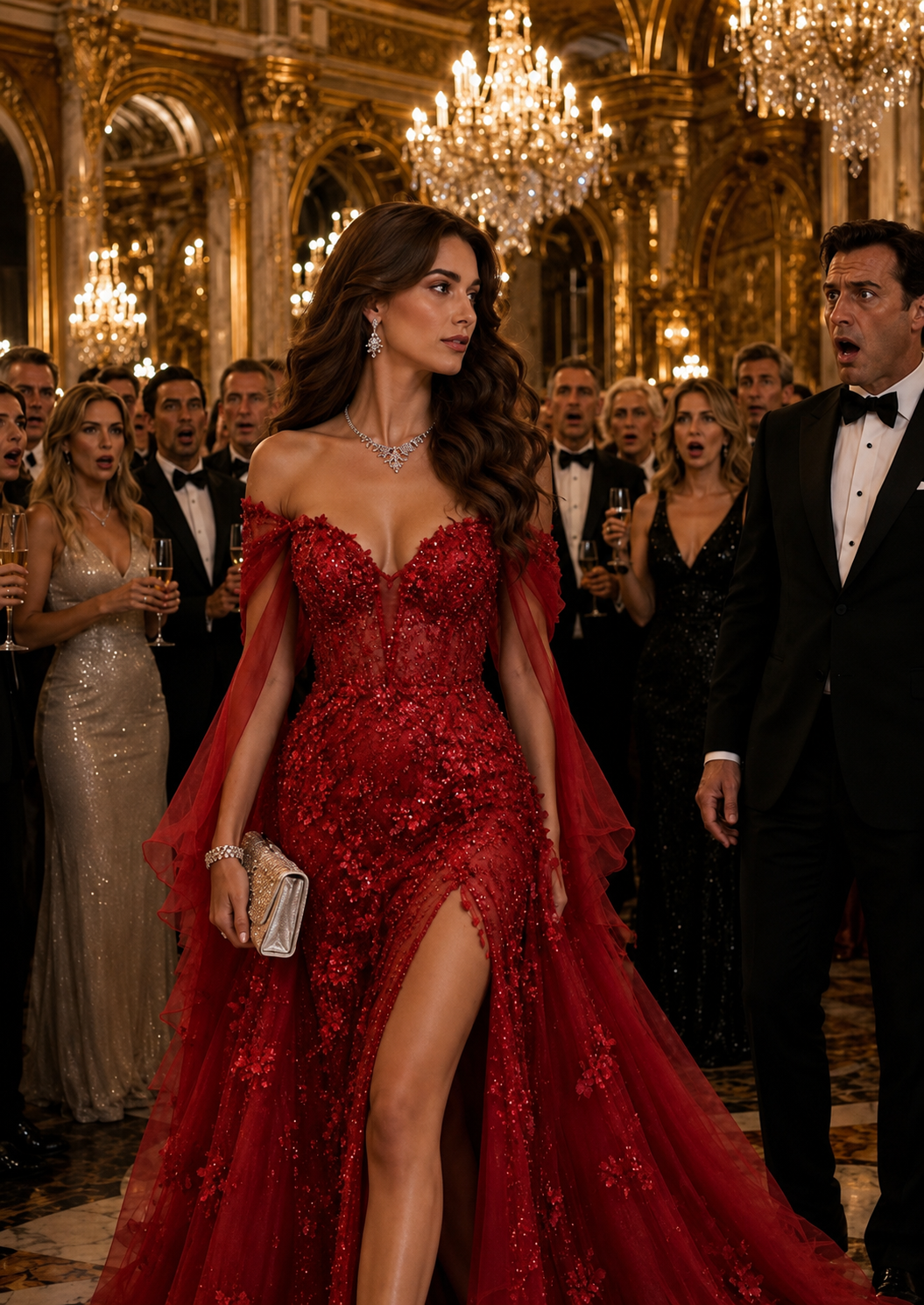
Rachel Bennett had expected silence.
She had expected whispers, maybe a few shocked glances, perhaps even Elijah Carter’s brief confusion before he recovered behind one of those polished smiles he wore in boardrooms and press conferences.
What she had not expected was the way the entire ballroom seemed to hold its breath.
Elijah stood before her in his black tuxedo, champagne glass forgotten in his hand, his blue eyes fixed on her as if the woman standing beneath the chandeliers had stepped out of a dream he had no right to enter.
“So, Elijah,” Rachel repeated softly, her smile controlled and devastating. “Do you still think nobody’s going to ask me to dance?”
Behind him, Tyler Brooks made a strangled sound into his drink.
Greg Sullivan looked from Rachel to Elijah, then down at the floor, fighting a grin that he clearly failed to hide.
Elijah opened his mouth.
No words came out.
For three years, Rachel had watched that man command rooms full of billionaires, politicians, investors, and rivals twice his age. He could destroy a hostile negotiation with one sentence. He could calm a panicked board with a glance. He could turn cold numbers into visions so convincing that people handed him millions before dessert arrived.
But now, faced with the woman he had dismissed as invisible, Elijah Carter looked utterly helpless.
Rachel tilted her head. “Nothing clever to say?”
His throat moved. “Rachel…”
The sound of her name on his lips was different now. Not casual. Not distracted. Not tossed over his shoulder as he handed her another impossible schedule.
It sounded like recognition.
Too late.
Before Elijah could gather himself, a warm voice spoke from Rachel’s left.
“Miss Bennett?”
She turned.
A tall older gentleman stood beside her, silver-haired, elegant, and smiling with the calm confidence of a man who had spent his entire life being welcomed everywhere.
Rachel recognized him immediately.
Nathaniel Voss.
Real estate magnate. Philanthropist. One of the wealthiest men in New York. More importantly, the primary donor for the children’s medical foundation hosting the gala that night.
He bowed slightly and offered his hand.
“Would you honor me with the first dance?”
A soft wave of whispers moved through the crowd.
Rachel felt Elijah stiffen beside her.
She placed her hand in Nathaniel’s.
“The honor would be mine.”
As Nathaniel led her onto the dance floor, Rachel felt dozens of eyes following her. Not mocking. Not dismissing. Watching.
The orchestra began a slow waltz.
Nathaniel moved with old-world grace, guiding her gently beneath the golden chandeliers.
“You have caused quite a stir, my dear,” he said.
Rachel gave a faint smile. “That wasn’t my intention.”
“No?” His eyes twinkled. “Then I would hate to see what happens when it is.”
For the first time all evening, Rachel laughed.
It was small. Genuine. Free.
Across the ballroom, Elijah heard it.
The sound struck him harder than any insult could have.
He realized, with a strange ache in his chest, that he had never heard Rachel laugh like that. Not once in three years. Not because she had no humor, but because she had never felt safe enough around him to show it.
And that realization landed with brutal force.
He had called her efficient.
Reliable.
Brilliant, when it served his business.
But he had never called her beautiful.
Never asked if she was tired.
Never wondered why she hid herself beneath dull clothes and heavy glasses.
Never considered that her invisibility might not be weakness at all, but armor.
Greg stepped beside him quietly.
“Well,” Greg murmured, “this is awkward.”
Elijah did not answer.
Tyler attempted a nervous laugh. “Come on. It’s not that serious. She just cleaned up nicely.”
Elijah turned his head slowly.
Tyler’s laugh died.
“Don’t,” Elijah said.
One word.
Cold enough to freeze the champagne in Tyler’s glass.
On the dance floor, Rachel noticed. She noticed everything. She always had. That was part of what made her so good at her job.
But tonight, she refused to arrange herself around Elijah’s discomfort.
When the waltz ended, Nathaniel lifted her hand and kissed her knuckles with grandfatherly charm.
“You are wasted behind a desk, Miss Bennett.”
Rachel’s smile faltered slightly.
Nathaniel noticed. “Forgive me. I meant that as a compliment.”
“I know,” she said softly. “But behind that desk, I built more than most people ever saw.”
His expression grew thoughtful. “Then perhaps it is time they see it.”
Before Rachel could answer, another man approached.
Then another.
A banker from London. A senator’s son. A young tech founder who blushed so badly Rachel nearly felt sorry for him.
Within twenty minutes, Elijah’s cruel bet had become a public joke without anyone needing to explain it.
Rachel Bennett was not standing alone.
She was the most requested dance partner in the room.
And Elijah Carter had no choice but to watch.
Every time another man smiled at her, his jaw tightened.
Every time Rachel laughed, something in him twisted.
But jealousy was not the worst part.
The worst part was shame.
Because he knew exactly what he had done.
He had not simply underestimated her beauty.
He had underestimated her humanity.
At half past nine, the foundation chairwoman stepped onto the stage to announce the evening’s major donations. Applause filled the ballroom as donors raised paddles, pledging six figures with casual smiles.
Rachel stood near a marble column, finally catching her breath.
Melanie appeared beside her, eyes shining.
“You,” Melanie whispered, “are officially a legend.”
Rachel smiled. “I feel like my feet are dying.”
“Worth it.”
“Absolutely.”
Melanie’s gaze shifted across the room. “He hasn’t stopped staring.”
Rachel did not look. “Let him.”
“He looks miserable.”
“Good.”
But even as she said it, Rachel felt the old wound tug inside her chest.
She hated that Elijah’s opinion had hurt her. She hated that part of her still remembered the rare moments when he had almost been kind.
Like the night her father died, when Elijah found her crying in the stairwell and silently canceled every meeting for the rest of the day.
Or the winter morning he noticed she had not eaten and left a sandwich on her desk without a word.
Or the time a board member snapped at her, and Elijah’s voice turned dangerously quiet as he said, “You will not speak to Miss Bennett that way.”
Those moments had been small.
Too small.
But they had existed.
And that made his cruelty worse.
Because he had known she was a person.
He had simply forgotten when it was convenient.
The chairwoman’s voice rose over the microphone.
“And now, we have one final special announcement before dinner.”
The room settled.
Rachel looked toward the stage.
A large screen lit up behind the podium.
The foundation logo appeared first, followed by images of children in hospital rooms, doctors in surgical masks, parents holding tiny hands.
Then the chairwoman smiled.
“Tonight, we are proud to announce a new scholarship and medical support initiative for children whose families cannot afford long-term treatment. This program was proposed, researched, structured, and privately funded in its first stage by someone who asked to remain anonymous.”
Rachel went still.
Melanie turned toward her slowly.
On the screen, a name appeared.
THE BENNETT HOPE FUND
The ballroom erupted in applause.
Rachel’s breath caught.
Elijah’s head snapped toward the stage.
Bennett.
His eyes searched the room until he found Rachel by the column, standing frozen, one hand pressed lightly against her stomach as if the name had struck her physically.
The chairwoman continued.
“The Bennett Hope Fund was created in memory of Daniel Bennett, a father, teacher, and cancer patient whose daughter believed no family should have to choose between treatment and survival.”
Rachel’s vision blurred instantly.
Her father.
For two years, she had quietly built that proposal at night. She had negotiated with clinics, contacted donors anonymously, and poured her savings into the first grant pool.
No one at Carter Holdings knew.
No one except Melanie.
And now, somehow, it was here.
Public.
Real.
Alive.
The applause became thunderous.
Rachel could barely breathe.
Then Nathaniel Voss stepped onto the stage.
The room fell into respectful silence.
“I had the privilege,” he said into the microphone, “of reading Miss Bennett’s proposal six months ago.”
A gasp moved through the crowd.
Rachel’s eyes widened.
Nathaniel looked directly at her.
“Yes, my dear. I knew it was you.”
Elijah’s face changed.
Shock first.
Then confusion.
Then something deeper, something that looked almost like awe.
Nathaniel continued, “Miss Bennett asked for no attention. No name recognition. No reward. She simply sent me the most detailed, compassionate, financially sound proposal I have seen in a decade and asked me to help children she would never meet.”
Rachel covered her mouth.
The applause began again, louder than before.
Nathaniel smiled.
“So tonight, I am matching the initial fund with ten million dollars.”
The ballroom exploded.
Melanie grabbed Rachel’s arm.
“Rachel,” she whispered, crying openly. “Ten million.”
Rachel could not move.
She had walked into the gala expecting to reclaim her dignity.
She had not expected her dream to be handed back to her beneath a thousand lights.
Elijah crossed the room before he realized he was moving.
By the time he reached her, Rachel had lowered her hand from her mouth, but tears glimmered on her cheeks.
“Rachel,” he said quietly.
She looked at him.
For once, he did not look powerful.
He looked undone.
“I didn’t know,” he said.
Her expression hardened slightly. “You never asked.”
The words hit exactly where they were meant to.
Elijah looked down.
Around them, people still applauded. Cameras flashed. Donors whispered her name. The woman he had mocked had just become the moral center of the evening.
And he had never felt smaller.
“I was cruel,” he said.
Rachel said nothing.
“I was arrogant. Careless. Wrong.” His voice roughened. “And I humiliated you for a laugh.”
“Yes,” she said.
He nodded once, accepting it.
“I’m sorry.”
It was not polished. Not strategic. Not CEO-perfect.
Just two words.
But Rachel had spent too many years surviving on crumbs of kindness to mistake an apology for repair.
“Thank you,” she said softly. “But sorry doesn’t erase what I heard.”
“I know.”
“Do you?”
His gaze lifted.
Rachel stepped closer, keeping her voice low enough that only he could hear.
“You didn’t just call me unattractive, Elijah. You turned my loneliness into entertainment. You made a bet on my humiliation. You looked at me every day for three years and decided I was too invisible to matter.”
Pain flickered across his face.
“I never thought you didn’t matter.”
“But you acted like it.”
The truth stood between them, sharp and undeniable.
Then Nathaniel approached, saving them from the silence.
“Miss Bennett,” he said gently. “The foundation board would like you to say a few words.”
Rachel’s heart lurched. “Now?”
“Yes. Now.”
“I don’t speak in front of crowds.”
Nathaniel smiled. “My dear, you just silenced one by walking into a room.”
Melanie squeezed her hand. “Go.”
Rachel looked toward the stage.
Then toward Elijah.
He said nothing.
But something in his expression had shifted.
No entitlement.
No expectation.
Only remorse.
Rachel turned away from him and walked to the podium.
The applause grew as she climbed the steps. Under the lights, the ballroom looked endless. Faces blurred into gold and black and diamonds.
Her hands trembled when she touched the microphone.
For one terrifying second, the invisible woman inside her begged to run.
Then she thought of her father.
Daniel Bennett, thin and tired in a hospital bed, still smiling as he told her, “Don’t shrink yourself just because the world is careless, Ray.”
Rachel inhaled.
“My father used to say,” she began, her voice trembling but clear, “that kindness is only meaningful when it costs us something.”
The room quieted.
“He was a schoolteacher. He never had much money. But he had this terrible habit of giving away whatever he had left. Time. Advice. Groceries. Sometimes even his own medication money, though he would deny that if he were here.”
Soft laughter moved through the guests.
Rachel smiled through tears.
“When he became sick, I learned how expensive hope can be. I learned that illness does not only attack the body. It attacks dignity. It attacks choices. It attacks families in quiet rooms where no one applauds.”
Elijah stood at the edge of the crowd, unable to look away.
This was Rachel.
Not the hidden version.
Not the assistant behind glass.
This was the woman he had failed to see.
Rachel continued, stronger now.
“The Bennett Hope Fund is for those families. For the parents counting bills beside hospital beds. For children who should be dreaming about birthdays, not treatment plans. For every person who has ever felt invisible in a system that should have protected them.”
Her eyes moved briefly across the ballroom.
They landed on Elijah for half a second.
Then moved on.
“I spent years believing invisibility was safer. Maybe sometimes it is. But tonight, I am learning that being seen can also become a kind of power.”
The applause began before she finished.
This time, Rachel did not flinch from it.
She stood in the light and let the room see her.
When she stepped down, Nathaniel embraced her warmly. Melanie nearly tackled her next. Donors approached. Reporters requested interviews. Board members offered partnerships.
And Elijah watched as Rachel’s world expanded beyond him.
For the first time, he understood something that frightened him.
Rachel did not need him.
She never had.
His company needed her.
His calendar needed her.
His reputation needed the quiet excellence she had given him daily.
But Rachel Bennett did not need Elijah Carter to become extraordinary.
She already was.
Near midnight, Rachel escaped to the balcony.
The cold Manhattan air brushed against her bare shoulders. Far below, traffic moved like rivers of light. Inside, music and applause continued, softened by the glass doors behind her.
She gripped the stone railing and exhaled.
“You always disappear when people start celebrating you.”
Rachel closed her eyes briefly.
Elijah.
She did not turn around. “Old habit.”
“I’ll go if you want.”
“You can stay for one minute.”
He stepped beside her, leaving careful distance between them.
For a while, neither spoke.
Then Elijah said, “I owe you more than an apology.”
Rachel looked at the city. “Yes.”
“I want to make a donation to the fund.”
“You should.”
His mouth twitched faintly. “That was direct.”
“I learned from the best.”
The faint smile faded.
“Rachel, what I said in my office… there’s no excuse for it.”
“No, there isn’t.”
“I thought being honest meant being harsh. I thought noticing someone’s usefulness was the same as valuing them.” He looked at her, voice lower. “I was wrong.”
Rachel finally turned.
Moonlight softened the hard lines of his face. He looked tired, younger somehow, stripped of the arrogance that usually surrounded him like expensive cologne.
“For years,” she said, “I made myself plain because I was tired of being looked at like a thing. Then you looked at me like nothing. I’m still not sure which was worse.”
Elijah closed his eyes briefly.
When he opened them, there was no defense in them.
“I’m sorry,” he said again. “Not because you came here looking beautiful. Not because everyone knows I was wrong. I’m sorry because I should have respected you when I thought no one was watching.”
Rachel’s throat tightened despite herself.
That apology was closer to the truth.
Still not enough.
But closer.
Behind them, the balcony door opened.
A woman’s voice cut through the cold air.
“Rachel Bennett?”
Rachel turned.
A sharply dressed woman in a silver gown stood there, holding a phone and wearing the expression of someone carrying urgent news.
“Yes?”
The woman stepped forward.
“My name is Clara Whitmore. I represent the Voss Foundation’s legal advisory board.”
Elijah straightened slightly.
Rachel frowned. “Is something wrong?”
Clara glanced at Elijah, then back at Rachel.
“I’m afraid this is private.”
Rachel’s pulse quickened.
Elijah took a step back. “I’ll leave.”
“No,” Rachel said before she could think.
Both Elijah and Clara looked at her.
Rachel swallowed. “He can stay.”
Clara hesitated, then nodded.
She handed Rachel the phone.
On the screen was a scanned document.
Old.
Official.
Stamped by a hospital.
Rachel’s eyes moved over the words.
Then stopped.
Her blood turned cold.
“This doesn’t make sense,” she whispered.
Elijah’s voice sharpened. “What is it?”
Clara’s expression was grave.
“Miss Bennett, when Mr. Voss’s office verified the history behind your father’s medical case, we found an irregularity. A payment record. A sealed donor transfer. Someone anonymously paid a large portion of Daniel Bennett’s treatment costs eight years ago.”
Rachel stared at her.
“That’s impossible. My father died because we couldn’t afford the trial.”
Clara’s face softened.
“That is what you were told.”
The city seemed to tilt beneath Rachel’s feet.
Elijah moved closer, alarm breaking through his restraint.
“Rachel?”
She could barely hear him.
Clara continued carefully, “The payment was made. The hospital received it. But the funds were diverted before your father was admitted into the program.”
Rachel’s hand tightened around the phone.
“Diverted by who?”
Clara looked down at the document.
Then she said a name that made Rachel’s heart stop.
“Carter Holdings Medical Trust.”
Elijah went pale.
Rachel turned to him slowly.
The apology, the ballroom, the dances, the humiliation—everything vanished beneath one terrible question.
“Elijah,” she whispered, “what did your company do to my father?”
His face drained of all color.
“I don’t know.”
But Rachel saw the fear in his eyes.
He truly didn’t.
And that made the truth even more terrifying.
Because somewhere inside Carter Holdings, hidden beneath years of polished reports and charitable donations, was the reason Daniel Bennett never got the treatment that might have saved his life.
Rachel stepped back from Elijah as if he had become a stranger all over again.
Inside the ballroom, the orchestra began another song.
Outside, beneath the cold stars, Rachel Bennett realized the cruel bet had only been the beginning.
…If you want to know what happened next, please type “YES” and like for more.