My Arrogant Son-In-Law Publicly Mocked Me As A Free-Loading Mooch At His 40-Person Cookout, Completely Unaware I Secretly Held His Quarter-Million-Dollar Business Loan
Part 1: The Dropped Tongs and the Picnic Table Banker

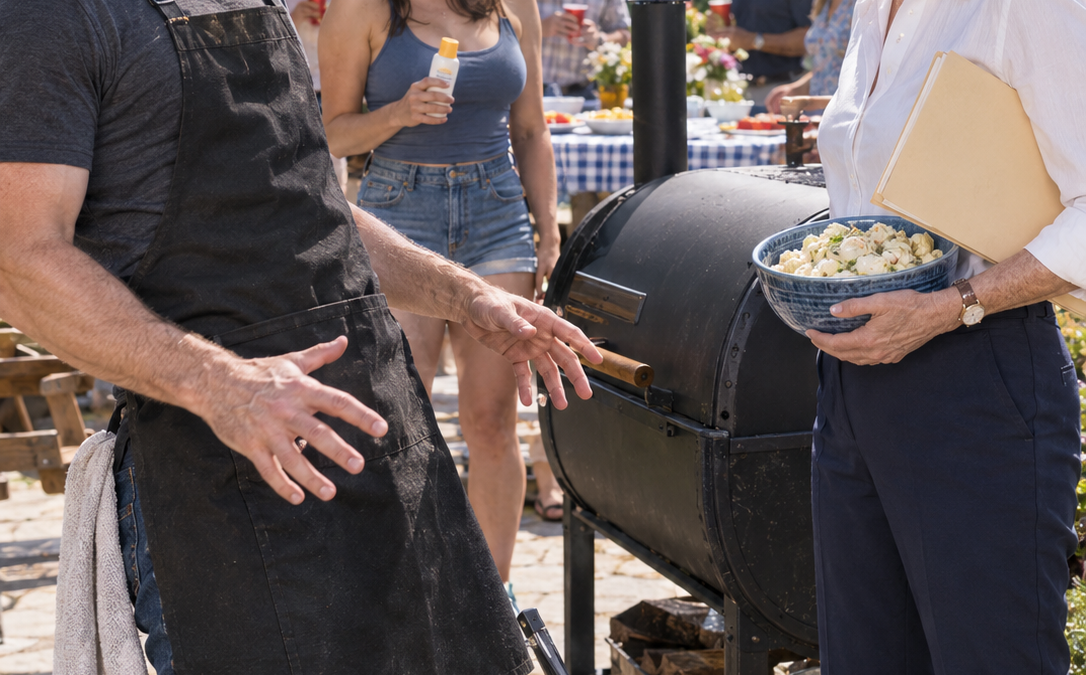
The heavy, twenty-four-inch stainless steel tongs clanged against the stone patio pavers with a sharp, violent ring that sliced straight through the blaring country music. At the center picnic table under the cedar pergola, forty neighborhood guests fell dead silent as the grease smoke from the massive commercial smoker drifted between us.
My son-in-law, Bo Strad, stood frozen across from me in his embroidered black pitmaster apron, his arm still locked in the air where he had just finished toasting my arrival like a carnival ringmaster. His broad, sunburnt face had drained of every drop of color, leaving his skin the exact gray shade of the hardwood ash cooling in his firebox.
“Honey,” I repeated, keeping my voice as calm, level, and polite as a Sunday morning church program, “let’s talk about your payment schedule.”
Bo didn’t bend down to pick up the tongs Hal had bought him. His fingers simply twitched against his empty palm, his jaw working soundlessly as his eyes darted from my face down to the crisp manila folder tucked firmly beneath my arm.
Directly behind him, seated on a wooden bench beside a half-eaten paper plate of beef brisket, a distinguished man in his mid-fifties wearing pressed khakis and wire-rimmed reading glasses slowly lowered his fork. That was Sam Okafor, senior vice president of commercial lending at Osage Trail Bank, and the man Bo had invited to the cookout to celebrate his upcoming restaurant expansion.
“What did you just say, Fonda?” Bo whispered, his voice cracking so sharply that two line cooks near the beer coolers set down their aluminum cans without making a sound.
Across the lawn, by the galvanized drink trough, Bo’s mother, Glenda, threw back her head with a harsh, barking laugh, sloshing spiked lemonade over her red, white, and blue blouse. “Oh, let her talk, Bo! Let the mooch have her say! We’ve all been listening to her whine about her grocery bills all summer anyway!”
She had shouted it to the entire yard, confident in her cruelty, entirely unaware that the manila envelope in my hands contained the complete legal machinery required to foreclose on her son’s livelihood before the sun went down.
Part 2: The Pedigree of Silence and the Price of Pride
To understand why Bo Strad felt entitled to wave those tongs in my face, you have to understand the decades of quiet labor that built the woman standing in front of him. I am sixty-seven years old, a certified public accountant who spent thirty-five years auditing the razor-thin margins of Kansas City restaurant kitchens, reading meat-packing invoices and waste bins the way other people read the weather.
After my late husband Hal passed four years ago, leaving our daughter Nora a modest nest egg and leaving me with our paid-off house and a 2012 Buick with a dented quarter panel, I became completely invisible to my son-in-law. To Bo and his mother, a retired woman who wore clearance-rack cardigans, clipped grocery coupons, and happily picked up six-year-old Owen from day camp twice a week was merely a penniless widow looking for a warm meal.
When Bo wanted to transition from his cramped catering trailer into a brick-and-mortar storefront on Third Street three years ago, every commercial bank in Jackson County turned him down cold. His culinary talent was undeniable, but his financial projections were reckless, his portion control was nonexistent, and his credit history carried the scars of his mother’s previous bankrupt diner.
One desperate evening, Nora called me weeping from her hospital breakroom, terrified that her husband’s broken ambition would tear their young marriage apart.
I didn’t offer Bo a family handout; proud men like him only resent the hands that feed them openly. Instead, I had my longtime corporate attorney, Ruth Ostrander, quietly establish Juniper Lane Funding LLC—a private investment vehicle named after the impoverished dirt road in Sedalia where my widowed mother had raised me on motel-maid wages.
Through an intermediary broker, Juniper Lane issued Bo a private commercial loan of two hundred and sixty thousand dollars at eight and a half percent interest, secured by every piece of kitchen machinery he owned, backed by his personal guarantee. For twenty-six straight months, Bo paid his forty-one hundred dollars on the fifteenth of every month to our third-party servicing agency in Overland Park, convinced he was satisfying a faceless corporate lender while privately sneering at his mother-in-law’s thrifty habits.
The dynamic worsened dramatically the moment Glenda moved into their spare bedroom eight months ago. Glenda was a woman who had run her own breakfast diner into liquidation fifteen years earlier and now carried a bitter, venomous chip on her shoulder toward anyone who managed their finances with discipline.
She needed a scapegoat in that household to distract from her own complete dependence on Bo, and she found it in me.
Every Sunday dinner, without fail, Glenda would eye the vintage blue Pyrex dish I brought through the back door and drop the same dripping remark across the kitchen island: “Look who’s here right at suppertime—the old mooch came for free groceries.” Bo would smirk into his draft beer, Nora would look down at her lap with exhausted, defeated silence, and little Owen would watch his father’s cruel grin, slowly learning that treating Grandma with disrespect was an acceptable family tradition.
Part 3: The Ghost On The Balance Sheet
The fracture began in June, when the monthly note servicing statement arrived at my kitchen table with three words I had never seen in over two years: No payment received.
I told Ruth to issue a standard, gentle grace-period reminder, knowing that walk-in freezers fail and kitchen payroll can stumble in early summer. But July fifteenth passed into August with total radio silence, even as Bo rolled up to Owen’s seventh birthday party towing a custom fourteen-thousand-dollar competition smoker behind his heavy-duty pickup truck.
The genuine crisis didn’t hit until the second week of August, when Bo submitted his delayed second-quarter profit-and-loss statement to the servicing portal.
Tucked between equipment expenses and bulk butcher orders was an outrageous line item that made my hands shake: Consulting Retainer, G. Strad — $11,700. Bo was quietly siphoning nine hundred dollars a week out of the restaurant’s cash reserves directly into his mother’s checking account, prioritizing Glenda’s vanity over the legal debt keeping the doors open.
Worse, he had brought on an aggressive, smarmy private developer named Jace Pard—a man I had personally audited out of a corporate franchise nine years earlier for steering illegal kickbacks to his own shell companies. Jace had convinced Bo to pursue an ill-advised second location in Blue Springs, funded through a four-hundred-and-twelve-thousand-dollar expansion loan from Osage Trail Bank.
On Thursday morning, Ruth summoned me to her office to review an urgent legal notice sent by Osage Trail’s commercial loan officer, Sam Okafor. The bank was formally requesting that Juniper Lane subordinate its first-position equipment lien, falsely stating that Bo had certified his existing debts were entirely current and in good standing.
Attached to the bank’s underwriting packet was the final, devastating blow: under the heading of Secondary Collateral Guarantee, Bo had pledged Nora’s inheritance account from Tall Grass Investments—two hundred and fourteen thousand dollars saved over thirty-one years of her father’s hard manual labor.
Nora was scheduled to sign the irrevocable hypothecation agreement on Tuesday morning at nine o’clock, completely unaware that her husband was three months delinquent on his primary note and gambling her father’s legacy on a fraudulent expansion scheme.
When I tried to reach my daughter on Friday morning, her voice was choked with manufactured suspicion; Jace and Bo had already gotten into her ear, warning her that her “jealous, meddling mother” would try to invent a crisis to sabotage her husband’s big moment.
Then came the group text for the Labor Day cookout, followed by Bo’s brutal private text instructing me to stay away from the backyard until after Tuesday’s bank closing.
I stood in my quiet kitchen holding my mother’s chipped Pyrex dish, realizing that playing the invisible protector had nearly allowed my family to be destroyed. I signed my full legal name onto Juniper Lane’s official rejection notice, packed the promissory ledgers into a plain manila envelope, and spent Monday morning hand-peeling twenty pounds of russet potatoes for the last cookout Bo Strad would ever take for granted.
Part 4: The Stone Patio Reckoning
The aroma of hickory wood and caramelizing sugar was thick in the humid holiday air as I stepped through the stone terrace gate, making a direct line for the offset smoker where Bo stood surrounded by his staff and investors.
When Bo dropped Hal’s tongs and Sam Okafor set down his fork, the silence across the forty-person crowd was suffocating.
“We can step into your study and handle this like business partners, Bo,” I said softly, looking directly into his bloodshot eyes. “Or we can handle it right here on the patio where you just called me a mooch.”
“Don’t you dare come into my yard and play head games, Fonda!” Bo hissed, stepping closer, his knuckles whitening as he tried to regain his footing in front of his crew. “You’re a retired bookkeeper who drives an eleven-year-old clunker! You don’t know the first thing about commercial credit!”
From the picnic bench, Sam Okafor stood up, adjusting his reading glasses as he rounded the smoker with a sharp, professional stride. “Mrs. Fowler? You’re the representative from Juniper Lane Funding?”
“I’m not the representative, Mr. Okafor,” I answered, sliding the first legal document out of the envelope and handing it directly to the banker. “I am the sole managing member and hundred-percent equity owner of Juniper Lane Funding LLC.”
A collective gasp swept through the yard. Near the steps, Nora froze with a bottle of sunscreen in her hand, her eyes widening in sheer shock as the name struck her like a physical blow.
“Juniper Lane?” Nora stammered, stepping forward onto the flagstones. “Mom… that was Grandma Irene’s street. The house where you grew up.”
Glenda marched over from the bar, her painted eyebrows drawn in a furious, theatrical sneer. “Don’t listen to this nonsense, Sam! She’s making it up! She’s a bitter old woman trying to steal the spotlight from my boy!”
Sam ignored her completely; he dialed a contact on his smartphone, put it to his ear, and spoke two brief sentences to Ruth Ostrander before hanging up. When he turned back to Bo, his demeanor had shifted from friendly holiday guest to ice-cold risk investigator.
“It’s verified, Bo,” Sam said, his voice carrying clearly to every guest on the terrace. “Juniper Lane holds your first-position lien, and Mrs. Fowler has formally declined our subordination request.”
“What does that mean?” Nora demanded, her voice trembling as she stepped between her husband and the banker.
“It means there is no closing tomorrow, Mrs. Strad,” Sam stated, pulling a formal notice from his pocket. “Your husband swore under penalty of federal fraud that his primary facility was current. Juniper Lane’s ledger proves he has defaulted on his June, July, and August installments, totaling over twelve thousand dollars in unpaid principal and penalties.”
Nora stared at Bo, her face draining of color. “You haven’t paid your lender since spring? And you were going to let me sign over Dad’s Tall Grass account tomorrow morning to cover it?”
Bo lunged toward Jace Pard, pointing a shaking, grease-stained finger. “Jace told me we could roll the default into the new loan! He said the bank would never look at the private note once the Blue Springs contracts were signed!”
Jace stepped back into the crowd, tossing his plastic cup into the grass, his friendly networking persona vanishing instantly. “You signed the disclosures yourself, Bo. Don’t drag my consulting firm into your domestic disaster.”
Before Jace could reach the gate, I stepped into his path, holding up page six of the Blue Springs prospectus. “Mr. Pard, your twelve-thousand-dollar closing kickback is officially cancelled, and if you ever contact my daughter or step foot near my family again, the state licensing division will receive a complete forensic copy of the 2016 Hearthstone audit that got you fired in Overland Park.”
Jace went completely white, spun on his heel, and sprinted through the wooden gate, slamming it shut behind him without looking back.
I turned back to Bo, pulling the final three-page document from the envelope and resting it directly atop his cold cutting board.
“You called me a mooch for eating a plate of barbecue, Bo, while you were quietly writing nine-hundred-dollar weekly checks to your mother out of money that belonged to my company,” I said, looking Glenda dead in the eye as she shrank behind her lawn chair. “Here is your restructured payment schedule. The delinquent twelve thousand dollars is tacked onto the back of the seven-year note at statutory interest. All unearned family consulting fees cease immediately. You will hire an independent certified bookkeeper, and my daughter’s inheritance is permanently removed from every commercial balance sheet you touch.”
Bo looked down at the signature line, tears of public humiliation spilling over his cheeks, before collapsing heavily onto the wooden picnic bench.
“Sign it on Friday at Ruth’s office, Bo,” I said gently, picking up my empty purse. “Or I exercise our default foreclosure on Monday morning at nine.”
Part 5: The Blue Bowl Returns
By nightfall, the Strad backyard was entirely deserted, littered with abandoned paper plates and half-melted coolers.
The reckoning within the family was swift, absolute, and completely necessary. On Friday afternoon, Bo sat in Ruth Ostrander’s quiet conference room with red-rimmed eyes, methodically signing every page of the revised loan covenants without uttering a single complaint.
Glenda’s weekly nine-hundred-dollar stipend was severed that very afternoon; unable to maintain her grand illusions without her son’s secret subsidies, she packed her matching luggage the following Tuesday and moved across the state line to live with her widowed sister.
Nora took an administrative leave from the pediatric clinic for three weeks, using the time to completely separate her personal credit accounts from Bo’s commercial ventures, locking her father’s hard-earned life insurance proceeds into an irrevocable, single-signature trust that no business partner could ever breach.
For six months, I did not receive a single invitation to Sunday dinner, and I did not ask for one. I spent my mornings swimming laps at the community pool, reading balance sheets for small local non-profits, and driving my paid-off Buick through the quiet autumn parks with the windows cracked to the cool Missouri wind.
Then, on the first Sunday in November, a soft, familiar knock sounded against my front door.
I opened it to find Nora standing on the welcome mat, holding six-year-old Owen by the hand. Tucked against her hip was my mother’s vintage blue Pyrex bowl, heaped high with freshly prepared potato salad and dusted with bright red paprika.
“We brought dinner, Mom,” Nora whispered, her voice breaking into a tearful, long-overdue sob as she buried her face in my shoulder. “And we didn’t come with empty hands.”
Behind them, standing at the base of my concrete porch steps in a clean flannel shirt, Bo Strad stood with his hands tucked respectfully into his pockets, Hal’s vintage grill tongs held quietly at his side.
He didn’t make a rehearsed speech, and he didn’t offer a hollow excuse for the names he had called me. He simply looked up at the woman who had saved his livelihood from total annihilation, bowed his head in genuine humility, and whispered, “The grill is ready whenever you are, Mrs. Fowler.”
I stepped back, opening the door wide to the warm, lit hallway of my home.
The ledger was finally balanced, the ghosts of the past were laid to rest, and around my table, respect had finally replaced the silence.