PART 2
For several seconds, no one in the community hall moved.
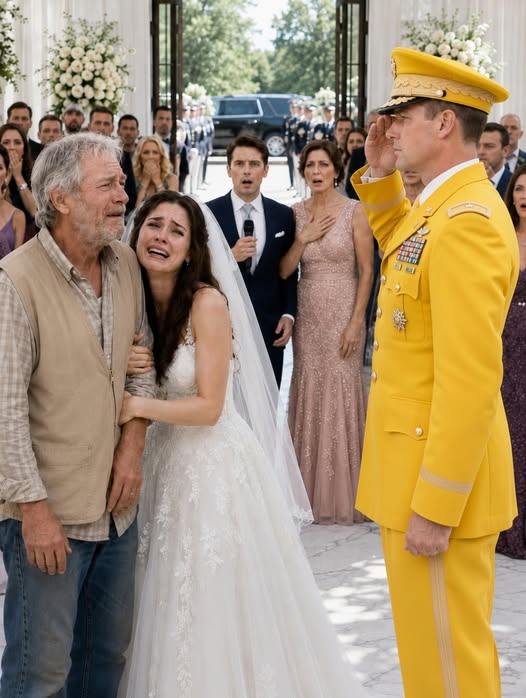
The military commander remained perfectly still, his right hand raised in a formal salute, while my father stared at him with a face drained of color. The room that had been filled with whispers and cruel laughter only moments earlier became so quiet that I could hear the old ceiling fan clicking above us.
My father’s lips trembled.
“Daniel?” he whispered.
The commander slowly lowered his hand. His stern expression broke, revealing an emotion so deep that it seemed to have waited decades to surface.
“Yes, sir,” he said. “Lieutenant Daniel Mercer. Though they call me General Mercer now.”
My father stepped backward as if the name had struck him physically. I tightened my arm around his waist, afraid his knees might give way again.
Tristan, still standing beside his parents near the entrance, gave a short, nervous laugh.
“This is absurd,” he said. “There must be another James Evans.”
General Mercer turned toward him.
The warmth vanished from his face.
“No,” he said. “There is only one James Evans.”
Behind him, several uniformed officers entered the hall. Their polished shoes struck the floor in perfect rhythm. A group of government officials followed, along with two elderly men wearing military decorations over dark suits.
Every one of them stopped before my father.
Then, one after another, they saluted him.
Gasps spread through the crowd.
My father lowered his head, overwhelmed.
“Please,” he murmured. “You don’t have to do this.”
General Mercer stepped closer.
“We should have done it thirty years ago.”
I looked from the commander to my father, struggling to understand what was happening.
My father had never told me he had served in the military.
He had spoken about my mother, about gardening, about the importance of honest work, but never about uniforms, medals, or battlefields. The only photographs in our home showed him standing beside flowerbeds, holding me as a child, or smiling with my mother beneath the old apple tree behind our house.
“Dad,” I whispered. “What are they talking about?”
He closed his eyes.
Before he could answer, General Mercer faced the guests.
“Many of you appear to know Mr. Evans as a gardener,” he said. “That is honorable work. But before he spent his days planting flowers and trimming hedges, he served his country as a combat medic and intelligence officer.”
A murmur rolled through the hall.
Tristan’s mother, Mara, stopped smiling.
General Mercer continued.
“Thirty-one years ago, our unit was sent into a region torn apart by civil war. Official records describe our mission as a humanitarian evacuation. The truth is that we were ordered to rescue civilians trapped behind enemy lines and recover evidence of an international weapons-smuggling operation.”
My father’s fingers tightened around mine.
“The mission was compromised,” Mercer said. “Someone leaked our position. We were ambushed before dawn. Twenty-four soldiers entered that valley. Only seven returned.”
Several people covered their mouths.
“One of those seven was me.”
Mercer turned toward my father.
“I had been shot twice. One bullet tore through my shoulder. Another entered below my ribs. I could not walk. Enemy forces were closing in, and evacuation helicopters had been ordered to withdraw.”
His voice became unsteady.
“James Evans refused to leave us.”
The commander explained that my father had dragged wounded soldiers through nearly four miles of rocky terrain while under continuous gunfire. He had treated their injuries with almost no supplies, using strips torn from his own uniform to stop the bleeding.
When one soldier could no longer breathe, my father performed an emergency procedure using a broken piece of medical tubing.
When another begged to be left behind, my father lifted him onto his shoulders.
“He carried men who were larger than he was,” Mercer said. “He crossed a river while bullets struck the water around him. And when we finally reached the extraction point, he refused to board the helicopter until every wounded soldier had been lifted inside.”
I looked at my father.
The tired gardener standing beside me seemed suddenly unfamiliar, yet every word sounded exactly like the man who had raised me.
Of course he had carried them.
He had carried me through every illness, every heartbreak, every frightened night after my mother died.
He had spent his life carrying people and never asking who would carry him.
“Why didn’t anyone know?” one guest asked.
General Mercer’s jaw tightened.
“Because the mission uncovered something powerful men wanted buried.”
One of the elderly veterans stepped forward. He introduced himself as Colonel Samuel Reid. His left leg was supported by a metal brace.
“James found documents proving that senior officers and private contractors had been stealing money intended for medicine and civilian relief,” Colonel Reid said. “He reported them. The evidence disappeared, and his military record was sealed.”
General Mercer nodded.
“My recommendation for the nation’s highest military honor was rejected. Two officers who supported James died under suspicious circumstances. James was threatened. His wife was threatened.”
My heart stopped.
“My mother?” I asked.
My father’s face collapsed.
He turned toward me, and for the first time in my life, I saw fear in his eyes.
“Maisie,” he whispered, “this is not how I wanted you to learn the truth.”
The room seemed to tilt around me.
I remembered my mother’s final months: her sudden illness, the hospital visits, the doctors who never gave us clear answers. I remembered my father sitting beside her bed every night, holding her hand as though he could keep her from slipping away through sheer strength.
I had been told she died from a rare infection.
“Was Mom’s death connected to this?” I asked.
My father could not answer.
General Mercer looked down.
“We don’t know,” he said carefully. “But we finally have reason to believe it may not have been an accident.”
A painful sound escaped my father’s throat.
Tristan stepped forward, irritation replacing his nervousness.
“What does any of this have to do with us?” he demanded. “This is supposed to be a wedding.”
I stared at him.
Only minutes earlier, he had humiliated my father in front of everyone. Now he spoke as though the ceremony still belonged to him.
General Mercer studied him.
“You’re Tristan Vale?”
Tristan straightened his jacket.
“Yes.”
“And that is your father, Richard Vale?”
Richard’s face turned pale.
“I don’t see why my family is being questioned,” he said.
General Mercer reached inside his uniform and removed a sealed folder.
“Vale Strategic Holdings,” he said. “Previously known as Meridian Relief Logistics.”
Richard’s hand tightened around the back of a chair.
Mara looked at her husband.
“What is he talking about?”
General Mercer opened the folder.
“Meridian Relief Logistics received military contracts during the conflict. The company was responsible for transporting medicine, food, and emergency equipment into the region where our unit was deployed.”
He lifted a document.
“Nearly half of those supplies never arrived.”
The guests turned toward Richard.
Tristan shook his head.
“My father’s company didn’t exist thirty years ago.”
“It existed under another owner,” Mercer replied. “A man named Victor Harlan.”
Richard swallowed.
“Many companies change ownership.”
“Correct,” the general said. “But very few are purchased using money transferred from secret accounts controlled by the officers accused of stealing military relief funds.”
Richard’s glass slipped from his hand.
It shattered across the floor.
The sound made several guests jump.
Mara stared at him.
“Richard?”
He did not look at her.
General Mercer’s voice hardened.
“For years, investigators believed Victor Harlan was the mastermind. Two months ago, new evidence surfaced. Harlan was not acting alone. He had a silent partner.”
The commander looked directly at Tristan’s father.
“Richard Vale.”
The hall erupted.
People whispered, shouted, and began recording with their phones. Some moved away from the Vale family as though guilt itself were contagious.
Tristan rushed toward General Mercer.
“This is slander!”
Two military officers stepped between them.
Tristan stopped.
“You can’t come into my wedding and accuse my family of crimes without proof!”
I almost laughed.
His wedding.
Even after abandoning me at the altar, he still believed everything belonged to him.
General Mercer calmly removed another paper.
“This is a copy of a financial transfer bearing your father’s signature.”
Richard finally spoke.
“You have no authority to arrest me.”
“No,” Mercer said. “But the federal agents waiting outside do.”
Mara let out a cry.
Through the open doors, several dark vehicles pulled into the parking lot. Men and women in plain clothes stepped out.
Richard’s face became gray.
He leaned toward Tristan and whispered something.
Tristan’s expression changed instantly.
He looked at me.
Not with love.
Not with regret.
With calculation.
Then he forced a smile and walked toward me.
“Maisie,” he said softly, “we need to talk.”
I stepped away from him.
“There is nothing to discuss.”
“Please. What happened earlier was a mistake.”
The words stunned me.
“A mistake?”
“I was under pressure,” he said. “My parents were concerned about appearances. I said things I didn’t mean.”
My father looked at him with quiet disbelief.
Tristan reached for my hand.
I pulled it back.
“You stood in front of everyone and called my father worthless.”
“I was angry.”
“You let him apologize for being poor.”
“I can fix this.”
A few guests muttered angrily.
Tristan lowered his voice.
“We can still get married.”
The sheer audacity of it left me speechless.
Minutes earlier, he had declared that he would never marry the daughter of a gardener. Now that he had learned my father was a decorated veteran and his own family might lose everything, he wanted the ceremony restored.
“No,” I said.
He blinked.
“What?”
“I said no.”
His pleasant expression cracked.
“You’re emotional. Think carefully about what you’re doing.”
“I am thinking clearly for the first time since I met you.”
His eyes narrowed.
“Maisie, don’t embarrass me.”
I looked around the hall, at the decorations my father had paid for with twelve years of savings, at the food prepared by neighbors, and at the altar where Tristan had tried to destroy us.
“You embarrassed yourself.”
Tristan grabbed my wrist.
Before I could react, my father stepped between us.
He did not raise his voice.
“Take your hand off my daughter.”
Tristan scoffed.
“You don’t frighten me.”
My father looked into his eyes.
The old gardener seemed to disappear.
In his place stood the man who had crossed a battlefield carrying wounded soldiers.
“You should not confuse kindness with weakness,” he said.
Tristan released me.
General Mercer gave a subtle nod, as though he recognized the soldier my father had once been.
Richard pushed through the crowd.
“We’re leaving.”
Two federal agents entered the hall.
“Richard Vale,” one called.
Richard froze.
The agent displayed identification.
“We have a warrant to search your home, offices, vehicles, and financial records. You are also required to surrender your passport.”
Mara clutched his arm.
“You told me those investigations were over.”
The hall fell silent again.
Richard turned on her.
“Be quiet.”
Her face changed.
“You knew?”
“It was business.”
“Did you know about the stolen medicine?”
“I said be quiet!”
Mara stepped away from him as though she no longer recognized the man she had married.
Tristan looked from his father to the agents.
“You said everything was protected.”
Richard’s head snapped toward him.
“That is enough.”
But it was too late.
Everyone had heard.
General Mercer studied Tristan carefully.
“What exactly did your father say was protected?”
Tristan’s mouth opened, then closed.
One of the agents took out a notebook.
Richard pushed past him, but another agent blocked the door.
“We are not arresting you at this moment,” she said. “Do not make that change.”
Richard stopped.
My father sat heavily in a chair.
I knelt beside him.
“Dad, are you all right?”
He stared at the floor.
“I wanted this day to be beautiful for you.”
“It still can be.”
His eyes filled with tears.
“You lost your wedding.”
“No,” I said. “I escaped the wrong marriage.”
He looked at me.
For the first time since Tristan’s announcement, a faint smile touched his face.
Around us, the atmosphere shifted. Guests who had remained silent during our humiliation began approaching my father.
Some apologized.
Others shook his hand.
A businessman who had laughed when Tristan called him a gardener now claimed he had always respected working men. My father listened politely, but I saw the disappointment in his eyes.
People admired him now because they had learned he was a hero.
I had admired him when they thought he was only a gardener.
That difference mattered.
Aunt Clara came forward carrying a plate of food.
“No one is wasting my mole because of that foolish boy,” she declared.
Laughter spread through the room.
The musicians, who had packed away their instruments, began playing again. Neighbors moved the broken glass and rearranged the chairs.
The wedding celebration became something else.
A celebration for my father.
Colonel Reid raised a glass and told stories about James Evans, the young medic who joked during enemy fire because he knew frightened soldiers needed something to hold onto.
Another veteran described how my father had given his last ration to an injured child.
General Mercer revealed that my father had once disobeyed an evacuation order to rescue twenty-three civilians trapped inside a school.
Each story made me cry.
Each one also made me wonder how many pieces of his life my father had hidden to keep me safe.
When the music softened, General Mercer approached us with a small velvet box.
“This belongs to you,” he told my father.
My father did not take it.
“What is it?”
“Something that should have reached you decades ago.”
Mercer opened the box.
Inside rested a silver military cross surrounded by a faded blue ribbon.
The commander’s voice carried across the hall.
“James Evans, this decoration was approved after the mission but withheld by officials involved in the cover-up. The president has authorized its formal restoration.”
My father stared at the medal.
“I don’t want recognition.”
“This is not only recognition,” Mercer said. “It is evidence that they failed to erase you.”
My father’s hands trembled as the general pinned the medal to his shirt.
Everyone stood.
The applause began softly, then grew until the walls seemed to shake.
My father cried openly.
I wrapped my arms around him.
For one brief moment, the pain of the ruined wedding disappeared.
Then General Mercer leaned close.
“There is another reason I came today.”
My father stiffened.
Mercer handed him a yellow envelope.
“We recovered this from a private archive belonging to Victor Harlan.”
My father stared at the envelope but did not open it.
“What’s inside?”
“A letter written by your wife.”
The joy vanished from his face.
“My wife?”
“The letter is dated three days before she became ill.”
My father nearly dropped it.
I felt cold spread through my body.
“Why would my mother write to Victor Harlan?” I asked.
General Mercer’s eyes shifted toward the Vale family.
“She didn’t. She wrote to Richard Vale.”
Richard was standing near the door between two agents.
He turned slowly.
My father tore open the envelope.
Inside was a single sheet of paper and an old photograph.
The photograph showed my mother much younger, standing outside a warehouse beside Richard Vale. She was holding a folder against her chest. Richard appeared furious.
On the back, my mother had written a date.
Beneath it were six words:
If anything happens, James must know.
My father unfolded the letter.
As he read, the color drained from his face.
“What does it say?” I whispered.
He did not answer.
Richard suddenly lunged forward.
“Give me that!”
The agents restrained him.
My father looked up, grief and rage mixing in his eyes.
“You went to our house,” he said.
Richard struggled against the agents.
“I don’t know what you’re talking about.”
“My wife saw the records.”
“She misunderstood them.”
“You threatened her.”
“She was interfering in matters that did not concern her.”
My father’s voice broke.
“She died.”
Richard stopped struggling.
For one terrible second, guilt flickered across his face.
Mara saw it.
“What did you do?” she whispered.
Richard said nothing.
Tristan stared at his father.
“Dad?”
General Mercer took the letter and read it silently. His expression became grim.
“What does it say?” I demanded.
He looked at me with hesitation.
“Your mother discovered that stolen medical supplies were being resold through local hospitals. She collected invoices and shipping records. According to this letter, she planned to testify.”
I remembered my mother working late at the kitchen table when I was a child. I remembered stacks of papers she quickly hid whenever someone knocked at the door.
“She wasn’t only a nurse,” my father said quietly. “She managed medical inventory for the county hospital.”
Mercer nodded.
“She recognized serial numbers from missing military shipments.”
My father looked at Richard.
“You knew she had proof.”
Richard’s calm finally shattered.
“You think I controlled everything? Harlan had people everywhere. Your wife refused to stop. She brought danger into your home.”
My father surged to his feet.
General Mercer grabbed his arm.
“What happened to her?” my father shouted.
Richard’s face twisted.
“I never touched her!”
“That isn’t an answer.”
“I warned her. That was all.”
One of the federal agents stepped closer.
“Mr. Vale, you should stop speaking.”
But Richard seemed unable to control himself.
“She thought she could destroy powerful men with a folder of invoices. She didn’t understand what was at stake.”
“What happened to my mother?” I cried.
Richard looked at me.
For the first time, his arrogance weakened.
“I don’t know.”
“You’re lying.”
“I swear.”
Tristan moved toward him.
“You told me the Evans family was dangerous. You told me marrying Maisie would help us recover something they had.”
My breath caught.
The entire room seemed to stop.
Richard stared at his son with horror.
“Tristan, shut your mouth.”
But Tristan’s face was pale with panic.
“No. You said James Evans might still have evidence. You told me to search his house after the wedding.”
I took a step backward.
The memories rearranged themselves inside my mind.
Tristan’s sudden interest in my childhood.
His questions about my mother’s belongings.
The night he insisted on helping my father repair the roof, then spent nearly an hour alone inside the house.
The time I caught him searching through an old cabinet and he claimed he was looking for a glass.
“You never loved me,” I whispered.
Tristan turned toward me.
“That’s not true.”
“You approached me because of my father.”
“At first, yes, but then—”
The sound of my palm striking his face echoed across the hall.
Tristan touched his cheek.
“You used me.”
“I was trying to protect my family.”
“You humiliated my father to make everyone believe you wanted nothing to do with us.”
His eyes widened.
I understood.
“That was the plan, wasn’t it? You wanted to marry me, search our home, and then leave. But when your father thought the investigation was getting closer, he ordered you to abandon me publicly so no one would connect our families.”
Tristan said nothing.
His silence was an admission.
Mara stared at her son with disgust.
“What kind of people have I been living with?”
Richard pulled against the agents again.
“You enjoyed the houses, the cars, and the parties. Don’t pretend you’re innocent.”
She slapped him.
The agents immediately separated them.
General Mercer placed the letter back into the envelope.
“This is enough to reopen the investigation into Evelyn Evans’s death.”
My father sat down again, suddenly looking older than he had that morning.
“I buried her believing I had failed to save her.”
“You did not fail her,” Mercer said.
“I should have listened. She told me someone was following her.”
My heart broke at the guilt in his voice.
I knelt and held his hands.
“You raised me. You kept me safe. You gave Mom every piece of your heart. None of this was your fault.”
He looked at me through tears.
“I was afraid that if I continued fighting, they would come after you. So I disappeared. I became a gardener. I stayed quiet.”
General Mercer rested a hand on his shoulder.
“And now you don’t have to stay quiet anymore.”
The federal agents escorted Richard toward the door for further questioning. Tristan attempted to follow, but an agent stopped him.
“We need your statement.”
Tristan looked at me one final time.
“Maisie, I did care about you.”
I removed the engagement ring from my finger.
The diamond had once seemed beautiful.
Now it looked like a tiny piece of ice.
I walked toward him and placed it in his palm.
“You cared about what you thought my family was hiding.”
His fingers closed around the ring.
“You’ll regret this.”
“No,” I said. “I would have regretted marrying you.”
He was led away.
The crowd watched in silence.
When the doors closed behind the Vale family, the musicians began playing again, but the celebration no longer felt possible.
Too much had changed.
My father had been revealed as a hero.
My mother’s death had become a mystery.
My fiancé had become a stranger.
And beneath everything lay a secret powerful men had killed to protect.
Later that evening, after the guests left, my father and I returned home with General Mercer.
The little house looked exactly as it always had: faded blue paint, a crooked porch railing, gardening boots beside the door.
But inside, nothing felt the same.
Mercer asked my father whether my mother had left behind documents, diaries, or personal files.
My father shook his head.
“After she died, someone broke into the house. They took her papers.”
“Was anything else missing?” Mercer asked.
“One wooden box.”
I looked toward the hallway.
“What wooden box?”
My father hesitated.
“Your mother kept it beneath a loose floorboard in your childhood bedroom.”
I stared at him.
“There isn’t a loose floorboard.”
“There used to be.”
We walked into my old room.
The wallpaper had faded, but tiny painted stars still covered the ceiling. My father moved the bed and knelt beside the wall.
He pressed on one floorboard.
It shifted.
My heart began pounding.
He lifted it carefully.
Beneath it was an empty space.
General Mercer shone a flashlight inside.
At first, we saw nothing.
Then I noticed a small piece of red fabric wedged beneath the wooden beam.
I reached down and pulled.
A tiny cloth pouch came free.
My father stared at it.
“That belonged to your mother.”
Inside the pouch was a key and a folded note.
The note contained only an address and four words written in my mother’s handwriting:
Trust the man who salutes.
General Mercer went still.
The address belonged to an abandoned train station outside Oakridge.
“We need to go now,” he said.
The station had been closed for more than twenty years. By the time we arrived, darkness had settled over the countryside.
Mercer brought two officers with us.
We entered through a broken side door. Dust covered the floor, and moonlight slipped through shattered windows.
The key fit a locker hidden behind the old ticket counter.
My father turned it.
Inside sat a metal case.
For thirty years, it had waited in darkness.
My father opened it.
The case contained photographs, military invoices, shipping records, and a cassette tape labeled with my mother’s name.
There was also a sealed envelope addressed to me.
Maisie Evans.
My hands shook as I opened it.
The first sentence made my knees weaken.
My dearest daughter, if you are reading this, then the man who killed me has finally returned for what I stole from him.
A noise sounded behind us.
Glass shattered.
One of the officers shouted.
The lights went out.
In the darkness, someone grabbed the metal case.
General Mercer drew his weapon.
“Stop!”
Footsteps raced toward the rear exit.
A gunshot exploded through the station.
My father pushed me to the floor.
When the emergency lights flickered on, the case was gone.
One officer lay wounded beside the ticket counter.
And General Mercer was standing near the open door, staring at something clutched in his hand.
It was the missing photograph of my mother.
But now I could see that someone else had been standing beside her.
A younger General Mercer.
On the back, my mother had written one final message:
Daniel knows the truth about Maisie’s real father.
…If you want to know what happened next, please type “YES” and like for more.