PART 2
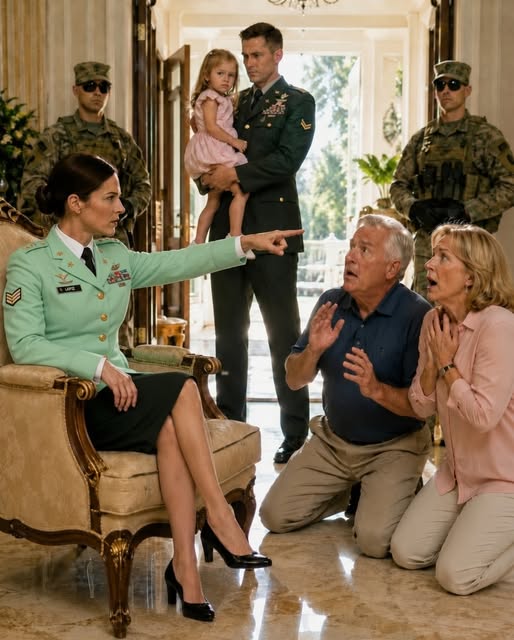
I read the first sentence again, certain I had misunderstood it.
Then I read it a third time.
To my granddaughter, Colonel Emily Carter: If this letter has been delivered, then your parents have finally endangered the one person I feared they would hurt most—your child.
The rain tapped against the windows behind me. On the porch, my father stood frozen beneath the yellow security light. My mother’s face had turned so pale that even her lipstick looked unnaturally bright. Miranda stared at the envelope in my hands as though it were a weapon.
The gray-haired attorney beside them remained perfectly calm.
“My name is Samuel Whitmore,” he said. “I represented your grandmother, Eleanor Bennett, for twenty-eight years.”
I remembered him vaguely from childhood—always present at holiday dinners, funerals, and quiet conversations that stopped whenever children entered the room.
My grandmother had died eight years earlier.
She had been the strongest person I had ever known.
She had also been the only person in my family who never treated Miranda as though she were made of glass and me as though I were made of steel.
My father stepped forward.
“This is ridiculous,” he said. “Eleanor’s estate was settled years ago.”
Mr. Whitmore looked at him without blinking.
“Part of it was.”
My mother’s voice trembled.
“Samuel, you have no right to bring private family matters here.”
“I have every right,” he replied. “And a legal obligation.”
Miranda crossed her arms.
“This is obviously Emily’s doing. She canceled our payments and now she’s hired some lawyer to scare us.”
I lowered the letter.
“I didn’t know he was coming.”
“Of course you did,” she snapped. “You always plan everything.”
David moved closer to me, not aggressively, but enough to make it clear that no one would step inside unless we allowed it.
Behind us, the hallway was dark. Lily was upstairs asleep, unaware that the family who had left her in a storm had arrived at our door demanding money.
I turned to Mr. Whitmore.
“What exactly is this?”
He glanced at my parents.
“It would be better discussed privately.”
My father gave a short, bitter laugh.
“You’re not going inside.”
“This is my house,” I said quietly.
His eyes shifted toward me.
For the first time in my life, I saw something in his face I had never expected.
Fear.
Not anger.
Not pride.
Fear.
I opened the door wider.
“Mr. Whitmore may come in. The rest of you can leave.”
My mother’s expression hardened.
“Emily, don’t be cruel.”
The word nearly made me laugh.
Cruel.
She had looked at her six-year-old granddaughter through a car window, told her there was no room, and driven away in a thunderstorm.
But now cruelty meant refusing to let her into a warm house.
“I’m protecting my daughter,” I replied.
“From us?” my mother asked, pressing a hand dramatically to her chest.
“Yes.”
The answer silenced everyone.
Miranda’s mouth fell open.
My father’s jaw tightened.
My mother looked as though I had slapped her.
May you like



Mr. Whitmore stepped inside. David closed the door, leaving my parents and sister on the porch.
Their voices rose immediately.
My father pounded once against the wood.
“You can’t hide from this!”
David locked the deadbolt.
Then he turned to Mr. Whitmore.
“Dining room?”
The attorney nodded.
We sat at the same table where, only the night before, David and I had calculated exactly how much of our lives had been consumed by my family.
The spreadsheets were still open on my laptop.
Mortgage payments.
Insurance.
Tuition.
Medical bills.
Vacation deposits.
A financial history of people who believed my success belonged to them.
Mr. Whitmore placed his leather folder on the table and removed several documents.
“The first thing you need to understand,” he said, “is that your grandmother did not trust your parents.”
I looked toward the front door, where my father’s voice could still be heard.
“That doesn’t surprise me.”
“She believed your father had become financially reckless. And she believed your mother enabled him.”
David leaned forward.
“What kind of reckless?”
Mr. Whitmore slid a document toward us.
It was a property deed.
The address belonged to my parents’ house.
The same house where Miranda and I had grown up.
The same house whose mortgage I had been paying for nearly four years.
But the owner’s name was not my father’s.
It was not my mother’s.
It belonged to the Eleanor Bennett Family Preservation Trust.
I stared at it.
“I don’t understand.”
“Your grandmother purchased the property thirty-two years ago,” Mr. Whitmore explained. “Your parents were permitted to live there under a conditional occupancy agreement.”
“A what?”
“They could remain in the home as long as they maintained it, paid the taxes, and did not borrow against it.”
My stomach tightened.
“I’ve been paying a mortgage on that house.”
“There should not be a mortgage.”
The room went completely still.
David looked at me.
I looked at the papers.
Then I remembered the monthly statements my father had sent me—scanned documents bearing the logo of a private lending company.
Every month, I had transferred nearly five thousand dollars to cover what he claimed was the remaining loan.
“Are you saying the house was paid off?”
“It was purchased in cash.”
My hands went cold.
David’s voice sharpened.
“Then where has the money been going?”
Mr. Whitmore opened another file.
“That is what your grandmother suspected would eventually happen.”
He showed us a series of filings.
Four years earlier, my father had created a shell company called Carter Residential Holdings. Using falsified documentation, he had represented himself as the owner of the trust property and secured a private loan against its supposed equity.
The lender was not a bank.
It was an investment group.
The terms were predatory.
The interest rate was staggering.
Worse, my father had not used the money for repairs, medical emergencies, or family expenses.
He had invested most of it in a luxury development project with two business partners.
The project had collapsed within eighteen months.
The debt remained.
I felt as though the floor had tilted beneath me.
“How much does he owe?”
Mr. Whitmore hesitated.
“Approximately one point two million dollars.”
David swore under his breath.
“That’s impossible,” I whispered.
“It would have been,” Mr. Whitmore said, “if the loan had been legally secured. The property did not belong to him, so the lien is invalid. But the fraud is not.”
The word struck harder than the number.
Fraud.
My father had not merely mismanaged money.
He had forged documents.
He had used a home he did not own as collateral.
And then he had convinced me that the payments were necessary to save the family house.
Every dollar I sent had protected him from the consequences.
“Does my mother know?” I asked.
Mr. Whitmore’s silence answered before he spoke.
“She signed two of the supporting documents.”
I closed my eyes.
A memory surfaced from three years earlier.
My mother had called me crying, saying they might lose the house. She said my father had been too ashamed to tell me. She said stress was affecting his heart. She begged me not to ask too many questions because he could not handle the humiliation.
I had wired them twenty-five thousand dollars that afternoon.
Later, Miranda called to thank me for “saving everyone.”
That same summer, my parents had taken Miranda’s family to Hawaii.
They told me the trip was paid for with airline points.
I opened my eyes.
“And Miranda?”
Mr. Whitmore removed another document.
“She received forty percent of the original loan proceeds.”
I stared at him.
“For what?”
“She claimed she was starting an educational consulting business.”
Miranda had never worked in education.
She had never started a business.
She had renovated her kitchen, purchased a new SUV, enrolled Ethan and Chloe in private school, and posted photographs from resorts in Mexico and the Caribbean.
Each time she ran short, she called me.
Not because she had fallen on hard times.
Because she had spent stolen money and expected me to refill the account.
David pushed back from the table and stood.
He walked toward the window, pressing both hands against the frame.
“I’m trying very hard not to go outside,” he said.
Mr. Whitmore folded his hands.
“There is more.”
I almost laughed from disbelief.
“Of course there is.”
“Your grandmother anticipated that your parents might attempt to exploit you financially.”
“She knew?”
“She knew your personality. She knew you were loyal. Responsible. She feared they would turn those qualities against you.”
The words hurt because they were true.
All my life, my parents had praised me for being independent.
Emily can handle it.
Emily never complains.
Emily doesn’t need help.
Miranda, meanwhile, was always fragile.
Miranda needed support.
Miranda had anxiety.
Miranda had children first.
Miranda’s marriage was difficult.
Miranda deserved another chance.
My strength had never earned me respect.
It had simply made me easier to use.
Mr. Whitmore continued.
“Your grandmother placed several assets into the trust. The house was only one of them.”
He handed me another document.
It listed investment accounts, municipal bonds, and two commercial properties.
The total value was more than six million dollars.
I read the number twice.
“Who controls this?”
“You do.”
I looked up.
“What?”
“You became successor trustee upon your grandmother’s death.”
“No. I never signed anything.”
“You were not required to assume active control immediately. Your grandmother included a delayed notification clause.”
David returned to the table.
“Why would she hide it from Emily?”
“She wanted Emily to build her own life without knowing she would one day control substantial assets. She also believed the trust should remain dormant unless specific conditions occurred.”
“What conditions?” I asked.
Mr. Whitmore glanced toward the staircase.
“If your parents endangered your child, committed financial fraud involving trust property, or attempted to force you to support them through deception.”
All three had happened.
The realization settled over me like ice.
Yesterday, my parents had left Lily in the rain because there was not enough room in the car for her.
But that single act had triggered something my grandmother had prepared almost a decade earlier.
My father pounded on the door again.
“Emily! Open this door!”
Mr. Whitmore looked toward the sound.
“He knows what this means.”
“What does it mean?”
“Their occupancy rights are terminated.”
I stared at him.
“They have to leave the house?”
“Yes.”
“When?”
“Legally, they can be served with notice immediately.”
My heart should have felt satisfaction.
Instead, I felt grief.
Not for the house.
For the family I had believed existed.
I remembered Christmas mornings in that living room. My father lifting Miranda and me to place ornaments high on the tree. My mother baking cinnamon rolls. My grandmother sitting near the fireplace, watching everything with eyes that seemed to notice more than she ever said.
How much of it had been real?
How long had my parents been lying?
A soft voice came from behind us.
“Mom?”
I turned.
Lily stood at the edge of the dining room in pink pajamas, clutching her stuffed rabbit.
Her hair was tangled from sleep.
Her eyes moved from me to the papers on the table.
Then she looked toward the front door, where my father was still shouting.
“Is Grandpa mad?”
I stood immediately and crossed the room.
“No, sweetheart. Grandpa is leaving.”
“Did I do something wrong?”
The question broke something inside me.
I knelt and pulled her close.
“No. You did nothing wrong.”
“But everybody’s fighting because I told you.”
“You were supposed to tell me.”
I held her face gently between my hands.
“Listen carefully, Lily. When someone leaves you alone, scares you, or tells you to keep a secret from me, you always tell me. Even if they’re family. Especially if they’re family.”
She nodded, though tears had gathered in her eyes.
Mr. Whitmore watched us silently.
Then he reached into his folder and removed a small cream envelope.
“Your grandmother left something for Lily as well.”
My breath caught.
“She died before Lily was born.”
“She prepared letters for any future great-grandchildren.”
He handed me the envelope.
On the front, in my grandmother’s familiar handwriting, were the words:
For Emily’s first child, should the family ever forget her worth.
Lily looked at me.
“Who wrote it?”
“Your great-grandmother.”
“Did she know me?”
“Not exactly.”
I carried her to the sofa and sat beside her. David joined us.
The noise outside had stopped.
Perhaps my parents were listening.
Perhaps they finally understood they had lost control.
I opened the envelope.
Inside was a single handwritten page.
Dear little one,
I may never meet you, but I know something about you already. You are Emily’s child, which means your mother will love you fiercely. It also means some people may assume you are strong enough to accept less love than others. Never believe them. Strength does not make a child less deserving of protection. Independence does not make a person less worthy of care. And family is not measured by who shares your blood, but by who makes room for you when the storm comes.
My voice broke on the final sentence.
Lily leaned against me.
“Great-Grandma knew about the rain?”
“No,” I whispered. “But I think she understood storms.”
Mr. Whitmore lowered his gaze.
David wiped his eyes quickly, pretending he had something in them.
Then the doorbell rang.
Not pounding this time.
One slow chime.
David checked the camera.
“They’re gone,” he said. “But there’s a police officer outside.”
My body tensed.
Mr. Whitmore did not appear surprised.
“That may be for your father.”
David opened the door halfway.
A Fairfax County detective stood on the porch, rain beading across his jacket. Behind him, two patrol cars were parked along the curb.
“Colonel Carter?” he asked.
I approached.
“Yes.”
“I’m Detective Ruiz. I need to speak with you regarding a fraud investigation involving your father, Thomas Carter.”
My pulse quickened.
“You already knew?”
“We’ve been investigating for several months.”
Mr. Whitmore stepped beside me.
“I contacted your office this afternoon.”
Detective Ruiz nodded.
“We received documents from Mr. Whitmore, but there’s another issue. Your father filed a complaint earlier today claiming you had stolen money from him.”
For a moment, I thought I had heard incorrectly.
“He claimed what?”
“He said you accessed family accounts without authorization and canceled payments belonging to him.”
David’s expression turned incredulous.
“The accounts are in Emily’s name.”
“We know that now.”
The detective looked uncomfortable.
“He also alleged that your military position gave you access to confidential financial systems.”
“That’s absurd.”
“Yes. But because he specifically referenced your security clearance and employment at Fort Belvoir, the accusation was forwarded to federal authorities.”
A cold anger moved through me.
My father had not merely called me cruel.
He had tried to damage my career.
The career that had funded his life.
The position I had worked nearly twenty years to earn.
“He tried to have me investigated?”
“He tried to pressure you,” Detective Ruiz said. “But his complaint created the opposite result. It brought additional scrutiny to his finances.”
Mr. Whitmore gave a faint nod.
“Predictable.”
“Where is he now?” I asked.
“We stopped him two blocks away.”
My heart pounded.
“Is he under arrest?”
“Not yet.”
The answer surprised me.
Detective Ruiz glanced toward Lily and lowered his voice.
“We were preparing to detain him when your sister left the vehicle and offered to cooperate.”
Miranda.
I looked at David.
He looked equally shocked.
“What did she say?”
“She claims your father controlled the entire scheme. She says she believed the money came from a legitimate family trust.”
“That’s a lie.”
“I suspected you might say that.”
The detective opened a small notebook.
“She also claims your mother has records proving your father forged both of their signatures.”
Mr. Whitmore frowned.
“That contradicts the documents I reviewed.”
“Exactly.”
I understood immediately.
They were turning on each other.
Before the night was over, my father, mother, and sister had already begun rewriting the truth to save themselves.
“What happens now?”
“We need formal statements. We’ll also need copies of every payment you made and every message in which they requested money.”
“I have years of them.”
“That will help.”
Detective Ruiz handed me his card.
Then he hesitated.
“There’s something else you should know.”
The phrase had become terrifying.
“What?”
“When we stopped your father, officers found several packed suitcases in the trunk.”
My mother and Miranda had not come to my house simply to argue.
They had been preparing to leave.
“Where were they going?”
“We don’t know. But your father was carrying thirty-eight thousand dollars in cash and three passports that did not belong to anyone in the vehicle.”
Mr. Whitmore’s eyes narrowed.
“Whose passports?”
“One belonged to an elderly woman named Margaret Bennett.”
The name struck me with a force I could not explain.
Bennett was my grandmother’s maiden name.
But I did not know any Margaret.
Mr. Whitmore did.
His face changed completely.
For the first time since entering my house, the calm attorney looked shaken.
“Margaret is Eleanor’s younger sister.”
“I thought Grandma was an only child.”
“That is what your parents told you.”
“Is Margaret alive?”
Mr. Whitmore looked at Detective Ruiz.
“She should be.”
The detective closed his notebook.
“We haven’t been able to locate her.”
A chill ran through me.
“Why would my father have her passport?”
“That,” Detective Ruiz said, “is what we’re trying to determine.”
After he left, Mr. Whitmore remained standing near the door.
His hands were no longer steady.
I watched him carefully.
“You knew about Margaret.”
“Yes.”
“Why was she kept secret?”
He returned slowly to the table.
“Your grandmother and Margaret were close when they were young. But Margaret had significant developmental challenges. After their parents died, Eleanor became her legal guardian.”
“What happened to her?”
“Your grandmother placed her in a private assisted-living residence. The trust paid for everything.”
“Where?”
“Maryland.”
“And after Grandma died?”
Mr. Whitmore hesitated.
“Your father petitioned to become her guardian.”
My chest tightened.
“Did he?”
“Yes.”
“Then he controlled her money.”
“He controlled a separate care account. Not the primary trust.”
David’s expression darkened.
“How much was in it?”
“Approximately nine hundred thousand dollars at the time.”
The number hung between us.
“Where is Margaret now?” I asked.
“I believed she was still at the residence.”
“Believed?”
“I received annual reports signed by the facility administrator.”
“Have you spoken to her?”
“Not in several years.”
Anger flashed through me.
“You were her attorney.”
“I was the trust attorney,” he corrected, though regret filled his voice. “Your father insisted Margaret became distressed around people she did not know. He provided medical letters recommending limited contact.”
“Letters he could have forged.”
“Yes.”
The room seemed suddenly too small.
My parents’ cruelty toward Lily had exposed financial fraud.
The fraud had exposed the trust.
And the trust had revealed a missing relative no one had ever told me existed.
I looked down at my grandmother’s letter.
Family is measured by who makes room for you when the storm comes.
Had Margaret spent years waiting for someone to make room for her?
“We need to find her,” I said.
Mr. Whitmore nodded.
“I’ll contact the residence tonight.”
He called from the dining room while David took Lily upstairs.
I remained at the table, reviewing old bank transfers.
Once I knew what to look for, the pattern became obvious.
Every few months, my father requested money for a crisis.
A damaged roof.
An insurance premium.
A medical procedure.
A tax bill.
But several dates matched transfers from Margaret’s care account listed in Mr. Whitmore’s documents.
My father had been drawing money from both of us at the same time.
The assisted-living residence answered after the fourth call.
Mr. Whitmore introduced himself and asked for Margaret Bennett.
The person on the other end spoke for less than a minute.
Then Mr. Whitmore stood so abruptly that his chair scraped across the floor.
“What do you mean she was discharged?”
My heart began hammering.
He listened.
“When?”
Another pause.
“Who signed the release?”
His face drained of color.
He slowly lowered the phone.
“What happened?”
He looked at me.
“Margaret was removed from the residence three years ago.”
“By my father?”
“By you.”
I stared at him.
“That’s impossible.”
“The release documents carry your name, your signature, and a copy of your military identification.”
I could barely breathe.
“I’ve never been there.”
“I believe you.”
“Then where did he take her?”
“The facility does not know.”
He turned the phone toward me.
An email had arrived containing a scanned discharge form.
At the bottom of the page was my name.
Colonel Emily Carter.
The signature looked almost perfect.
Beside it was a photocopy of an old military ID I had reported missing four years earlier.
The same year my father had claimed they were about to lose the house.
The same year I began making monthly payments.
I suddenly remembered a family barbecue that summer.
My father had asked detailed questions about my travel schedule.
My mother had insisted on keeping Lily overnight.
Miranda had wandered through my bedroom while pretending to look for a bathroom.
They had not simply been taking my money.
They had been building an identity they could use.
My phone buzzed.
A message from an unknown number appeared.
There was no greeting.
No explanation.
Only a photograph.
An elderly woman sat in a dim room, holding that day’s newspaper against her chest. She had silver hair, frightened eyes, and my grandmother’s unmistakable face.
Below the photograph were seven words.
Stop investigating, or Margaret disappears for good.
A second message arrived immediately afterward.
This one contained an address.
I recognized it.
It was an abandoned hunting cabin my father had inherited from an uncle years ago.
Then a final message appeared.
Come alone. Do not contact the police.
David returned to the dining room and saw my expression.
“What is it?”
I locked the phone before he could see the screen.
In that instant, military training and maternal instinct collided inside me.
One told me to contact Detective Ruiz immediately.
The other told me that whoever had Margaret was frightened, desperate, and watching every move we made.
I stood.
“I need to check on Lily.”
Upstairs, my daughter was asleep again, curled beneath her blanket. Her stuffed rabbit rested under one arm.
I sat beside her and brushed the hair from her forehead.
Yesterday, she had been the person left outside.
Tonight, because she told the truth, an entire structure of lies had begun collapsing.
I kissed her gently.
Then I returned downstairs, unlocked my phone, and showed David the messages.
His face hardened.
“You’re not going alone.”
“I’m not going at all without a plan.”
Mr. Whitmore looked at the photograph.
“That is Margaret.”
“Are you certain?”
“Yes.”
My phone buzzed once more.
A video began playing automatically.
Margaret stared at the camera while someone stood behind her, just outside the frame.
Her voice shook.
“Emily, I’m sorry. They told me you didn’t want me. They said Eleanor left everything to Miranda.”
A hand appeared on her shoulder.
Margaret flinched.
Then a man spoke from behind the camera.
A voice I had known my entire life.
My father’s voice.
“Midnight, Emily. Bring the original trust documents, or your great-aunt will pay for your disobedience.”
The video ended.
But in the final second, a mirror behind Margaret revealed something my father clearly had not noticed.
He was not alone in the cabin.
My mother stood beside him.
And behind her, holding the camera, was Miranda.
All three of them had been stopped by police less than an hour earlier.
Which meant the video had been recorded in advance.
They had planned everything.
Even worse, the newspaper in Margaret’s hands was dated six months earlier.
The photograph was not proof she was alive tonight.
It was proof they had been hiding her for far longer than anyone imagined.
Then I zoomed in on the mirror.
Near the cabin door stood a fourth figure.
A tall man in a dark military uniform.
My breath stopped.
On his shoulder was the insignia of my own unit.
And although his face was blurred, I recognized the ring on his hand.
It belonged to the senior officer who had been sitting beside me in the secure conference room when Mrs. Patterson called about Lily.
The betrayal was no longer confined to my family.
It had followed me onto the base.
…If you want to know what happened next, please type “YES” and like for more.