PART 2
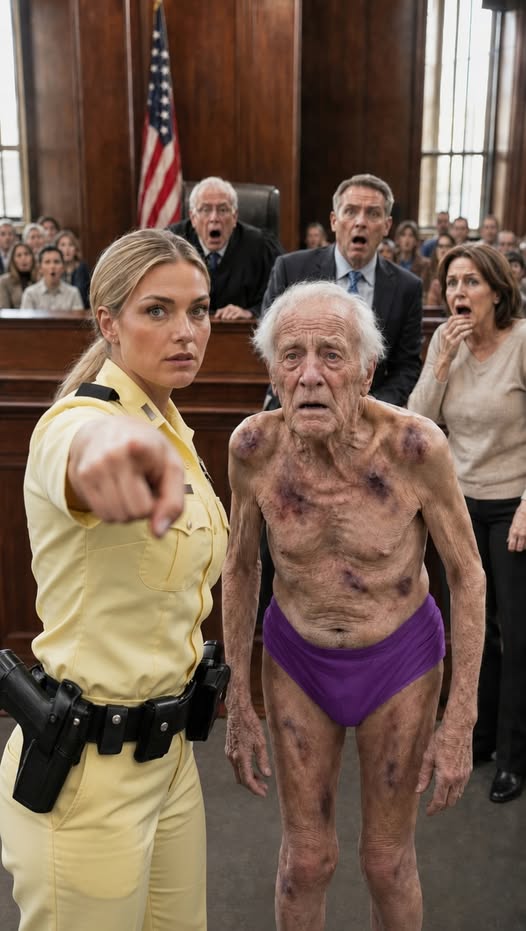
“Move in now,” I said into the secured line, keeping my voice steady. “One elderly hostage located alive. Multiple suspects on site. Assume they are armed and dangerous.”
For a heartbeat, nothing happened.
Rain hammered the shed roof. Water slid down my grandfather’s hollow cheeks as if the night itself were weeping for him. Behind me, my father stood ankle-deep in the mud, his expensive shoes ruined, his fists clenched at his sides. Nolan lingered near the back steps, wearing the uncertain smile of a man who had spent his entire life believing consequences were things that happened to other people.
My mother folded her arms over her silk dress.
“You’ve always been theatrical,” she said. “Put the phone away before you embarrass yourself.”
Then the eastern sky turned white.
Floodlights swept across the estate. Engines roared beyond the trees, followed by the grinding collapse of the iron front gate. Four black tactical vehicles surged up the driveway, their tires spraying gravel and rainwater. Another team crossed the neighboring field on foot, moving with synchronized precision.
My mother’s expression vanished.
Nolan stopped smiling.
My father looked directly at me, and for the first time in my life, I saw fear in his eyes.
“Captain Vale,” a voice sounded through my phone. “Perimeter secured. Alpha team approaching the residence.”
I stepped in front of my grandfather.
“Everyone keep your hands visible.”
My father took one slow step backward.
Red beams appeared across his chest.
“Do not move!” an agent shouted from the darkness.
Figures in black armor emerged through the rain. Their rifles remained angled downward, but every movement carried the controlled violence of people trained to end danger before it fully formed. Within seconds, two agents surrounded Nolan, another covered my mother, and a medical team rushed toward the shed.
My mother began to scream.
“This is our property! You can’t storm into our home!”
“Actually,” I said, “a credible report of unlawful imprisonment, elder abuse, financial coercion, and possible national-security crimes gives us more authority than you can imagine.”
Her face turned pale.
A medic knelt beside Grandpa and wrapped him in a thermal blanket. When she touched the bruises around his wrists, her professional expression hardened.
“How long has he been confined?”
“I don’t know,” I answered.
“Sixteen days,” Grandpa whispered.
The words nearly split me open.
Sixteen days.
Sixteen nights in a freezing shed while my family ate prime steak beneath crystal chandeliers.
I crouched beside him. “Why didn’t you call me?”
“They took my phone.” His trembling fingers closed around mine. “They said you had changed your number. They showed me messages.”
“What messages?”
His eyes filled with shame. “Messages from you. Saying I was a burden. Saying you never wanted to see me again.”
I looked toward Nolan.
He immediately lowered his gaze.
The rage inside me sharpened into something colder than anger.
“You forged them,” I said.
Nolan swallowed. “I don’t know what he’s talking about.”
Grandpa stared at him. “You stood outside that door and read them aloud.”
An agent seized Nolan’s arms and pulled them behind his back.
“Wait!” he shouted. “You can’t arrest me because an old man is confused!”
My father found his voice at last.
“Everyone calm down. This has been misunderstood. My father is mentally unstable. He wandered into traffic twice last month. The shed was temporary protection.”
“Protection?” I stepped aside so he could see the stained mattress, the rusted bucket, the empty water bottles, and the chain bolted to the wall. “Is that what you call this?”
My father’s jaw tightened.
“He refused professional care.”
“So you locked him in a shed?”
“He was becoming dangerous.”
Grandpa let out a broken laugh.
“I was dangerous,” he murmured, “because I discovered what they stole.”
The rain seemed to soften around us.
I turned back to him. “What did they steal?”
His eyes moved toward the house.
“The basement.”
My father lunged.
He barely managed half a step before Agent Reed slammed him against the shed wall. His cheek struck the wet wood, and his arm was twisted behind him.
“Don’t!” my father gasped. “You don’t understand what’s down there.”
“That’s exactly why we’re going to look,” I said.
My mother’s composure cracked.
“Elena, please.”
It was the first time she had spoken my name without contempt.
I looked at her.
Rain had flattened her carefully styled hair. Mascara streaked beneath her eyes. She suddenly seemed smaller, older, but I refused to confuse vulnerability with innocence.
“You called him pathetic,” I said. “You mocked him while he starved twenty yards away.”
Her lips trembled. “Your father said he was being fed.”
My grandfather’s voice came quietly from behind me.
“She brought the food herself.”
My mother went still.
I closed my eyes for one second.
When I opened them, whatever remained of my childhood loyalty was gone.
“Take them inside separately,” I ordered. “No communication between suspects. Search the entire property.”
The agents moved immediately.
Nolan resisted, shouting that he knew senators, attorneys, judges. My mother demanded to call the family lawyer. My father said nothing as he was led across the lawn, but his eyes remained fixed on me.
There was something in his stare that unsettled me.
Not hatred.
Warning.
I followed the entry team through the kitchen. The dining room remained exactly as we had left it. Steam no longer rose from the plates. My chair lay on its side, and my mother’s champagne had spilled across the white carpet like diluted blood.
The normality of the room felt obscene.
Agent Reed approached me.
“Captain, we found surveillance equipment throughout the house. Most of it is recent. Hidden microphones, encrypted transmitters, and cameras covering every exterior route.”
“Domestic security system?”
He shook his head. “Military-grade.”
I looked toward the basement door at the end of the hallway.
A new electronic lock had been installed above the handle.
“Can you breach it?”
“Already working on it.”
Two technicians opened a compact case and attached a bypass device to the keypad. Numbers flashed rapidly across the small screen.
I went upstairs while they worked.
Grandpa’s bedroom had been stripped nearly bare. His clothes were gone. Family photographs had been removed from the walls, leaving clean rectangles against faded wallpaper. On the desk, I found an unsigned guardianship petition declaring him mentally incompetent.
A physician’s name appeared at the bottom.
Dr. Vincent Shaw.
I knew that name.
He had served as a medical consultant for federal intelligence operations before being dismissed for falsifying psychological assessments.
My pulse quickened.
This was no improvised family cruelty. Someone had prepared legal documents, medical evidence, surveillance infrastructure, and financial transfers. My parents had not simply lost patience with an elderly man.
They had been executing a plan.
A drawer beneath the desk had been forced open. Inside, among torn papers, I found an old photograph.
Grandpa stood beside five younger men in front of an unmarked aircraft. All wore civilian clothes, but their posture was unmistakably military. On the back, in his handwriting, were four words:
THE FIRST VIGIL TEAM.
My breathing stopped.
Vigil was the classified task force I commanded.
Officially, the unit had been formed twelve years ago to investigate threats too politically sensitive for conventional agencies. I had been recruited after distinguishing myself during a hostage rescue overseas. My grandfather had celebrated when I received the assignment, though I had never told him the unit’s name.
At least, I thought I hadn’t.
I stared at the photograph again.
It had been taken almost forty years earlier.
“Captain,” Reed called from downstairs. “The basement is open.”
I slipped the photograph into my jacket and returned to the hallway.
The basement door stood ajar.
Cold air poured from below.
The stairs led deeper than I remembered. When I was a child, the basement had contained old furniture, canned food, and my father’s neglected woodworking tools. Now reinforced metal lined the walls. Fiber-optic cables ran along the ceiling. At the bottom, a second door had been concealed behind a false storage cabinet.
The technicians cut through its lock.
Beyond it lay a room filled with servers.
Rows of machines blinked in the darkness. Maps covered one wall, marked with colored pins across Washington, Berlin, Ankara, Singapore, and Moscow. Photographs of military officers, intelligence officials, scientists, and defense contractors had been arranged into interconnected networks.
At the center of the room stood a glass table.
On it rested dozens of classified files.
Reed picked up the nearest folder and examined the cover.
His face changed.
“These came from Sentinel Command.”
“That’s impossible,” I said.
Sentinel Command oversaw some of the country’s most restricted defense programs. Even I did not possess unrestricted access.
A technician inserted a protected drive into one server.
“Encrypted,” she said. “But the architecture resembles government systems.”
“Can you determine what was copied?”
“Not quickly.”
A second agent called from the far corner.
“Captain, you need to see this.”
He had found a locked cabinet. Inside were blank passports, foreign currency, biometric molds, and six compact communication devices identical to those issued to covert operatives.
Below them sat a velvet case.
I opened it.
My own service badge lay inside.
I instinctively touched the badge clipped beneath my jacket.
The one in the case looked perfect, down to the microscopic authentication marks.
“Someone duplicated my credentials,” I said.
Reed’s expression hardened. “For what purpose?”
Before I could answer, shouting erupted upstairs.
We ran toward the staircase.
My father had broken free from the agent holding him. He stood in the kitchen with a carving knife pressed against my mother’s throat. Her eyes bulged in terror.
“Back away!” he shouted.
Agents raised their weapons.
“Put down the knife,” Reed ordered.
My father tightened his grip.
A thin line of blood appeared on my mother’s neck.
“Elena,” he said, breathing hard. “Tell them to lower their guns.”
I stepped into the room.
“Why are you protecting the basement?”
“I’m protecting you.”
“You kept Grandpa chained in a shed.”
“Because he wouldn’t stop.”
“Stop what?”
“Digging into things he had no right to reopen.”
My grandfather had been brought inside on a stretcher. From the hallway, he watched his son with exhausted grief.
“You were warned,” Grandpa said.
My father’s eyes flashed toward him.
“You destroyed this family.”
“No,” Grandpa answered. “I tried to save it.”
My father laughed bitterly. “Save it? You chose your secrets over us. You disappeared for months. You lied about everything. And then you handed the future to her.”
He looked at me.
The hatred returned.
Not because I was a failure.
Because I had received something he believed belonged to him.
“What future?” I asked.
Grandpa reached beneath the thermal blanket.
When his hand emerged, he was holding a small metal key on a broken chain. An unfamiliar insignia had been engraved into its surface: an eye within a circle, crossed by a vertical sword.
I recognized it.
The same emblem existed inside Vigil’s sealed command chamber, a room accessible only to the unit’s director and operational captain.
Grandpa held out the key.
My father pressed the blade harder against my mother’s throat.
“Don’t give it to her!”
Grandpa ignored him.
“Elena, come here.”
I moved slowly across the kitchen. Every weapon remained trained on my father. My mother shook so violently the knife trembled against her skin.
Grandpa placed the key in my palm.
It was heavier than it looked.
“What does it open?” I asked.
“The truth.”
My father shouted, “He’s manipulating you!”
Grandpa’s eyes never left mine.
“Vigil was not founded twelve years ago,” he said. “It was rebuilt twelve years ago.”
The photograph in my jacket seemed to burn against my chest.
“You were part of the original unit.”
“I created it.”
Silence filled the house.
Even the agents seemed to stop breathing.
Grandpa continued.
“After the Cold War, a group inside our own government began selling restricted technology to foreign buyers. They believed loyalty was obsolete and profit was the only power that mattered. Vigil was formed to identify them.”
“Who were they?”
“We called them the Circle.”
My father’s face had turned gray.
Grandpa looked at him.
“Your father became one of their couriers.”
My mother made a broken sound.
“That’s a lie,” my father snapped.
“Then tell Elena why her credentials were copied.”
My father’s eyes flickered.
It was enough.
I felt the room tilt.
“How long?” I asked.
He said nothing.
“How long have you been using my identity?”
His voice softened.
“Long enough to make sure the blame would land where it needed to.”
The betrayal struck with surgical precision.
The mocking comments, the jokes about my “little government job,” the deliberate effort to make me feel invisible—it had all been camouflage. My family had known exactly who I was. They had needed me distant, ashamed, and unsuspecting while they built crimes around my name.
I stared at Nolan.
“You knew?”
He shook his head too quickly.
“Not everything.”
“What did you know?”
His eyes filled with tears. “Dad said you were helping us. He said your badge gave him access to investment information.”
“Investment information?”
“I thought it was corporate intelligence. I didn’t know about military files.”
My father laughed without humor.
“You knew enough to spend the money.”
Nolan’s face collapsed.
The luxury watch. The cars. The unexplained trips. The private accounts.
He had not asked questions because comfort had been easier than conscience.
My mother whispered, “Richard, let me go.”
My father’s expression changed.
For one second, the man I remembered appeared—the man who had taught me to ride a bicycle, who had carried me home after I broke my ankle, who used to call me his brave girl.
Then he shoved my mother toward the agents and ran.
He slammed his hand against the kitchen wall.
An explosion shook the basement.
The lights died.
Smoke rolled up the stairwell.
Agents tackled my mother to the floor for protection. Reed fired once toward the back door, but my father had already disappeared into the darkness.
“Server room!” someone shouted.
A suppression alarm screamed through the house.
We rushed downstairs.
Flames spread across the equipment, unnaturally fast and bright. Thermite charges had been planted beneath the server racks. Drives melted into glowing slag before we could reach them.
“He planned a destruction protocol,” Reed said.
A shadow moved beyond the smoke.
I followed it through a narrow passage hidden behind the cabinet. The tunnel sloped downward beneath the foundation, emerging near the old greenhouse at the edge of the property.
My father was fifty yards ahead, running toward a parked SUV.
“Stop!” I shouted.
He looked back.
For a man in his sixties, he moved with startling speed.
I chased him across the wet grass. He reached the vehicle, yanked open the door, and pulled a handgun from beneath the seat.
I dove behind a stone planter as two shots cracked through the rain.
Agents spread out behind me.
“Richard Vale!” Reed called. “Drop the weapon!”
My father fired again.
Then Grandpa’s voice came through my earpiece.
“Elena, the vehicle is wired.”
I froze.
“How do you know?”
“Because the Circle never leaves evidence behind.”
My father climbed into the driver’s seat.
I stood.
“Dad!”
His hand paused over the ignition.
For one impossible moment, our eyes met through the rain-streaked windshield.
“Get out of the car,” I shouted. “It’s a trap.”
He stared at me as though trying to decide whether I was his daughter or his enemy.
Then he smiled sadly.
“You still think I’m the worst person in this family.”
He turned the key.
The SUV exploded.
The force threw me backward. Heat tore across my face. Glass and metal rained over the lawn. My ears filled with a high, endless ringing.
When I opened my eyes, Reed was dragging me away from the flames.
My father was gone.
The vehicle burned until only its frame remained.
At dawn, the estate looked like a battlefield.
My mother and Nolan sat in separate vehicles, wrapped in blankets and guarded by agents. Grandpa had been transported to a secure hospital under armed protection. The basement fire was contained, but most of the servers had been destroyed.
A forensic team recovered fragments of documents, partial drives, and one heat-resistant black case buried beneath the floor.
Inside were financial ledgers.
The transactions spanned two decades.
My father’s name appeared repeatedly.
So did Nolan’s.
My mother’s signature authorized several shell companies.
And beside hundreds of transfers was an identification code that belonged to me.
Captain Elena Vale.
According to the records, I had sold defense intelligence to foreign intermediaries, approved illegal operations, and received more than eighty million dollars through offshore accounts.
The evidence was fabricated.
But it was excellent.
By sunrise, I understood my father’s plan.
If his network were ever discovered, I would become the architect of the entire conspiracy.
Reed stood beside me near the ruins of the greenhouse.
“We’ll prove the records were forged.”
“Will we?”
He did not answer.
My secure phone vibrated.
The caller ID displayed no number.
I answered.
A distorted voice spoke.
“Captain Vale, you have been compromised.”
“Identify yourself.”
“Return the key.”
My hand closed around the metal object Grandpa had given me.
“What does it open?”
“The only archive your father failed to destroy.”
“Where?”
“You already know.”
The call ended.
I looked toward the hospital helicopter disappearing into the pale morning sky.
Grandpa knew where the archive was.
And someone knew he had given me the key.
Reed approached with a grim expression.
“Captain, Internal Security just issued an order.”
“What order?”
He hesitated.
“Your immediate suspension and detention.”
Agents began emerging from the house.
Men and women I had commanded for years.
People who had trusted me with their lives.
They surrounded me slowly.
Reed lowered his voice.
“The evidence recovered downstairs identifies you as the leader of the Circle.”
“I’ve been framed.”
“I believe you.”
“Then help me reach my grandfather.”
His eyes shifted toward the arriving armored convoy.
“I may not have that authority anymore.”
The lead vehicle stopped.
Director Marcus Thorne stepped out.
He was the man who had recruited me into Vigil, trained me, promoted me, and once told me that loyalty mattered most when trust became dangerous.
He approached with his hands behind his back.
“Elena,” he said, almost gently, “give me your weapon and the key.”
I stared at him.
“How do you know about the key?”
Something flickered across his face.
A mistake.
Small, but unmistakable.
Only Grandpa, my father, Reed, and I had seen it.
The caller had demanded its return.
And now Director Thorne wanted it.
My grandfather’s warning returned to me with terrifying clarity: The Circle had survived inside the government.
I slowly removed my pistol.
Thorne relaxed.
Then Grandpa’s metal key pulsed once in my closed hand.
A hidden light appeared along its edge, projecting a string of coordinates across my palm.
Beneath them, four words glowed:
TRUST NO VIGIL DIRECTOR.
I looked up.
Thorne had already drawn his gun.
He aimed it directly at my heart.
…If you want to know what happened next, please type “YES” and like for more.