“People around my family become very curious when they feel threatened. They may learn things about your life you would prefer to keep private.”
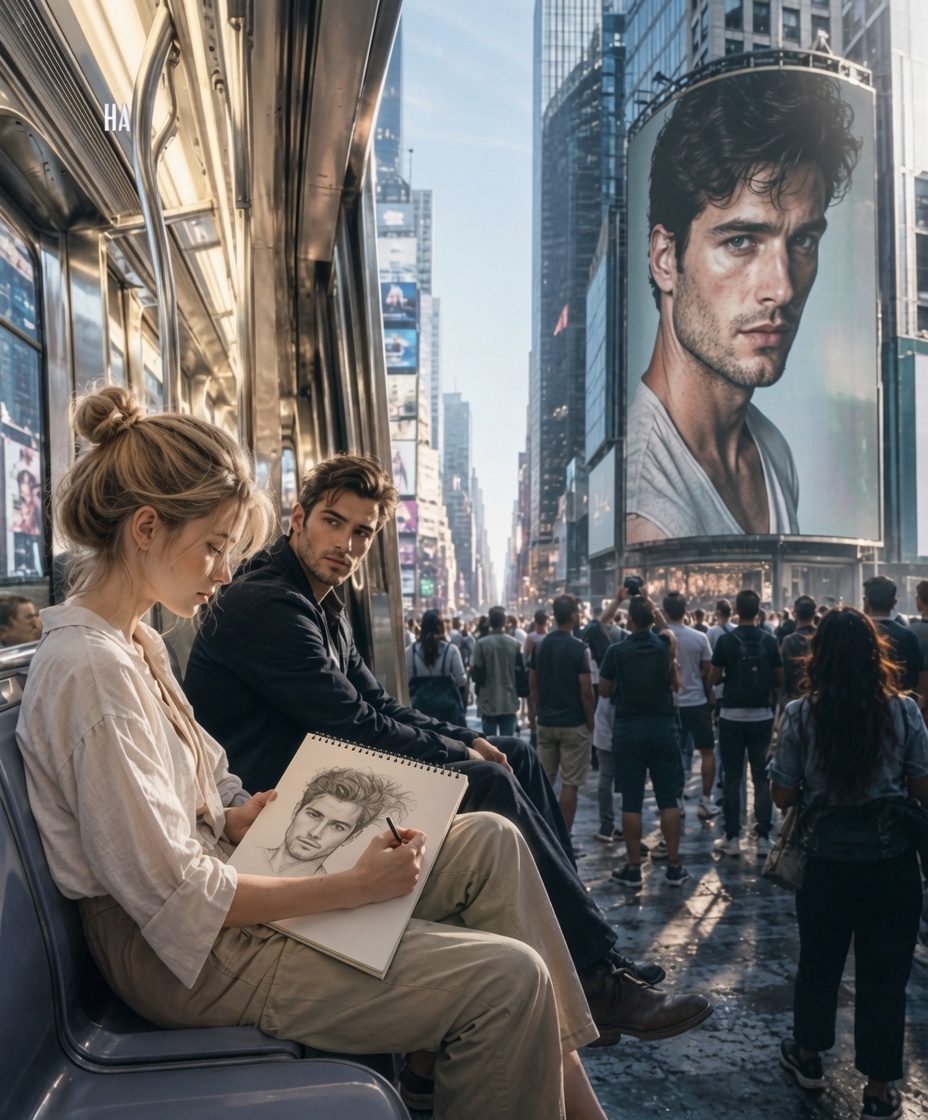
Eleanor looked toward the battered shoebox on a shelf.
“Everyone has a box, Miss Bellamy. Some simply contain more than others.”
She left through a storm of camera flashes.
Minutes later, Norah received a text from an unknown number.
Car outside. He’ll see you.
The car took her to the Sinclair Building.
Julian’s office occupied the fortieth floor, but it did not look like a place where anyone actually lived. There was glass, pale stone, an enormous empty desk and a view of Manhattan that seemed designed to remind visitors how small they were.
One object did not belong.
A chipped blue enamel mug sat beside Julian’s phone.
He stood before the window with his jacket removed and his watch still turned inward.
“My mother visited you,” he said.
“Yes.”
“What did she offer?”
“A check before lunch and a threat before five.”
“You refused the check?”
“Yes.”
“Why?”
“Because I need you to believe the truth.”
She explained everything—the subway, her daily sketches, Priya’s post and the shoebox where no subject had ever seen their portrait.
Julian watched her face the way she had watched his.
“I did not put you on that screen,” she finished. “Watch me while I say it. I can’t lie to a face I’ve drawn.”
His shoulders loosened by a fraction.
Then his phone vibrated.
Julian read the message, and the fragile possibility of belief disappeared.
“The Times Square screen was purchased three days ago.”
Norah stared at him. “That’s impossible.”
“You drew me yesterday.”
“Yes.”
“Someone paid for the display two days before the drawing existed.”
The office seemed to tilt.
Julian placed his phone on the desk with terrifying care.
“This was planned, Miss Bellamy. Someone knew you would draw me before you ever saw me.”
Norah searched her memory.
Then she remembered running toward the subway as the doors were closing.
“A man held the train.”
Julian went still.
“He stood in the doorway and waited for me,” she said. “He didn’t look annoyed. He didn’t even look at the conductor. He watched me run toward him.”
“Did he board?”
“I don’t remember.”
Julian pressed a button on his desk.
The woman in gray entered.
“Dana, get the platform footage from Chambers Street. Yesterday between four thirty and five.”
“That will require transit authorization.”
“Then get authorization.”
Two hours later, grainy security footage played on a conference-room screen.
Norah saw herself running down the platform.
A man in a gray cap blocked the subway doors until she entered the car.
Then he released them.
He did not get on.
He walked away.
“Rewind,” Julian said.
Dana changed camera angles.
Ten minutes before Norah arrived, the woman in the straw hat stood near the turnstiles, fanning herself.
The man in the gray cap approached.
She handed him a phone without speaking.
Norah felt every hair on her arms rise.
“The woman sat beside me,” she whispered. “She told me to give you the drawing.”
Julian’s eyes remained on the frozen image.
“Do you know her?”
“No.”
“Then somebody does.”
Part 2
By noon, Norah Bellamy had become famous.
By two, she had become a suspect.
By sunset, Julian Sinclair had started believing she might be the only innocent person involved.
Dana found no clear image of the man in the cap, but Priya remembered something disturbing.
Three weeks earlier, a man carrying a canvas messenger bag had visited Aster and Vane. He claimed to represent a small arts foundation looking for undiscovered portrait artists.
“He asked about you,” Priya told Norah over the phone. “He wanted to know whether you drew from photographs or from life.”
“What did you say?”
“I told him you only drew people in person. I told him you were brilliant.”
“You told him my subway route?”
“No. But I said you usually arrived from Brooklyn around nine and sometimes came in late because you stopped to sketch commuters.”
Norah closed her eyes.
Someone had researched her habits.
Someone had chosen a train.
Someone had placed Julian across from her and an old woman beside her.
Someone had bet an enormous amount of money that Norah would see the loneliness in his face.
The realization frightened her more than the billboard.
Julian called her back to his office that evening.
The sunlight had softened, turning the glass room gold. A second coffee mug waited beside the chipped blue one.
“You drink coffee this late?” Norah asked.
“I drink the idea of coffee.”
He handed her the plain mug awkwardly.
“It’s what people do after difficult days.”
“You sound uncertain.”
“I’m generally surrounded by people who bring me things because it is their job.”
Norah sat across from him near the window.
“The blue mug was my grandmother’s,” Julian said after noticing her looking at it. “She owned a diner in Queens.”
“Owned?”
“My mother said she became ill and moved to a private facility six years ago. She didn’t want visitors.”
“You believed that?”
“I was given paperwork.”
Norah studied his face.
“Paper isn’t a person.”
“No, but paper rarely asks you to trust it before betraying you.”
His bitterness was old and carefully organized.
Before Norah could ask more, Marcus Hale, Julian’s general counsel, entered carrying a tablet.
He placed it on the table.
“Six years ago, the Sinclair Family Foundation funded one anonymous scholarship for a student completing an art degree.”
Norah recognized the cream letterhead immediately.
Her stomach tightened.
Marcus continued.
“The recipient was Norah Bellamy.”
Julian looked at her.
Norah shook her head. “I didn’t know.”
“The recommendation was personally signed by Eleanor Sinclair,” Marcus said.
“That isn’t possible.”
“It is documented.”
Norah remembered the envelope that had saved her from dropping out after her mother’s medical debt consumed everything they had. She had written thank-you letters for a year without ever learning who paid her tuition.
Now Julian was staring at her as though a string had finally become visible between them.
“My mother financed your education,” he said. “Six years later, you drew me on a train, and the portrait appeared on a screen purchased in advance.”
“I didn’t know your mother.”
“She visited you within hours.”
“To threaten me.”
“Or to control the story.”
Norah stood.
“You believed me ten minutes ago.”
“I wanted to.”
The words hurt more than they should have.
“You keep saying that as though wanting to believe someone is weakness.”
“In my experience, it is.”
“I’m not part of your experience.”
“You may have been part of it for six years.”
Julian turned toward the window.
“Dana will take you home.”
Norah’s throat tightened. “You’re throwing me out.”
“I am removing an unknown variable.”
“I’m a person, Julian.”
His jaw shifted.
She had used his first name without permission, but neither of them acknowledged it.
“At least look at me when you decide I’m lying,” she said.
He did not turn.
Norah walked toward the door, then stopped.
“The trap was never built around me,” she said. “It was built around you.”
Julian remained motionless.
“I’ve drawn thousands of strangers. Someone chose the one man whose loneliness they already understood. Ask yourself who has known you were lonely long enough to design all this.”
She glanced at the blue mug.
“You keep that so something remembers who you were before the tower. I learned that in one day. Whoever planned this has known it for years.”
The elevator carried her down forty floors.
As she crossed the lobby, her phone buzzed.
An unknown number had sent a photograph.
A straw hat rested on a diner counter beside a blue enamel mug identical to Julian’s.
Tucked into the hatband was a folded drawing.
Norah enlarged the image.
Her knees nearly gave out.
She recognized the graphite work as her own, but the portrait was not on her apartment wall. It showed a much younger Julian asleep against a subway window.
Norah had drawn him before.
Eight years earlier, when she was nineteen.
A message appeared beneath the photograph.
You always did see him best. Come find out why.
An address followed.
Ruth’s Diner stood on a downtown corner between a shuttered bank and a new glass tower. Its faded sign looked as if it had survived several versions of New York through sheer stubbornness.
The woman in the straw hat waited in the last booth.
Two mugs sat before her.
One white.
One chipped blue.
“You’re Ruth,” Norah said.
“I am.”
“Julian’s grandmother.”
Ruth lifted her paper fan. “Sit down, baby. Your coffee is approaching honesty.”
Norah remained standing.
“You arranged the train.”
“Yes.”
“The man at the door.”
“Samuel. He held doors for customers at my diner for forty years. Holding one subway car didn’t kill him.”
“You bought the Times Square screen.”
“With money that would otherwise have gone to people who put glass balconies on perfectly good brick buildings.”
“You used me.”
Ruth’s expression lost its humor.
“Yes.”
The admission landed harder because it contained no excuse.
“You followed me for years.”
“I watched from a distance.”
“That is not better.”
“No. It is simply more accurate.”
Ruth unfolded the old portrait on the table.
“You were nineteen. It was raining. Julian was sleeping across from you after working two jobs. You drew him. I asked to see the page, and you were young enough to show a nosy old woman.”
“I don’t remember.”
“You got off the train. I took a photograph before you did.”
Ruth touched the paper gently.
“It was the last honest picture anyone made of him before Eleanor turned him into a Sinclair.”
Norah looked at the sleeping young man.
He wore a cheap jacket. His hair was too long. There was exhaustion in his face, but not yet the hard isolation she had drawn the day before.
“He worked two jobs?”
“He wanted to build something without his family’s money. Eleanor thought honest work embarrassed the name she was busy polishing.”
Ruth explained that Eleanor had grown ashamed of the diner, of Queens, and of the blue-collar history behind the Sinclair fortune. The modern empire had begun with Ruth’s husband repairing apartment boilers and Ruth feeding construction crews at four in the morning.
When Ruth refused to disappear from public view, Eleanor pushed her out of Julian’s life.
“She told him I was sick,” Ruth said. “Then she told him I didn’t want him visiting. Pride helped me make her lie easier. I waited for him to come looking.”
“He thought you rejected him.”
“And I thought he had chosen the tower.”
“So you decided to manipulate both of us?”
“I decided I was old, angry and running out of time.”
Ruth had spent two years searching for the young artist from the subway. When she found Norah, she quietly created the scholarship.
“Your mother’s medical bills were swallowing your tuition,” Ruth said. “I paid the rest.”
“Why did Eleanor sign the recommendation?”
“She controlled the foundation. I made my donation conditional on her signature, but I never told her why I chose you. She thought I was funding a random student to irritate her.”
Norah sat at last.
“You paid for my education because I drew your grandson.”
“I paid because you looked at a tired stranger without knowing his name and decided he was worth seeing.”
“And then you watched me.”
“I made sure the money had not changed what I believed about you.”
“You had no right.”
“No.”
Ruth’s eyes remained steady.
“Neither did I when I arranged yesterday. I will answer for that. But I watched Julian become less human every year. Every public photograph was polished. Every interview sounded prepared by six lawyers. He stopped coming to Queens. He stopped laughing. He turned his watch inward because he learned that everyone around him was measuring what they could take.”
“So you humiliated him.”
“I made him visible.”
“There’s a difference only if the person agrees.”
Ruth absorbed the rebuke without flinching.
“You are right.”
The old woman looked suddenly smaller.
“But he never would have agreed. And I had already lost eleven years waiting for permission from people too frightened to speak honestly.”
Norah looked at the old portrait.
“You knew I would draw him again.”
“I hoped.”
“You bought the screen before the drawing existed.”
“I trusted your eye.”
“And if I had drawn someone else?”
Ruth smiled faintly. “Samuel had instructions to keep you off the train until Julian was seated across from the only empty space.”
Norah almost laughed, but anger held it back.
“You planned everything.”
“Not everything. Priya’s post was luck. I had people prepared to photograph the page if you gave it to Julian. When Priya put it online, she saved us several steps.”
“This could have destroyed me.”
“I know.”
“It hurt him.”
“I know that too.”
“Then why are you smiling?”
“I’m not smiling, baby. This is simply the face I wear when I am afraid I have gone too far.”
For the first time, Ruth looked old rather than formidable.
She pushed the blue mug toward Norah.
“I did not want the city to know Julian. I wanted Julian to know he could still be seen.”
“He thinks Eleanor planned it.”
“Then bring him here.”
“He won’t come.”
“He came to Times Square. He summoned you to the tower twice. That boy has spent one day chasing the truth harder than he has chased anything in years.”
Ruth nodded toward Norah’s phone.
“Tell him the woman who did it is waiting.”
Norah sent the message.
The one who planned everything is sitting across from me. It was not your mother, and it was not me. Come to Ruth’s.
Julian arrived twenty minutes later.
He came alone.
When he stepped through the diner door and saw the woman in the straw hat, every layer of control left his face.
“Gran?”
The word broke in the middle.
Part 3
Julian did not move from the doorway.
Ruth did not stand.
For eleven years, each had apparently waited for the other to cross a distance that now measured less than twenty feet.
“Sit down,” Ruth said. “Your coffee is cold.”
“They told me you were in a care facility.”
“Do I look like I’m in a care facility?”
“They said you didn’t want visitors.”
“Did you ever hear me say it?”
“I received letters.”
“From your mother’s office.”
Julian crossed the diner slowly.
He stopped beside the booth and looked at the old drawing.
His hand hovered above the page.
“I remember this train,” he whispered. “I had worked the overnight shift at a warehouse. I thought nobody saw me.”
Norah looked at him.
“I did.”
He raised his eyes.
“I didn’t know it was you,” she said. “Not then and not yesterday.”
“Twice,” Julian murmured. “You drew me twice without knowing my name.”
“You were the loneliest person in the car both times.”
Ruth pushed the blue mug toward him.
Julian did not take it.
“You put my face in Times Square,” he said.
“I did,” Ruth replied.
“You exposed the one thing I have spent my entire adult life hiding.”
“I exposed it because hiding it was killing you.”
“You had no right.”
“No.”
“You manipulated her.”
“Yes.”
“You made me suspect an innocent woman.”
“That part you managed yourself.”
Julian’s jaw tightened.
Ruth leaned forward.
“You want to be angry? Be angry. Throw every chair through the window. Buy the building and tear it down tomorrow. But be angry at me. Norah only did the one honest thing anyone has done to you in a decade.”
“You call drawing someone without permission honest?”
“I call seeing him honest. The drawing was complicated.”
Despite himself, Julian released a breath that almost became a laugh.
It died quickly.
“You could have called me.”
“I did.”
“My office received no calls.”
“I didn’t call the office. I called you. You stopped answering unknown numbers because your mother said everyone wanted something.”
“You could have come to the building.”
“I did. Security informed me there was no Ruth Sinclair on the approved family list.”
Julian closed his eyes.
Ruth’s voice softened.
“I was proud. You were hurt. Eleanor stood between us and called the wall protection. We both let her.”
The bell above the diner door rang.
Eleanor Sinclair entered.
She stopped when she saw the booth.
Her mother.
Her son.
Norah.
The two blue mugs.
For the first time that day, Eleanor had no prepared expression.
“You,” she said to Ruth. “You did this?”
“I did.”
“Do you understand what I have spent thirty years protecting this family from?”
Ruth glanced around the diner.
“Breakfast?”
“Public humiliation. People learning where we came from.”
“Where you came from.”
Eleanor looked at Julian.
“I was protecting you.”
“No,” Ruth said. “You were protecting yourself from the shame of having once been poor.”
Eleanor’s face tightened.
Ruth continued in the same steady voice.
“You took a boy who fell asleep on trains after honest work, built him a glass box with no doors and called it safety. You removed every person who remembered him before the expensive suit.”
“That is not what happened.”
“You told him I was sick.”
“You refused to behave rationally.”
“You told him I didn’t want him.”
“You were interfering with decisions that affected thousands of employees.”
“I served him pie, Eleanor. I was not overthrowing the board.”
Julian remained standing beside the booth.
“Did you lie to me?” he asked.
Eleanor looked at her son.
The question stripped away every argument she had prepared.
“I believed distance would be healthier.”
“That is not an answer.”
“Yes,” she whispered. “I lied.”
The diner fell silent.
Eleanor gripped the back of the empty chair.
“I thought if you kept coming here, you would never become what you needed to become.”
“What did I need to become?”
“Untouchable.”
Julian looked at the billboard portrait lying on the table.
“And did it work?”
Eleanor’s eyes moved over his face.
“No.”
The word seemed to cost her more than any check she had ever written.
She turned toward Norah.
“I offered you money because I was afraid Julian would connect the scholarship to my signature. I thought he would believe I had arranged everything.”
“He did believe that,” Norah said.
“I spent the afternoon trying to remove the screen and bury the story. I would rather have had him hate you than discover what I had done to my mother.”
Julian’s voice was quiet.
“I know now.”
Eleanor looked at Ruth.
“I didn’t think you would disappear completely.”
“You told every door in Manhattan to close.”
“I thought you would force one open.”
“I thought my daughter would eventually ask me to come home.”
For a long moment, neither woman spoke.
Then Eleanor looked at the empty chair.
“May I sit?”
Ruth’s expression changed.
The sharpness remained, but something underneath it opened.
“That was always the trick, baby. You only had to ask.”
Eleanor sat.
She took out her phone and called Marcus.
“Stop the legal takedown,” she ordered. “The screen and the press story.”
She listened briefly.
“No. Issue a correction in my name. State that the portrait was displayed through an unauthorized family campaign and that Norah Bellamy neither purchased nor approved the placement.”
Another pause.
“She is to receive full credit. Any investigative firm examining her private life will stop immediately or lose every Sinclair account.”
Eleanor’s hand trembled as she ended the call.
“It cannot be taken back,” she said.
Ruth covered her daughter’s hand with her own.
“I didn’t want it taken back. I wanted you at my table.”
Julian looked across the booth at Norah.
“Come outside with me.”
They stepped into the warm night.
The city moved around them, unaware that the mystery on the Times Square screen had been solved inside a nearly forgotten diner.
For a while, Julian said nothing.
Norah let him have the silence.
“I’m still up there,” he said finally.
“The screen was purchased for the whole day.”
“My grandmother never did anything by halves.”
“Neither do you. You went from stranger on a train to an investigation involving transit footage and private lawyers in less than twelve hours.”
“I have control issues.”
“I noticed.”
A faint smile appeared.
It was the first genuine smile Norah had seen on him.
“I believed you in my office,” he said. “Before Marcus showed me the scholarship.”
“Then why did you send me away?”
“Because paper has always felt safer than people.”
“That sounds lonely.”
“I understand you have documented that professionally.”
“I’m not a professional. I work in a frame shop.”
“You made a grown man cry beneath a billboard this morning.”
“I didn’t make him do anything.”
“No. You only made it possible.”
Julian turned toward her.
“I owe you an apology.”
“You owe me several.”
“I’m beginning with the elevator.”
“That was a bad one.”
“I accused you because trusting you frightened me more than blaming you.”
“That is not flattering.”
“You said you don’t flatter.”
“I don’t.”
He nodded, accepting the blow.
“Everyone I have allowed near me was selected, approved or investigated by my mother. Then you appeared on a train with graphite on your hand and no idea who I was.”
“I didn’t appear. Your grandmother placed me there.”
“She arranged the seat. She did not arrange what you saw.”
Norah glanced toward the diner window.
“She used both of us.”
“Yes.”
“Are you going to forgive her?”
“Not tonight.”
“Good.”
He looked surprised.
Norah continued.
“Forgiveness offered too quickly is usually just fear wearing good manners. You are allowed to be angry. So am I.”
“I don’t know what happens next.”
“Neither do I.”
“That is also new for me.”
Julian slowly reached for her right hand.
He did not take it immediately. He waited, leaving enough space for her to step away.
Norah let him turn her palm upward.
He studied the graphite stain along its edge and the callus on her middle finger.
“This morning I ordered you to show me your hands.”
“You were frightening.”
“I was terrified.”
“I know.”
“Of course you do.”
His thumb moved once across the gray mark.
“You keep a box of strangers so someone remembers they were seen,” he said. “I keep a chipped mug so something remembers who I was.”
“That sounds like something I would say.”
“I had an unusually observant teacher.”
He lifted his eyes.
“Do not leave this one in the box, Norah.”
Her chest tightened.
“What are you asking?”
“I don’t entirely know. Coffee, perhaps. A second subway ride without surveillance. The opportunity to become a person before I become another drawing.”
“You’re already a person.”
“That may be the nicest and most insulting thing anyone has said to me.”
“I have range.”
This time, Julian laughed.
The sound startled both of them.
It was low and unpracticed, as though laughter were a language he had once spoken and had only just remembered.
They did not kiss.
Not that night.
Some truths deserved more than a dramatic sidewalk ending.
They returned to the diner and found Ruth teaching Eleanor how to warm a coffee pot before filling it. Eleanor was listening with the rigid concentration of a woman negotiating an international merger.
Julian sat beside his grandmother.
Norah took the fourth chair.
The Times Square screen went dark at midnight.
By morning, the Sinclair family’s correction appeared across every major outlet that had carried the mystery. Norah was identified as the artist and cleared of involvement in the billboard campaign.
Eleanor publicly accepted responsibility for attempting to suppress the truth.
The admission damaged her reputation in certain circles.
It repaired something more important elsewhere.
Norah refused every interview that asked her to discuss Julian’s loneliness.
She agreed to one conversation with a local arts reporter, but only to talk about consent, anonymity and the responsibility of artists who captured real people.
“I spent years believing it was enough to hide the drawings,” she said. “I was still taking something. I need to think differently about what it means to see someone.”
Aster and Vane gained ninety thousand followers.
Most bought nothing.
One mysterious customer ordered enough custom frames to keep Priya complaining happily for months.
“You almost destroyed my life,” Norah reminded her.
“And accidentally introduced you to a billionaire.”
“You are never using that as a defense.”
“It’s not a defense. It’s marketing.”
Ruth reopened her diner two mornings a week.
Julian began coming on Sundays.
At first, he sat stiffly at the counter and checked his phone every three minutes. Then the phone remained in his pocket for ten. Then twenty.
Eleanor came too, though she arrived before the breakfast rush and pretended it was for privacy rather than because she was learning to make coffee beside her mother.
Forgiveness did not arrive in a single beautiful scene.
It came in small, stubborn pieces.
A pie carried to the correct table.
A question asked instead of an assumption made.
A phone call answered.
A chair left open.
Norah changed the way she drew.
She still sketched strangers, but she began approaching them before they left.
Sometimes they refused the picture.
Sometimes they stared at it and cried.
Sometimes they laughed because she had caught an expression they never knew they made.
She created a project called Seen, offering free portraits to subway workers, caregivers, overnight nurses and anyone whose labor kept the city moving while remaining largely invisible.
Julian offered to fund it.
Norah refused.
Then she allowed him to help create an independent grant with no Sinclair name attached and no control over the artists.
“You are difficult,” he told her.
“You’re welcome to leave.”
“I didn’t say I was leaving.”
By the end of summer, Julian no longer turned his watch inward.
He claimed the change was practical.
No one believed him.
One evening, Norah stood beside him on the fortieth floor while Manhattan’s windows caught the last gold of sunset.
Two mugs of coffee cooled on the low table.
The blue one remained chipped.
Julian looked at the new drawing in her lap.
It showed him behind Ruth’s diner counter, warming the coffee pot while his grandmother supervised from a stool. His suit jacket hung over a chair. His sleeves were rolled up. The straw hat rested beside him.
There was still loneliness in the portrait.
Norah had not erased it.
But it was no longer the only thing in his face.
“You’ve never signed one,” Julian said.
“The point was never me.”
“Sign this one.”
“Why?”
“Because the entire city saw what you found in me before I was ready. Now I want at least one drawing to show what happened after.”
Norah looked down at the page.
“What happened after?”
“I came down from the tower.”
“That sounds dramatic.”
“I spent a great deal of time with you this summer.”
“My influence is showing.”
He touched the edge of the sketchbook.
“I want people to know whose hand saw me first.”
Norah signed her name beneath the portrait.
Julian smiled.
Then he laughed, openly and without apology, filling a room that had held silence for eleven years.
Outside, darkness settled gently over ten thousand windows.
Every one of them held a stranger.
Every stranger held a truth.
And every truth, Norah now understood, deserved more than to be captured.
It deserved to be carried with care.
THE END