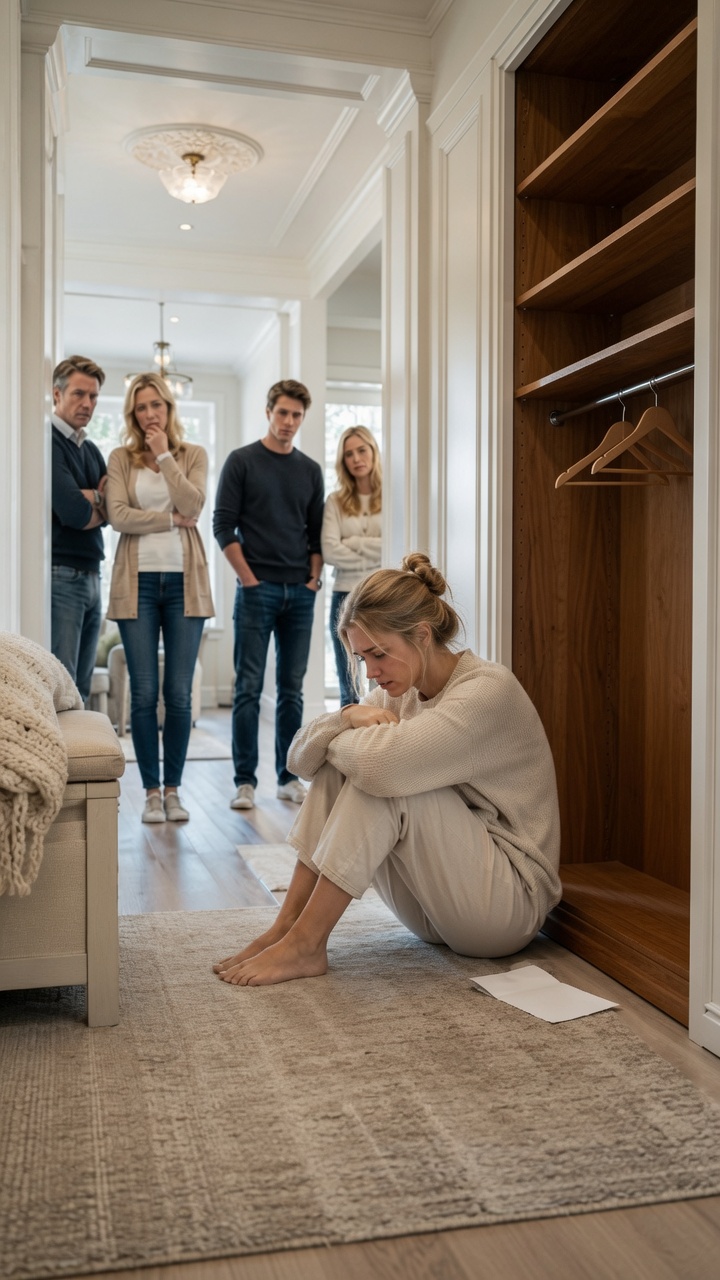
Rachel stood there holding Madison’s package against her chest.
“I forgot.”
Daniel shook his head. “You’ve been forgetting things lately.”
Rachel handed the package to Madison.
“Oh, thank God,” Madison said. “I need this for tomorrow.”
She tore into the box without looking up.
Ruth called from the living room.
“Rachel, I haven’t eaten since lunch.”
Rachel carried her bag to the kitchen.
She made spaghetti because it was quick.
She heated Ruth’s sauce separately because Ruth disliked garlic.
She grated extra cheese for Noah.
She left the mushrooms out of Madison’s portion.
She warmed Daniel’s plate when he waited until halftime to eat.
No one thanked her.
After dinner, Daniel left his plate on the table.
Noah added his beside it.
Madison disappeared upstairs with her package.
Ruth asked Rachel to bring her evening pills.
At 10:30, Daniel put on the blue shirt Rachel had ironed.
“You’re still going to Greg’s dinner?” she asked.
“Of course.”
“I thought maybe we could do something tonight.”
Daniel frowned as though she had asked an inconvenient question.
“Tonight? Rachel, I told you about this two weeks ago.”
“I know.”
“We can do something this weekend.”
“For what?”
He was already fastening his watch.
“For whatever you wanted to do.”
Rachel stared at him.
He kissed her forehead.
“Don’t wait up.”
The front door closed behind him.
At 11:58, Rachel lit her candle.
At 12:04, she washed the plates.
At 12:17, she went upstairs and pulled a small suitcase from the back of the closet.
She did not pack angrily.
Anger would have been easier.
She folded three shirts, two pairs of jeans, her favorite blue sweater, toiletries, sneakers, and the navy dress she had not worn in six years.
From the bottom drawer, she removed an old leather notebook.
Inside was a postcard showing a quiet mountain town called Cedar Hollow, Virginia.
A white church stood on a hill. Maple trees surrounded a brick town square. On the back, in Rachel’s younger handwriting, were the words:
Someday I will come here without asking permission to want something.
A patient had given her the postcard twelve years earlier.
The woman had grown up in Cedar Hollow and spent her final weeks telling Rachel about mist over the mountains, warm bread from the corner bakery, and a hiking overlook where the whole valley turned gold in October.
Rachel had promised she would visit.
Then Madison needed braces.
Noah broke his arm.
Daniel changed jobs.
Ruth’s husband died.
There was always a reason to wait.
Rachel opened her banking app.
For almost four years, she had been transferring small amounts from each paycheck into a separate savings account.
Twenty dollars.
Forty dollars.
Sometimes only ten.
She had called it emergency money.
Sitting on the bedroom floor beside her suitcase, she understood what it really was.
It was hope she had hidden from herself.
At 4:40 a.m., Rachel went downstairs.
She prepared coffee.
She packed Noah’s lunch.
She placed Ruth’s medications beside her glass.
She left Daniel’s blue shirt soaking in the laundry sink because he had spilled wine on it when he came home.
Then she returned upstairs and wrote a note.
She did not accuse them.
She did not threaten divorce.
She did not list every forgotten sacrifice.
She wrote only three sentences.
I spent so many years making sure no one in this house felt alone that I didn’t notice how long I had been alone.
I am safe.
I am not leaving you, but I need to find the part of me I left behind.
She placed the note on the bed beside the burned candle.
At 5:35, Rachel quietly carried her suitcase outside.
Her car was in the driveway, but she did not take it.
Daniel needed it for work.
Even as she left, part of her was still making life easier for him.
She walked three blocks to the bus stop in the cold October darkness.
When the bus arrived, Rachel climbed aboard, chose a seat by the window, and rested the old postcard in her lap.
As her neighborhood disappeared behind her, guilt rose so sharply that she nearly asked the driver to stop.
Then the sky began to brighten over the highway.
Rachel looked down at the words she had written twelve years earlier.
Someday I will come here without asking permission to want something.
She pressed the postcard against her heart.
For once, someday had arrived.
At 6:20, Daniel woke to the smell of coffee.
He reached across the bed.
Rachel’s side was empty.
That was not unusual. Rachel was always up first.
He showered and went downstairs.
“Rachel?”
No answer.
He found the coffee, Noah’s lunch, and Ruth’s pills.
Everything was where it belonged.
Except Rachel.
Daniel called again.
“Rachel?”
Madison came down, already looking at her phone.
“Where’s Mom? I need her to sign something.”
Noah appeared behind her.
“She didn’t wake me up.”
Ruth entered the hallway.
“Why is everyone shouting?”
Daniel went upstairs.
The closet looked almost untouched, but Rachel’s blue sweater was gone.
So was the small suitcase.
He saw the candle first.
Then the note.
He read it once.
Then again.
The words seemed too simple to explain the sudden fear filling his chest.
Madison took the paper from him.
Her face changed before she reached the final sentence.
“What does she mean, she was alone?”
No one answered.
Then Madison looked at the calendar visible through the bedroom doorway.
The date from the day before was circled in blue ink.
October 17.
“Oh my God,” she whispered.
Daniel followed her gaze.
Noah stopped moving.
Ruth lowered herself slowly onto the edge of the bed.
Madison covered her mouth.
“Yesterday was Mom’s birthday.”
The silence that followed was the first thing in the Bennett house that had ever belonged entirely to Rachel.
Part 2
Rachel’s phone began vibrating before the bus crossed the state line.
Daniel called first.
Then Madison.
Then Noah.
Then Daniel again.
Messages filled the family group chat.
Where are you?
Did you take the spare key?
What is Grandma supposed to eat?
Do you know the password for the utility account?
Mom, I can’t find my soccer uniform.
Rachel read each message without responding.
Not one asked how she felt.
At 9:14, she finally typed:
I am safe. I need a few days. Please do not come looking for me. You are all capable of taking care of one another.
She hesitated before adding one final sentence.
I am trying to come back to myself.
Then she silenced the phone.
Cedar Hollow looked almost exactly like the postcard.
The bus stopped beside a brick station no larger than a convenience store. Beyond it, the town square glowed beneath red and gold maple trees.
A white church stood on the hill.
Rachel stepped onto the sidewalk with her suitcase and took a long breath.
The air smelled like leaves, cold stone, and wood smoke.
No one was waiting for her.
No one needed anything.
For the first time in years, Rachel had nowhere she was required to be.
She checked into the Bluebird Inn, a two-story bed-and-breakfast with pale shutters and a porch overlooking a garden.
The owner, a silver-haired woman named Evelyn Price, handed Rachel a brass key.
“Room seven. Breakfast is from seven to ten, but no one will drag you out of bed if you miss it.”
Rachel almost laughed.
“I’m usually awake before six.”
“Then maybe it’s time to disappoint your alarm clock.”
The room was painted a soft blue.
Rachel placed her suitcase on the bed and stood in the silence.
At home, silence meant someone was angry, asleep, or about to call her name.
Here, it meant nothing.
That should have felt peaceful.
Instead, it frightened her.
She unpacked, then repacked.
She sat by the window, stood up, checked the bathroom towels, and reorganized the toiletries she had placed on the counter.
At 3:30 in the morning, she opened the bus schedule on her phone.
There was a return bus at 6:15.
Her finger hovered over the purchase button.
She imagined Ruth waiting for her medicine.
She imagined Noah searching for his uniform.
She imagined Daniel burning breakfast.
The guilt felt so much like love that for several seconds Rachel could not tell the difference.
Then the postcard slipped from her notebook and landed beside her.
She read the sentence again.
Without asking permission to want something.
Rachel closed the bus app.
She began to cry.
Not loudly.
Not dramatically.
She cried the way exhausted people cry when they finally reach a place where no one can hear them.
The next morning, Rachel woke at 8:47.
For several panicked seconds, she thought she had missed work.
Then she remembered where she was.
She put on the blue sweater and walked into town.
At a bakery called Maple & Rye, the woman behind the counter asked, “Coffee with cream or black?”
Rachel almost answered the way Daniel liked it.
Instead, she paused.
“I don’t know.”
The woman smiled. “First coffee?”
“No. First time choosing without ordering for someone else.”
The woman studied her, then placed two small sample cups on the counter.
“Try both.”
Rachel tasted one with cream and cinnamon.
Then the dark roast.
“I like this one,” she said, pointing to the cinnamon coffee.
“Then that’s what you get.”
Rachel carried the cup to a window table.
An older woman sat nearby, sketching the church tower in a notebook.
“Visiting?” the woman asked.
“Is it that obvious?”
“You look like you’re waiting for someone to tell you what to do next.”
Rachel looked down at her coffee.
The woman closed her sketchbook.
“My name is Louise.”
“Rachel.”
“You running from something, Rachel?”
Rachel considered lying.
“I think I’m running toward something. I’m just not sure what.”
Louise nodded as if that answer made perfect sense.
“Then drink your coffee before it gets cold. People like us spend too much of our lives reheating things we forgot to enjoy.”
Rachel smiled.
Back home, Daniel was discovering how many invisible tasks held his family together.
The first morning, he made coffee with twice as much grounds as necessary.
Noah took one sip and made a face.
“It’s terrible.”
Daniel nearly snapped at him.
Then he remembered saying the same thing to Rachel on her birthday.
He drank the entire cup.
Madison could not find the form she needed for school.
“It’s probably in Mom’s desk.”
“Then look.”
“She organizes everything.”
“So learn her system.”
“I don’t know her system.”
Neither did Daniel.
He knew Rachel paid the water bill on the twelfth.
He knew she worked four ten-hour shifts most weeks.
He knew she kept Ruth’s pills in a white case.
But he did not know which pharmacy she used.
He did not know when Noah’s next dental appointment was.
He did not know why Madison had been crying in the bathroom the previous Tuesday.
He knew the mechanics of Rachel’s life.
He did not know Rachel.
Madison went into her mother’s desk searching for the school form and found an old photograph.
Rachel looked no older than twenty-two.
She stood outside a hospital in a denim jacket with a camera around her neck.
Her hair was loose. Her smile was wide and unguarded.
On the back, she had written:
First nursing job. First paycheck. Next goal is to photograph every place people forget to notice.
Madison stared at the picture.
The woman in it was her mother, but also someone she had never met.
She carried the photograph downstairs.
“Did you know Mom liked photography?”
Daniel looked at the camera hanging from Rachel’s neck.
“I knew she had a camera when we met.”
“That isn’t what I asked.”
Daniel had no answer.
Noah sat on the stairs, listening.
He remembered the blue sweater.
His mother wore it on days she wanted to look nice.
He had never asked why she liked it.
He had only asked where his charger was.
That afternoon, Noah sent Rachel a message.
I miss you, Mom.
He stared at the screen after it showed as delivered.
For the first time, he understood what it was like to wait for someone without asking them to do anything.
Ruth’s realization came more slowly.
She watched Daniel burn rice.
She watched Madison ruin a load of laundry by mixing a red sweatshirt with white towels.
She watched Noah become angry because no one had washed his practice clothes.
Her first instinct was to say, Rachel would know what to do.
Instead, she heard the cruelty hidden inside the sentence.
Rachel always knew because everyone expected her to know.
Ruth had praised her daughter-in-law for years.
“You’re so strong.”
“You always manage.”
“I don’t know how this family would survive without you.”
She had believed those words were gratitude.
Now she understood they had also been permission to keep taking.
On the second evening, Daniel called Rachel.
She watched his name flash on the screen until the ringing stopped.
He called again the next morning.
This time, she answered.
“When are you coming home?” he asked.
Rachel closed her eyes.
No hello.
No how are you.
“When you called, did you think about what you wanted to say?”
“I’ve been worried sick.”
“That isn’t what I asked.”
Daniel exhaled sharply. “Rachel, we forgot your birthday. It was awful. I understand that. But leaving without telling us where you were going was extreme.”
She stood by the inn window, looking at the mountains.
“You still think this is about my birthday.”
“What else would it be about?”
“The birthday was just the day I finally saw it.”
“Saw what?”
“That I have become a service everyone expects instead of a person anyone knows.”
“That’s not fair.”
“Do you know what I wished for?”
Daniel was silent.
“Do you know my favorite place?”
No answer.
“Do you know why I wear the blue sweater?”
“Rachel—”
“Do you know the last thing I did before I packed my bag?”
He said nothing.
“I washed your dinner plate.”
Her voice cracked.
“I spent my birthday making sure everyone else was comfortable enough not to notice I was breaking.”
“We love you.”
“I believe you. But love that never looks closely can still make someone disappear.”
Daniel’s voice softened.
“What do you want me to do?”
“For once, don’t ask me to give you the instructions.”
Rachel ended the call.
Her hands shook afterward.
Part of her wanted to call back and apologize.
Instead, she walked to Maple & Rye.
A small sign on the bakery door advertised an afternoon bread-making class.
Rachel signed up.
She had cooked thousands of meals, but she had never made bread simply because she wanted to learn.
The first loaf collapsed.
Rachel stared at the flattened dough.
Then she laughed.
The sound surprised her.
Nothing terrible happened because she had failed.
No one complained.
No one needed her to fix it.
The instructor dusted flour from her hands.
“Try again.”
Rachel did.
On the third day, she hiked to the Cedar Hollow overlook with her old camera, which she had found in the garage before leaving home.
The battery was weak, and the strap was cracked.
But it worked.
She photographed sunlight spilling across the valley.
She photographed a child tossing leaves at his father.
She photographed Louise sketching beneath an oak tree.
Then Louise took the camera from her.
“Your turn.”
“My turn for what?”
“To exist in the picture.”
Rachel stood awkwardly at the railing.
The wind lifted her hair.
“Stop trying to look useful,” Louise called. “Just look happy.”
Rachel laughed.
Louise pressed the shutter.
That evening, Rachel looked at the photograph on the camera screen.
For the first time in years, she did not look tired.
She looked alive.
At home, Daniel began paying attention.
Not performing.
Not making grand promises.
Paying attention.
He found the grocery receipt for the birthday cupcake in the trash.
One chocolate cupcake.
One white candle.
The sight of those two items hurt more than the note.
He imagined Rachel buying her own cake.
He imagined her carrying it home while believing they might surprise her.
He imagined walking past the kitchen that night without noticing the small glow beneath the door.
Daniel sat at the table with the receipt in his hands until Ruth entered.
“I taught him to expect it,” she said quietly.
Daniel looked up.
“Expect what?”
“A woman who never says no.”
Ruth lowered herself into a chair.
“Your father never washed a plate. Never packed a lunch. Never knew when your school pictures were. I told myself I raised you differently.”
She looked toward the laundry room.
“But I only taught you to say thank you while a woman did everything.”
Daniel stared at her.
“I love Rachel.”
“So did your father love me.”
The words landed heavily.
“Love wasn’t the problem,” Ruth continued. “He never imagined I could leave. Neither did you.”
That night, Daniel left Rachel a voice message.
“I found the receipt for the cupcake. I keep thinking about you buying it yourself. I’m not calling to ask when you’re coming back. I just need you to know I finally understand why one forgotten birthday could hold years of hurt. I’m sorry I made you feel like the things you did mattered more than the woman doing them.”
Rachel listened twice.
She did not answer immediately.
But she did not delete it.
The following evening, the family called her together.
Daniel sat in the kitchen with Madison, Noah, and Ruth beside him.
Rachel appeared on the screen from the porch of the Bluebird Inn.
No makeup.
Hair loose.
Blue sweater.
She looked different.
Not because she had changed in four days.
Because they were finally looking.
Madison spoke first.
“Mom, I’m sorry I asked you to pick up my package on your birthday.”
Rachel nodded.
“I should have remembered,” Madison continued. “But I’m also sorry that most of my messages to you start with ‘Can you.’ I found your hospital picture. I didn’t know you wanted to be a photographer.”
“I still love nursing.”
“I know. But that isn’t the only thing you are.”
Rachel’s eyes filled.
Noah leaned closer to the phone.
“I noticed the blue sweater was gone.”
Rachel smiled faintly. “Did you?”
“Why do you like it?”
“My grandmother gave it to me before she died. She said blue made me look brave.”
Noah swallowed.
“You do look brave.”
Ruth took the phone next.
“I used to say you were strong as if that meant you never had the right to be tired.”
Rachel looked at her.
“I thought I was praising you,” Ruth said. “But sometimes praise is just another way of asking a person to keep carrying what we refuse to carry ourselves.”
“I never wanted you to feel like a burden.”
“And I should never have treated your kindness like an obligation.”
Daniel was last.
“I know your birthday isn’t the whole story.”
“No.”
“I don’t know how to fix eighteen years in one conversation.”
“You can’t.”
He nodded.
“What happens when you come home?”
Rachel looked toward the darkening mountains.
“When I come home, I need to be allowed to exist there.”
“What does that mean?”
“It means I’m not responsible for every meal, every appointment, every missing shirt, every emotion, every crisis. It means one afternoon a week belongs to me. It means the kids learn to take care of themselves. It means your mother’s care is shared. It means when I say no, no one punishes me with silence, anger, or guilt.”
Daniel nodded slowly.
“And it means,” Rachel continued, “I have to change too. I have to speak before I reach the breaking point. I have to stop saying yes when I mean no.”
Madison wiped her eyes.
“Are you coming back?”
Rachel looked at each of them.
“Yes.”
Relief moved across their faces.
“But not tomorrow.”
Daniel’s smile disappeared, though he tried to hide it.
Rachel saw.
“I need to know I’m returning because I choose to,” she said, “not because guilt dragged me back.”
After the call, Rachel opened her notebook.
On a fresh page, she wrote:
Things I am allowed to want.
A weekly photography class.
Coffee while it is still hot.
A locked bathroom door.
One quiet afternoon.
A trip without apologizing.
Help without begging.
Love that notices.
At the bottom, she wrote one more line.
A life in which I do not have to disappear to be seen.
Part 3
Rachel stayed in Cedar Hollow for eight days.
By the final morning, she no longer woke with panic in her chest.
She went to the bakery, ordered cinnamon coffee without hesitation, and ate breakfast while it was still warm.
Louise joined her at the window table.
“So,” Louise said, “did you find what you came looking for?”
Rachel considered the question.
“I thought I came here looking for rest.”
“And?”
“I came here looking for permission.”
“Did you find it?”
Rachel smiled.
“I realized I was waiting for permission from people who never knew I needed it.”
Louise lifted her cup.
“That’s usually how it works.”
Rachel opened her notebook.
“I’m going home today.”
“Because they need you?”
“No.”
“Because you’re afraid to stay?”
“No.”
Louise smiled.
“Then you’re ready.”
Before leaving, Rachel walked to the overlook one last time.
The valley shimmered beneath the pale morning sun.
She set the camera on a flat stone, used the timer, and stepped into the frame.
She did not pose carefully.
She simply stood there with the wind in her hair and the blue sweater bright against the autumn mountains.
The camera clicked.
Rachel checked the photograph.
She looked like someone returning, not someone retreating.
The bus ride home followed the same highway, but Rachel felt different inside it.
She did not spend the journey making mental lists for everyone.
She did not plan dinner.
She did not worry about the laundry.
She watched farms, gas stations, and distant hills pass the window.
When the bus reached Brookhaven, Daniel was waiting at the station.
He stood beside their car holding a small bundle of daisies from a roadside stand.
He looked nervous.
Rachel stepped down with her suitcase.
For a moment, neither moved.
Then Daniel lifted the flowers.
“They’re not for your birthday.”
She raised an eyebrow.
“I know your birthday is over. I bought them because I saw them and thought you’d like them.”
Rachel took the bouquet.
“I do.”
“I almost bought roses,” he admitted. “Then I remembered you once said roses smelled like funeral homes.”
A surprised laugh escaped her.
“You remembered that?”
“I’m trying to.”
He reached for her suitcase, then stopped.
“May I?”
Rachel nodded.
On the drive home, Daniel did not ask whether she planned to cook dinner.
He told her Noah had learned to make grilled cheese, though he burned four sandwiches first.
He told her Madison had created a household schedule.
He told her Ruth had called a home-care service to arrange help twice a week.
Rachel listened without praising him excessively.
She did not say she was proud of him for completing basic responsibilities.
That, too, was part of the change.
When she opened the front door, Noah ran toward her.
He wrapped his arms around her so hard she nearly lost her balance.
“I missed you.”
“I missed you too.”
He pulled away.
“Do you know where my soccer jersey is?”
The room went silent.
Noah froze.
Then his face reddened.
“Never mind. I’ll look for it.”
Rachel smiled.
Not because he had been perfect.
Because he had noticed.
Madison approached more slowly.
“Can I hug you?”
Rachel opened her arms.
Madison held on for a long time.
“I put the picture I found back in your desk,” she whispered.
“You could have kept it.”
“I want you to show me your other pictures.”
“I’d like that.”
Ruth waited near the kitchen.
She did not ask about dinner.
She did not complain about being left.
She simply held out her hand.
“Welcome home, Rachel.”
Rachel squeezed it.
“Thank you.”
The house looked familiar but slightly rearranged.
A chart hung on the refrigerator.
Daniel cooked Monday and Thursday.
Madison handled laundry on Wednesday.
Noah packed his own lunches and managed the dishwasher.
Ruth’s care appointments were divided among the family and a home aide.
Rachel’s name was not listed under every category.
Near the bottom of the chart, in Madison’s handwriting, were the words:
Saturday afternoon belongs to Mom.
Rachel stared at the sentence.
Daniel appeared behind her.
“It doesn’t have to be Saturday. Or every Saturday. We just wanted to make sure there was space before everything else filled it.”
Rachel touched the paper.
“It’s a start.”
That evening, Daniel made chicken and vegetables.
The chicken was dry.
The vegetables were undercooked.
Everyone ate without complaining.
When Daniel began clearing the table, Rachel instinctively stood.
“I’ll help.”
He looked at her.
“You can. But you don’t have to.”
Rachel sat back down.
At first, it felt unnatural.
Then it felt wonderful.
Later, after the children went upstairs and Ruth went to bed, Rachel unpacked.
She placed the postcard in the top drawer of her nightstand instead of hiding it beneath old sweaters.
Beside it, she placed the burned birthday candle.
Daniel watched from the doorway.
“You’re keeping it?”
“Yes.”
“Doesn’t it make you sad?”
“It reminds me of the night I finally listened to myself.”
Daniel came closer but did not touch her until she reached for his hand.
“I’m sorry,” he said.
“I know.”
“I wish I could go back.”
“I don’t.”
He looked surprised.
“If you went back and remembered my birthday, we might have had cake and continued exactly as we were.”
The truth hurt, but Daniel nodded.
“I don’t want flowers once a year,” Rachel said. “I want a life where I’m visible on ordinary Tuesdays.”
“I want that too.”
“Wanting is not the same as doing.”
“I know.”
Rachel looked at him steadily.
“For a while, I need you to show me.”
“I will.”
The following weeks were imperfect.
Daniel sometimes asked where an item was before looking for it.
Madison occasionally sent a request without saying hello.
Noah left dishes beside the sink.
Ruth complained about the home aide and hinted that Rachel understood her routines better.
But Rachel no longer swallowed every frustration until it became invisible.
When Daniel asked whether she could iron a shirt ten minutes before work, she said, “No. You’ll need to wear another one.”
He opened his mouth to argue.
Then he stopped.
“Okay.”
He wore another shirt.
When Madison asked Rachel to cancel her photography class to drive her to the mall, Rachel said, “You can ask your father or take the bus.”
“But you’re already going out.”
“Yes. To something important to me.”
Madison looked disappointed.
Rachel allowed her to be disappointed.
She went to class.
The instructor placed an old manual camera in her hands and asked what she liked to photograph.
“Things people overlook,” Rachel said.
She photographed reflections in rain puddles.
Wrinkled hands.
Empty playground swings.
A coffee cup growing cold beside an open book.
At the end of the class, the instructor studied her work.
“You’re good at finding the quiet story.”
Rachel thought about her life.
“I’ve had practice.”
At home, Daniel began changing in ways that did not require applause.
He learned Ruth’s medication schedule.
He attended Noah’s parent-teacher meeting.
He asked Madison why she had been unusually quiet and listened when she talked about a friendship ending.
He washed dishes before Rachel came home from a hospital shift.
One evening, she found him standing at the sink.
“I noticed you always do these after working ten hours,” he said. “That didn’t seem right.”
It was a small sentence.
But Rachel felt something in their marriage shift.
He was beginning to see labor before asking for it.
Madison changed too.
At first, her new messages sounded forced.
How was your day, Mom?
Also, can you—
But slowly, the questions became real.
She sat with Rachel while she edited photographs.
She learned her mother’s favorite singer.
She learned Rachel hated coconut but loved blueberry pie.
She learned Rachel had once dreamed of traveling across the country with a camera and a notebook.
“I thought you always wanted to be a nurse,” Madison said.
“I did.”
“Then why did you stop taking pictures?”
“I didn’t decide to stop. I just kept deciding that something else was more urgent.”
Madison looked at the photographs spread across the table.
“Was being our mom one of those urgent things?”
“Yes.”
“Do you regret it?”
Rachel reached for her daughter’s hand.
“Never. But loving you should not have required erasing me.”
Madison’s eyes filled.
“I don’t want that either.”
Noah began handling his own laundry.
The first time, he shrank three shirts.
Rachel did not rescue him.
He saved money from mowing a neighbor’s lawn and replaced them.
“Laundry is terrible,” he announced.
Rachel laughed. “It is.”
“Why didn’t you tell us?”
“I did. You weren’t listening.”
He nodded, accepting the answer.
Ruth’s apology took the longest because it required facing her own life.
One Sunday afternoon, she found Rachel on the porch editing photographs.
“My mother was like you,” Ruth said.
Rachel closed the laptop.
“She took care of seven people. Never complained. When she got sick, none of us noticed until she collapsed in the kitchen.”
Ruth’s voice trembled.
“I swore I wouldn’t live the way she did. I became louder. I demanded help. But when I came here after my surgery, I handed the burden to you.”
“You were grieving.”
“So were you. You had a job, children, a marriage, and your own life. I never asked what it cost you.”
Rachel sat beside her.
“I should have told you.”
“You should not have needed a perfect speech before we treated you like a human being.”
Rachel looked toward the yard.
“No. But I also need to stop treating silence like kindness.”
Ruth reached for her hand.
“Can we both do better?”
“We can try.”
Two months after Rachel returned, October’s leaves had disappeared and the first snow covered Brookhaven.
On a Saturday morning, she packed a small bag.
Noah appeared in the doorway carrying her old camera.
“Are we really going?”
“We are.”
Cedar Hollow had become more than a place Rachel visited.
It was proof that she could leave without abandoning anyone.
She and Noah planned a weekend there together.
Daniel did not ask who would manage Ruth’s meals.
Madison did not ask Rachel to change the date.
Ruth told her to take a heavier coat.
At the bus station, Daniel kissed Rachel.
“Have fun.”
She searched his face for resentment.
There was none.
“You’ll be okay?”
He smiled.
“We are capable of taking care of one another.”
Rachel laughed softly.
“I’ve heard that somewhere.”
In Cedar Hollow, Noah photographed the white church, the bakery windows, and Louise feeding birds in the square.
He asked Rachel to tell him the story of the postcard.
She told him about the patient who had given it to her.
She told him about the promise.
“Did you really wait twelve years?” he asked.
“Yes.”
“That’s a long time.”
“It is.”
“Are there other things you’ve been waiting to do?”
Rachel looked at her son.
“Yes.”
“Will you do them?”
“I’m going to try.”
Noah raised the camera.
“Stand by the fountain.”
Rachel moved into place.
“Wait,” he said. “You look too serious.”
“What should I do?”
“Look brave.”
The words caught in her chest.
Rachel remembered telling him why she loved the blue sweater.
She smiled.
Noah took the picture.
On the morning of Rachel’s fortieth birthday, she woke to silence.
For one terrible second, the old pain returned.
Then she smelled something burning.
She went downstairs.
Daniel stood beside a lopsided cake.
Madison was attempting to hang a banner that kept falling.
Noah held a plate of scrambled eggs.
Ruth sat at the table wearing a paper party hat and complaining that no one had made coffee correctly.
They all turned when Rachel entered.
“Happy birthday!” they shouted.
Rachel laughed.
The cake leaned dangerously to one side.
The eggs were cold.
The banner read HAPPY BIRTHDY because Noah had lost an A.
It was not perfect.
It was not expensive.
It was everything.
Daniel placed a wrapped box in front of her.
Inside was a new camera strap with small blue flowers embroidered along the leather.
Madison handed her a photo album.
The first page held the old hospital photograph.
The second held the picture Louise had taken of Rachel at the overlook.
The remaining pages were blank.
“For the places you haven’t seen yet,” Madison said.
Noah placed a candle in the cake.
Before lighting it, he looked at Rachel.
“What are you going to wish for?”
Rachel gazed at the family around her.
A year earlier, she would have wished for their happiness.
That morning, she understood that love did not require surrendering every wish to someone else.
“I’m keeping it for myself,” she said.
Noah grinned. “Good.”
Daniel lit the candle.
Rachel closed her eyes.
She wished for courage.
Not the courage to leave.
Not the courage to stay.
The courage to keep choosing herself even while loving the people around her.
She blew out the candle.
Months later, on an ordinary Tuesday, Rachel sat at the kitchen table editing photographs.
She wore her blue sweater even though nothing special was happening.
Daniel entered carrying a folder.
“Could you do something for me?”
Rachel looked at the unfinished photograph on her screen.
For nearly eighteen years, that question had received the same answer.
Of course.
Yes.
I can do it.
Even when she was exhausted.
Even when she was hurt.
Even when saying yes required abandoning something of her own.
Rachel took a breath.
“Not right now.”
Daniel glanced at the folder, then at her camera.
“Okay. I’ll handle it.”
He walked away.
No argument.
No guilt.
No demand for an explanation.
Rachel returned to the photograph.
Outside the kitchen window, snow fell gently across the yard.
Nothing collapsed because she had said no.
No one stopped loving her.
The family did not fall apart.
But somewhere inside Rachel, a missing piece quietly returned home.
For years, she had told everyone, “I can manage.”
Now the words meant something different.
She could choose.
She could rest.
She could speak.
She could love her family without disappearing inside their needs.
And she could finally offer herself the same devotion she had given everyone else.
THE END