PART 3 — THE WOMAN IN THE DARK
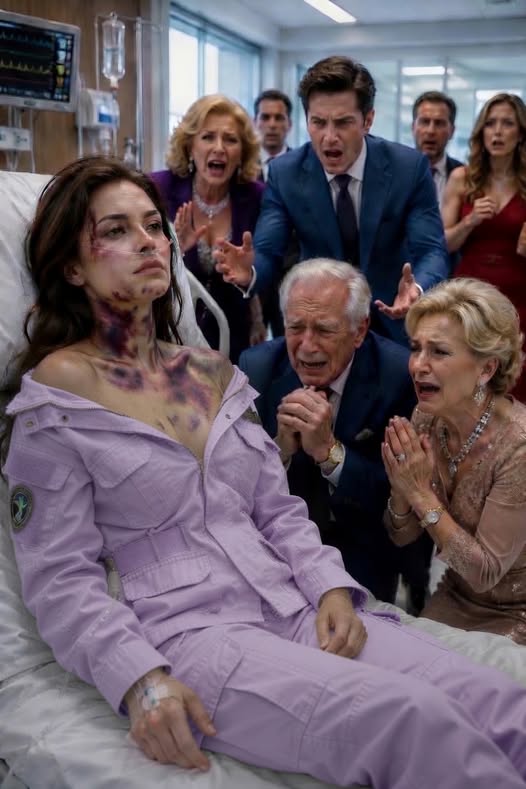
The cold object pressed into my palm was not a weapon.
It was a key.
For one disorienting second, I could hear nothing but the pulsing alarm of the backup generator and the violent pounding of my own heart.
My mother stood beside my hospital bed, her face pale beneath the dim emergency lights.
“You should have left the signatures alone,” she whispered.
I closed my fingers around the key. “What is this?”
“The only reason you’re still alive.”
Before I could answer, Lena rushed into the room with two hospital security officers behind her. One officer restrained my mother while the other searched the hallway. The guard who had been stationed outside my door was found unconscious near the stairwell.
My mother did not resist.
She only stared at me.
“Listen to me,” she said. “Adrian is not the one you should fear.”
Lena stepped between us. “You’re done speaking to her.”
“No,” I said.
Everyone looked at me.
My ribs screamed as I forced myself upright.
“What does the key open?”
My mother swallowed.
“A safety deposit box.”
“Whose?”
“Your grandmother’s.”
The room seemed to shrink around me.
My grandmother, Margaret Ellison, had been the only person in my childhood who made me feel safe. She died when I was twenty-two, leaving me the inheritance that later funded Adrian’s company.
My parents had always claimed there was nothing else.
“What’s inside?” I asked.
“The truth.”
Lena studied my mother carefully. “Why come here during a power failure?”
My mother looked toward the hallway.
“Because I received a message saying Claire would be moved tonight.”
“Moved where?”
“The facility Adrian purchased.”
My skin turned cold.
The psychiatric hospital.
My mother’s voice cracked. “I helped create the plan years ago, but it was never supposed to end like this.”
I laughed bitterly. “You helped arrange my marriage to a man who nearly killed me.”
“I thought I could control him.”
“You sold me.”
Her eyes filled with tears.
“Yes.”
The word struck harder than any excuse could have.
My mother had always defended herself with denial, guilt, and manipulation. Hearing her admit the truth felt almost unreal.
She continued.
“Your father’s business collapsed eight years ago. We owed people money—dangerous people. Adrian approached us with a solution. He knew about your inheritance and your grandmother’s trust.”
“How?”
“Your father told him.”
I looked at her in disbelief.
“We thought Adrian would marry you, gain access to the company, and help us recover financially. We believed you would be comfortable.”
“Comfortable?”
“I didn’t know what he would become.”
“You heard me crying. You saw the bruises.”
“I know.”
“And you still sent me back.”
My mother’s shoulders folded inward.
“Because by then, Adrian had evidence against us. Fraud, hidden transfers, tax crimes. Every time you tried to leave, he threatened to destroy your father and me.”
“You chose yourselves.”
“Yes.”
There was no defense left.
Only the truth.
Lena took the key from my hand and examined its number.
“We need the bank location.”
My mother gave her an address.
Then she said something that made even Lena go still.
“Your grandmother knew Adrian before you did.”
I stared at her.
“That’s impossible.”
“No. She investigated him.”
My grandmother had distrusted almost everyone my parents admired. She used to say charm was often just a curtain drawn over an empty room.
“What did she find?”
“I never saw everything. Your father hid the files. But she changed her estate plan three weeks before she died.”
I remembered the official reading of the will. The inheritance had passed to me through a simple investment account.
Or so I had been told.
My mother nodded toward the key.
“Margaret created a second trust. Your father has spent years trying to find it.”
“What is in it?”
“I don’t know.”
Lena turned to security. “Call the detectives. Mrs. Ellison is not leaving.”
My mother looked terrified.
“You don’t understand. Your father already knows she came here.”
As if summoned by her words, my phone vibrated.
A video call appeared from my father.
I answered.
His face filled the screen, but the background was not their home.
He was sitting in a car.
“Where is your mother?” he asked.
“With me.”
His expression changed.
“Claire, give her the phone.”
“No.”
“You’re making everything worse.”
“For whom?”
He ignored the question.
“Your mother is confused. She has been under stress.”
The familiar strategy made my stomach turn.
Everyone around Adrian eventually learned to imitate him.
My father leaned closer to the camera.
“That key belongs to me.”
“No,” I said. “It belonged to Grandma.”
“She stole from this family.”
“She protected me from it.”
His mouth tightened.
Then he made a mistake.
He glanced to his right.
Only briefly.
But I saw another person sitting beside him.
Adrian.
My breath stopped.
Adrian was supposed to be in custody.
Lena saw him too.
“Trace the call,” she ordered.
Adrian leaned into view, smiling.
There was dried blood near his temple.
“Hello, Claire.”
“How did you get out?”
He chuckled. “You still think the police control this?”
My father looked terrified, but Adrian looked exhilarated.
“You embarrassed me,” Adrian said. “You took my company. You gave my files to strangers. And now you think a hospital room will protect you.”
My mother stepped closer to the screen.
“Richard, what have you done?”
My father shouted, “You were supposed to bring her quietly!”
Adrian’s smile vanished.
“You were supposed to keep your wife obedient.”
My father turned toward him.
That was when the screen jolted violently.
The sound of a struggle filled the call.
A gunshot exploded.
The video went black.
My mother screamed.
The detectives arrived minutes later. Roads were sealed. Patrol units searched the city. Adrian and my father vanished before the call could be traced.
By dawn, I was moved under police protection to a secure medical facility.
The key never left Lena’s possession.
Two days later, we entered the bank.
The safety deposit box was small.
Inside were three objects.
A sealed envelope addressed to me.
A flash drive.
And a photograph of my grandmother standing beside a younger man I recognized instantly.
Adrian’s father.
On the back, my grandmother had written one sentence:
If anything happens to me, do not trust the Vale family.
PART 4 — THE DEAD WOMAN’S WARNING
The flash drive contained a video recorded twelve days before my grandmother’s death.
Margaret sat in her study wearing the blue cardigan I remembered from childhood. Her hair was silver, her hands thin, but her voice remained sharp.
“Claire,” she began, looking directly into the camera, “if you are watching this, then your parents have lied to you.”
My throat tightened.
Lena sat beside me in the bank’s private conference room.
My grandmother continued.
“Richard has become involved with a man named Victor Vale. Victor presents himself as an investor, but he launders money through struggling family businesses. Richard borrowed from him and used your future inheritance as security.”
Victor Vale.
Adrian’s father.
Margaret lifted a folder.
“I refused to allow it. Victor threatened me. Richard begged me to cooperate. Eleanor asked me to think of the family.”
Her expression hardened.
“When people ask you to sacrifice yourself for the family, Claire, ask who benefits from your sacrifice.”
Tears blurred my vision.
She had known.
Even then, she had known what they would do to me.
Margaret explained that she transferred the majority of her estate into a protected trust. The money I had received after her death was only the first distribution.
The larger trust included real estate, investments, and controlling interests in several companies.
Its current value exceeded forty-two million dollars.
I stared at the screen.
Lena whispered, “My God.”
The trust had remained dormant because its release depended on a specific condition:
I had to voluntarily assert that I was acting independently of my parents.
Until then, the trustees were instructed to conceal its existence.
My grandmother had understood that wealth would make me a target.
She had designed the trust not merely to enrich me, but to expose anyone trying to control me.
Then came the final warning.
“Victor has a son named Adrian. He is charming, ambitious, and already involved in his father’s affairs. If he approaches you, it is not by accident.”
My breath caught.
Adrian had not been recruited by my parents.
The Vale family had chosen me years earlier.
My marriage was part of a financial operation that began before my grandmother died.
The video ended with Margaret leaning toward the camera.
“Claire, you are not weak. You have simply been surrounded by people who profit from convincing you that you are.”
I cried then.
Not quietly.
Not gracefully.
I cried for the girl who believed her parents loved her. For the young woman who thought Adrian’s attention was fate. For the wife who apologized after being beaten.
Lena waited until I could breathe again.
Then she opened the sealed envelope.
Inside was a handwritten letter and a list of account numbers.
The letter gave me immediate authority over the trust if criminal coercion connected to my marriage could be proven.
The evidence already existed.
Within twenty-four hours, the trustees recognized my claim.
I became the legal controller of assets Adrian and my father had spent years trying to steal.
But the most important discovery was not the money.
One account belonged to Victor Vale.
My grandmother had secretly purchased his debt years ago through an intermediary.
That meant the trust held liens over several properties and businesses controlled by the Vale family.
Adrian had believed he was hunting my inheritance.
In reality, my inheritance owned the ground beneath him.
Federal investigators joined the case.
They traced Adrian’s escape to a private airfield. Security footage showed him and my father boarding a chartered plane registered to one of Victor Vale’s companies.
The flight landed in Belize.
Victor had lived there for years under the protection of corrupt officials and private security.
My father was now trapped with the very family he had once trusted.
My mother agreed to cooperate.
Her testimony revealed decades of fraud.
She admitted helping Adrian forge my signatures. She admitted manipulating me into staying married. She admitted accepting money in exchange for keeping me isolated.
The prosecutors offered her no immunity.
She testified anyway.
“I don’t expect Claire to forgive me,” she said during a recorded deposition. “I only want the truth to stop being useful to them.”
I watched from another room.
Part of me hated her.
Another part saw a frightened, aging woman finally confronting the monster she had helped build.
But guilt was not redemption.
And confession did not erase consequence.
My mother was charged with conspiracy, fraud, and obstruction.
She accepted a plea agreement requiring prison time.
Before she was taken away, she asked to see me.
I almost refused.
Then I remembered my grandmother’s words.
Independence was not only leaving people behind.
Sometimes it was facing them without allowing them to define you.
My mother sat behind a glass partition.
She looked smaller than I remembered.
“I’m sorry,” she said.
I held the phone silently.
She began to cry.
“I told myself I was protecting the family.”
“You were protecting the house.”
“Yes.”
“And Dad.”
“Yes.”
“And yourself.”
“Yes.”
“Never me.”
Her face crumpled.
“No.”
The honesty hurt, but it also released something inside me.
I no longer had to search for hidden love beneath her cruelty.
There had been choices.
She had made them.
“I won’t forgive you today,” I said.
“I understand.”
“I may never forgive you.”
“I understand that too.”
“But I won’t become you.”
My mother pressed her hand against the glass.
For a moment, I remembered being five years old, holding that same hand while crossing a street.
Then I stood and walked away.
Three weeks later, my injuries had begun to heal.
I moved into one of my grandmother’s properties under an assumed name. The house stood near the coast, surrounded by high cliffs and cedar trees.
Lena visited every morning.
The company stabilized under temporary leadership. Employees who had been pressured into illegal conduct began cooperating. Clients returned once the board announced an independent audit.
For the first time, my life belonged to me.
Then an envelope arrived without postage.
Inside was a photograph of my father tied to a chair.
A handwritten message appeared beneath it:
Release the Vale assets, or Richard dies.
I stared at the photograph for a long time.
My father had betrayed me.
He had helped Adrian destroy my life.
But I could not ignore the possibility that he would be killed.
Lena read the note.
“It could be a trap.”
“It is a trap.”
“What are you thinking?”
I looked toward the ocean.
“That Adrian still believes I’ll sacrifice myself to save someone who sacrificed me.”
Lena waited.
I folded the photograph.
“So this time, we let him believe he’s right.”
PART 5 — THE TRAP INSIDE THE TRAP
The negotiations began through an encrypted channel.
Adrian demanded control of the Vale properties, ten million dollars in liquid funds, and a signed statement withdrawing my accusations.
In exchange, he promised to release my father.
I agreed too quickly.
That was intentional.
People like Adrian believed fear made everyone predictable.
He assumed my old habits had returned.
He did not know I had spent years studying his.
A federal hostage team coordinated the operation. Financial agents created false transfer documents. The trustees prepared accounts that appeared active but could be frozen instantly.
I recorded a video for Adrian.
I wore no makeup. The remaining bruises were visible.
“You win,” I said. “Please don’t hurt my father.”
Lena watched the recording twice.
“You hate saying that.”
“Yes.”
“Good. It sounds real.”
Adrian responded within nine minutes.
He wanted me to travel alone to Belize.
The agents refused.
So we offered an alternative.
A private island off the Florida coast belonged to one of the Vale companies. It was isolated enough for Adrian to feel secure but close enough for federal jurisdiction.
He accepted.
The exchange was scheduled for midnight.
I wore a concealed tracker beneath my clothing and a microphone inside the clasp of my necklace.
The island’s abandoned resort had once been a playground for wealthy investors. Now the buildings stood dark, their windows shattered by storms.
A helicopter dropped me near the marina.
I carried a metal case filled with forged documents.
Adrian waited beneath the remains of a white pavilion.
My father sat tied to a chair beside him.
He was alive.
His face was swollen.
Victor Vale stood behind them.
He was nearly seventy, tall and elegant, with the same cold eyes as his son.
“So this is Margaret’s granddaughter,” Victor said.
I stopped ten feet away.
“You murdered her.”
Victor smiled.
“Your grandmother was old.”
“She was healthy.”
“She was inconvenient.”
My chest tightened, but I kept my expression blank.
The microphone captured every word.
Adrian stepped closer.
“You brought the transfer?”
“Yes.”
“Show me.”
I opened the case.
He inspected the papers while Victor watched me.
“You look different,” Adrian said.
“I am different.”
He laughed. “A few weeks without me and you think you’re strong?”
“No. I realized I was strong while I was with you.”
His smile faded.
My father began to speak.
“Claire, don’t give them anything.”
Adrian struck him across the face.
I flinched.
He noticed.
“There she is,” he whispered. “My obedient wife.”
“You said you would release him.”
“And you believed me?”
“No.”
The word stopped him.
Adrian looked at the case.
The forged documents contained a tracking device and chemical marker.
But he did not know that.
Victor stepped forward.
“Where are the account codes?”
“I memorized them.”
“Write them down.”
“Release my father first.”
Victor nodded to Adrian.
Adrian untied one of my father’s hands.
Then gunfire erupted near the marina.
Victor’s guards scattered.
The federal team had been detected too early.
Adrian grabbed me and pressed a pistol against my ribs.
Pain exploded through my healing injuries.
“Call them off!” he shouted.
Victor dragged my father toward a waiting boat.
Chaos filled the pavilion.
Agents shouted from the darkness.
Spotlights swept across the beach.
Adrian pulled me backward.
“You ruined everything,” he hissed.
“No. You did.”
He forced me toward the water.
Then my father moved.
With one hand still bound, he slammed his shoulder into Victor.
The two men fell against the dock railing.
A gun discharged.
Victor collapsed.
My father staggered backward, blood spreading across his shirt.
“Dad!”
Adrian turned toward him.
That moment was enough.
I drove my elbow into Adrian’s injured temple.
He lost his grip.
I twisted away.
The pistol fell onto the dock.
Adrian lunged for it.
So did I.
My hand reached it first.
I raised the weapon.
He stopped.
For six years, I had imagined Adrian afraid.
The reality was quieter than I expected.
He stared at the gun, then at me.
“You won’t shoot.”
He sounded certain.
“You still think you know me.”
“I made you.”
“No,” I said. “You tried to erase me.”
Agents surrounded the dock.
Adrian lifted his hands.
Then he smiled.
“You think this ends with prison?”
“It ends with you no longer controlling the story.”
His expression hardened.
He moved suddenly.
I fired.
The bullet struck the dock beside his foot.
Adrian froze.
“I missed on purpose,” I said.
The agents tackled him.
Victor survived the gunshot and was taken into custody. My father was rushed to a hospital.
During the flight back, I sat beside him.
His breathing was weak.
“Claire,” he whispered.
“Don’t speak.”
“I have to.”
His hand found mine.
“I knew Adrian was dangerous.”
Tears burned my eyes.
“Why did you give me to him?”
“I was afraid of losing everything.”
“You lost me.”
“Yes.”
His voice broke.
“That was everything.”
I wanted to pull my hand away.
Instead, I held his until the helicopter landed.
My father survived surgery.
He was arrested from his hospital room.
He agreed to testify against Victor and Adrian.
The Vale empire collapsed within weeks.
Properties were seized.
Accounts were frozen.
Officials in three countries were charged.
The company my grandmother had tried to protect was finally free of them.
I believed the worst was over.
Then the forensic accountant called Lena.
One set of trust records did not match.
Someone had accessed my grandmother’s hidden accounts six months after her death.
The authorization carried my signature.
But the digital timestamp proved something impossible.
The transaction occurred while I was attending my grandmother’s funeral.
And the money had not gone to Adrian, Victor, or my parents.
It had gone to a woman listed as deceased for more than twenty years.
My grandmother’s first daughter.
A daughter no one had ever told me existed.
PART 6 — THE SISTER WHO NEVER DIED
Her name was Evelyn.
According to the official records, Evelyn Margaret Ellison died at age three in a boating accident.
There was no body.
Only a death certificate signed by a doctor later convicted of falsifying records.
Lena found a photograph hidden among my grandmother’s documents.
Two little girls stood beside a lake.
One was my mother.
The other looked almost identical.
Twins.
Evelyn had not been my grandmother’s daughter.
She was my mother’s twin sister.
Everything I thought I understood changed again.
My mother agreed to another interview from prison.
When Lena showed her the photograph, all color left her face.
“Where did you find that?”
“Who is Evelyn?”
My mother stared at me through the screen.
“My sister.”
“You said you were an only child.”
“I was supposed to.”
“Why?”
She closed her eyes.
“When we were children, Victor Vale’s father ran money through my parents’ business. Your grandmother discovered it and tried to leave. They threatened the family.”
“What happened to Evelyn?”
“She was taken.”
My breath caught.
“Kidnapped?”
“Hidden. Raised by another family under a different name. Your grandmother was told Evelyn would die if she went to the police.”
“Did Grandma know where she was?”
“Not for years.”
The hidden account was not theft.
It was support.
My grandmother had found Evelyn and secretly sent her money.
“Where is she now?” I asked.
My mother shook her head.
“I don’t know.”
Lena traced the payments through a series of foundations.
The final account belonged to a woman named Dr. Elise Warren, director of a trauma recovery clinic in Oregon.
We contacted her.
She agreed to meet.
When Elise entered the room, I understood immediately.
She had my mother’s eyes.
But where my mother carried tension like armor, Elise moved with quiet steadiness.
She looked at me for a long moment.
“You have Margaret’s face,” she said.
“You’re Evelyn.”
“That was my name once.”
She explained that she had been raised by a couple connected to Victor’s family. They were not cruel, but they were paid to keep her identity hidden.
At eighteen, she learned the truth.
She contacted my grandmother years later.
Margaret tried to bring her home, but Evelyn refused.
“I had spent my life being used as leverage,” she said. “I would not become another weapon in the family.”
“Why did Grandma hide you from me?”
“To protect you. Victor believed I was dead. If he discovered otherwise, he would have used us against each other.”
Elise had received money from the trust, but she had never touched most of it.
Instead, she used the funds to establish shelters for survivors of domestic violence.
The clinic she directed had helped thousands of women disappear safely from dangerous homes.
I stared at her.
“My grandmother’s money built this?”
“Partly.”
“And you knew about me?”
“Yes.”
“Did you know about Adrian?”
Her eyes filled with regret.
“Not until three years ago.”
Anger rose inside me.
“You knew he was hurting me?”
“I suspected.”
“Why didn’t you come?”
“Because every attempt to contact you was intercepted.”
She opened a folder.
Inside were letters.
Dozens of them.
All addressed to me.
Some warned me about Adrian.
Some offered a safe place.
Some contained photographs and evidence about the Vale family.
Every letter had been returned, redirected, or marked undeliverable.
Adrian had controlled my mail.
My parents had helped him.
Elise leaned forward.
“When I realized you were completely isolated, I began collecting evidence. Vanessa was one of my sources.”
I stared at her.
“Vanessa worked for you?”
“Not at first. She contacted the clinic after Adrian attacked her during a business trip.”
Vanessa had never mentioned that.
“She stayed with him to gather evidence,” Elise continued. “We hoped to build a case strong enough to remove you safely.”
“Why didn’t she tell me?”
“She was afraid you would confront him before we were ready.”
The betrayal I felt toward Vanessa shifted into something more complicated.
She had helped Adrian.
She had also risked herself to expose him.
Nothing in my life was simple.
Elise reached across the table but stopped before touching my hand.
“You deserved to know sooner. I am sorry.”
I studied her face.
A stranger.
An aunt.
A living piece of my grandmother.
“What happens now?” I asked.
“That depends on what you want.”
The question nearly broke me.
For years, everyone had told me what I should want.
Marriage.
Family loyalty.
Silence.
Forgiveness.
Elise was the first person to place the decision back in my hands.
“I want to see the clinic,” I said.
Two weeks later, I traveled to Oregon.
The recovery center stood on hundreds of acres of forest. There were cottages, therapy rooms, legal offices, childcare facilities, and vocational programs.
Women arrived with nothing.
They left with identities, education, jobs, and safety plans.
One evening, I sat beneath a cedar tree with Elise.
“My grandmother built a trust to save me,” I said. “But I used part of it to build Adrian’s company.”
“You could not have known.”
“I helped create something that trapped employees and moved illegal money.”
“You also exposed it.”
“That doesn’t undo the harm.”
“No,” she said. “But responsibility is not the same as blame.”
Her words stayed with me.
I decided to restructure Vale Strategic Consulting entirely.
The company was renamed Margaret Advisory Group.
Profits from the seized assets funded survivor services, legal aid, and financial literacy programs.
Employees implicated in crimes were dismissed.
Those who had been coerced received protection and counseling.
Priya Shah became chief executive.
I retained my ownership but refused an executive role.
I did not want another throne.
I wanted a life.
Adrian’s trial approached.
The prosecution had recordings, financial records, medical evidence, and testimony from Vanessa, my parents, and Victor’s employees.
Conviction seemed certain.
Then Adrian’s attorney produced a new witness.
A former nurse claimed I had admitted planning to frame my husband.
The statement was false.
But the nurse had worked in the ICU the night of the power failure.
And she possessed a recording of my mother saying:
“We need Adrian gone permanently.”
The defense argued that my family had created the entire conspiracy to seize the Vale assets.
Public opinion shifted overnight.
News channels called me a calculating heiress.
Anonymous accounts published photographs of my injuries beside captions accusing me of manipulation.
Adrian appeared in court looking calm and wounded.
For the first time since his arrest, he smiled at me.
He had found a new way to make me defend reality.
Then Elise discovered something in the nurse’s employment records.
The nurse had changed her name.
Before working at the hospital, she had been employed by Victor Vale.
And she was not merely an accomplice.
She was Adrian’s older sister.
PART 7 — THE LAST LIE
Her real name was Cassandra Vale.
Unlike Adrian, Cassandra had remained invisible.
She had no social media presence, no property in her name, and no official role in the family businesses.
She moved through hospitals, legal offices, and private clinics using false identities.
Her purpose was simple.
She created records.
Medical histories.
Psychiatric evaluations.
Death certificates.
Evidence that turned lies into official truth.
Cassandra had signed Evelyn’s childhood death certificate.
She had helped Victor conceal financial crimes.
And she had prepared the documents intended to declare me incompetent.
The prosecution arrested her outside the courthouse.
The recording she submitted had been edited. The full version revealed my mother saying:
“We need Adrian gone permanently from Claire’s life through the courts.”
The defense’s dramatic revelation collapsed within hours.
Adrian’s trial began three weeks later.
I testified for two days.
His attorney questioned every decision I had made.
Why had I stayed?
Why had I hidden evidence?
Why had I continued attending social events with him?
Why had I smiled in photographs?
The questions were designed to make survival look like consent.
I answered each one.
“I stayed because leaving was dangerous.”
“I hid evidence because he searched my belongings.”
“I attended events because refusing made him violent.”
“I smiled because he was standing beside me.”
Then Adrian’s attorney displayed a photograph from our fifth anniversary.
Adrian kissed my cheek while I laughed.
“Does this look like fear?” he asked.
I looked at the image.
Beneath the table, hidden from the camera, Adrian’s hand had been gripping my injured wrist.
“Yes,” I said. “It does to me.”
The courtroom became silent.
Vanessa testified next.
She described the affair, the shell companies, and Adrian’s threats.
She admitted her crimes without minimizing them.
“I helped him because I wanted the life he promised me,” she said. “Then I stayed because I was afraid of the man behind the promise.”
My mother testified in shackles.
She confessed to selling my trust.
My father testified from a wheelchair, still recovering from the gunshot.
He admitted arranging my first meeting with Adrian.
Victor Vale refused to testify.
Cassandra attempted to bargain.
Adrian blamed everyone.
The jury deliberated for eleven hours.
He was convicted of conspiracy, fraud, money laundering, unlawful imprisonment, aggravated assault, insurance fraud, and attempted murder.
When the verdict was read, Adrian showed no emotion.
Then the judge asked whether he wished to speak before sentencing.
Adrian stood.
He turned toward me.
“Claire thinks this verdict makes her free,” he said. “But she will spend the rest of her life wondering who loved her and who was paid.”
His words found the deepest wound.
He knew they would.
Then Elise stood from the gallery.
Not loudly.
Not dramatically.
She simply stood where I could see her.
Behind her were Lena, Priya, Vanessa, several women from the recovery center, and former employees who had rebuilt their lives.
People who had nothing to gain from controlling me.
People who had chosen to remain.
I looked back at Adrian.
“You’re wrong,” I said.
The judge warned me not to interrupt.
But Adrian heard.
For the first time, his words no longer entered me like commands.
He was sentenced to sixty-eight years in federal prison.
Victor received life imprisonment.
Cassandra received thirty-two years.
My father was sentenced to eight years after cooperating.
My mother received five.
The legal battles continued, but the danger ended.
Or so I believed.
Six months after the trial, I received a call from a hospital in Vermont.
My father had suffered a stroke while being transferred for medical treatment.
He was not expected to survive.
I flew there.
He lay unconscious beneath thin blankets, machines breathing softly around him.
For hours, I sat beside him.
I did not know whether I came to forgive him or to say goodbye.
Near midnight, his eyes opened.
“Claire,” he whispered.
“I’m here.”
He tried to lift his hand.
“I don’t deserve that.”
“No.”
A faint smile touched his face.
“You sound like Margaret.”
“I hope so.”
He looked toward the dark window.
“There’s one more thing.”
My body tensed.
Another secret.
Another hidden document.
Another betrayal waiting beneath the last one.
He struggled to speak.
“Adrian believed your grandmother’s trust was the prize.”
“It wasn’t?”
“No.”
“What else is there?”
“Margaret left something with me. I hid it because I wanted leverage.”
“Of course you did.”
Tears slid from the corners of his eyes.
“It is not money.”
He gave me the name of a storage company and a password.
Then he whispered, “I am sorry I loved fear more than I loved you.”
His heart stopped before dawn.
I held his hand until the machines were turned off.
Grief arrived in a form I did not expect.
I mourned the father he had been when I was small.
I mourned the man he chose to become.
I mourned the relationship we would never repair.
After the funeral, Lena and I visited the storage facility.
The unit contained a single wooden trunk.
Inside were my grandmother’s journals, family photographs, and hundreds of letters.
At the bottom lay a sealed adoption file.
My name appeared on the cover.
I stared at Lena.
“I was adopted?”
She opened the file.
The birth mother’s name had been redacted from most documents.
But one page remained intact.
My biological mother was not Eleanor Ellison.
It was Evelyn Margaret Ellison.
Elise.
The woman I knew as my aunt was my mother.
PART 8 — THE DAUGHTER WHO CAME HOME
I confronted Elise at the Oregon clinic.
She did not deny it.
She closed her office door and sat across from me, her face drained of color.
“You were going to let me believe you were my aunt forever?”
“No.”
“When were you planning to tell me?”
“When you were safe enough to decide what the truth meant.”
“That was not your decision.”
“You’re right.”
Anger surged through me.
“Everyone says they lied to protect me.”
“I know.”
“They all decided I was too fragile to know my own life.”
“I know.”
“Did you give me away?”
Elise’s eyes filled with tears.
“I was seventeen.”
The words stopped me.
She told me the rest.
After being raised under a false identity, Evelyn—Elise—ran away at sixteen. She returned secretly to find Margaret.
Soon afterward, she became pregnant by a young man connected to Victor’s organization.
When Victor learned she planned to expose the family, he threatened the baby.
Margaret arranged a private adoption.
My mother’s twin sister, Eleanor, agreed to raise me as her own.
At first, the arrangement was meant to be temporary.
But Eleanor and Richard grew attached to the inheritance that might one day follow me.
They cut Elise out.
They told Margaret that Elise was unstable.
They told Elise that I was safer without her.
By the time my grandmother discovered the deception, legal custody had been established and Victor was watching the family.
Margaret chose secrecy.
Another decision made for me.
“Why didn’t you come when I became an adult?” I asked.
“I tried.”
“The letters.”
“Yes.”
“You could have come in person.”
“I did.”
My heart stopped.
“When?”
“Your wedding.”
I remembered a woman standing near the back of the church.
She wore a gray dress and left before the reception.
“I saw Adrian’s father outside,” Elise said. “I understood then that the Vales had found you. I believed approaching you openly would put you in greater danger.”
“So you watched me marry him.”
“I failed you.”
Her voice broke.
“I told myself I was gathering evidence. I told myself patience would save you. But the truth is, I was afraid. I had spent my entire life hiding, and when you needed me, I hid again.”
The honesty cut through my anger.
She did not ask for forgiveness.
She did not call her choices love.
She accepted what they had cost me.
“I don’t know what to call you,” I said.
“You don’t have to call me anything.”
“I don’t know if I can trust you.”
“Then don’t. Not yet.”
“What do you want from me?”
“Nothing.”
That answer frightened me more than a demand.
No one in my family had ever wanted nothing.
Elise opened a drawer and handed me a small velvet box.
Inside was my grandmother’s ring.
“She wanted you to have it when you knew the whole truth.”
I slipped it onto my finger.
It fit perfectly.
For several months, Elise and I spoke only at the clinic.
We worked together.
We argued.
We learned each other slowly.
She did not try to become my mother overnight.
I did not pretend the revelation erased thirty years of absence.
Healing was not a single dramatic reunion.
It was repetition.
Showing up.
Keeping promises.
Telling the truth even when the truth made you look small.
Vanessa served eighteen months after cooperating with prosecutors. When she was released, she asked to work at the recovery center.
I refused at first.
Then she proposed creating a program for women trapped by financial abuse and workplace coercion.
Elise supported the idea.
I agreed on one condition.
Vanessa would not be treated as a hero.
She would tell the whole truth.
She did.
The program became one of the center’s most effective services.
My mother wrote to me from prison.
For nearly a year, I did not respond.
Then one letter arrived without excuses.
She wrote:
I used motherhood as a title instead of a responsibility. Elise gave birth to you, but Margaret was the person who protected you most. I was given the privilege of raising you, and I turned that privilege into ownership. I am sorry.
I read the letter three times.
Then I wrote back.
I did not forgive her.
I told her the truth.
That was the beginning of a different kind of relationship—limited, careful, and honest.
When she was released, she did not ask to live with me.
She moved into a small apartment and began working with a nonprofit that taught financial accountability to families in crisis.
Perhaps she changed.
Perhaps she simply learned to live with what she had done.
Either way, her redemption was no longer my responsibility.
Two years after Adrian’s conviction, Margaret Advisory Group became one of the country’s most respected ethical consulting firms.
Priya led it with discipline and transparency.
My ownership funded legal centers in twelve states.
The trust purchased safe housing, education, and emergency transportation for survivors.
The private psychiatric facility Adrian intended to use as my prison was transformed into a residential trauma center.
We renamed it Margaret House.
On opening day, hundreds of people gathered in the courtyard.
Elise stood beside me.
Lena stood on my other side.
The building’s old locked wards had been replaced with classrooms, gardens, art studios, and apartments.
A reporter asked whether the center represented revenge against Adrian Vale.
“No,” I said. “Revenge keeps the person who hurt you at the center of your life. This place is about everyone who comes after.”
That evening, after the crowd left, I walked alone through the garden.
A little girl sat near the fountain, waiting while her mother completed an intake appointment.
She looked frightened.
I sat several feet away.
“My name is Claire,” I said.
She looked at me cautiously.
“Are you the boss?”
“No.”
“Everyone says you own this place.”
“I help take care of it.”
She stared at the fountain.
“My mom says we’re starting over.”
“That can be scary.”
“Did you ever start over?”
I looked at the building behind us.
At the windows glowing warmly against the evening sky.
At the place designed to imprison me, now filled with unlocked doors.
“Yes,” I said. “More than once.”
“Was it hard?”
“Very.”
“Did it get better?”
I thought of my grandmother.
Of Lena arriving in the ICU.
Of Elise standing in the courtroom.
Of my mother finally telling the truth.
Of the woman I had become when I stopped confusing obedience with love.
“Yes,” I said. “But not because someone rescued me.”
The girl frowned.
“Then how?”
“I learned that leaving was only the first part. After that, I had to build somewhere worth arriving.”
Her mother appeared at the doorway and called her name.
The girl ran toward her.
Elise came into the garden carrying two cups of tea.
She handed me one.
“You’re good with children,” she said.
“I had a good grandmother.”
“She would be proud of you.”
“I wish she could see this.”
Elise looked toward Margaret House.
“I think she imagined it before either of us did.”
We stood in silence.
Then she asked, “Would you come to dinner Sunday?”
I glanced at her.
“Is this a clinic meeting?”
“No.”
“A trust meeting?”
“No.”
“A legal strategy session?”
“No.”
“What is it?”
Her voice softened.
“Dinner with your mother.”
The word still felt unfamiliar.
But it no longer felt impossible.
I smiled.
“Sunday works.”
Five years later, Margaret House had expanded into a national network.
The company continued funding it.
Vanessa directed the financial recovery program.
Lena became chair of the legal foundation.
Priya remained my closest friend and the fiercest chief executive I had ever known.
Elise and I built a relationship without pretending the lost years could be returned.
My mother attended therapy, lived quietly, and never again asked me to carry her consequences.
Adrian wrote to me from prison.
I never opened the letters.
His voice no longer belonged inside my home.
On the anniversary of Margaret House, I stood before a room filled with survivors, advocates, employees, and families.
My grandmother’s ring gleamed on my hand.
Behind me hung a photograph of Margaret beneath a simple inscription:
She believed the truth should set people free, not make them easier to control.
I looked across the room.
For most of my life, I had believed family was something assigned at birth and endured at any cost.
I was wrong.
Family was the person who believed you when the lie was more convenient.
The person who stood beside you without demanding ownership.
The person who told you the truth and allowed you to choose what came next.
After the ceremony, Elise found me near the entrance.
“You disappeared,” she said.
“I needed air.”
“Are you all right?”
I looked through the open doors.
Women were laughing in the courtyard.
Children chased each other between the flower beds.
No one was whispering.
No one was hiding bruises beneath sleeves.
No one was being told that suffering was the price of loyalty.
“I’m more than all right,” I said.
For the first time, it was completely true.
I had lost a husband, a false family, a company, and the story everyone had written for me.
In return, I found the truth.
I found my voice.
I found the mother who had spent years trying to reach me.
Most importantly, I found the woman I had been before fear taught me to disappear.
Her name was Claire.
And at last, her life belonged entirely to her.
THE END