PART 2
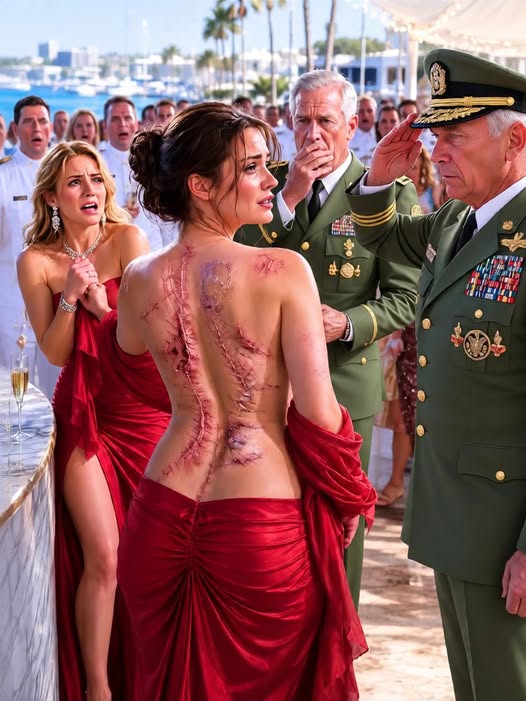
“Welcome home, Captain Harrington.”
Admiral Thomas Reed’s voice rolled through the ballroom with the force of a naval cannon.
For several heartbeats, nobody moved.
Two hundred guests stood frozen beneath crystal chandeliers, their champagne glasses suspended halfway to their lips. Moments earlier, they had watched Celeste tear open my blouse and expose the scars across my back. Some had laughed. Others had whispered behind jeweled hands. Most had simply stared.
Now the same people looked at me as though I had become someone else.
But I had not changed.
They were only seeing me clearly for the first time.
My father’s whiskey glass slipped from his hand.
It struck the marble floor and shattered at his feet.
The sharp crack echoed through the silence.
“No,” Richard Harrington whispered.
His face had always been disciplined, polished, and unreadable. He had built a billion-dollar defense company by making powerful men believe he was incapable of fear.
Yet fear was exactly what I saw in his eyes.
Admiral Reed held his salute.
I straightened my shoulders despite the cold air against my exposed scars. The torn silk hung from my arms, but I made no attempt to cover myself.
Instead, I raised my hand and returned the salute.
“At ease, Admiral.”
A murmur moved through the room.
Celeste stared at me as though I had struck her.
“You?” she breathed. “You’re a Navy captain?”
I lowered my hand slowly.
“Not according to the stories you told.”
Her face tightened.
For five years, my sister had helped my parents turn my disappearance into a social tragedy. They claimed I had abandoned the family after a nervous breakdown. They told reporters I was unstable, jealous, and unable to cope with Celeste’s success.
Whenever someone asked where I was, my mother sighed sadly.
Whenever someone wondered whether I was alive, my father changed the subject.
And whenever Celeste spoke about me, she smiled.
Admiral Reed removed his formal jacket and placed it gently over my shoulders.
The gesture was respectful, not pitying.
“These scars,” he said, turning toward the guests, “were sustained aboard the USS Resolute during a classified rescue operation in the North Atlantic.”
My father’s eyes flickered.
The movement was small, but I saw it.
So did the Admiral.
“A fire tore through the lower decks after an explosion disabled the ship’s electrical systems,” Reed continued. “Captain Harrington entered a burning corridor three times. She pulled eleven sailors through smoke and flame before a steel hatch collapsed behind her.”
The ballroom remained silent.
“She suffered severe burns, three broken ribs, and a punctured lung. She refused evacuation until every trapped sailor had been accounted for.”
Someone near the stage whispered, “My God.”
Celeste’s fingers released the strip of silk she had torn from my blouse.
It fell to the floor.
Admiral Reed’s expression hardened.
“Thirty-seven service members returned home because Captain Harrington refused to leave them behind.”
A group of uniformed officers near the rear of the room stood straighter.
One by one, they raised their hands.
The first salute came from a gray-haired rear admiral.
Then another officer joined him.
Then another.
Within seconds, nearly every active-duty and retired service member in the ballroom was saluting me.
My mother covered her mouth.
Celeste looked around in horror.
My father did not move.
He stood among the broken glass, staring at me with an expression I remembered from childhood.
It was the look he gave whenever something escaped his control.
Admiral Reed lowered his salute.
“The details of Captain Harrington’s service were sealed under executive authorization,” he said. “Her family was not informed because they did not possess the necessary security clearance.”
My father finally found his voice.
“This is absurd.”
His tone was louder than necessary.
He stepped down from the stage, crunching glass beneath his polished shoe.
“My daughter had no military career. She studied engineering for two years, dropped out, and disappeared after embarrassing this family.”
“I did not drop out,” I said.
His eyes snapped toward me.
“I was recruited.”
The words struck him harder than I expected.
“Recruited by whom?”
“That information remains classified,” Admiral Reed answered.
Richard’s mouth twisted.
“You expect me to believe my unstable daughter secretly became a captain?”
The Admiral’s face darkened.
“Choose your next words carefully.”
My father looked around the ballroom.
He saw the senators watching him.
The defense executives.
The military officers.
The journalists who had been invited to celebrate his retirement.
His humiliation was no longer private.
So he did what Richard Harrington always did when cornered.
He attacked.
“This woman arrives without warning,” he said, gesturing toward me. “She disrupts an important event and manipulates a respected officer into performing some theatrical display. Evelyn has always been desperate for attention.”
A few guests shifted uncomfortably.
No one agreed with him.
My mother stepped forward at last.
“Richard, perhaps we should speak privately.”
He ignored her.
“Evelyn,” he said, “if you truly served this country, why did you never contact us?”
The question carried accusation, not sorrow.
I looked at the man who had raised me.
For years, I had imagined this reunion.
Sometimes I pictured him apologizing.
Sometimes I imagined him embracing me.
On darker nights, I imagined telling him everything and watching his certainty collapse.
But standing there, I felt surprisingly calm.
“I wrote to you,” I said.
My mother’s eyes widened.
My father did not blink.
“I sent fourteen letters during my first two years of service. I sent them through secure channels. Each one was cleared for delivery.”
“That’s a lie,” Celeste said quickly.
I turned toward her.
“Is it?”
She opened her mouth, but no sound came out.
My mother looked from Celeste to my father.
“Richard?”
He remained silent.
That silence was an answer.
A memory returned to me.
I was twenty-one, sitting alone in a military transport plane, holding a letter from my mother. It had been the only reply I ever received.
Do not contact us again.
Your father believes your absence is best for everyone.
I had carried that sentence through training, deployments, storms, gunfire, and sleepless nights.
For years, I believed my entire family had rejected me.
Now I saw my mother’s confusion.
She had never written those words.
“You intercepted them,” I said.
My father’s face stayed expressionless.
Celeste stepped closer to him.
“You told us she never reached out.”
My mother’s voice trembled.
“You told me she hated us.”
Richard glanced at her impatiently.
“This is not the time.”
“It is exactly the time,” I said.
Admiral Reed nodded toward two officers waiting near the ballroom entrance.
They carried a black leather case between them.
The atmosphere changed instantly.
My father noticed it.
“What is that?” he asked.
The officers approached.
One placed the case on a nearby table. The other entered a security code, pressed his thumb against a scanner, and opened the locks.
Inside rested a sealed envelope marked with the insignia of the Department of Defense.
Admiral Reed removed it carefully.
“Captain Harrington did not attend tonight’s gala for a family reunion,” he said.
My father’s confidence faltered.
“Then why is she here?”
I looked at the enormous banner hanging behind the stage.
RICHARD HARRINGTON: FORTY YEARS OF SERVICE AND INNOVATION.
Beneath those words, photographs displayed his company’s achievements.
Advanced navigation systems.
Encrypted communication networks.
Emergency propulsion units.
Technology sold to the United States Navy and allied governments around the world.
Technology that had made him rich.
Technology that had also killed people.
“I came because tonight was the only time every member of the Harrington Systems board would be in the same room,” I said.
Several executives near the stage went pale.
My father looked at them, then back at me.
“What are you suggesting?”
“I am not suggesting anything.”
Admiral Reed handed me the envelope.
“I am delivering findings.”
Richard laughed, but the sound was brittle.
“Findings from what?”
“The Resolute explosion was not an accident,” I said.
The silence deepened.
My scars began to ache beneath the Admiral’s jacket.
They always did when I remembered the heat.
The ship had been moving through violent northern waters when the navigation system failed. Seconds later, an unauthorized signal triggered a power surge in the engine compartment.
The explosion ripped through three decks.
Men and women screamed in the darkness.
Emergency doors malfunctioned.
Fire suppression systems refused to activate.
Equipment manufactured by Harrington Systems had failed one component at a time.
At first, investigators blamed seawater corrosion.
Then we found the hidden code.
Someone had built a remote access channel into the software.
Someone had sold the access key.
My father stared at me.
“You were aboard the Resolute?”
“Yes.”
He looked at my scars again.
For the first time, his expression changed.
Not into guilt.
Into calculation.
Admiral Reed addressed the guests.
“Evidence recovered by Captain Harrington’s team indicates that classified naval technology was deliberately compromised. The same vulnerability has been detected in systems installed aboard six additional vessels.”
A defense contractor near the bar quietly set down his drink.
A senator stepped closer.
“Are you saying someone inside Harrington Systems sabotaged naval equipment?”
“We are saying the breach originated from Harrington Systems,” Reed replied.
My father’s voice sharpened.
“My company employs twelve thousand people. A security breach could have come from anywhere.”
“It came from an executive account,” I said.
The members of the board exchanged frightened glances.
Celeste moved away from them.
“Whose account?” my mother asked.
I broke the seal on the envelope.
My father watched every movement.
Inside were several pages of names, transaction records, and encrypted communications.
The first page contained a list of offshore payments.
The second identified the foreign intermediary.
The third revealed the authorization code used to access the naval systems.
At the bottom was an electronic signature.
RICHARD A. HARRINGTON.
My father’s eyes dropped to the page.
Then he smiled.
It was not the reaction anyone expected.
The smile was slow, almost amused.
“You returned after five years,” he said, “believing a printed signature would destroy me?”
“It is more than a signature.”
“Digital records can be forged.”
“Not these.”
He stepped closer.
“Do you have any idea how many enemies I have? Competitors, politicians, foreign governments. Anyone could have planted this.”
“We considered that possibility,” I said.
“And?”
“The authentication was confirmed by three independent agencies.”
His smile disappeared.
Admiral Reed gestured toward the entrance.
The ballroom doors opened.
Four federal agents entered.
They wore dark suits and carried credentials.
A ripple of panic spread through the guests.
One board member hurried toward a side exit.
An agent blocked him.
“Everyone remains inside until interviews are completed.”
My father looked at the agents, then at me.
“You planned this.”
“For eighteen months.”
Celeste gripped his arm.
“Dad, tell them it’s a mistake.”
He pulled away from her.
“Do not touch me.”
The cruelty in his voice startled even her.
My mother stepped between us.
“Richard, did you know about the defective systems?”
He looked at her as though she were an inconvenience.
“Go home, Margaret.”
“Did you know?”
He did not answer.
Her face crumpled.
For the first time, my mother seemed to understand that the man beside her was not simply cold.
He was dangerous.
One of the federal agents approached.
“Richard Harrington, we need you to come with us.”
My father remained still.
“Am I under arrest?”
“At this moment, you are being detained for questioning.”
“At this moment,” he repeated.
His gaze moved toward the journalists.
Several had already raised their phones.
He smiled again, reclaiming a trace of his public composure.
“Then I will cooperate fully. I have nothing to hide.”
As the agents surrounded him, he leaned close to me.
Only I heard his whisper.
“You should have stayed dead.”
A chill moved through me.
Before I could respond, he stepped away and offered his wrists as though posing for a photograph.
The guests watched him leave the ballroom.
Some looked horrified.
Others looked fascinated.
None of them looked proud anymore.
Celeste sank into a chair.
Her diamond bracelet caught the chandelier light, but she seemed smaller now, stripped of the arrogance she had worn all evening.
“This can’t be happening,” she whispered.
I picked up the torn piece of my blouse from the floor.
“You made certain everyone saw my scars,” I said. “Now they will see his.”
She looked up at me.
“I didn’t know.”
“You never wanted to know.”
Her eyes filled with tears.
For a moment, she resembled the little girl who used to follow me through the gardens, begging me to climb trees with her.
Then her expression hardened.
“You came here to destroy us.”
“No. I came here to stop him.”
“He is our father.”
“He is responsible for the deaths of sixteen sailors.”
Celeste stood abruptly.
“You don’t know that.”
“I held one of them while he died.”
My voice remained quiet, but the memory rose around me.
Lieutenant Daniel Mercer had been twenty-six.
He had a wife named Anna and a newborn daughter he had never met.
When I pulled him from the burning corridor, half his uniform had melted into his skin.
He kept asking whether the ship was safe.
Even while dying, he worried about everyone else.
“He asked me to tell his daughter that he loved her,” I said. “He died before sunrise.”
Celeste’s anger faded.
I stepped closer.
“The system that trapped him was built by our father’s company. Richard knew the software had been compromised. He kept selling it because recalling the systems would have cost billions.”
My mother made a broken sound behind me.
She lowered herself into a chair.
“How could I not know?” she whispered.
I turned toward her.
“You knew he controlled everything.”
“That is not the same as knowing he killed people.”
“No,” I said. “It isn’t.”
She looked at me through tears.
“Did you really write to me?”
“Every month at first.”
“I never received anything.”
“I know that now.”
She reached for my hand.
I hesitated.
Her fingers stopped in the air.
“I searched for you,” she said. “Your father told me the Navy had no record of you. He said private investigators found evidence you had gone overseas with a man.”
“There was no man.”
“I know.”
“Do you?”
The question hurt her.
I did not apologize.
Love without courage had abandoned me as completely as hatred.
Before she could answer, Admiral Reed approached.
“Captain, we need to speak.”
His voice was low.
Something in his expression made me follow him away from the others.
We stopped near a tall window overlooking the harbor. Naval vessels rested in the distance beneath silver moonlight.
“What happened?” I asked.
“One of the agents searched your father before he left.”
“And?”
Reed handed me a small object sealed inside a clear evidence bag.
It was a metal key.
Old-fashioned.
Heavy.
A number had been engraved along its side.
I recognized it immediately.
My breath caught.
Five years earlier, before I entered officer training, I had found an identical key hidden inside my father’s study.
At the time, I assumed it belonged to a bank deposit box.
Three nights later, someone broke into my apartment.
Nothing was stolen except the key.
“That’s impossible,” I whispered.
“Do you know what it opens?” Reed asked.
“No.”
“You have seen it before.”
“Yes.”
I told him about the burglary.
His jaw tightened.
“Why was that not in your original statement?”
“Because I didn’t connect it to the investigation. It happened before I knew about the compromised systems.”
Reed looked toward the ballroom doors.
“Your father carried this inside the lining of his jacket.”
“Why bring it tonight?”
“That is what concerns me.”
A federal agent hurried toward us.
“Admiral.”
“What is it?”
The man lowered his voice.
“Harrington’s transport never reached headquarters.”
Reed’s face went still.
“What do you mean?”
“The vehicle was struck three blocks from here. The driver and one agent are unconscious. The second agent is missing.”
“And Richard?”
“Gone.”
My pulse quickened.
The ballroom seemed suddenly too open, too bright.
“Lock down the building,” Reed ordered. “No one leaves.”
The agent moved away.
I stared at the key.
My father had expected something to happen tonight.
Perhaps he had even arranged it.
Celeste approached before Reed could stop her.
“What’s going on?”
“Your father escaped,” I said.
Her eyes widened.
“That’s impossible.”
“Apparently not.”
She looked toward the exit.
Then I saw it.
A flicker of recognition crossed her face when she noticed the key.
“You know what this opens,” I said.
“No.”
“You looked directly at the number.”
“I was looking at the bag.”
“Celeste.”
She turned away.
I caught her wrist.
Her diamond bracelet slid upward, revealing a faint bruise beneath it.
“Tell me.”
She pulled free.
“It opens a locker.”
“Where?”
“I don’t know.”
“You are lying.”
She glanced at our mother.
Margaret was speaking with an agent across the room.
Celeste lowered her voice.
“Dad took me to Union Station six months ago. He opened a private storage locker with a key like that.”
“What was inside?”
“I never saw. He made me wait outside.”
“Why did he bring you?”
“He needed me to sign something.”
“What?”
“A transfer document.”
My stomach tightened.
“What did you transfer?”
“Shares in the company.”
“To whom?”
“A holding corporation.”
“What corporation?”
She closed her eyes.
“North Atlantic Restoration.”
Admiral Reed and I exchanged a glance.
North Atlantic Restoration had appeared repeatedly in the financial records.
It was the shell company that received millions from the foreign intermediary.
“You signed ownership documents for a company involved in the sabotage,” I said.
“I didn’t know!”
“But your name is on them.”
Terror filled her face.
“He said it was part of my trust.”
“Did he give you anything else?”
She shook her head.
Then stopped.
“There was an envelope.”
“What envelope?”
“He told me to keep it somewhere safe and never open it.”
“Where is it?”
“At my apartment.”
Reed immediately signaled to an agent.
Before the man reached us, every light in the ballroom went out.
Darkness swallowed the room.
Screams erupted.
Glass crashed.
People pushed toward the exits.
“Stay down!” Reed shouted.
I heard footsteps running behind me.
Then Celeste cried out.
I reached for her, but my hand closed around empty air.
Emergency lights flickered on several seconds later, bathing the ballroom in dim red.
Celeste was gone.
My mother stood near the stage, screaming her name.
One of the side doors swung slowly on its hinges.
I ran toward it.
The corridor beyond was deserted.
On the carpet lay Celeste’s diamond bracelet.
Beside it rested a phone.
Her phone.
The screen glowed with a newly received message.
I picked it up.
The message contained a photograph taken only seconds earlier.
Celeste sat inside a dark vehicle, her mouth covered with silver tape. A gloved hand gripped her shoulder.
Under the photograph were seven words.
BRING THE KEY, OR YOUR SISTER DIES.
Admiral Reed appeared behind me.
“We cannot let you go alone.”
“They want me.”
“They want the key.”
“Then they believe I know what it opens.”
He studied the message.
“There is no location.”
Another message arrived.
UNION STATION. LOCKER 317. MIDNIGHT.
I checked the time.
We had twenty-two minutes.
Reed began issuing orders, but I barely heard him.
My father had escaped.
My sister had been taken.
And somewhere inside locker 317 was something important enough to destroy lives.
We left the ballroom through a secured entrance.
A black government vehicle waited outside.
Rain had begun to fall, silver beneath the streetlights.
As we drove toward Union Station, I watched the city blur past the window.
For five years, I had believed the worst night of my life occurred aboard the Resolute.
I was wrong.
The station was nearly empty when we arrived.
Reed’s team entered through separate doors.
I walked alone toward the locker hall, carrying the key inside my closed fist.
Locker 317 stood at the end of a narrow corridor.
No kidnappers waited nearby.
No Celeste.
Only a security camera turned slowly above me.
I inserted the key.
The lock clicked.
Inside was a black military case.
I lifted it out and placed it on the floor.
The case required a six-digit code.
A date came to mind.
The date I disappeared.
I entered it.
The case opened.
Inside were dozens of classified files, financial records, and photographs.
But the item on top made my blood turn cold.
It was a photograph of me aboard the USS Resolute.
The picture had been taken during the fire.
I was dragging Daniel Mercer through the burning corridor.
Someone had written a sentence across the bottom in black ink.
SHE WAS NEVER SUPPOSED TO SURVIVE.
A phone began ringing inside the case.
I answered it.
My father’s voice came through the speaker.
“Hello, Evelyn.”
“Where is Celeste?”
“She is alive.”
“For now?”
“That depends on you.”
“You sabotaged the Resolute.”
He laughed softly.
“You still believe this is about a ship.”
“What is it about?”
“Our family.”
I stared at the files.
“What do you want?”
“Open the red folder.”
Beneath the photograph lay a thin red file.
I opened it.
The first page contained a birth certificate.
My name was printed across the center.
Evelyn Grace Harrington.
But Richard Harrington was not listed as my father.
The name beneath FATHER was Admiral Thomas Reed.
I stopped breathing.
Behind me, footsteps entered the corridor.
I turned slowly.
Admiral Reed stood beneath the dim station lights.
His face had gone pale.
On the phone, Richard whispered the words that shattered everything I believed.
“Ask the Admiral why he abandoned you.”
If you want to know what happened next, please type “YES” and like for more.