PART 3 — THE DEAD MAN AT MY DOOR
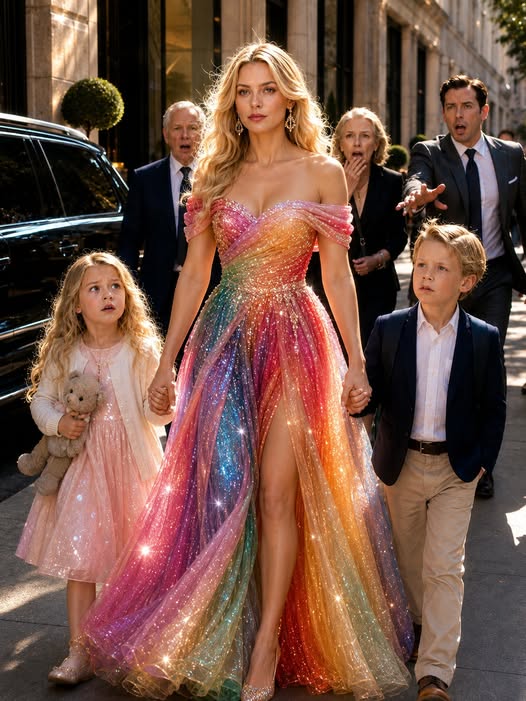
The man with the scar smiled as if he had not just stepped out of a grave.
Vivian’s fingers dug into my wrist. “Marina, take the children and run.”
But my feet would not move.
The stranger stood beneath the gray Madrid sky, tall and still, his dark eyes fixed on the staircase behind me. “Hello, Marina,” he said again. “I believe it’s time I met my son.”
My heart slammed against my ribs.
“Your son?” I whispered.
Before he could answer, the back door of the black car opened.
Julian stepped out.
For a moment, I forgot how to breathe.
He looked ruined. His perfect suit was wrinkled, his eyes bloodshot, his arrogance stripped down to something raw and human. Behind him stood Camila, pale and trembling.
Vivian let out a broken sound. “Mateo.”
The scarred man did not look at her. “You let my son believe he belonged to Esteban.”
Julian stared at him. “Don’t call me that.”
“My son?”
Julian’s jaw clenched.
Mateo Morales.
The name hit me with the force of an old family curse. Julian’s uncle, supposedly dead for eight years in a warehouse fire. The man Vivian had once slapped Camila for mentioning at dinner. The man whose portrait had vanished from every Morales wall.
“You’re supposed to be dead,” I said.
Mateo’s smile faded. “Esteban preferred me that way.”
Vivian closed her eyes.
Julian turned toward me, and for the first time since the courthouse, there was no cruelty in his face. Only panic. “Marina, I didn’t come for the kids.”
“Then why are you here?”
“Because everything we knew is a lie.”
Mateo stepped closer. “Eight years ago, you found something in Leo’s bloodwork. A rare hereditary marker. You were told it could not have come from Julian.”
The staircase seemed to tilt beneath me.
“How do you know that?”
“Because the doctor who told you was paid by Esteban.”
Vivian whispered, “He forged the comparison file.”
My stomach twisted. “No.”
Julian looked at me, horrified. “What comparison file?”
I could barely speak. “After Leo was born, Dr. Ortega told me your bloodline didn’t match his. I thought…”
“You thought I wasn’t Leo’s father,” Julian finished.
His voice cracked on the last word.
I had carried that secret for eight years—not because I had betrayed him, but because I feared the Morales family would use Leo like property if they knew the truth.
Mateo looked at Julian. “You are not Esteban’s son. You are mine.”
Julian staggered back as if struck.
Camila covered her mouth. Vivian turned away, ashamed.
“And if Julian is my son,” Mateo continued, “then Leo’s marker makes perfect sense.”
The world went silent.
Leo was Julian’s son.
My son had been abandoned by the very father whose blood he carried.
A bitter laugh escaped me. “So Esteban lied to me, lied to Julian, faked your death, and now he wants Leo because the truth threatens his empire?”
May you like


Mateo nodded. “Leo is proof. So is Sophie. So is Julian.”
Julian’s face collapsed.
The same man who had called our children dead weight now looked as if those words were burning through his skin.
From upstairs, Sophie called, “Mom?”
I moved instantly. “No one comes up.”
Julian stepped forward. “Marina, please—”
“No.” My voice was quiet, but everyone heard the steel in it. “You signed them away.”
His eyes filled with tears.
And for the first time in ten years, Julian Morales had no answer.
PART 4 — THE ULTRASOUND THAT DESTROYED A DYNASTY
We moved that night.
Rafael arrived with two cars, three trusted friends, and the kind of silence that meant he had already decided no one would touch his family. By midnight, Leo and Sophie were asleep in a rented farmhouse outside Toledo, surrounded by olive trees and locked gates.
Julian was not allowed inside.
He waited on the terrace in the cold, hands buried in his pockets, while Mateo told me the truth.
“Esteban was never the rightful heir,” Mateo said. “My mother left controlling shares of Morales Holdings to me. When Vivian became pregnant with Julian, Esteban realized the family would eventually discover I was Julian’s father.”
Vivian sat opposite me, stripped of pearls and pride. “I was afraid of Esteban. Afraid of scandal. Afraid of losing everything.”
“So you let Julian grow up under a monster,” I said.
She flinched. “Yes.”
Mateo’s scar caught the lamplight. “When I threatened to reveal the truth, Esteban arranged the warehouse fire. I survived. Barely. A loyal employee hid me in Portugal.”
“And now?” Rafael asked.
“Now Esteban knows Leo’s existence can reopen the trust.”
I looked toward the hallway where my children slept. “Leo is eight.”
“To Esteban, age does not matter. Blood does.”
The next morning, a video arrived on every news outlet: Julian shouting in the clinic, Bianca sobbing, Vivian slapping Esteban.
But the real explosion came two hours later.
Bianca called me.
I almost rejected it, but something in me answered.
Her voice was hoarse. “Marina, I know you hate me.”
“I don’t have enough room left in my life to hate you.”
She cried softly. “Esteban made me lie. He said Julian would marry me, that my baby would be protected.”
“Protected from what?”
“From him.”
I froze.
Bianca whispered, “The baby is Esteban’s daughter, but he wanted everyone to believe she was Julian’s son. He said a girl was useless to him unless she could be hidden.”
Something cold moved through me.
Julian’s obsession with an “heir” had not even been his own. It was Esteban’s poison poured into him since childhood.
“Why are you telling me?” I asked.
“Because he’s looking for Leo. And because I found something.”
An hour later, a package arrived through Rafael’s contact.
Inside was a small flash drive and a hospital bracelet from the night Leo was born.
The video on the drive showed Dr. Ortega meeting Esteban in a parking garage, taking an envelope, and saying, “Mrs. Morales will believe whatever the records say.”
Julian watched the footage with me.
His face turned gray.
“I did this,” he whispered.
“No,” I said. “Esteban did.”
Julian looked at me with red eyes. “I called my own children dead weight.”
I did not comfort him.
Some guilt deserved to sit alone in the dark.
That evening, Leo found him on the terrace.
I watched through the window as Julian slowly knelt, careful not to reach for him.
Leo stood stiffly. “Mom says you can’t come with us.”
Julian nodded. “She’s right.”
“Did you really not want us?”
Julian covered his mouth with one hand.
Then he said the first honest words I had heard from him in years.
“I was stupid and cruel, and I hurt you. But you were never unwanted. Not by your mother. Not by the world. And someday, if you let me, I’ll spend the rest of my life proving I know that.”
Leo stared at him for a long time.
Then he walked back inside without answering.
Julian stayed on his knees after Leo left.
And I let him.
PART 5 — THE VAULT BENEATH THE CHAPEL
Mateo said the original trust documents were hidden in the old Morales chapel outside Segovia.
I laughed when he told me.
“A chapel? Of course. Your family even hides crimes dramatically.”
For the first time, Mateo smiled. “My mother had a sense of theater.”
We went at dawn: Rafael, Mateo, Vivian, Julian, and me. Camila stayed behind with the children, and to my surprise, she guarded them like a wolf. Shame had changed her faster than kindness ever could.
The chapel stood on a hill, abandoned and beautiful, its stone walls silver under the morning mist. Inside, dust floated in beams of pale light. Vivian walked straight to the altar, pressed her palm beneath a carved angel, and a hidden panel clicked open.
Behind it was a narrow stairway.
Julian stared at her. “How long have you known?”
Vivian’s voice was empty. “Long enough to be guilty.”
Below the chapel was a small vault.
Inside were ledgers, letters, photographs, and a steel box sealed with the Morales crest. Mateo opened it with a key he wore beneath his shirt.
The first document was his mother’s will.
The second was a confession.
Vivian read it aloud, her voice shaking.
“If my son Mateo is harmed, disappeared, or declared dead under suspicious circumstances, all voting control transfers to the legal guardian of the youngest living minor descendant of his line, until that child reaches twenty-five.”
Rafael looked at me.
Julian slowly turned.
Mateo said, “That is Leo.”
My knees weakened.
“No,” I said.
Vivian lowered the paper. “Marina, you control the Morales empire.”
Julian let out a broken laugh. “Of course she does. Of course the one person none of us respected is the one holding the crown.”
“I don’t want your crown,” I snapped.
Mateo stepped closer. “Then use it to end him.”
Before I could answer, footsteps echoed above us.
Rafael drew me back.
Esteban’s voice drifted down the stairs. “Touching. Truly. All the little traitors gathered in one grave.”
He appeared at the bottom of the stairway with two men behind him.
His eyes moved from Vivian to Mateo to Julian, then finally to me.
“There she is,” he said. “The abandoned wife who became inconvenient.”
Julian moved in front of me. “Stay away from her.”
Esteban laughed. “Now you remember you’re a husband? How sentimental.”
“I’m not her husband anymore,” Julian said. “But I am done being your weapon.”
Esteban’s face hardened.
Then he pulled out his phone and held it up.
On the screen was Sophie.
She was sitting at the farmhouse kitchen table, Camila beside her, both frightened but unharmed.
Esteban smiled. “Give me the documents, Marina, or my men take the girl first.”
For one terrible second, the chapel disappeared, and all I could see was my daughter’s face.
Julian lunged.
Rafael hit one guard.
Mateo slammed the steel box shut.
I did not scream.
I did something colder.
I looked Esteban in the eyes and said, “You should have checked who was recording.”
His smile faded.
Vivian lifted her purse and showed the tiny red light of Rafael’s transmitter.
Every word had gone live to Attorney Miller, Spanish police contacts, and three journalists Bianca had already trusted with her story.
Sirens began screaming outside the chapel.
Esteban looked at Vivian with pure hatred.
She whispered, “I finally chose my grandchildren.”
And the first crack appeared in the king’s face.
PART 6 — THE FALL OF ESTEBAN MORALES
Esteban ran.
Not gracefully. Not like a powerful man. He ran like a thief whose pockets were full of fire.
He shoved past his own guards and bolted up the chapel stairs, but Mateo followed him. Julian followed Mateo. I followed them both.
Outside, police cars tore through the mist. Esteban reached his car, but Bianca was standing beside it.
Pregnant, pale, and shaking—but standing.
She held another phone in her hand.
“You said my daughter was useless,” she told him. “Let’s see what the world thinks of that.”
Esteban stopped.
For the first time, he looked afraid.
The journalists arrived before the lawyers. Cameras flashed. Questions sliced through the air.
“Did you fake Mateo Morales’s death?”
“Did you bribe Dr. Ortega?”
“Is Bianca Rojas carrying your child?”
Esteban’s mouth opened and closed, but no command came out.
Julian stood beside me, watching the man he had worshipped collapse under the weight of his own name.
Then Esteban turned to him.
“You are nothing without me.”
Julian’s face went still.
For years, those words would have crushed him.
Now he only said, “Then I’ll finally find out who I am.”
By evening, Esteban Morales was in custody.
By midnight, Morales Holdings froze his authority.
By morning, every newspaper carried the same headline: THE HEIR WAS A LIE.
But the biggest shock came two days later, during the emergency board hearing.
I entered with Attorney Miller on one side and Rafael on the other. Mateo walked behind me. Vivian appeared last, wearing black, as if attending the funeral of the woman she used to be.
The board expected Mateo to claim control.
He did not.
They expected Julian to beg for his place.
He did not.
They expected me to be frightened.
I was not.
Attorney Miller placed the documents on the table.
“As legal guardian of Leonardo Morales-Valdez, Marina Valdez holds temporary voting control under Alma Morales’s trust.”
A director scoffed. “She has no business experience.”
I looked at him. “Neither did Esteban when he inherited stolen power. Yet all of you applauded him.”
Silence.
Then I opened my folder.
Inside were reports from employees who had been silenced, families cheated out of wages, and victims of Esteban’s projects who had never seen justice.
“My first vote,” I said, “is to remove every director who helped Esteban bury crimes.”
Three men stood up shouting.
I raised one hand. “My second vote is to convert forty percent of family-held shares into an employee restitution fund.”
The room erupted.
Julian stared at me as if seeing me for the first time.
Vivian began to cry silently.
“And my third vote,” I continued, “is to create a protected trust for Leo, Sophie, and Bianca’s daughter—not as heirs to a throne, but as children who will never be used as weapons again.”
One by one, the old directors realized the cameras were running.
One by one, they sat down.
Mateo leaned close and whispered, “Alma would have liked you.”
I looked at the men who had built an empire out of fear.
“The Morales dynasty is over,” I said. “The family can survive. The kingdom cannot.”
That was the day the house of Morales fell.
And strangely, it was the first day any of us began to breathe.
PART 7 — THE FATHER WHO ARRIVED TOO LATE
Julian did not ask me to take him back.
That was the first sign he had changed.
He rented a small apartment in Madrid, sold his luxury cars, resigned from the board, and began working with the restitution team. At first, I thought it was performance. Shame often dresses itself as sacrifice when people are watching.
But then the cameras left.
And Julian stayed.
He attended therapy. He wrote letters to Leo and Sophie, but never handed them over unless I approved. He came to school events and stood at the back. He brought no gifts expensive enough to be bribes. He learned Sophie liked stories about dragons and Leo hated being asked if he was “the man of the house.”
One afternoon, Leo came home quiet.
“What happened?” I asked.
He shrugged. “Dad was outside school.”
“Did he bother you?”
“No.” Leo sat at the kitchen table. “He asked if he could walk behind us to the bus stop. Not with us. Behind.”
My chest tightened.
“And?”
“I said okay.”
That was how Julian reentered their lives—not through rights, demands, or family names, but through distance, patience, and small permissions.
Sophie was harder.
She hid behind me whenever she saw him.
One rainy day, he knelt outside the school gate with a pink umbrella shaped like a flamingo.
Sophie stared at him. “That’s ugly.”
Julian nodded solemnly. “Extremely.”
“Why did you buy it?”
“Because it looked lonely.”
She considered that.
Then she took the umbrella.
Not his hand.
Just the umbrella.
But Julian cried in his car afterward. I saw him.
I did not forgive him that day.
Forgiveness was not a door I owed him.
But I stopped wishing he would disappear.
Vivian changed, too, though more painfully. She sold her jewels and donated the money to the restitution fund. She asked to see the children only through me. When Sophie finally agreed to meet her, Vivian brought no pearls, no lectures, no pride.
Only a box of old photographs.
“This is your grandfather Mateo,” she told Leo. “And this is your father when he was little.”
Leo studied the pictures. “Dad looks sad.”
Vivian’s lips trembled. “He was. And I should have protected him.”
Across town, Bianca gave birth to a daughter.
She named her Alma.
Not after the empire.
After the woman whose will destroyed it.
When I visited the hospital, Bianca looked exhausted and afraid.
“I don’t know how to be a good mother,” she whispered.
I looked at the tiny girl sleeping against her chest. “Neither did I, at first.”
“You hate me.”
“I hated what you helped break,” I said. “That is not the same thing.”
Bianca cried then, quietly, without performance.
Before I left, she touched my sleeve. “Marina?”
“Yes?”
“Thank you for making a world where my daughter won’t belong to Esteban.”
I looked at baby Alma’s tiny fist curled against the blanket.
None of our children would belong to him.
That was enough.
PART 8 — THE WOMAN WHO KEPT THE KEY
One year later, the old Morales mansion reopened as a public foundation.
No gold gates. No private guards. No portraits of men who mistook cruelty for greatness.
The ballroom where Vivian once hosted charity dinners became a legal aid center. Esteban’s office became a children’s library. The chapel vault became an archive, its secrets cataloged under glass where no one could weaponize them again.
On opening day, Leo stood beside me in a navy jacket, nervous and serious.
“Do I have to give a speech?” he whispered.
“No.”
“Good. I’m eight.”
I smiled. “Exactly.”
Sophie ran past us with Bianca’s toddler, Alma, both of them shrieking with laughter while Julian pretended not to notice that his shoes were covered in mud.
Mateo stood near the garden, alive in sunlight after years of hiding. Vivian sat beside him. They were not healed, not entirely, but they were speaking.
Camila arrived carrying trays of pastries and announced she had burned the first batch “in honor of family tradition.”
For the first time, the Morales name sounded less like a curse.
At noon, Attorney Miller handed me the final court order.
Esteban had been convicted of fraud, bribery, conspiracy, and attempted coercion. His appeals were already failing. His fortune was gone. His power was gone.
But that was not the surprise.
Miller smiled. “There is one final clause from Alma’s will.”
I sighed. “Of course there is.”
He handed me a sealed letter.
Inside was a page written decades before my birth.
To the guardian who chooses the child over the crown:
If you are reading this, then my family has once again confused inheritance with love. Burn the throne. Keep the house open. Let the children decide what name they want when they are old enough to understand what names cost.
Below it was one final instruction.
The controlling shares were not to pass to Leo at twenty-five.
They were not to pass to Julian.
Not to Mateo.
Not to any bloodline.
They were to dissolve permanently into the foundation if the guardian refused personal ownership for seven consecutive years.
I started laughing.
Julian looked over. “What?”
I handed him the letter.
He read it, then laughed too. A stunned, breathless sound.
“All this time,” he said, “Esteban destroyed everyone for a crown that was designed to disappear.”
Mateo closed his eyes. Vivian covered her mouth.
I looked across the garden at Leo, Sophie, and Alma chasing each other beneath orange trees.
The shocking ending was not that I became powerful.
It was that I could choose not to keep the power.
Seven years later, I signed the final release.
By then, Leo was fifteen and wanted to become an architect who built homes “that didn’t scare people.” Sophie was thirteen and wrote stories where dragons rescued themselves. Alma was seven and called me Aunt Marina.
Julian never became my husband again.
But he became their father in the only way that mattered—slowly, humbly, and without asking the past to erase itself.
One evening, after the signing, Leo found me in the courtyard.
“Mom,” he said, “are we still Morales?”
I looked at him, at my brave boy who had once asked if he was wanted.
“You are Leo,” I said. “That is enough.”
He smiled.
Sophie appeared behind him. “And I’m Sophie. Also enough.”
“Obviously,” Leo said.
They ran toward the fountain, laughing.
Julian stood at the gate, watching them with tears in his eyes. He looked at me and mouthed, Thank you.
I nodded once.
Not forgiveness.
Not forgetting.
Just peace.
The sun lowered over Madrid, turning the old stones gold. For years, I had believed freedom meant escaping the Morales family. But freedom was not only leaving.
Sometimes freedom was taking the key from the people who built the cage, opening every door, and walking out with your children into a life no one could own.
I had entered that courthouse as a discarded wife.
I left with two passports, two children, and a signature that destroyed an empire.
And in the end, the heir was never a son.
It was never a name.
It was never a throne.
The real inheritance was peace.
The End.