PART 1
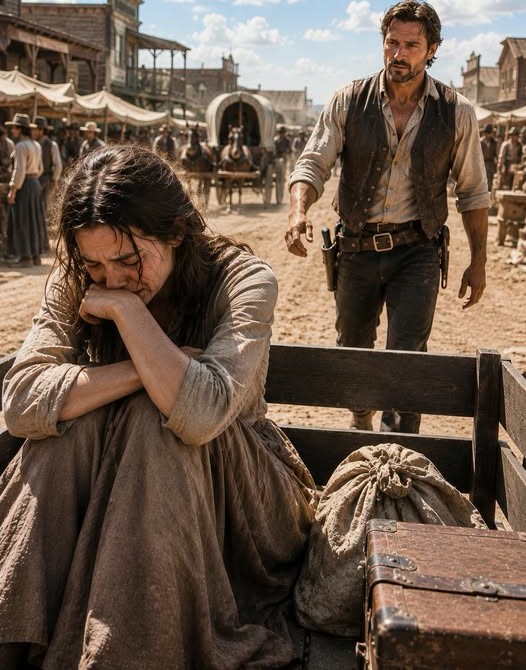
Abigail Whitmore stood frozen on the porch, clutching a suitcase held shut with rope, while her own brother laughed and told her she was nothing but a joke nobody wanted to keep.
“Say it again,” Abigail said. “Say it to my face, Silas. Not behind my back like you always do.”
Silas Whitmore didn’t even have the decency to stop grinning. He leaned against the porch post, thumbs hooked in his belt the way their father used to stand — though their father had never once looked at Abigail like she was something to be swept off the property.
“I already said it,” Silas answered. “Ain’t my fault the truth stings.”
Kora, his wife, stood in the doorway with her arms crossed over her apron, and she didn’t defend Abigail either. She only sighed the way a person sighs at a chore they’ve been putting off too long.
“It’s for the best, Abby. You know it is. You can’t stay here forever eating off Silas’s table and doing nothing but mending. A woman your age with no husband and no prospects — it ain’t right. It ain’t natural.”
“I do plenty,” Abigail said, her voice cracking despite her trying to hold it steady. “I tend the garden. I salt the meat. I raised Jonah’s boy near half his life while the rest of you were too busy to.”
“That ain’t the same as a husband,” Silas cut in. “That ain’t the same as a woman making her own way. You think any man in this county is going to come knocking for you?” He said it plain, like he was commenting on the weather. “Look at you, Abby.”
As if her face were a debt she owed the family — a mark against the Whitmore name that needed settling. Abigail had heard those words in one shape or another since she was twelve years old, since the barn dance where Llewellyn Briggs had laughed behind her hand and called her a heifer dressed up for slaughter. Every boy in earshot had laughed along, because that was easier than defending a girl nobody thought was worth defending. She had carried that laughter for fifteen years, into every room she’d ever walked into, waiting for it to happen again. It always did.
“I never asked you to find me a husband,” she said.
“No,” Jonah said, coming around the side of the house with a folded letter in his hand. He was the younger brother, and crueler for being weaker — he needed Silas’s approval too badly to ever contradict him. “You never asked. But somebody’s got to think of your future, Abby, on account of you sure ain’t thinking of it yourself.”
“What is that?”
“A rancher,” Jonah said. “Up in Montana territory. Man by the name of Thornton got himself a spread up in the mountains. No wife, no woman to keep his house. Preacher Coleman knows him through his cousin. Man’s desperate for help — desperate enough he don’t much care what he’s getting. So long as she can cook and keep a house and not run off screaming at the first sight of hard work.”
The words landed on Abigail like stones. Desperate enough he don’t much care what he’s getting.
“You already wrote to him,” she said. It wasn’t a question. She could see it in the way Jonah wouldn’t meet her eyes, in the way Kora had gone very still and very interested in a thread on her apron.|
“Three weeks ago,” Silas admitted. “Got his answer back yesterday. He’ll take you. Sight unseen. Says he don’t need a beauty, just a woman who will work and won’t complain.”
Something broke loose in Abigail’s chest, something that had been held together by sheer stubbornness for a very long time.
“You sold me,” she said. “Like a horse. Like a piece of furniture you couldn’t fit in the wagon.”
“Nobody sold you,” Kora said sharply. “Don’t be dramatic.”
“Then what do you call it?”
Nobody answered her. That was answer enough.
“The stage leaves at dawn,” Silas said, straightening off the post. “You’ll take it to the rail line. Then the train carries you the rest of the way to a town called Amber Creek. Thornton’s man will meet you there.”
“And if I refuse?”
Silas’s face went cold in a way that reminded her unpleasantly of their father in his worst moods. “Then you can walk yourself off this property tonight and see how far twenty-seven years of being nobody’s favorite gets you in this world alone. Your choice, Abby. Always has been.”
It wasn’t a choice at all, and they all knew it. A woman alone in this territory had exactly two futures — dependent on family who resented her, or dependent on a stranger who might resent her less. Abigail looked at her brother, at the man who shared her mother’s eyes and none of her mother’s kindness, and understood with terrible clarity that she’d already lost this argument before it began. She’d lost it fifteen years ago at a barn dance. She’d lost it every day since, in small cruelties disguised as honesty.
“Fine,” she said. “I’ll go.”
“Good,” Silas said, already turning away, already finished with her. “Pack light. Man like that won’t have room for foolishness.”
That night, Abigail sat on the edge of the narrow bed that had been hers since childhood, folding what little she owned into her mother’s old suitcase — two dresses, a shawl, a small wooden box holding her mother’s hairpins, the only inheritance anyone had thought to leave her. She held the box in her lap a long moment, running her thumb over the carved lid, and let herself cry the quiet, controlled way a woman cries when she’s learned that loud grief only invites more laughter.
“You’re not nothing,” she whispered to herself, the way she had a thousand times before, not quite believing it, needing to say it anyway.
When the stage rattled up the lane before dawn, no one came out to say goodbye except Jonah’s boy, six years old, who threw his arms around her waist and asked if she was coming back.
“Not for a while, sweet pea,” she told him, and kissed the top of his head, and did not let herself look back at the house as the stage pulled away.
The train let her off six days later at a small depot in a town called Amber Creek, and Abigail stood on the platform with her suitcase and her mother’s box, entirely, completely alone — until a voice behind her said her name, and she turned to find a man who would look at her the way no one ever had in her whole life.
PART 2
“Miss Whitmore.”
She turned. A man stood a few feet away — tall, broad through the shoulders, dressed in a plain work shirt and dust-colored trousers, hat in his hands rather than on his head. Dark hair, a jaw shadowed with a few days’ growth, and eyes the color of strong coffee, steady and unhurried in a way that made Abigail immediately aware of how badly her own hands were trembling.
“I’m — yes,” she said. “Abigail Whitmore.”
“Caleb Thornton.” He extended a hand, and when she took it, his grip was careful, like he was handling something he didn’t want to bruise. “Sorry for the wait. Horse threw a shoe halfway here.”
Abigail waited for it — the pause, the flicker in his eyes, the half-second where a man’s expression rearranged itself from expectation to disappointment before he remembered his manners. It didn’t come. Caleb Thornton looked at her the way he might look at anyone — plainly, directly, without apology and without appraisal. Then he reached down and picked up her suitcase like it weighed nothing at all.
“Wagons this way, ma’am. There’s a boarding house here in town, does a decent supper, if you’d rather eat before we start out. It’s a fair piece yet to the ranch.”
“No, thank you. I’d rather just go, if that’s all right.”
“That’s fine by me.” He glanced at her, something careful in the look — less judgment, more a man gauging the weather before a long ride. “You’ve had a hard few days. I can see it on you.”
“You don’t know anything about my few days, Mr. Thornton.” The words came out sharper than she intended, braced for the sting that always followed.
But Caleb only nodded, unbothered, and set her suitcase in the wagon bed. “No, ma’am, I don’t. But I know what a person looks like when they’ve been made to feel small by folks who ought to have known better. Seen it plenty. Don’t take much to recognize it.”
Abigail didn’t know what to say to that. No one had ever named it so plainly before — without pity, like it was simply a fact he’d observed and set aside rather than a wound he intended to press on. He helped her up onto the wagon seat, his hand steady under her elbow, and climbed up beside her.
“I ought to tell you plain,” Caleb said finally, eyes on the road, “since I reckon nobody else has bothered. I didn’t ask for a beauty, Miss Whitmore, on account of I don’t much trust beauty. Trusted it once, and it cost me more than I care to talk about. What I asked for was somebody who’d work honest and treat this place and the folks on it with some respect. That’s all I asked for. And near as I can tell from that letter your brother sent, that’s exactly what I’m getting.”
Abigail’s hands tightened in her lap. “My brother’s letter say anything else?”
Caleb was quiet a moment. “Said you weren’t much to look at. Said I shouldn’t expect a wife who’d turn heads.” His jaw tightened slightly — the only sign of anything working beneath the calm surface. “I didn’t care for the way it was written. Man oughtn’t talk about his own sister that way. Not to a stranger. Not to anybody. Struck me as a poor excuse for a brother.”
“He’s not wrong, though,” Abigail said quietly, looking down at her hands. “About how I look.”
“That’s so.” Caleb’s voice was mild, but there was something underneath it. “Well, I’ve been up in these mountains a long while, Miss Whitmore — mostly by my own choosing — and I’ve had time to notice folks tend to see exactly what they’ve been told to see, and nothing more. Your brother told me not to expect much. I expect he told you the same thing, probably more times than either of us could count.” He flicked the reins gently. “I don’t put much stock in what a man says about someone when he’s trying to be rid of her. Seems to me that’s the last person whose opinion’s worth trusting.”
She didn’t answer right away. The wagon climbed higher, the air growing thinner and cooler, and somewhere in the silence, Abigail found herself — for the first time in longer than she could remember — not bracing for the next cruelty.
“It suits me,” she said finally.
PART 3
They reached the ranch as the light slanted long and gold across the grass — a solid log house, a barn, a corral holding a dozen horses, all set into a wide shelf of land with the mountains rising close and steep behind it. A wiry ranch hand straightened up near the barn and squinted at Abigail with open, unhurried curiosity.
“This the new Mrs. boss?”
“This is Miss Whitmore,” Caleb said, an edge of correction in his tone. “She’ll be joining the household. Miss Whitmore, this is Otis. Been with me going on six years now. Good man. Talks too much.”
“Somebody’s got to,” Otis said cheerfully, tipping his hat. “Pleasure, ma’am. Boss don’t say six words if two will do, so I try and make up the difference.”
Despite the exhaustion and grief still sitting heavy in her chest, Abigail felt the corner of her mouth twitch toward a smile. “I’ll keep that in mind, Mr. Otis.”
“Just Otis, ma’am. Ain’t been a Mr. anything since my daddy passed.”
Inside, the house was plain but solid — no curtains, no flowers in a jar, nothing soft. The particular bareness of a place kept by a man alone.
“There’s a room upstairs, end of the hall,” Caleb said. “It’s yours. I’ll not be troubling you there unless you say otherwise, and I don’t expect to say otherwise anytime soon. We hardly know each other, Miss Whitmore. I don’t aim to rush a thing that oughtn’t be rushed.”
“Thank you,” Abigail said. “For that.”
“No need for thanks. It’s only decent.” He hesitated at the kitchen doorway, hat still in his hands, something almost boyish crossing his weathered face. “I know this ain’t the situation either of us would have chosen, the world worked different. Preacher Coleman arranged it so you’d stay through the winter first. Come spring, if we both find it suits, we’ll marry proper. If it don’t suit either one of us, I’ll pay your way wherever you’d rather go. Didn’t seem right, deciding a thing like marriage before two strangers had the chance to actually know each other.” He met her eyes. “But however this arrangement ends up, I mean to treat you fair, Miss Whitmore. Whatever else comes of this, I mean to treat you fair. That’s a promise, and I don’t make those loosely.”
Abigail looked at him a long moment — this quiet, careful, mountain-worn man who had spoken of her worth like a fact and not a favor — and felt something in her chest she hadn’t felt in fifteen years.
“I believe you,” she said.
The First Nights
Supper was quiet at first, the particular quiet of two strangers learning the shape of each other’s silences. By the time Abigail set down her spoon, Caleb had asked her three questions about herself — where she’d learned to cook, whether she preferred horses or cattle work, what she thought of the mountains — each asked plainly, with real interest.
“You ask a lot of questions for a man Otis says don’t say six words if two will do,” Abigail observed.
Something that might have been the beginning of a smile touched Caleb’s mouth. “Otis exaggerates. Truth is, I’ve lived alone on this mountain a good long while — longer than’s probably good for a man. Get so a person forgets how to make conversation. But I find I don’t mind trying with you.”
“Why is that?”
He considered the question seriously, turning it over. “Because you listen like you’re actually hearing what’s said. Most folks are just waiting for their turn to talk. You ain’t done that once tonight.”
The kitchen door banged open before she could answer, and a second ranch hand came in without knocking — younger, sharp-faced, unfamiliar. He stopped short at the sight of Abigail, and something in his expression curdled into open scorn.
“This the one Whitmore sent up? Lord above. Guess a man takes what he can get when he’s this far up a mountain.”
Caleb rose from his chair, unhurried but absolute. “Dutch. You’ll apologize to Miss Whitmore. Now.”
Dutch’s grin faltered, but pride made him reckless. “Come on, boss, I was only saying what half the county’s already—”
“I don’t much care what half the county’s saying,” Caleb cut in, and the words landed like a closing door. “I care what’s said in my house, under my roof, to a woman under my protection. You’ll apologize, or you’ll collect your pay tonight and find work someplace that suits your manners better. Your choice. I ain’t asking twice.”
Dutch’s jaw worked, humiliation and defiance warring across his face, and for a moment it seemed he might actually choose the door. Then his shoulders dropped.
“My apologies, ma’am,” he muttered, not looking at her.
“You meant every word of it,” Caleb said flatly. “But I’ll let it lie this once. See to that mare. We’ll talk in the morning about whether there’s still a place for you here.”
Dutch left without another word. Abigail sat very still, unused to anyone standing between her and a cruelty aimed her way.
“You didn’t have to do that,” she said quietly.
“Yes,” Caleb said simply, like there was no other possible answer. “I did.”
What Her Mother Taught Her
By the end of the first week, Caleb’s kitchen — bare shelves, bachelor stove, functional to the point of joylessness — no longer recognized itself. Bread rose by the window. A pot of beans simmered with salt pork. Otis stopped dead in the doorway one afternoon.
“Lord have mercy, it smells like something in here. Boss has been eating burnt bacon and hard tack going on three years.”
“Any chance a man could get a slice after supper?” he added hopefully.
“Same as everybody else,” Abigail said, swatting his hand away without looking up, and found herself smiling — genuinely, without immediately checking to see who was watching.
“My mother,” she told Caleb one evening, when he praised the bread. “She died when I was fifteen. Taught me everything she knew before that, though. Cooking, canning, doctoring with what grows wild. Said a woman ought to know how to take care of herself and everyone around her, on account of you never know who’s going to need taken care of, or when.”
“Sounds like she was a wise woman.”
“She was the only one in that house who ever thought I was worth teaching anything.” Abigail hadn’t meant to say it so plainly, and felt her face heat.
“I did ask, actually,” Caleb said. “You just answered honest, which I’d rather have than polite any day of the week.” He studied her in that unhurried way of his. “Your brothers give you trouble your whole life? Or was it something particular set it off?”
Abigail hesitated — it wasn’t a story she’d told anyone, not the whole of it. But something in Caleb’s stillness made the words come easier than she expected.
“There was a dance,” she said. “Barn dance, when I was twelve. I wore my mother’s dress, taken in to fit me, and thought I looked pretty enough. There was a girl there, Llewellyn Briggs, said something about me in front of the boys. Everybody laughed, even folks I thought were my friends. After that, it was like everybody in the county decided that was who I was. My own family started saying it too, eventually. Easier to join in than defend me, I suppose.”
Caleb was quiet a long moment, his jaw tight in a way that made her think, unexpectedly, of the way he’d stood up to Dutch.
“That Llewellyn Briggs still living in your hometown?” he asked.
“Last I knew. Why?”
“No reason,” Caleb said, though something in his tone suggested there was, and it wasn’t a kind one. “Filing away information. Man likes to know who he’s dealing with, even from three hundred miles off.”
Rachel
Three days later, Abigail found Caleb kneeling in the barn over a young mare gone lame, his hands moving over the joint with a gentleness at odds with his size. “This is Dolly,” he said. “My mother’s horse, years back. About the only thing of hers I’ve still got.”
That night, unable to sleep for thinking of the mare, Abigail slipped out to the barn and found Caleb already there, a lantern casting warm light across both of them.
“I told you I’d tell you,” he said finally, “about why the house sat empty so long. Her name was Rachel. We were to be married five years back. Grew up together, near enough. There was fever came through the territory that winter. Took her in eleven days. I sat with her near every one of them, and there wasn’t a thing I could do but watch.”
“Caleb. I’m so sorry.”
“After that, I didn’t much see the point in trying again. Buried myself in the work instead. Told myself the ranch was enough. Mostly believed it, until your brother’s letter came through Preacher Coleman, and something in me thought maybe it’s time to stop being alone just cuz it’s safer than the alternative.” He finally looked at her, something raw and unguarded in his eyes. “I didn’t ask for a wife because I’d forgotten Rachel, Miss Whitmore. I asked because five years of being alone taught me being safe from losing somebody ain’t the same thing as being happy. And I got tired of confusing the two.”
“Thank you,” Abigail managed, “for telling me.”
“For what it’s worth,” he said quietly, “I think whoever taught you to believe your face was something to apologize for was looking at the wrong thing entirely.”
Amber Creek
Trouble found them properly on a trip into town for supplies. Word had traveled — the mountain rancher had finally taken a wife, sight unseen — and the townsfolk stared without shame as the wagon rolled onto Main Street.
Mrs. Ashford, well-dressed and sharp-featured, stopped dead at the sight of Abigail, her expression curdling into poorly disguised amusement.
“Caleb Thornton. So the rumors were true.” Her eyes traveled over Abigail with an appraisal so blatant it made Abigail’s skin crawl. “Well. I suppose a man alone up in those mountains can’t afford to be too particular. Practicality over beauty. Very sensible, I’m sure.”
The old familiar shame rose up Abigail’s neck. Then Caleb’s voice cut through the street like a dropped stone through still water.
“Mrs. Ashford. I’ll thank you not to speak of Miss Whitmore that way in my hearing or otherwise. Her worth ain’t up for your discussion, and frankly, I’d think a woman of your standing would know better than to comment on a stranger’s looks in the middle of a public street. Ain’t exactly Christian behavior, is it?”
Color drained from Mrs. Ashford’s face. Caleb steered Abigail past her into the mercantile, and it wasn’t until they were alone in the aisle that Abigail let out the breath she’d been holding.
“You didn’t have to do that. Not in front of the whole street.”
“Yes,” Caleb said again. “I did.” Something fierce and protective moved across his expression. “Folks in this town are going to have to learn quick that anybody who speaks to you that way speaks to me too. Sooner they learn it, sooner they’ll stop trying.”
It was on their way back to the wagon that Abigail noticed a man watching them from the saloon porch — older, sharper-dressed than the ranchers milling through town, a look on his face closer to calculation than curiosity.
“Who is that man?”
Caleb’s jaw tightened. “Wendell Cross. Land agent, works for the territorial office, or claims to. Been sniffing around ranches in this valley the better part of a year, trying to convince folks to sell water rights or take out loans they don’t need. Slippery sort. I don’t do business with him.”
The Storm
The storm rolled in three nights later, violent and sudden, sending the horses screaming in the corral. Caleb ran for the barn shouting for Abigail to stay inside — but Dolly, still favoring her leg, was rearing in panic that could reinjure her, and Abigail ran through the rain after him anyway.
“Easy,” she said, slipping into the stall despite Caleb’s shouted order to get out, her voice low and steady over the thunder. “Easy now, girl. I’ve got you. I promise. Just breathe.”
By the time the worst of the thunder passed, Dolly stood quiet and shivering but steady, and Caleb was staring at Abigail like he’d never seen her before.
“How’d you do that?”
“My mother,” Abigail said simply. “Told you. She taught me most everything I know.”
Only then did she register how soaked and shivering she was. Caleb wrapped his own coat around her shoulders and steered her firmly toward the house, building up the fire, kneeling in front of her chair to check her hands for cold.
“You shouldn’t have gone out there,” he said, though the anger in his voice had gone soft, worried instead of scolding. “That mare could have killed you.”
“She didn’t, though.”
“Abigail.” Her name in his mouth, unadorned by any title, stopped her breath entirely. “You could have been hurt bad. I couldn’t have—” He stopped, jaw working. “I couldn’t have lived with that.”
“I’m all right, Caleb.”
He reached up slowly, giving her every chance to pull away, and brushed a strand of wet hair back from her face. “Nobody’s ever fought for anything of mine like that,” he said.
“I wasn’t fighting for something of yours,” Abigail said quietly. “I was fighting for something I’ve come to care about, too.”
The Ridge
Weeks passed, the tenderness between them growing steady in small, unremarkable moments — a shared laugh over a burnt pie, an evening teaching her to read cattle brands, a walk to the ridge behind the house where Caleb showed her where he meant to build a garden fence.
“I’m a practical man,” Caleb said, though the look he gave her was anything but. “Man plans for the things he intends to keep.”
“And you intend to keep me?”
“I intend to try. If you’ll let me.”
“I’ll let you,” she said softly.
He cupped her face in his weathered hand. “Abigail Whitmore. I don’t know what your family saw when they looked at you, and I don’t much care to understand it, on account of it clearly wasn’t the truth of you at all. What I see is a woman who calmed a panicked horse in a thunderstorm without a second thought for her own safety. A woman brave enough to hold her head up in a strange town despite every cruel word thrown her way. I see somebody I mean to spend the rest of my life being grateful for. If you’ll have me.”
“I’ll have you,” she whispered. “Caleb Thornton.”
He kissed her — gentle, careful, a question answered rather than a demand made.
Silas Rides In
It was on their walk back down from the ridge, hands still linked, that they saw the rider — moving fast, dust kicking up in the fading light. Abigail’s stomach dropped before the shape resolved fully.
“That’s my brother’s horse.”
Silas swung down from his horse before it had fully stopped, eyes moving from Abigail to Caleb, lingering a moment too long on their joined hands. “Well. Ain’t this a picture. Didn’t take you long to get comfortable, did it, Abby?”
“What are you doing here?”
“Family’s been talking, Abby. Kora’s had a hard time sleeping thinking about you. Made me start wondering if we did right by you.” Something almost like performance crossed his face — the look he’d worn right before lying to their father as a child. “There’s a matter involving Paw’s old homestead claim. Legal matter. Needs your signature on some papers.”
“What papers?”
“Just formalities. Releasing your claim on the property.”
“I never knew I had a stake in it at all,” Abigail said slowly, watching her brother’s face for the tell she knew was there. “What lawyer drew these up, Silas?”
Silas hesitated a fraction too long. “Fellow out of the territorial office. Works with land matters.”
“Does this lawyer have a name?”
“Cross,” Silas admitted — and the moment the word left his mouth, Caleb’s entire body went rigid beside her.
“Wendell Cross,” Caleb said very quietly, very dangerously. “You rode three hundred miles to bring your sister papers drawn up by Wendell Cross, and you expect us to believe that’s nothing but family formality?”
“I don’t know nothing about water rights,” Silas said, and for the first time his defensiveness sounded like genuine confusion. Cross had come to him a month back with an old filing about their mother’s maiden name on the homestead claim, said the whole thing could get tied up in court unless Abigail signed — and offered, besides, to forgive Silas’s debt.
“How much, Silas?” Abigail said, her voice gone quiet and cold. “How much is Wendell Cross paying you to bring me these papers?”
His shoulders sagged. “Two hundred dollars. Against the debt I owe him already.” His voice cracked. “I didn’t know it had come to all this, Abby. I swear I didn’t. I thought it was just paperwork.”
“You didn’t know. Or you didn’t ask,” Abigail said. “Because you never do, Silas. Never once in your whole life have you asked a hard question when a comfortable answer was sitting right there waiting to be believed instead.”
Caleb stepped forward. “This piece of land Cross wants cleared — where does it sit?”
“North boundary. Runs along the creek.”
“The creek that feeds this ranch,” Caleb said. “The creek that feeds half the water in this valley below the fork. Cross has been trying to buy up water access on every ranch in this valley for the better part of a year, one piece at a time, always through some legal technicality nobody quite understands until it’s already signed away. If he gets the headwaters, he controls every rancher downstream. Man’s not building a homestead, Whitmore. He’s building a stranglehold.”
“He used you,” Abigail said to Silas, something in her voice shifting from anger toward pity. “And he sent you to use me. I’ll not sign it.” She turned to the empty road behind him. “I don’t care what claim I have or don’t have on Paw’s old land. I won’t put my name on anything that comes from that man’s hand.”
“You’ll ride back,” Caleb told Silas, all restraint gone from his voice now, “and tell Cross his scheme failed here. And tell him Caleb Thornton knows exactly what he’s been doing in this valley — and intends to see every rancher along that creek knows it too before the week’s out.”
Silas mounted his horse in silence, then paused. “For what it’s worth,” he said, “you look happier than I’ve ever seen you. I suppose that counts for something.”
“It counts for everything,” Abigail said. “Just not from you.”
Dutch’s Confession
Dutch found Abigail alone in the kitchen two days later, none of his usual sullen defiance in him — just raw, uncertain nervousness.
“Miss Whitmore. I need to tell you something, and I expect once I do, the boss will fire me on the spot, and I expect I’ll deserve it. Cross has been paying me. Small money, mostly for information. Nearly three weeks ago, in the saloon, he asked about you specific. Asked if you had brothers, anybody back home he might could reach. I told him what I knew, and thought no more of it — figured him for a nosy sort of man.” He swallowed hard. “I didn’t put together why he’d wanted it till your brother showed up two days back. Must’ve taken Cross the better part of that three weeks to track down Preacher Coleman’s connection and get word to your brother, and your brother the better part of a week riding up here after that. I didn’t know he meant to use your own brother against you. I swear it, ma’am.”
“Why are you telling me this now?” Abigail asked. “You could have kept quiet.”
“Because I watched your brother ride in here and try to take something from you that weren’t his to take. And I watched you stand up to him anyway, scared as you clearly were. And I thought about how I’d been doing the same thing to you and the boss, both, just quieter about it.” He looked down at his boots. “Don’t make it right. But I’d rather tell the truth now and take what’s coming than keep on being the kind of man who sells out the people who took him in.”
Caleb’s reaction, once the full account was laid out, was quieter than Abigail expected — colder, more focused, a man calculating his next move.
“You’ll be docked a month’s wages,” he told Dutch. “And you’ll consider yourself on notice. But you told the truth when it cost you something to tell it, and that counts for more than you might think, especially now.” His eyes hardened. “He knows the ranch is stretched thin on cash after last winter. He’s been building toward calling in favors with the bank, same as he’s been building toward stealing water rights out from under half this valley.”
Caleb and Abigail rode from ranch to ranch across the valley, and at each one found the same story in different clothes — a widow who’d nearly signed away her water allotment, a young couple deep in saloon debt to Cross, an old rancher who’d already lost his creek frontage and now watched his cattle struggle through a dry pasture.
“He told me it was a formality,” the old man said, bitter and hollow. “By the time I understood what I’d signed, the ink was dry.”
“It won’t stay airtight,” Caleb told him, “not once enough of us stand together and say the same thing happened to each of us in turn.”
It was Abigail, though, who shifted the room from cautious interest into real resolve.
“I know what it feels like,” she said, “to have someone decide what you’re worth without ever asking you. To have your own family sell you out because it was easier than standing up for you. But every one of you standing here right now is proof that it isn’t just you, it isn’t just me. It’s a whole valley of good, hard-working people that one greedy man decided he could pick apart, one scared, desperate signature at a time. That only works if we stay scared and desperate and alone. It stops working the second we stop.”
The last ranch on their list belonged to a man everyone called Old Man Foster, who met them at his gate with a wariness that softened only once he understood why they’d come.
“Cross wanted my north pasture same as the rest,” Foster said. “I refused him twice. Week after the second refusal, my barn burned to the ground in the middle of the night. Everybody called it an accident — dry summer, careless spark. I had a hired man that season, fellow named Purdy, never did trust him much. He drew his pay the very morning after and left before sunup. Never saw him again. Couldn’t prove a thing. But I always figured Cross had a hand in it somehow.”
Dutch, who’d ridden along that day to help carry the growing ledger, went very still. “I seen that man,” he said slowly. “Purdy. Talking to Cross outside the saloon, a month or so before your barn went up, Mr. Foster. Didn’t think nothing of it at the time.”
Caleb’s expression hardened. “Write it down,” he told Foster. “All of it. If Cross has done this once already, finding that man — wherever he’s got to — might be the piece that finally ties the whole scheme together plain enough for a court to see it.”
By week’s end, they’d gathered testimony from eleven ranches — a ledger of dates and broken promises describing a scheme Cross had been running across the territory for nearly two years.
The Foreclosure
Cross struck back where they hadn’t protected: the bank. A letter arrived calling in Caleb’s loan in full within the week, citing “irregularities” in the ranch’s water rights and collateral.
“We stopped being the only ones who know what Cross is doing,” Caleb said grimly, gathering the testimonies and loan papers. “We ride to the federal marshal. Now, ahead of the deadline, not after.”
They left before dawn — Caleb, Abigail, and Otis — and rode four hard days to the territorial capital, where Marshal Boon reviewed the evidence with careful, methodical attention.
“This is substantial,” he said finally. “But fraud cases move slow, even with strong evidence.” He considered the loan papers. “The bank matter, though — I can send an official notice today informing them the water rights information is under federal investigation. That alone might stay the foreclosure.”
Relief flooded through Abigail so intensely her knees nearly buckled.
That night, camped under the mountain sky on the ride home, Caleb took her hand, firmer than usual, almost desperate.
“I need to tell you something, in case this doesn’t go the way we’re hoping. If Cross wins this, if the bank takes the ranch, I don’t want you thinking for one moment that any of it changes what’s between us. I chose you because you walked into my life and made me remember what it felt like to want something again instead of just enduring.” His thumb traced slow circles against her palm. “I love you, Abigail Whitmore. Not the version your brother decided you were. You, exactly as you are. And no bank, no land agent, no scheme in this territory is going to change that truth.”
Abigail kissed him, fierce and certain. “I love you too,” she said. “And we are going to win this. Not because I’m certain of it — because I refuse to imagine losing you now, after finally finding you.”
They returned to find the bank’s foreclosure suspended pending investigation — and the bank president himself, confronted with the pattern of fraud, agreed to hand over every record of Cross’s dealings to the marshal.
Days later, Otis rode into town at a gallop with news that broke over Abigail like a wave: Cross had been arrested. Purdy, the hired man who’d vanished the morning after Foster’s barn burned, had finally been tracked down trying to sell a horse two counties over, and rather than hang for arson alone, he’d confessed that Cross had paid him to set the fire as punishment for Foster’s refusal to sign. Marshal Boon hadn’t needed to wait on the slower fraud investigation at all.
The trial, when it came, unfolded over several tense days in a packed Amber Creek courtroom. Rancher after rancher took the stand, describing the same pattern of misleading paperwork and quiet intimidation. Dutch testified too, admitting his own part with a plainness that seemed to carry more weight with the jury than any legal maneuvering could undermine.
Silas took the stand as well, dressed in his best coat, visibly uncomfortable under the weight of every eye in the room — including his sister’s.
“I let a man’s debt make my decisions for me,” he said, his voice rough with something that sounded, to Abigail’s genuine surprise, like real shame. “I didn’t ask hard enough questions about what I was being asked to do, because the easy answer was more convenient than the honest one. That’s on me, not just Cross.”
When he stepped down, he looked toward Abigail in the gallery. She didn’t smile at him — she wasn’t ready for that, not yet, perhaps not ever entirely — but she gave him a small, acknowledging nod, and something in his shoulders eased.
The trial’s sharpest turn came on the final day, when a woman none of them recognized rose from the back of the courtroom.
“My name is Margaret Cross,” she said, and a startled murmur swept the gallery. “I am — I was — Wendell Cross’s wife. I have documents. Ledgers he kept before I finally left him. They detail schemes like the ones described here today — not just in this valley, but in three others before it.” Her eyes found Abigail’s. “When I heard about a young woman brave enough to stand against her own family’s cruelty and speak the truth anyway, I realized I owed this valley the same courage.”
Cross’s composure, which had held through days of damaging testimony, finally cracked entirely.
The jury did not take long to deliberate. When they returned with a guilty verdict on every count, Judge Renfield rose to impose sentence. “Wendell Cross, given the extensive pattern of similar conduct documented across multiple territories, this court sees no basis for leniency. You are sentenced to fifteen years in the territorial penitentiary, and ordered to make full restitution to every rancher whose water rights or property you fraudulently obtained.”
The courtroom erupted into relieved tears and quiet, disbelieving joy.
“It’s over,” Abigail whispered against Caleb’s chest. “It’s actually, truly over.”
“It’s over,” he agreed, his voice thick with emotion he made no effort to hide, “because you refused to let fear win. From the moment you endured Mrs. Ashford’s cruelty without letting it drive you back into hiding, straight through to standing beside every rancher in this valley when they needed someone brave enough to lead the way.”
The Wedding
The wedding took place four days later, under a sky so achingly blue it seemed designed for the occasion, in the field behind Thornton Ranch where Caleb had once promised to build her a garden. Nearly every rancher in the valley attended, the community bond forged through their shared fight now extending naturally into shared celebration.
Kora had helped arrange Abigail’s hair that morning, hands trembling slightly. “I know I’ve got no right asking for your forgiveness,” she’d said. “Watching what you built here — it’s made me ashamed of every unkind word I ever let pass without objecting to. I’m sorry, Abby. Truly.”
Abigail hadn’t offered easy absolution — fifteen years of wounds didn’t dissolve because circumstances had shifted — but she’d let the apology stand unrejected. “Thank you for saying it,” she’d said simply. “That’s a start, at least.”
Otis walked her forward in the absence of any father, grinning. “Ready, Miss Whitmore? Last chance to run for it, though I’d wager you’d have to outrun half the valley trying to stop you.”
“I’ve never been more ready for anything in my life.”
Caleb stood waiting, dressed in his best coat, his eyes never leaving her face. “You look,” he said, voice rough, “like every good thing I never let myself hope for.”
The vows were spoken with trembling voices and steady conviction. Caleb’s mother’s ring — gold, worn soft with age — settled permanently onto Abigail’s finger. When Preacher Coleman pronounced them husband and wife, the roar of celebration startled every horse within a mile.
Three months later, on a crisp October morning, Abigail stood once more on the ridge where Caleb had first told her he loved her, watching golden light move across land that had witnessed both terrible cruelty and remarkable redemption in a single eventful summer.
Caleb found her there, wrapping his arms around her from behind, resting his chin against her hair. “Deep thoughts this morning?”
“Just grateful ones,” Abigail said. “Thinking about everything that happened to bring us here. The barn dance that made me believe I was unworthy of love. My brother’s cruel letter that nearly convinced you I wasn’t worth the trouble. Wendell Cross’s greed that nearly cost us everything.” She turned to face him. “It’s strange, isn’t it? How something as ugly as everything we survived led us here — to this exact ridge, more certain of each other than either of us had any right to expect.”
“Maybe that’s just how the truest things work,” Caleb said. “They don’t arrive easy. They arrive through fire, through fear, through folks brave enough to stand up and say the truth mattered more than their own comfort.” He cupped her face in his weathered hands. “I don’t regret a single hard moment of this summer, Abigail. Every bit of it led me here, to you. I wouldn’t trade that for an easier road that led somewhere less true.”
“I love you, Caleb Thornton,” she said, tears rising, happy ones this time. “Completely. Without reservation. Exactly as fiercely as you’ve loved me since the very first moment you took my suitcase from that train platform and looked at me like I was already exactly enough.”
“You were always exactly enough,” Caleb said. “The whole world just needed time to finally see it plain.”
The woman who had once stood trembling on her brother’s porch, clutching a suitcase held shut with rope, believing herself unworthy of any love at all, had become instead the beating heart of a mountain ranch — trusted by an entire valley, fiercely loved by a man who had never once seen her as anything less than completely enough.
She was not the joke her had made her out to be. She had never been unwanted at all. She had simply been waiting, through every cruel word and every lonely year, for the one place and the one person capable of finally, truly seeing her.
And in Caleb Thornton’s steady love, in this valley’s hard-won peace, Abigail Whitmore had found exactly that — a certainty of her own worth she would carry for every remaining day of the life still waiting to unfold before her.
THE END