PART 3 — THE MESSAGE THAT BROKE THE HOUSE
The words on Ashley’s phone seemed to burn brighter than the screen itself.
He’s home early. Destroy the recordings before he finds out the baby isn’t the only secret.
For a moment, nobody moved.
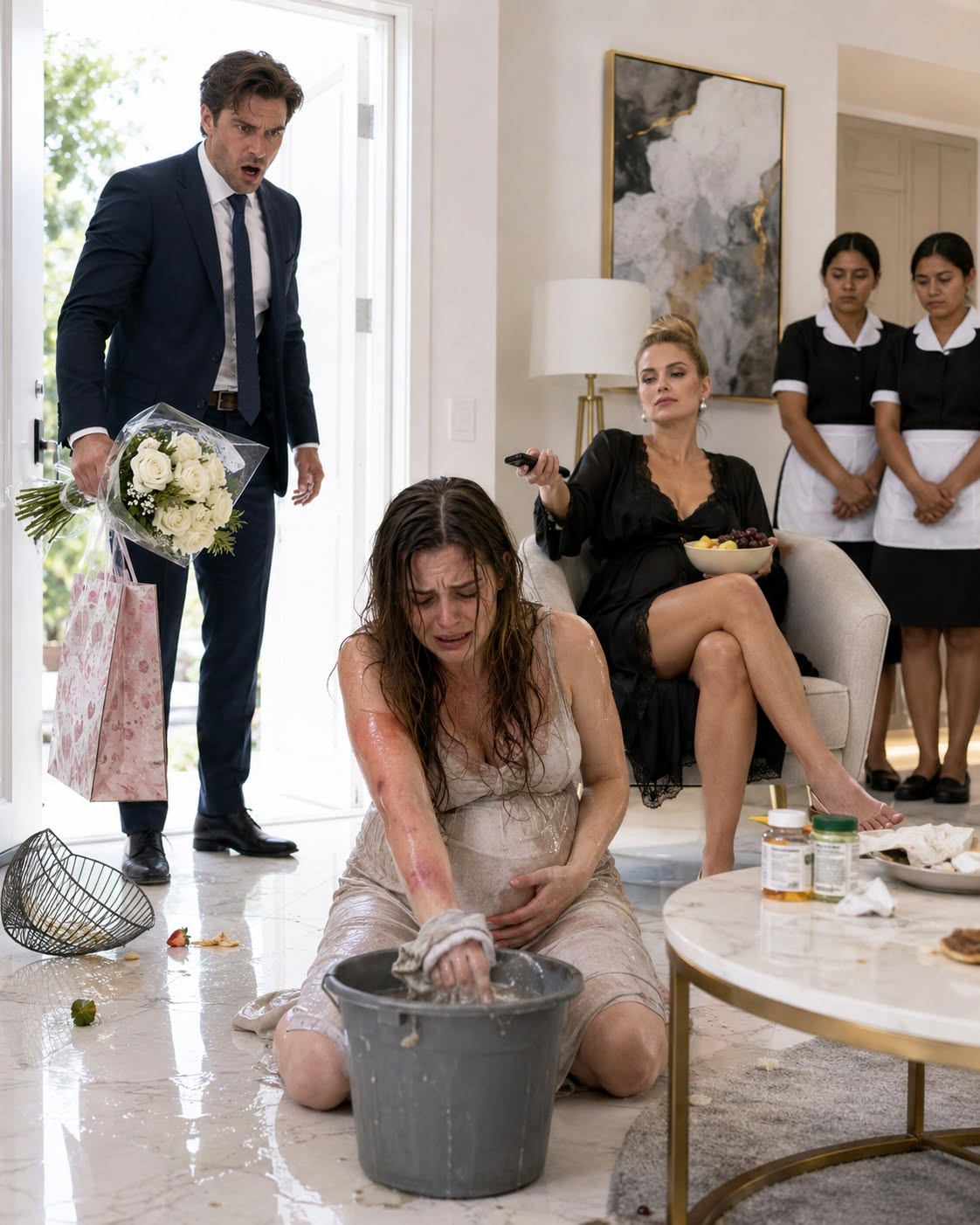
The house felt frozen around us—the staff by the doorway, Ashley standing pale and breathless, Lily wrapped in my coat on the floor, one hand protectively curved around her belly.
I read the message again, slower this time, hoping somehow I had misunderstood it.
But there it was.
The baby isn’t the only secret.
My blood turned cold.
Ashley tried to recover. “That’s not mine.”
“It came to your phone,” I said.
“I don’t know who sent it.”
“Then you won’t mind explaining it to the police.”
Her eyes flickered toward the back hallway.
That tiny glance told me everything.
I turned to the staff. “Lock every door. No one leaves.”
One of the younger maids began crying.
Another whispered, “Sir, we didn’t know it was that bad.”
I looked at her. “You watched my pregnant wife scrub herself raw while Ashley ate fruit in my chair.”
The maid dropped her gaze.
Lily clutched my sleeve tighter. “Daniel… please don’t shout.”
That stopped me more effectively than any warning could have.
My wife was not afraid of Ashley in that moment.
She was afraid of anger itself.
So I swallowed mine until it became something sharper and quieter.
“I’m not shouting,” I said softly. “I’m ending this.”
The police arrived first, followed minutes later by Dr. Rivera, Lily’s obstetrician, and then my lawyer, Martin Hale, who had handled every contract I had ever signed but had never once seen me without a tie.
He took one look at Lily and forgot to be formal.
“My God,” he whispered.
Dr. Rivera knelt beside Lily. “Lily, sweetheart, I’m going to check you and the baby. No one will touch you without permission.”
Lily nodded, tears sliding down silently.
Ashley stood near the fireplace, arms folded, trying to rebuild her composure.
“This is a misunderstanding,” she told the officers. “Mrs. Whitmore has severe anxiety. She imagines things. I’ve been documenting her behavior for months.”
“Documenting?” I asked.
Ashley’s mouth closed.
Martin stepped forward. “Where?”
No one answered.
Then a voice came from behind us.
“In the laundry room.”
We turned.
It was Rose, the oldest housekeeper, a woman in her sixties with trembling hands and eyes full of shame.
Ashley snapped, “Rose.”
Rose flinched, but this time she did not look down.
“There’s a cabinet behind the dryer,” she said. “Ashley kept files there. Videos too.”
Ashley lunged toward her.
An officer caught her arm before she could take two steps.
The sound that escaped Lily was small and broken.
I went still.
“Videos?” I repeated.
Rose began to cry. “She recorded Mrs. Whitmore crying. Begging. Cleaning. She said she needed proof in case you came home and asked questions. But that wasn’t all.”
My lawyer’s face hardened. “What else?”
Rose looked at Lily, then at me.
“She made Mrs. Whitmore record messages to you.”
My stomach sank.
“What messages?”
Rose wiped her cheeks with the back of her hand. “Saying she didn’t want the baby. Saying she hated the marriage. Saying she wanted to leave.”
Lily shook her head violently. “No. No, Daniel, I didn’t mean it. She told me if I didn’t say it, she’d call you and tell you I tried to hurt the baby.”
I dropped beside her. “I believe you.”
She stared at me, stunned by those three words.
“I believe you,” I repeated, because I should have said them months ago, years ago, every time her voice sounded small on the phone and I told myself she was just tired.
The officers searched the laundry room.
They came back carrying a black folder, several flash drives, a stack of printed emails, and a cheap hidden camera still blinking with a red light.
Then Dr. Rivera called my name.
Her face was calm, but her eyes were not.
“Daniel,” she said, “Lily needs to go to the hospital. Now.”
My heart stopped.
“The baby?”
“Heartbeat is present,” she said carefully. “But Lily is dehydrated, stressed, and showing signs of contractions too early.”
Lily began sobbing. “I’m sorry. I’m sorry.”
I held her face gently. “You have nothing to be sorry for.”
As the paramedics arrived and lifted her onto the stretcher, Ashley suddenly laughed.
It was a strange, cracked sound.
“You still don’t understand,” she said.
I turned.
Her eyes were wet, but not with fear anymore.
With hatred.
“You think this was about money? About some maid wanting power?” She shook her head. “Ask your mother why she hired me.”
The room tilted.
“My mother is dead,” I said.
Ashley smiled.
“No, Daniel. She isn’t.”
PART 4 — THE WOMAN WHO WAS SUPPOSED TO BE DEAD
The ambulance doors slammed shut with Lily inside, and for the first time in my life, I did not know which disaster to chase.
My wife and unborn child were being rushed to the hospital.
Ashley had just claimed my dead mother was alive.
And somewhere inside my own house, hidden cameras had watched my wife suffer while I believed I was building a future for her.
Martin gripped my shoulder. “Go with Lily. I’ll handle the house.”
“No,” I said, staring at Ashley. “She’s coming too.”
The police placed Ashley in a separate vehicle, but as they led her out, she looked back and smiled as if she had saved her best cruelty for last.
At the hospital, Lily was moved into a private room.
Monitors beeped softly beside her.
Her face looked too pale against the white pillow, her lips cracked, her fingers curled around mine like she feared someone might pull her away.
Dr. Rivera told me the contractions had slowed.
The baby was stable for now.
For now.
Those two words became a knife I could not remove.
When Lily finally fell asleep, Martin entered with a laptop and a face like stone.
“We found the recordings,” he said.
I stood. “Show me.”
He hesitated. “Daniel—”
“Show me.”
He opened the first video.
There was Lily at the kitchen table, alone, staring at a plate with only two crackers on it.
Ashley’s voice came from off-screen.
“Say it.”
Lily whispered, “I don’t want to.”
“Say it, or Daniel gets the file.”
Lily’s voice broke. “I’m unstable. I don’t deserve to be a mother.”
The video ended.
I couldn’t breathe.
Martin played another.
Lily standing barefoot in the laundry room.
Another of her crying in the nursery while Ashley told her Daniel only came home late because he was disgusted by her pregnancy.
Another where Ashley read messages from a phone and pretended they were from me.
My hands shook. “Those weren’t mine.”
“I know,” Martin said. “Different number. Spoofed contact name.”
Then he opened the emails.
Payments.
Instructions.
Reports sent weekly.
The recipient’s name made my vision blur.
Evelyn Hart.
My mother’s maiden name.
My mother, who had supposedly died when I was nine.
My mother, whose funeral I barely remembered except for the rain, my father’s silence, and a closed casket no one let me approach.
Martin’s voice was low. “I ran a preliminary search. Evelyn Hart has been living under several identities for years. The latest is Evelyn Crane. She owns a private care foundation in Boston.”
“Why would my mother do this?”
Martin’s jaw tightened. “Because of the trust.”
“What trust?”
He turned the laptop toward me.
A scanned legal document appeared on the screen.
My grandfather’s estate.
I recognized the name, but not the clause highlighted in yellow.
If Daniel Whitmore produces a legitimate heir within the marriage, controlling interest in the Whitmore Family Trust transfers fully to Daniel and his child. If no heir is born, residual control remains with Evelyn Hart Whitmore or her lawful assigns.
I read it once.
Then again.
“My father never told me this.”
“Your father died before the transfer date,” Martin said.
I thought of Lily, starving in our own home while my money bought fruit for the woman tormenting her.
My wife had not been abused because she was weak.
She had been targeted because our child was powerful before even being born.
A sound came from the bed.
Lily was awake.
Her eyes glistened. “Daniel?”
I rushed to her side. “I’m here.”
She swallowed. “Is your mother really alive?”
“I don’t know yet.”
She looked down at her stomach. “Ashley said someone wanted my baby gone.”
My chest tightened. “What?”
Tears spilled into her hair. “She said it once when she thought I was asleep. She said if fear didn’t work, the vitamins would.”
Martin froze.
I slowly turned toward him.
“The vitamins,” I whispered.
At that exact moment, Dr. Rivera entered with a lab report in her hand.
Her face had gone white.
“Daniel,” she said, “we tested Lily’s prenatal supplements.”
I already knew before she said it.
“They weren’t vitamins.”
PART 5 — THE POISON IN THE PRENATAL BOTTLE
Dr. Rivera did not say the word poison at first.
Doctors are careful people.
They use words like contamination, toxic levels, contraindicated compounds.
But I heard the truth beneath every clinical phrase.
Someone had been slowly hurting my wife.
Not only with fear.
Not only with hunger.
With a bottle labeled prenatal vitamins, placed on a shelf just high enough that Lily could reach it only when Ashley allowed her to.
I gripped the edge of the hospital table until my fingers ached.
“Will the baby be all right?” I asked.
Dr. Rivera looked at Lily before answering. “We caught it now. That matters. But we need continuous monitoring.”
Lily covered her mouth, trying not to sob.
I bent beside her. “Look at me.”
She shook her head. “I took them every day. I thought I was helping.”
“You were trying to protect our child.”
“I should have known.”
“No,” I said, firmer than before. “I should have been home.”
That truth lay between us, raw and undeniable.
Lily closed her eyes. “You always said you were doing it for us.”
“I was,” I whispered. “But I forgot that love cannot be wired from an office.”
Her fingers found mine.
That small touch almost broke me.
By dawn, the police had arrested Ashley for abuse, unlawful surveillance, coercion, and attempted poisoning pending further investigation.
But Ashley refused to speak—until Martin walked into the interrogation room and placed one photograph on the table.
Evelyn Crane.
My mother.
According to the detective, Ashley stared at the picture for nearly a full minute before saying, “She promised no one would get hurt.”
People who help monsters always say that after someone bleeds.
By noon, Evelyn Crane’s foundation office in Boston was empty.
Her apartment had been cleared.
Her bank accounts had begun moving money through shell companies before sunrise.
She had vanished.
But she left one mistake.
She called me.
The hospital room was quiet when my phone rang from an unknown number.
I answered without speaking.
For a moment, there was only breath.
Then a woman’s voice said, “You sound like your father when you’re angry.”
I stepped away from Lily’s bed, but Lily caught my wrist.
“No,” she whispered. “Stay.”
So I put the phone on speaker.
“Who are you?” I asked.
A soft laugh. “Don’t insult us both, Daniel.”
My throat tightened. “My mother is dead.”
“Your father told you that because he was a coward.”
“My father raised me.”
“Your father stole you from me.”
I looked at Lily.
Her eyes were wide.
Evelyn continued, her voice smooth as silk over glass. “I did what I had to do. That girl was never meant to carry Whitmore blood. She was nobody. No family. No protection. I assumed she would break quickly.”
My vision darkened.
Lily’s hand trembled inside mine.
I said, “You tried to kill my child.”
“No,” Evelyn said sharply.
For the first time, emotion cracked her voice.
“I tried to stop a transfer that would destroy everything your grandfather built. You don’t understand the people circling that money.”
“You mean you.”
Silence.
Then she said, “You always were clever.”
The police technician recording the call gave me a nod to keep her talking.
“Why fake your death?” I asked.
“Because your father was going to expose me. He found out I had moved family assets. He threatened divorce, custody, prison.” She sighed. “So I disappeared before he could ruin us.”
“Us?” I repeated. “You abandoned your son.”
“I preserved your future.”
I looked at Lily—my wife, bruised by loneliness, poisoned by greed, still holding my hand as though I deserved that mercy.
“No,” I said. “You preserved yourself.”
Evelyn’s voice softened. “Come to Boston alone. I’ll explain everything. Bring no police, no lawyer. If you don’t, the next file goes public.”
“What file?”
A pause.
Then she said the sentence that made Lily stop breathing.
“The file proving Lily was already pregnant before she married you.”
PART 6 — LILY’S CONFESSION
The hospital room changed after Evelyn’s call.
Not because I believed her.
Because Lily did.
Her hand slipped from mine as if the words had cut a cord between us.
“Daniel,” she whispered, “I need to tell you something.”
I turned to her, terrified not of betrayal, but of the look on her face.
It was not guilt.
It was old grief.
“Lily,” I said, “whatever it is—”
“No. Please. Let me say it before someone else twists it.”
She sat up slowly, wincing, one hand over her belly.
“When I met you, I had just left a shelter.”
I froze.
“You told me you had moved from another city for work.”
“I did,” she said. “But before that… I was engaged.”
The word struck me, but I stayed silent.
“His name was Caleb. He wasn’t cruel at first. They never are. He was charming, generous, protective. Then protective became controlling. Then controlling became frightening.”
Her voice thinned.
“I left him when I found out I was pregnant.”
The monitors beeped steadily, as if the room itself was holding its breath.
“You were pregnant before me,” I said carefully.
“I thought I was,” she whispered. “The shelter clinic did a quick test. Positive. I panicked. Caleb was dangerous, and I had no one. A week later, I miscarried.”
Tears rolled down her cheeks.
I closed my eyes.
Not because I was angry.
Because I suddenly understood the private sadness she carried whenever we passed a children’s store, the way she cried the first time she heard our baby’s heartbeat, the way fear lived under her joy.
She continued, “When I met you months later, I didn’t tell you because I was ashamed. Then when I got pregnant after our wedding, I was so happy and so terrified. Ashley found an old shelter document in my things. She used it against me. She said you’d think I trapped you. She said you’d demand a paternity test and take the baby away.”
I stood there, hearing every missed chance.
Every night I had answered her trembling voice with, “I’m in a meeting.”
Every time love had called softly and I had sent it to voicemail.
Lily looked down. “I should have told you.”
I sat beside her and took her face in my hands.
“No. You should have been safe enough to tell me.”
She broke then, not loudly, but completely.
Her forehead fell against my chest, and I held her as if my arms could undo every hour I had abandoned her to that house.
“I’m sorry,” she whispered.
“So am I.”
When Martin returned, I told him about Boston.
“You’re not going,” he said immediately.
“I am.”
“Daniel—”
“But not alone.”
By evening, the police had traced Evelyn’s call to a private medical facility outside Boston.
It had once belonged to her foundation.
Now it was closed, except for one active wing.
“That’s where she wants you,” Martin said.
“Then that’s where we’ll end it.”
Lily gripped my hand. “I’m coming.”
“No.”
Her eyes flashed with the first true strength I had seen in days. “This is about me too. About our baby.”
“You’re in the hospital.”
“And I’m done letting people discuss my life in rooms where I’m not present.”
Dr. Rivera forbade travel.
Lily obeyed for exactly three hours.
At midnight, Rose arrived at the hospital with a small duffel bag and tears in her eyes.
“I know where Evelyn keeps the originals,” she said.
We stared at her.
Rose reached into her coat and pulled out an old silver key.
“I worked for your mother before I worked for you, Daniel.”
The room went silent.
Rose looked at Lily.
“And I have been waiting twenty-three years to make one thing right.”
PART 7 — THE KEY TO THE DEAD WOMAN’S ROOM
Rose’s confession came in fragments, like glass being swept carefully from a floor.
She had been young when she worked for Evelyn.
A single mother then, desperate for money, terrified of losing her job.
Evelyn was elegant, brilliant, and cruel in the effortless way of people who had never been denied anything.
“She didn’t fake her death alone,” Rose said. “I helped her pack.”
I stared at her. “You let me think my mother was dead.”
Rose covered her mouth. “I was told you’d be safer. Your father said Evelyn was dangerous, but Evelyn said he was unstable. I didn’t know who to believe until years later.”
“Why come back into my house?”
“To watch over you,” she whispered. “And then Lily. But Ashley threatened my grandson. She had documents, debts, things she could ruin him with. I was a coward.”
Lily reached for Rose’s hand.
I almost told her not to.
But Lily, who had been hurt by everyone’s silence, still had compassion enough to offer it.
That humbled me more than anything.
Rose’s key opened a storage room in the basement of the closed Boston facility.
Martin arranged protection, the police coordinated with local authorities, and I made the hardest decision of my life.
Lily stayed behind.
Not because I ordered her to.
Because I asked her.
“Let me protect you this time,” I said.
She studied me for a long moment, then nodded. “Come back as my husband, Daniel. Not as a man trying to punish himself.”
I kissed her forehead. “I promise.”
Boston was gray when we arrived.
The old facility stood behind iron gates, its windows dark except for one wing glowing faintly in the rain.
Inside, the halls smelled of antiseptic and dust.
Rose led us downstairs to a steel door half-hidden behind shelves of archived medical records.
Her silver key turned with a tired click.
The room beyond was not a storage closet.
It was a life.
Photographs lined one wall.
Me at ten, leaving school.
Me at seventeen, receiving an award.
Me at twenty-six, shaking hands at my first major banking conference.
Me and Lily on our wedding day.
Lily alone in the garden.
Lily entering the obstetric clinic.
My skin crawled.
“She watched everything,” Martin whispered.
On the desk sat labeled files.
DANIEL.
LILY.
TRUST TRANSFER.
PATERNITY STRATEGY.
I opened the Lily file first.
Inside were shelter records, stolen medical notes, forged psychiatric evaluations, and a typed plan titled Emotional Destabilization Protocol.
I could not speak.
Martin photographed everything.
Then Rose made a strange sound.
She stood before a locked cabinet, staring as if at a ghost.
“What is it?” I asked.
“This cabinet belonged to your father.”
She opened it with a second key hidden beneath the desk drawer.
Inside was a sealed envelope, yellowed with age.
On it, in my father’s handwriting:
For Daniel, when the truth becomes dangerous.
My hands shook as I opened it.
There was a letter.
Danny,
If you are reading this, then your mother has found a way back into your life. I am sorry. I tried to protect you with silence, but silence is a poor shield against people like Evelyn.
She did not leave because I stole you.
She left because I discovered what she did to your newborn sister.
I stopped breathing.
Sister.
The letter blurred.
You were not an only child.
Her name was Grace.
She lived for eleven days.
Evelyn considered her weak, sickly, an embarrassment.
I could never prove what happened, but I knew.
When I threatened to expose her financial crimes and reopen Grace’s medical investigation, she vanished.
I told you she died because I was afraid she would come back for you.
Forgive me.
My knees nearly gave way.
A sound came from the doorway.
Slow clapping.
Evelyn stood there in a cream coat, older than the photographs, still beautiful in a cold, preserved way.
“My sentimental husband,” she said. “Always so dramatic.”
Behind her stood two private guards.
And in her hand was a phone displaying a live video feed.
Lily’s hospital room.
My wife asleep.
A nurse entering quietly with a syringe.
Evelyn smiled.
“Now, Daniel,” she said, “let’s discuss the trust.”
PART 8 — THE CHILD WHO INHERITED MORE THAN MONEY
There are moments in life when rage becomes useless.
It burns too hot, too fast, and leaves no room for strategy.
So I did not shout.
I did not threaten.
I looked at the live feed of Lily’s hospital room, at the nurse moving toward my sleeping wife, and I became perfectly still.
“What do you want?” I asked.
Evelyn smiled as if I had finally become reasonable.
“You will sign an emergency transfer of voting control back to me. You will state that Lily is mentally unwell, that the child’s paternity is uncertain, and that for the good of the family, I am the only suitable trustee.”
Martin’s voice was tight. “That document would never hold.”
“It only needs to hold long enough,” Evelyn said. “Markets move quickly. Assets disappear even faster.”
The nurse on the screen uncapped the syringe.
My heart pounded once.
Twice.
Then Lily’s eyes opened.
She grabbed the nurse’s wrist.
The room exploded into motion.
Two police officers burst from behind the curtain.
Dr. Rivera followed, face blazing with fury.
The nurse dropped the syringe and screamed.
Evelyn’s smile vanished.
I looked at her. “You really thought we left Lily unprotected?”
Her guards shifted, but the hallway behind them filled with officers.
Martin lifted his phone. “Everything you said was recorded.”
Rose stepped forward, tears running down her face. “So was everything in this room.”
Evelyn turned on her slowly. “You pathetic little servant.”
Rose did not flinch this time.
“No,” she said. “I was. Not anymore.”
For the first time, my mother looked afraid.
Not panicked.
Not defeated.
Afraid.
The officers moved in.
Evelyn raised her chin, clinging to dignity like a crown.
“You think this ends with me in handcuffs?” she said to me. “You have no idea how many people needed that trust controlled. Judges. Bankers. Doctors. Your precious world is dirtier than you know.”
“Then we’ll clean it,” I said.
She laughed. “With what? Love?”
I thought of Lily on her knees, whispering that she could be better.
I thought of my unborn child surviving poison, fear, and greed before ever taking a breath.
I thought of my father carrying the truth alone because he believed silence was protection.
“No,” I said. “With truth.”
Evelyn was arrested in that basement beneath the dead facility, surrounded by the evidence she had hidden for decades.
But the ending did not come quickly.
Monsters with money do not fall like stones.
They fall like buildings—floor by floor, with dust choking everyone nearby.
The investigation widened.
Ashley confessed in exchange for protection, naming doctors, lawyers, and financial advisers who had helped Evelyn forge reports and move assets.
The nurse admitted she had been paid to administer a drug that would have triggered premature labor and made it look like a medical emergency.
Several members of my own firm were suspended.
Two were arrested.
Martin worked like a man possessed.
Rose testified publicly, her voice shaking but clear.
And Lily…
Lily survived.
For three weeks, she stayed in the hospital.
I slept in a chair beside her bed every night, waking at every shift in her breathing, every beep from the monitors.
Sometimes she cried in her sleep.
Sometimes she woke and asked if the doors were locked.
They always were.
But healing is not a door that shuts once and stays shut.
It is a window opened carefully each morning.
One afternoon, she looked at me and said, “I don’t want to go back to that house.”
“Then we won’t.”
Her eyes filled. “But it was your home.”
“No,” I said. “It was a building where I failed to notice you disappearing.”
She turned her face away, but not before I saw her tears.
I sold the house without stepping inside again.
The furniture went to auction.
The money went into a foundation Lily named Grace House, after the sister I never knew.
It helped pregnant women escaping abuse, women with no family, women who had been told they were unstable when they were only terrified.
Lily chose the name herself.
“Your sister should have had someone protecting her,” she said softly. “Now others will.”
Two months before her due date, we moved into a smaller home near the sea.
No staff.
No marble halls.
No locked wings.
Just sunlight, open windows, and a nursery painted pale blue by my own hands while Lily sat nearby, laughing whenever I got paint in my hair.
Some nights were still difficult.
I learned that apology was not one grand speech.
It was showing up.
It was canceling meetings.
It was learning the names of her fears and not becoming impatient when they returned.
One night, Lily stood at the kitchen sink, staring at her reflection in the dark window.
I came up behind her slowly, making sure she saw me first.
“Bad memory?” I asked.
She nodded.
“Ashley used to make me stand in front of mirrors,” she whispered. “She’d tell me to repeat what was wrong with me.”
I felt the old rage stir, but I did not let it lead.
Instead, I took a dry-erase marker from the drawer and wrote on the window above her reflection:
You are safe.
Lily stared at the words.
Then she took the marker from my hand and added:
We survived.
A month later, during a stormy dawn, our daughter was born.
She came into the world angry, loud, and fiercely alive.
The moment I heard her cry, I broke down harder than I had ever broken before.
Lily held her against her chest, exhausted and glowing, tears shining at her temples.
“What should we call her?” I whispered.
Lily looked at me for a long time.
Then she smiled.
“Grace.”
I could not speak.
Our daughter opened her tiny hand against Lily’s skin, as if claiming the world that had tried so hard to deny her.
The trial began the following year.
Evelyn entered the courtroom in pearls.
Lily entered holding my hand.
Ashley testified first.
Then Rose.
Then the doctors.
Then the financial investigators.
But the moment that changed everything came from an old recording found in my father’s cabinet.
His voice, younger and broken, speaking to a private investigator after baby Grace’s death.
“If anything happens to me,” he said, “protect Daniel. And if he ever has a child, protect that child from her.”
The courtroom went silent.
Evelyn’s face finally cracked.
Not because she felt remorse.
Because she had lost control of the story.
She was convicted on multiple charges and sentenced to spend the rest of her life behind walls she could not buy her way through.
When the verdict was read, Lily squeezed my hand.
I expected relief.
Instead, I felt grief.
For my father.
For my sister.
For the boy who had mourned a mother who was never dead, only hollow.
Outside the courthouse, cameras flashed.
Reporters shouted questions.
Lily ignored them all and bent over Grace’s stroller.
Our daughter slept peacefully beneath a white blanket, one tiny fist curled beside her cheek.
“She has your stubborn chin,” Lily said.
“She has your courage.”
Lily looked at me. “I wasn’t courageous.”
“Yes,” I said. “You were. You kept loving a child they tried to turn into a weapon. You kept breathing when they wanted you broken. That is courage.”
She looked away, smiling through tears.
Years later, people would call the case shocking.
They would write articles about the Whitmore Trust, Evelyn Crane’s secret life, the hidden cameras, the poisoned vitamins, the forged files.
But they never understood the true miracle.
The miracle was not that Evelyn was caught.
The miracle was not that I inherited the trust.
The miracle was not even that our daughter survived.
The miracle was that Lily learned to laugh loudly again.
That she danced barefoot in the kitchen with Grace on her hip.
That she planted white roses in the garden, not because they reminded her of the day I came home too late, but because she wanted to make ugly memories grow into something softer.
And every year, on Grace’s birthday, we visited a small stone beneath an old oak tree.
Grace Evelyn Whitmore.
Eleven days old.
Beloved.
My sister finally had flowers.
My daughter placed them there with solemn little hands.
One afternoon, when Grace was five, she looked up at Lily and asked, “Mommy, why do we bring roses here?”
Lily knelt beside her.
“Because some people leave the world before they get enough love,” she said. “So we bring them some of ours.”
Grace considered this, then placed her favorite ribbon beside the stone.
“For Aunt Grace,” she declared.
I turned away, pretending to study the trees.
Lily slipped her hand into mine.
“You came back,” she whispered.
I looked at her, confused. “From where?”
“From the man you thought you had to be.”
The wind moved softly through the roses.
Our daughter ran ahead, laughing in the sunlight, alive and free and impossible to silence.
And for the first time in many years, I understood what my father had tried and failed to give me.
Not money.
Not legacy.
Not a name carved into buildings.
A family safe enough to tell the truth.
That was the inheritance Evelyn could never steal.
That was the empire Lily and I built from the ruins.
And when Grace turned back to us, holding out both tiny hands, Lily and I walked toward her together.
THE END