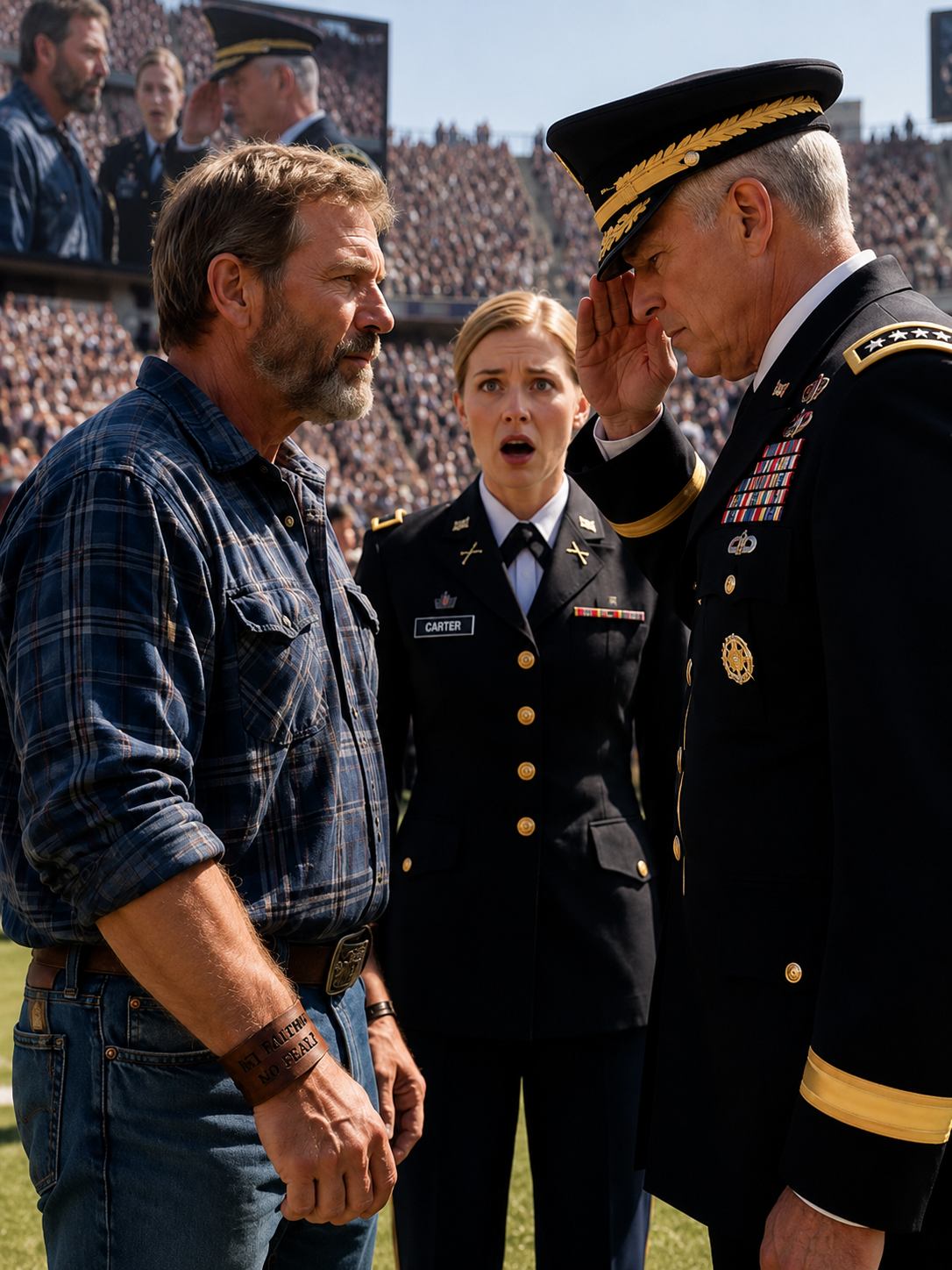
The gray-haired civilian walked across the turf like he had no fear of generals, cameras, or consequences.
He wasn’t in uniform, but every officer near him seemed to recognize the kind of power he carried. It was quieter than rank. Colder. The kind that lived in sealed folders and rooms without windows.
He stopped beside Lieutenant General Mercer and held the file against his chest.
For a moment, no one spoke.
The stadium, packed with thousands of parents, cadets, soldiers, and guests, had become so silent it felt abandoned.
My daughter’s hand found my arm.
“Dad,” Emma whispered, “what is happening?”
I wanted to answer her.
I wanted to tell her that everything was fine, that this was just some old misunderstanding finally crawling out of the dark.
But the truth was, I didn’t know what was happening.
Not anymore.
The gray-haired man looked at me carefully, his eyes sharp behind wire-framed glasses.
“Mr. Carter,” he said.
My stomach tightened.
I had not heard my full name spoken with that tone in years.
“Who are you?” I asked.
He did not answer right away. Instead, he looked at the wristband.
That old leather strip suddenly felt heavier than iron.
“My name is Arthur Voss,” he said. “Department of Defense Special Review Office.”
Mercer turned to him sharply. “Special Review?”
Voss ignored the question.
He opened the file, and I saw old photographs clipped inside. Grainy satellite images. Blacked-out mission reports. A list of names typed on yellowing paper.
My name was one of them.
Thomas Carter.
I had not seen it printed beside those other names in twenty-six years.
Emma saw it too.
Her fingers tightened around my sleeve.
“Dad,” she said, quieter now, “why is your name in that file?”
I stared at the paper and felt the years fall away.
The stadium disappeared.
The sunlight faded.
And suddenly I was back in rain, smoke, and jungle heat.
Twenty-six years earlier.
I had been younger then. Stronger. Stubborn enough to believe courage could keep a man alive.
There were seven of us on that mission. Officially, we were never there. Unofficially, we were sent to pull a captured intelligence officer out of a compound built into a mountain valley no map would admit existed.
Sergeant Michael Holloway was our point man.
He was the kind of soldier people followed before anyone told them to. Calm eyes. Quiet voice. Always checking his men before checking himself.
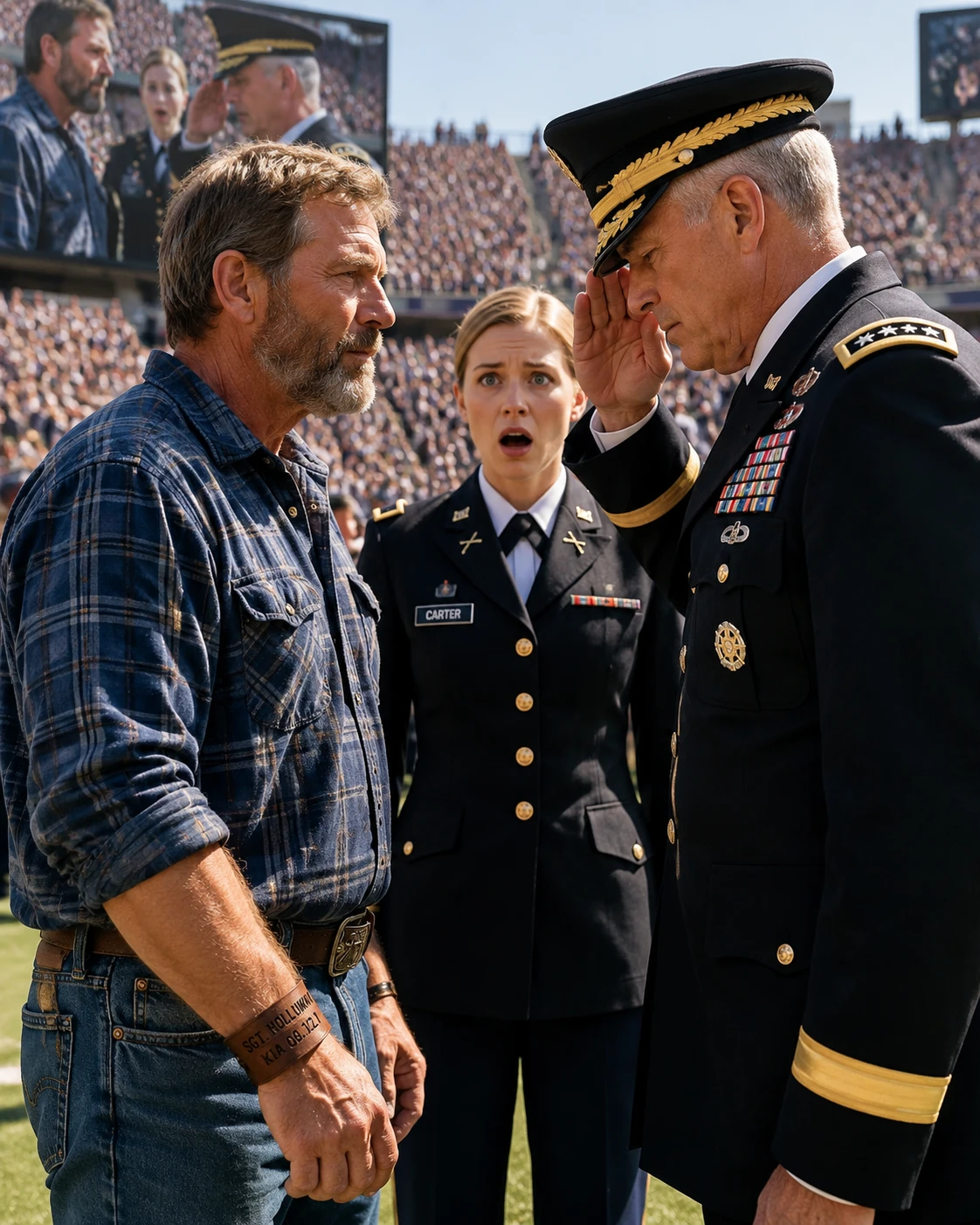
He wore that leather band on his right wrist.
Said his wife had made it for him before his first deployment.
“Luck is for gamblers,” he told me once. “This is a reminder. You make a promise, you come home carrying it.”
I used to laugh at that.
Until the night everything burned.
The operation went wrong before we even reached the extraction point. Someone had warned them. The compound was waiting for us. Floodlights snapped on. Machine fire tore through the trees. Our radios died one by one.
By dawn, only Holloway and I were still moving.
He had been hit twice.
I had shrapnel in my leg and blood in my eyes.
We dragged the intelligence officer three miles through mud and roots while flares burst overhead like angry stars.
When the helicopter finally found us, it could barely stay low because of the incoming fire.
Holloway shoved the rescued man in first.
Then me.
I reached back for him.
I can still feel his hand in mine.
Strong.
Slippery with blood.
He looked straight at me, and for the first time that night, I saw fear in his eyes.
Not fear for himself.
Fear that the truth would die with him.
He cut the band from his wrist with a field knife and shoved it into my palm.
“Find her,” he said.
I shook my head. “Get in!”
“Carter,” he said. “Promise me.”
The helicopter lurched.
Rounds sparked off the metal frame.
I kept pulling.
He smiled once, like he had already forgiven me for failing.
Then he slammed his hand against my chest and pushed me backward into the bird.
The last thing I saw was Michael Holloway standing in smoke as the valley swallowed him.
For twenty-six years, the world called him Missing in Action.
For twenty-six years, I carried his band.
And for twenty-six years, I failed to keep the promise.
Because when I came home, there was no wife to find.
No address.
No record that Sergeant Michael Holloway had ever been married.
It was as if someone had erased that part of him before erasing the mission itself.
I returned to civilian life with a damaged knee, a sealed discharge, and a warning from men I never saw twice.
Do not speak.
Do not ask.
Do not look.
So I drove trucks.
Raised my daughter.
Paid bills.
Kept moving.
But every night, somewhere between one empty highway and the next, I heard Holloway say the same words.
Find her.
Now Arthur Voss stood in front of me with a file bearing that dead man’s name, and the past had finally found me instead.
General Mercer lowered his salute slowly.
His voice was controlled, but I heard the anger underneath.
“Mr. Voss, explain why this is happening in the middle of a commissioning ceremony.”
Voss looked toward the stands. Cameras were lifted everywhere. Phones recording. Thousands witnessing something that was never meant to have witnesses.
“That,” Voss said, “is precisely why I had to come now.”
A murmur passed through the crowd.
Mercer stepped closer. “You had to interrupt a public military ceremony?”
“No,” Voss replied. “I had to stop the wrong person from taking an oath under a lie.”
Emma stiffened beside me.
My blood went cold.
“What did you just say?” I asked.
Voss finally looked at her.
“Cadet Emma Carter,” he said, “before you are commissioned into the United States Army, there is information you must know about your father, Sergeant Holloway, and the operation that connected them.”
Emma’s face went pale.
“My father?” she repeated.
The word sliced through me.
I stepped in front of her instinctively.
“You leave her out of this.”
Voss’s expression did not change.
“I’m afraid she has been part of this from the beginning.”
Mercer’s head snapped toward him. “Careful.”
Voss opened the file and removed a photograph.
He handed it to me.
My fingers hesitated before taking it.
The photograph was old and creased. In it stood Sergeant Michael Holloway, younger than I remembered him now, grinning in civilian clothes beside a woman with dark hair and tired, beautiful eyes.
She was holding a baby wrapped in a yellow blanket.
I stared at the image.
The stadium tilted beneath my boots.
The woman’s face was not familiar.
But the baby…
There are things a father recognizes even when reason tells him not to.
The shape of the mouth.
The tiny wrinkle between the brows.
The same expression Emma used to make when she was trying not to cry.
My hand began to tremble.
Emma leaned over and saw the photograph.
For a long second, she did not breathe.
“That baby,” she whispered.
I could not answer.
Voss did it for me.
“Was registered under a false civilian identity three weeks after Operation Black Lantern collapsed,” he said. “The mother disappeared shortly afterward. The child was placed through an emergency military protection channel.”
“No,” I said.
The word came out rough and broken.
Voss looked at me with something almost like pity.
“You were given guardianship papers eighteen months later.”
Emma stepped away from me.
Only one step.
But I felt it like the ground opening.
“No,” I said again, turning to her. “Emma, listen to me.”
Her eyes filled with tears, but her voice remained steady.
“Dad… am I adopted?”
The whole stadium seemed to hold its breath.
I remembered a hospital room in Kentucky. A social worker with kind eyes. A baby girl asleep in my arms. Papers I signed because her mother was gone, because no family could be found, because I had already lost everyone else from that mission and could not stand the thought of losing one more thing connected to it.
“Yes,” I said softly.
Emma flinched.
“But I swear to you, I didn’t know this. I didn’t know you were Holloway’s child.”
Her lips parted, but no sound came out.
I reached for her, then stopped myself.
The proud young woman in uniform standing before me was my daughter.
But in that moment, I knew she was also a child seeing the shape of her life change without permission.
Voss turned the page.
“Sergeant Holloway’s daughter was hidden because certain individuals believed she might become a target if the truth came out.”
Mercer’s face hardened. “What truth?”
Voss looked at the general.
“That Sergeant Holloway did not go missing during enemy action.”
The senior officers behind Mercer shifted uneasily.
Voss held up another document.
“He was recovered alive six days after extraction.”
A sound moved through the crowd like wind through dry leaves.
Alive.
The word hit me so hard I nearly stumbled.
I saw Holloway again, pushing me into the helicopter, blood on his teeth, smoke curling behind him.
“You’re lying,” I said.
“I wish I were.”
Mercer’s voice dropped. “Where is he?”
Voss closed the file.
“That depends on who you ask.”
I stepped toward him. “Don’t talk in riddles.”
For the first time, the man looked uncomfortable.
“Officially, Sergeant Holloway died in custody in 2003.”
“Custody?” Mercer demanded. “Whose custody?”
“Ours.”
The word landed like a grenade.
Even the band stopped shifting in their seats.
Emma stared at Voss as if he had become something monstrous.
“You kept him prisoner?” she asked.
“No,” Voss said. “Not legally. Not officially.”
“That does not make it better,” Mercer said.
Voss nodded once. “No, General. It does not.”
My mouth had gone dry.
I could feel my heartbeat in my damaged knee, in the old scar along my ribs, in the leather band wrapped around my wrist.
“Why?” I asked.
Voss looked at me.
“Because Holloway brought something back from that valley.”
I laughed once, but there was no humor in it.
“He brought back bullet holes.”
“He brought back names,” Voss said.
The stadium lights hummed overhead.
“He discovered the ambush was not arranged by the enemy. It was arranged by someone inside our own command structure. Black Lantern was not compromised by accident. It was sacrificed.”
Mercer went still.
Voss continued, each word measured.
“Seven men were sent into a trap because the intelligence officer they rescued had proof of illegal weapons transfers involving high-level personnel. Holloway survived long enough to identify one of the officers involved.”
My eyes moved to Mercer.
But he was staring at the file as if it had turned poisonous.
“Who?” Mercer asked.
Voss hesitated.
Then he said a name.
“Major General Richard Vale.”
The reaction among the older officers was immediate.
Some gasped.
Some lowered their eyes.
Some looked toward the VIP section, where rows of distinguished guests sat frozen in place.
I followed their gaze.
An elderly man in a dark suit sat near the front.
Silver hair. Straight posture. A polished smile that had vanished completely.
I knew him.
Not personally.
But I knew his face.
Everyone in the Army did.
Retired General Richard Vale.
Former adviser. National security figure. Public hero.
A man whose speeches were quoted in leadership manuals.
A man who had been invited to pin bars on one of the top cadets that morning.
A man who was now slowly standing.
General Mercer turned toward the VIP section.
“Secure him,” he ordered.
Two military police officers moved immediately.
But Vale did not run.
He simply buttoned his suit jacket and walked down the steps with the calm confidence of a man who had spent his life watching others obey.
When he reached the field, he looked not at Mercer, not at Voss, not at the officers closing in around him.
He looked at me.
“Well,” Vale said, his voice carrying easily in the silence, “Thomas Carter. I wondered if grief would keep you quiet forever.”
Something inside me went cold and clear.
“You knew me?”
Vale smiled faintly.
“I signed your silence order.”
Emma’s face twisted with shock.
“You did this?”
Vale’s eyes moved to her.
For half a second, something strange crossed his face.
Not guilt.
Recognition.
“So that is Holloway’s girl,” he said.
I stepped toward him so fast Mercer put a hand out, not to stop me entirely, but to remind me where we were.
Vale looked amused.
“You have his eyes,” he told Emma. “Unfortunate. He had a habit of looking at powerful men as though they were ordinary.”
Emma lifted her chin.
“And were they?”
The faint smile vanished from Vale’s face.
Mercer turned to the military police.
“Take him into custody.”
But Vale raised one hand.
“General Mercer,” he said, “you may want to check who else is standing on this field before you perform theater for civilians.”
No one moved.
Voss’s eyes narrowed.
Vale looked toward the officers’ section.
“Colonel Briggs,” he said calmly.
A tall colonel near the stage went rigid.
Then another officer.
Then another.
One by one, faces changed.
Not many.
But enough.
Enough to make Mercer understand that the past had not come alone.
It had roots.
It had branches.
It had worn uniforms, earned promotions, shaken hands, given speeches, and pinned medals on men who never knew what those hands had done.
Mercer’s voice became quiet.
“All officers named or implicated will stand down immediately.”
No one obeyed.
The stadium shifted into frightened confusion.
Parents began pulling children closer. Cadets looked from commander to commander, unsure whose order mattered.
Then Vale laughed softly.
“You still think rank controls history.”
His eyes returned to my wrist.
“That band caused a great deal of trouble.”
I looked down at it.
For twenty-six years, I thought it was only a memory.
Now I understood it had been evidence.
Holloway had not given it to me just to remember him.
He had given it to me because something was hidden inside.
My thumb pressed against the worn metal imprint.
For years, I had touched it without thinking.
A small oval plate, scratched nearly smooth.
But now, under the hard stadium light, I noticed something I had never noticed before.
The edge of the metal was not sealed.
It had a seam.
Voss saw my face change.
“So you never opened it,” he said.
Vale’s expression sharpened.
“Mr. Carter,” he warned.
I ignored him.
My hands shook as I worked my thumbnail under the edge of the metal plate.
Emma stepped closer.
“Dad?”
The plate resisted.
Then popped loose.
A tiny object fell into my palm.
At first, it looked like a sliver of dark glass.
Then Mercer leaned in.
“A microfilm chip,” he whispered.
Voss exhaled like a man seeing a ghost confirm its own haunting.
Vale’s calm finally cracked.
“Give that to me.”
No one moved.
His voice hardened.
“That material is classified.”
I closed my fist around it.
“No,” I said. “It’s buried.”
For the first time since he reached the field, Vale looked afraid.
Only for a second.
But I saw it.
So did Emma.
And somehow that fear did more for her than any explanation I could have given.
She stepped beside me, shoulder to shoulder.
Not behind me.
Beside me.
General Mercer turned toward his adjutant.
“Lock down the stadium. No one leaves the field command area. Contact Army CID, DOJ, and the Inspector General.”
Voss shook his head.
“It’s bigger than that.”
Mercer glared at him. “Then we start with what’s in front of us.”
Vale’s laugh returned, but it was thinner now.
“You have no idea what you are opening.”
I looked at him.
“No,” I said. “But Holloway did.”
Emma’s eyes were wet, but her voice was steady when she spoke.
“Is he really dead?”
Voss looked at her.
For the first time, he seemed unable to answer.
The hesitation said enough.
My chest tightened.
Mercer noticed it too.
“You told us officially he died in 2003,” he said. “What is the unofficial truth?”
Voss closed the file slowly.
Before he could speak, a sound broke through the stadium.
A phone ringing.
Not loud.
Not dramatic.
Just a simple ringtone coming from inside Voss’s coat.
He froze.
Everyone watched as he reached into his pocket and pulled out a secure black phone.
He looked at the screen.
The color drained from his face.
Mercer stepped closer.
“Who is it?”
Voss did not answer.
The phone kept ringing.
Finally, he pressed the button and lifted it to his ear.
He listened.
His eyes moved to me.
Then to Emma.
Then to the leather band.
He lowered the phone without ending the call.
“What?” I asked.
Voss swallowed.
His voice was barely audible.
“They found him.”
The words moved through me like lightning.
Emma grabbed my hand.
Mercer stepped forward. “Found who?”
Voss looked straight at my daughter.
“Sergeant Michael Holloway.”
For a moment, the entire world stopped.
Then Vale shouted, “That is impossible!”
His panic told me everything.
Voss listened again to the voice on the phone.
His hand began to tremble.
“No,” he said into the receiver. “Say that again.”
He went silent.
A military helicopter thundered somewhere beyond the stadium, low and fast.
People turned their faces skyward.
The wind began to rise.
Flags snapped hard against their poles.
Voss slowly lowered the phone.
His eyes found mine.
“He’s alive,” he said. “And he’s asking for the girl with his eyes.”
Emma’s knees nearly buckled.
I caught her before she fell.
Across the field, Richard Vale stopped struggling.
He stared at us with a face suddenly emptied of arrogance.
Then he smiled.
Not in victory.
In warning.
“You should have let him stay buried,” Vale said. “Because Holloway was never the most dangerous thing hidden in that file.”
The helicopter dropped lower over the stadium, its shadow sweeping across the field like a dark hand.
And from somewhere inside the black military SUV, the classified file marked HOLLOWAY began to beep.
Voss turned toward it.
Mercer drew his sidearm.
Emma whispered, “Dad…”
I pulled her behind me just as the file’s metal clasp snapped open by itself.
Inside, beneath twenty-six years of lies, a red light blinked over one final sealed photograph.
A photograph of me.
Not from the mission.
Not from the past.
From that morning.
Standing beside my truck in the parking lot.
And written across the bottom in fresh black ink were six words:
CARTER WAS NEVER SUPPOSED TO ARRIVE.
…If you want to know what happened next, please type “YES” and like for more.