PART 3: THE LETTER HE THREW AWAY
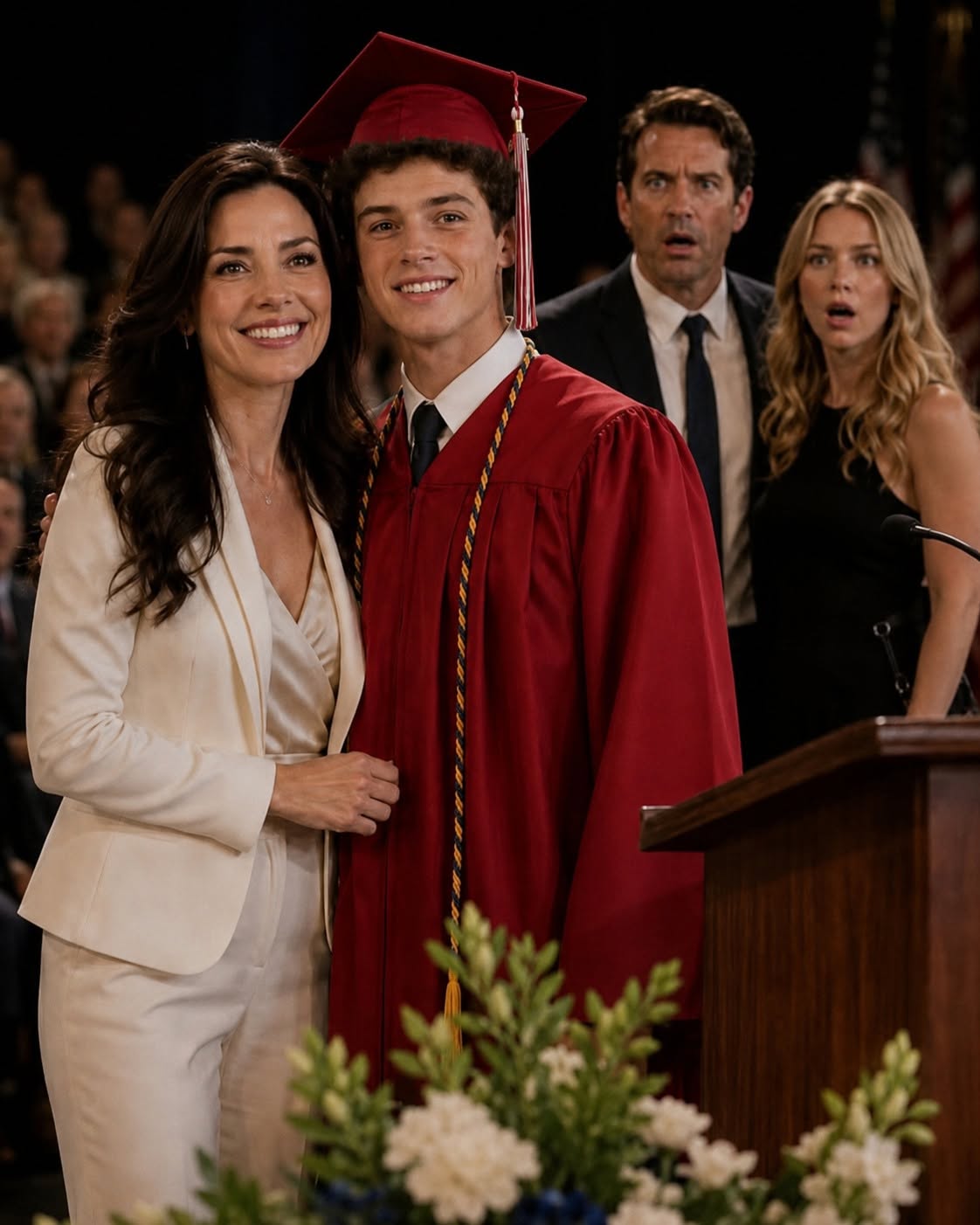
The auditorium froze so completely that even the applause seemed to die in midair.
Ethan stood beneath the white stage lights, holding the second paper in his hand, while Richard stood behind me with his face drained of color.
“Stop,” Richard said again, louder this time. “You don’t know what you’re talking about.”
But Ethan did not step back.
For fifteen years, my son had been quiet, patient, and careful. He had swallowed questions most children would have screamed. He had grown up with secondhand clothes, late bills, and a mother who smiled through exhaustion. But in that moment, he looked nothing like a boy.
He looked like the truth finally given a voice.
Ethan unfolded the letter slowly.
“I found this in a box of old court records,” he said. “It was never delivered to my mother. It was addressed to Claire Whitmore, dated three weeks after I was born.”
My heart began pounding.
I turned in my seat.
Richard’s eyes met mine, and for the first time in my life, I saw fear in them.
“Claire,” he said, his voice low. “This isn’t the place.”
I stood slowly.
“What letter?”
Ethan looked at me with tears shining in his eyes.
“Mom,” he said softly, “Grandma Evelyn wrote to you before she died.”
The name struck me like lightning.
Richard’s mother.
Evelyn Whitmore had been a cold, wealthy woman who never thought I was good enough for her son. When she died, Richard told me she had left everything to him. He said she had not mentioned me. He said she had never accepted Ethan.
I believed him.
Because back then, I was too weak, too abandoned, and too broken to question anything.
Ethan lifted the letter to the microphone.
“Dear Claire,” he read, “if this reaches you, then I hope you understand something my son may never have the courage to admit. You gave this family what it desperately needed—not status, not money, but love. I was wrong about you for many years.”
A murmur swept through the crowd.
Richard stepped into the aisle.
“Enough!”
But the security staff moved toward him before he could reach the stage.
Ethan continued, his voice trembling now.
“I have placed a trust in Ethan’s name and arranged a separate support account for you during his childhood. Richard is aware of this. He has been instructed to deliver the documents immediately after my passing.”
My legs weakened.
The room blurred.
A trust?
A support account?
For me?
For Ethan?
Ethan read the last line, and it shattered me.
“Tell my grandson that he was wanted. Tell him that his grandmother believed he would become extraordinary.”
I covered my mouth with both hands.
For fifteen years, I had thought we were alone.
For fifteen years, I had skipped meals, sold my wedding ring, worked until dawn, and prayed over unpaid bills while money meant for Ethan sat hidden somewhere because Richard had decided we did not deserve it.
Richard shouted, “That letter is fake!”
Ethan turned toward him.
“No, it isn’t,” he said. “I had it verified by the estate attorney.”
The entire auditorium gasped.
A man near the judges’ table stood.
Tall. Silver-haired. Serious.
“My name is Daniel Reeves,” he said. “I represented Evelyn Whitmore’s estate.”
Richard looked as if the floor had opened beneath him.
Daniel Reeves faced the audience. “The young man contacted me six months ago. I confirmed the authenticity of the letter and the trust documents. I also confirmed that Richard Whitmore signed acknowledgment of receipt and never delivered them.”
The silence that followed was brutal.
Richard’s wife took a step away from him.
His son Parker stared at him as if seeing a stranger.
And I stood there with my heart breaking all over again, not because of what Richard had taken from me, but because of what he had stolen from Ethan.
A grandmother’s love.
A chance at security.
A truth that could have softened years of loneliness.
Ethan lowered the letter.
“My mother told me some people leave,” he said, “but the ones who stay matter more. She stayed. She worked. She sacrificed everything. And today, I want everyone to know that whatever I become, it started with her.”
The auditorium erupted again, but I barely heard it.
I walked to the stage steps.
Ethan came down before I reached him.
Then my son, my miracle, my baby born into betrayal, wrapped his arms around me in front of hundreds of people.
“I’m sorry, Mom,” he whispered.
I held him so tightly I could feel his heartbeat.
“No,” I whispered back. “You have nothing to be sorry for.”
Across the room, Richard tried to leave.
But Daniel Reeves was already on the phone.
And for the first time in fifteen years, Richard Whitmore could not walk away from what he had done.
PART 4: THE FALL OF RICHARD WHITMORE
By the next morning, Richard’s name was everywhere.
Not because Ethan had wanted fame.
Not because I had wanted revenge.
But because someone in the auditorium had recorded everything.
The video spread fast.
The brilliant fifteen-year-old boy. The abandoned mother. The hidden letter. The father who stole a trust from his own son.
By noon, Richard’s company had released a statement.
By evening, his business partners were no longer answering his calls.
By the end of the week, he had been placed on “temporary leave pending investigation,” which everyone knew meant he was being pushed out before the scandal pulled the whole company down with him.
I watched it all from my kitchen table, the same old table where I had once counted pennies for formula.
Ethan sat across from me, pale and silent.
“You don’t look happy,” I said gently.
He looked up.
“I thought I would.”
I reached for his hand.
“Justice doesn’t always feel like joy at first.”
He swallowed.
“Did I do the wrong thing?”
“No,” I said immediately. “You told the truth.”
“But I hurt people who didn’t hurt us. Parker. Richard’s wife.”
I studied my son’s face and saw the part of him that made me proudest—not his intelligence, not his awards, not his impossible courage.
His compassion.
“You are not responsible for the pain caused by someone else’s lies,” I said. “You are responsible for how you carry the truth after it comes out.”
Two days later, Daniel Reeves came to our apartment.
He wore the same serious expression from the auditorium, but his eyes softened when he saw Ethan’s science trophies lined up on the bookshelf beside old paperbacks and a cracked lamp.
“This should have been handled fifteen years ago,” he said.
I sat stiffly on the sofa.
“How much was in the trust?”
Daniel opened his folder.
“The original trust for Ethan was four hundred thousand dollars.”
My breath caught.
Ethan stared at him.
Daniel continued. “The support account for you began at one hundred and twenty thousand. It was intended to cover medical care, housing assistance, and childcare during Ethan’s early years.”
I closed my eyes.
I thought of every night I had chosen between medicine and groceries.
Every overdue notice.
Every fever I had hidden because I could not afford to be sick.
My voice came out barely above a whisper.
“What happened to it?”
Daniel’s mouth tightened.
“That is what we are investigating.”
Ethan leaned forward.
“You mean he took it.”
Daniel looked at him carefully.
“I mean there is evidence that funds were redirected.”
The room went cold.
Richard had not simply abandoned us.
He had robbed us.
Daniel explained that legal action would begin immediately. There would be civil claims, possible criminal referrals, and a review of Richard’s handling of estate documents. He told us it would take time.
Time.
That word almost made me laugh.
I had given Richard fifteen years of time.
The following week, Richard called me for the first time in nearly a decade.
I stared at his name on my phone until it stopped ringing.
Then it rang again.
And again.
Finally, I answered.
“What?”
His voice came rough through the speaker.
“Claire, we need to talk.”
“No. You need to talk. I need to listen to my attorney.”
“Don’t do this.”
I looked across the room at Ethan, who was pretending not to hear.
“Do what, Richard? Tell the truth? Ask where my son’s money went? Ask why your mother’s letter never reached me?”
He breathed hard.
“You don’t understand. I was desperate.”
I almost laughed.
“You were at expensive restaurants with teenagers while I was recovering from surgery.”
“That’s not fair.”
“No,” I said quietly. “What you did was not fair.”
His voice cracked then, but I did not mistake it for remorse.
Remorse cares about the wound.
Richard only cared about the consequences.
“If this goes forward, I’ll lose everything,” he said.
I looked at Ethan’s baby photo on the wall, the one in the knitted blue blanket.
“No, Richard,” I said. “You already threw everything away.”
Then I hung up.
For the first time in fifteen years, my hands were not shaking.
PART 5: THE BOY WHO WOULD NOT HATE
The lawsuit began like a storm.
Reporters called. Strangers sent messages. Some were kind. Some were cruel. Some accused me of using my son for attention. Others called Ethan a hero.
Ethan hated all of it.
He withdrew into his room, not because he was ashamed, but because the world had suddenly become too loud.
One night, I found him sitting on the floor surrounded by old photographs.
There was one of me holding him as a baby.
One of him at five with spaghetti sauce on his chin.
One of him asleep at seven with a book open on his chest.
And one photo I had forgotten existed.
Richard holding Ethan in the courtroom hallway during that first forced visit.
Ethan stared at it.
“He held me once,” he said.
I sat beside him.
“Yes.”
“Did he look happy?”
I looked at the photograph.
Richard’s arms were stiff. His smile was shallow. His eyes were pointed toward the camera, not the baby.
“No,” I admitted. “But that says nothing about you.”
Ethan nodded.
“I know.”
But his voice told me knowing something and feeling it were two different things.
A week later, something unexpected happened.
Parker came to our apartment.
Richard’s other son stood in the hallway wearing a school blazer and a lost expression. He looked about fourteen, nervous and embarrassed, with Richard’s eyes but none of Richard’s cruelty.
“Is Ethan here?” he asked.
I hesitated.
Then Ethan appeared behind me.
“What do you want?” he asked.
Parker swallowed.
“I wanted to say I’m sorry.”
Ethan’s face hardened.
“You didn’t do it.”
“No,” Parker said. “But I benefited from it.”
That silenced us both.
Parker looked down. “My private school. My camps. My robotics equipment. My dad always said he worked hard for it. Now my mom is asking questions, and everything is falling apart.”
Ethan did not answer.
Parker’s voice broke. “I didn’t know about you.”
For a long moment, neither boy moved.
Then Ethan stepped aside.
“Come in.”
I watched them sit at the kitchen table, awkward and quiet at first. Then Parker noticed Ethan’s prototype parts. Ethan explained the system. Parker asked a question about the sensor board. Ethan corrected him. Parker laughed. Ethan almost smiled.
Something softened in the room.
Not forgiveness.
Not yet.
But possibility.
Over the next month, Parker visited twice more. He was lonely in a way that looked different from Ethan’s loneliness. Ethan had grown up without a father. Parker had grown up with a father who had built his life on lies.
One evening, Parker said something that stayed with me.
“I used to think Dad was strong because everyone listened to him,” he said. “Now I think people listened because they were afraid.”
Ethan looked up from his circuit board.
“My mom says fear is the cheapest kind of power.”
Parker glanced at me.
“She’s right.”
The boys became friends slowly, carefully, like two people crossing a frozen lake.
Richard hated it.
He called Parker’s mother and accused me of poisoning his family. He sent Ethan a message from an unknown number.
You think you won. You have no idea what you’ve started.
Ethan showed it to me.
I felt the old fear return.
But Ethan only looked tired.
“He still thinks this is about winning,” he said.
“What is it about?”
Ethan looked at the message.
“Ending it.”
The court case moved forward.
Daniel Reeves uncovered bank transfers, forged signatures, and estate distributions that had never been properly disclosed. The trust had not disappeared entirely, but much of it had been drained, redirected through accounts tied to Richard’s business and personal expenses.
Madison had been paid from it.
Trips had been paid from it.
Even Parker’s early private school tuition had unknowingly come from money meant for Ethan.
When Parker found that out, he cried.
Ethan did not comfort him with lies.
He simply sat beside him and said, “Then don’t become him.”
That was the moment I realized my son’s greatest victory would not be destroying Richard.
It would be refusing to become like him.
PART 6: THE TRIAL OF TRUTH
The courtroom was smaller than I expected.
After all the public noise, the legal drama, the headlines, and the whispers, I imagined something grander. But justice, I learned, often happens in plain rooms under fluorescent lights, with tired clerks, wooden benches, and people holding their breath.
Richard sat at the opposite table with his attorney.
He looked older.
Not humble.
Just worn down by exposure.
His wife was not there. She had filed for separation. Parker sat behind me beside Ethan, his shoulders tense, his face pale.
When Richard saw the two boys together, something bitter twisted in his expression.
Daniel Reeves testified first.
Then financial investigators.
Then handwriting experts.
Each one placed another stone on the mountain Richard had built with his own hands.
Forged acknowledgment.
Concealed documents.
Misused funds.
False statements.
By lunch, Richard’s attorney looked exhausted.
Then I was called.
Walking to the stand felt like walking back through fifteen years.
I swore to tell the truth.
Then I did.
I spoke about Ethan’s birth. The surgery. Richard’s cruelty. The divorce papers. The years of late payments. The support I never knew existed.
I did not scream.
I did not sob.
I simply told them what happened.
That was worse for Richard.
Because truth told calmly leaves no place for drama to hide.
His attorney tried to paint me as bitter.
“Mrs. Whitmore, isn’t it true you resented Mr. Whitmore for leaving you?”
“Yes,” I said.
The attorney paused, surprised.
“And isn’t it true you wanted him punished?”
I looked at Richard.
Then at Ethan.
“I wanted my son protected. If punishment comes from that, it is because Richard made choices that deserve consequences.”
The judge wrote something down.
Then Ethan was called.
My heart clenched.
He walked to the stand in a navy blazer, tall and composed, but I could still see the child who once asked if his father had liked him.
Richard leaned forward.
For the first time, he seemed to understand that Ethan was real.
Not an insult.
Not a burden.
Not a mistake.
A person.
His son.
Ethan testified about finding the documents, contacting Daniel, verifying the letter, and tracing the inconsistencies. He answered every question clearly.
Then Richard’s attorney made his mistake.
“Ethan,” he said smoothly, “isn’t it possible you pursued this because you were angry your father was absent?”
Ethan looked at him.
“I was angry.”
The attorney smiled faintly.
“And isn’t anger capable of clouding judgment?”
“Yes,” Ethan said. “That’s why I checked every fact before I spoke.”
A ripple moved through the room.
The attorney tried again.
“You wanted revenge.”
Ethan’s eyes shifted toward Richard.
“No. Revenge would have been letting him remain exactly who he is while I became worse trying to hurt him.”
The courtroom fell silent.
“I wanted the truth,” Ethan said. “For my mother. For myself. And for everyone else he lied to.”
Richard looked down.
It was the closest thing to shame I had ever seen on his face.
When the judge finally ruled, the words felt unreal.
Richard was ordered to repay the remaining stolen funds with penalties. The case would be referred for criminal review. Ethan’s trust would be restored through seized assets, insurance claims, and Richard’s liquidated holdings. I was awarded damages for concealed support and financial harm.
But the greatest moment came after court ended.
Richard approached Ethan in the hallway.
“Son,” he said.
Ethan turned.
One word.
Nothing more.
Richard’s face trembled. “I made mistakes.”
Ethan studied him for a long moment.
“No,” he said. “You made choices.”
Richard flinched.
Ethan continued, “And I’m not your son because you say it now. I was your son when I was hungry, when Mom was sick, when you saw me at the science fair and looked away.”
Richard’s mouth opened, but no words came.
Ethan took my hand.
“Come on, Mom.”
And together, we walked away.
PART 7: WHAT EVELYN LEFT BEHIND
Three months later, Daniel Reeves called us to his office.
“I found something else,” he said.
I was instantly afraid.
After everything, I had learned that buried things rarely stayed gentle.
But Daniel’s expression was different this time.
Softer.
He led us into a conference room where a small wooden box sat on the table. It was dark mahogany, polished but old, with Evelyn Whitmore’s initials engraved on the lid.
“This was stored with personal estate items,” Daniel said. “Richard never claimed it. Given the contents, it belongs to Ethan.”
Ethan looked at me before opening it.
Inside were photographs.
Richard as a child.
Evelyn as a young woman.
Old family portraits.
And beneath them, a stack of envelopes tied with blue ribbon.
Each one was addressed in careful handwriting.
To my grandson, Ethan.
Ethan stopped breathing.
Daniel spoke quietly. “Evelyn wrote one every year after she learned Claire was pregnant. There are fifteen letters.”
My eyes filled.
“She died when Ethan was a baby.”
“Yes,” Daniel said. “But she prepared them in advance. Birthdays, milestones, advice. She was more sentimental than she allowed people to know.”
Ethan touched the first envelope as if it might disappear.
“Can I read one?”
Daniel nodded.
Ethan opened the envelope marked Fifteen.
His hands shook.
He read silently at first. Then his lips parted.
“Read it aloud,” I whispered.
He did.
“My dear Ethan, if you are reading this at fifteen, then you are old enough to know that adults can fail children in ways children do not deserve. Do not let another person’s emptiness convince you that you are difficult to love.”
Ethan’s voice broke.
I reached for his hand.
He continued.
“I do not know what kind of man your father will become. I pray he becomes better than he has been. But if he does not, remember this: blood may give you a name, but character gives you a life.”
Daniel looked away.
Even he was crying.
The letter ended with a sentence I would never forget.
“Take care of your mother, not because she is weak, but because she was strong before you knew what strength was.”
Ethan folded the letter carefully.
For a long time, he said nothing.
Then he whispered, “She knew.”
“Yes,” I said. “Somehow, she knew.”
The restored trust changed our lives, but not in the way people might expect.
We did not move into a mansion. Ethan did not become arrogant. I did not buy diamonds or expensive cars.
We moved to a safer apartment with sunlight in the kitchen.
I paid off debts that had followed me for years like ghosts.
Ethan set aside most of the money for college, research, and a nonprofit idea he refused to stop talking about.
The first thing he bought for himself was not a phone, a car, or designer clothes.
It was a new soldering station.
The second thing was a frame for Evelyn’s letter.
Parker kept visiting.
His mother eventually divorced Richard, and though the separation was painful, Parker seemed lighter every time he came over. He and Ethan began working together on improving the monitoring device. Their arguments were constant, technical, and oddly affectionate.
One afternoon, I found them in the kitchen surrounded by wires and toast crumbs.
Parker said, “Your code is impossible to read.”
Ethan replied, “Your wiring looks like spaghetti had a panic attack.”
They both looked up when I laughed.
For the first time, I saw not two boys damaged by one man’s lies, but two brothers building something better from the wreckage.
And somewhere far away, Richard was selling his house, losing his company, and facing the kind of loneliness he had once handed to us without a second thought.
I thought that was the ending.
But life had one final surprise waiting.
PART 8: THE MIRACLE NAMED ETHAN
Five years later, Ethan stood on another stage.
This one was larger.
Brighter.
Filled with doctors, investors, researchers, journalists, and families whose lives had been touched by the medical device he had built from pain.
He was twenty now.
No longer the boy in a borrowed suit.
Still calm. Still serious. Still carrying a notebook. Still my miracle.
Beside him stood Parker, now his co-founder and closest friend. Together, they had turned Ethan’s teenage prototype into a real device used in community clinics to monitor post-surgical patients who could not afford expensive care.
They named the foundation Evelyn’s Promise.
When I first saw the name on the building, I cried so hard Ethan had to guide me to a chair.
“Mom,” he said, embarrassed, “people are watching.”
“Let them,” I said. “I spent years crying quietly. I can cry loudly now.”
That evening, Ethan received a national humanitarian innovation award.
I sat in the front row, wearing a blue dress that reminded me of the blanket my mother had knitted for him when he was born.
Halfway through the ceremony, I noticed movement near the back of the hall.
Richard.
He looked thinner now. Older than his years. His expensive confidence was gone, replaced by something hesitant and hollow. He stood alone, holding a program in both hands.
For a moment, anger rose in me by old instinct.
Then it faded.
Not because he deserved peace.
Because I did.
Ethan saw him too.
His face changed, but only slightly.
When the award was placed in his hands, the audience stood.
Ethan stepped to the microphone.
“I used to think success meant proving someone wrong,” he said.
He looked at me.
“Then I learned success means proving the people who loved you right.”
My breath caught.
“This foundation exists because my mother survived what should have broken her. She raised me with patience when life gave her cruelty. She taught me that pain can become purpose if you refuse to pass it on.”
The applause was gentle at first, then thunderous.
Ethan turned slightly.
“And Parker, my brother, taught me that people are not responsible for the lies they are born into—but they are responsible for the truth they choose afterward.”
Parker wiped his eyes and pretended he had not.
Then Ethan’s gaze moved toward the back of the room.
“And my father…”
The room stilled.
Richard’s shoulders tightened.
Ethan paused for a long moment.
“My father taught me that abandonment can leave a wound. But it does not have to become a destiny.”
Richard lowered his head.
After the ceremony, he waited near the exit.
I thought Ethan would walk past him.
Part of me wanted him to.
But my son stopped.
Richard looked at him with wet eyes.
“I don’t expect forgiveness,” he said.
Ethan was quiet.
“Good,” he replied. “Because forgiveness isn’t something you request like a favor.”
Richard nodded, devastated.
“I know.”
Ethan studied him.
Then he said, “But I’m done hating you.”
Richard began to cry.
Not dramatically.
Not loudly.
Just an old man finally facing the empty room inside himself.
Ethan continued, “I don’t want a father now. I needed one then. But I hope you become someone who tells the truth, even if no one rewards you for it.”
Richard covered his mouth.
“I’m sorry,” he whispered.
For once, the words sounded real.
Ethan nodded.
Then he turned and walked back to me.
“Are you okay?” I asked.
He smiled faintly.
“I think so.”
Outside, snow began to fall over the city, soft and white beneath the streetlights.
Parker joined us, shivering without a coat because he had forgotten it inside.
“Geniuses,” I said, pulling my scarf around Ethan’s neck, “apparently still don’t understand weather.”
Parker laughed.
Ethan rolled his eyes.
And there, standing between the two boys who had survived Richard Whitmore in different ways, I felt something I had not felt in a very long time.
Peace.
Not the fragile peace I had felt in the nursery before Richard shattered it.
A deeper peace.
One built from truth, courage, and the astonishing fact that life can still bloom after betrayal.
Years earlier, Richard had looked at my newborn son and said a child born to an old woman would never accomplish much.
He had been wrong.
Ethan did not just accomplish something.
He became the kind of man who healed what others broke.
And as we walked into the snowy night together, my son took my hand like he had when he was little.
“Mom,” he said, “are you proud?”
I squeezed his hand.
“Ethan,” I whispered, “I was proud of you before the world knew your name.”
He smiled then, and in that smile, I saw every sleepless night, every unpaid bill, every tear, every sacrifice, every prayer.
None of it had been wasted.
My miracle had grown up.
And somehow, after all the cruelty, all the lies, and all the years of being underestimated, we had not only survived.
We had won.
THE END