PART 3 — The Key That Dug Her Grave
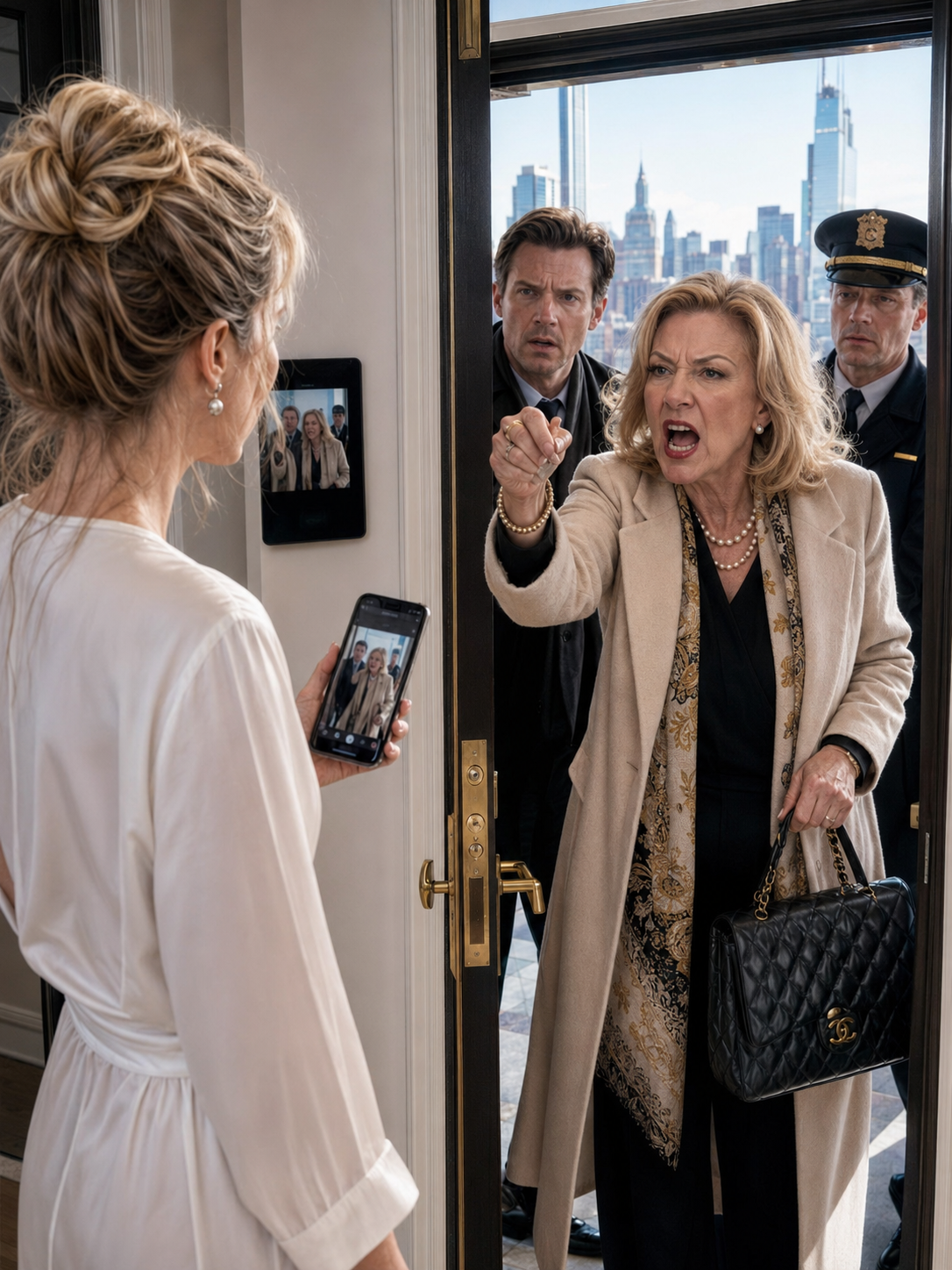
The door opened exactly three inches.
Then the steel security bar caught with a metallic crack so sharp it echoed down the marble hallway like a judge’s gavel.
Victoria froze.
For one beautiful second, her perfect red mouth went slack.
Then she shoved the door again.
The bar held.
“Remove this ridiculous thing,” she hissed through the gap. “Now.”
I stood ten feet away, barefoot, wearing silk pajamas and holding my phone like it weighed nothing, even though my pulse was hammering so hard I could feel it in my throat.
“No.”
Richard appeared behind her shoulder, his face tight with panic disguised as anger. “Sophia, don’t be dramatic.”
I tilted my head. “You gave your mother a key to my apartment after telling my attorney you returned every copy.”
His eyes flickered.
There it was.
Fear.
Victoria, of course, mistook it for weakness.
“This apartment was my son’s marital residence,” she snapped. “I have every right to enter.”
“No, Victoria. You have every right to leave.”
Her fingers curled around the edge of the door. I could see her nails, glossy and pale pink, pressing into my woodwork like claws.
Behind them, the security guard cleared his throat. “Mrs. Bennett, maybe we should step back.”
She turned on him so fast he flinched. “Do not tell me what to do.”
I raised my phone.
“Too late.”
Richard frowned. “What does that mean?”
“It means my attorney is on the line. So is building security. And NYPD is being dispatched.”
Victoria’s face changed.
Not much. Not dramatically.
But enough.
For the first time since I had known her, Victoria Bennett understood she was not controlling the room.
A calm voice spoke through my phone speaker. “Sophia, this is Gabriel. Do not open the door. Repeat clearly that they do not have permission to enter.”
I looked straight at Victoria through the crack.
“You do not have permission to enter my home.”
Richard’s jaw hardened. “You’re really doing this?”
“No, Richard. You did this when you lied about the key.”
Victoria laughed, brittle and cruel. “You think a little lawyer’s performance frightens me? I have been in rooms with senators, judges, men who built this city.”
“And yet here you are,” I said, “stuck behind a three-inch gap and a fifty-dollar security bar.”
Her eyes burned.
Then she made her second mistake.
She lowered her voice and said, “Give me the blue folder, Sophia, and I’ll forget this little tantrum.”
The hallway went silent.
Richard closed his eyes.
The guard looked from her to me.
And I finally understood.
She had not come for the credit card.
She had come for the evidence.
I smiled slowly.
“Oh, Victoria,” I whispered. “You should have led with that.”
Police sirens cried somewhere far below, faint at first, then rising through the bones of the building.
Victoria stepped back from the door.
Richard reached for her arm. “Mom.”
She jerked away. “Shut up.”
That was the thing about people like Victoria. They thought rage was power because, for years, everyone around them had mistaken it for authority.
But rage made people careless.
And careless people handed you knives by the blade.
The officers arrived four minutes later.
Victoria immediately became a different woman.
Her voice softened. Her shoulders curved delicately. Her hand went to her pearls as if she were a wounded duchess in need of rescue.
“Officers,” she said, “this is a family matter.”
I opened the door only after the officers asked me to and only after the security bar stayed in place between us.
One officer, a woman with steady eyes, asked, “Did you give either of these individuals permission to enter your apartment today?”
“No.”
“Did you provide that key?”
“No.”
Richard muttered, “It used to be mine.”
The officer looked at him. “That wasn’t the question.”
I handed her the first page from my folder.
A signed statement from Richard, dated two weeks earlier, confirming all keys, access cards, and security codes had been returned.
The officer read it.
Then she looked at him.
Richard’s face went white.
Victoria said, “This is absurd.”
I handed over the next document.
A certified notice revoking all financial and residential access, delivered to both Richard and Victoria Bennett three days before the divorce was finalized.
Victoria blinked.
Once.
Twice.
Then she lifted her chin. “I never opened that.”
Gabriel’s voice came smoothly through the speaker. “Receipt was signed by your housekeeper at 9:14 a.m. Tuesday morning, Mrs. Bennett.”
Her lips compressed.
The officer asked, “Why were you trying to enter?”
Victoria said nothing.
Richard swallowed.
I answered for them.
“They came for a blue folder.”
The female officer turned back to Victoria. “What’s in the blue folder?”
Victoria smiled.
But this time, it did not reach her eyes.
“Nothing that belongs to her.”
My fear should have come back then.
It didn’t.
Because I knew what was in that folder.
Five years of receipts. Five years of messages. Five years of quiet theft wrapped in family language.
And one thing Victoria didn’t know.
The folder was not in my apartment.
It was already in Gabriel’s safe.
By the time the officers left, Victoria had been given a formal warning, Richard had been told not to return, and the building had revoked every access credential tied to my former marriage.
Victoria paused near the elevator, turned back, and gave me the smile she used at charity luncheons.
“Enjoy your little victory, Sophia,” she said. “Women like you always mistake noise for strength.”
I leaned against my doorway.
“No, Victoria. I mistake evidence for strength.”
The elevator doors closed on her face.
And for the first time that morning, I let myself breathe.
But Gabriel did not.
“Sophia,” he said quietly through the phone.
“Yes?”
“She said blue folder.”
“I heard.”
“That means she knows what we have.”
I looked at the hallway where her perfume still hung in the air like poison.
“Good,” I said.
Then I locked my door.
And prepared to ruin her properly.
PART 4 — The Receipts Had Teeth
By noon, Gabriel Shaw’s office looked like a crime scene built from paper.
Statements covered the conference table. Credit card bills. Wire transfers. Boutique invoices. Jewelry appraisals. Charity donations with names that sounded noble and addresses that led to vacant offices.
Gabriel stood at the window, sleeves rolled to his elbows, his silver hair catching the winter light.
“You told me she overspent,” he said.
“I did.”
He turned, holding up a page.
“This isn’t overspending. This is a system.”
My stomach tightened.
He laid the statements in rows.
At first, I saw the familiar humiliations. Victoria’s $7,800 coat. Her $4,200 shoes. Her $18,000 “birthday lunch” at a private club where I had not been invited.
Then Gabriel pointed lower.
“Look here.”
A recurring monthly charge.
Bennett Legacy Preservation Fund — $12,500.
“I thought that was Richard’s family foundation,” I said slowly.
Gabriel’s expression hardened. “It is not registered as a nonprofit. It is an LLC.”
“Owned by who?”
He slid another document toward me.
Victoria Bennett.
The room tilted.
For five years, Victoria had not only used my money.
She had routed it back to herself.
My hands curled around the edge of the table.
“How much?”
Gabriel did not soften it.
“Preliminary total? Just under nine hundred thousand dollars.”
For a moment, I heard nothing.
Not the traffic below.
Not Gabriel’s voice.
Not even my own breathing.
I saw Victoria at my wedding, wearing champagne silk and diamonds, kissing both my cheeks while whispering, “Try not to look so tense, dear. People can smell desperation.”
I saw Richard telling me, “It’s just how Mom is. Don’t take everything personally.”
I saw myself signing bills because I wanted peace.
Peace, I had learned, could become a very expensive prison.
Gabriel sat across from me.
“Sophia, we can pursue civil recovery. But if you want criminal exposure, we need to prove intent.”
I looked at the spreadsheet.
Then at the blue folder.
“She came for the folder.”
“Yes.”
“She used a key she had no right to possess.”
“Yes.”
“She asked for evidence she claimed didn’t exist.”
“Yes.”
I leaned back.
“Then let’s give her a chance to explain herself.”
Gabriel’s eyes narrowed.
I reached into my purse and removed the small black recorder my therapist had suggested I carry after Richard once followed me into a parking garage during our separation.
“I started recording after the first pound on the door.”
Gabriel stared at it.
Then, slowly, he smiled.
Not kindly.
Legally.
“You recorded her saying the words ‘blue folder.’”
“I recorded everything.”
He took the device like it was a holy relic.
By evening, things moved faster than I expected.
A temporary protective order was filed.
A fraud complaint was prepared.
The bank opened an internal investigation.
And Victoria Bennett, who had spent decades floating through New York society like a swan, suddenly discovered that swans looked ridiculous when dragged onto land.
Her response came at 9:03 p.m.
Not from her.
From Richard.
A new number.
I almost deleted the message.
Then I read it.
You don’t understand what you’re doing. She’ll destroy both of us before she admits anything.
I stared at the screen.
For years, I had thought Richard defended his mother because he adored her.
Now I saw something else in his message.
Fear old enough to have roots.
Another text arrived.
There are things you don’t know about my father. About the house. About why she needed the money.
My thumb hovered.
Then I typed one sentence.
Then tell Gabriel. Not me.
He called immediately.
I didn’t answer.
The next morning, Victoria struck back.
A detective came to my apartment with a polite face and an uncomfortable question.
“Mrs. Laurent, Victoria Bennett has filed a report claiming you stole a family necklace.”
I actually laughed.
The detective looked relieved that I did.
“What necklace?”
He showed me a photo.
Victoria’s pearls.
The ones she had worn while trying to break into my apartment.
“She says they belonged to her grandmother,” he said.
I walked to my office, opened a drawer, and returned with a receipt.
The detective glanced at it.
Then again.
His eyebrows rose.
Pearl and diamond collar necklace. Purchased at Cartier. Paid by Sophia Laurent. Delivered to Victoria Bennett.
Date: three years earlier.
Occasion: Mother’s Day.
I remembered that day with painful clarity.
Victoria had opened the box, touched the pearls, and said, “At least you understand presentation, even if elegance doesn’t come naturally.”
I had smiled.
I had thanked her for accepting my gift.
The detective sighed.
“I’ll need a copy of this.”
“You can have it.”
He left fifteen minutes later with more than a copy.
He left with a second folder.
Because Victoria had not merely lied.
She had lied to the police.
And that, unlike social cruelty, had consequences.
At 6:00 p.m., Gabriel called.
“She’s escalating,” he said.
“She’s scared.”
“Yes. But scared people are dangerous.”
I stood before my window, looking out at the glittering city Victoria had tried to teach me I was lucky to enter.
“What happens now?”
Gabriel paused.
“Now we subpoena the Bennett house.”
My reflection in the glass looked calmer than I felt.
“Good.”
Because buried somewhere inside that house was the reason Victoria had treated my money like oxygen.
And I was done letting her breathe through me.
PART 5 — The Woman Who Brought a Knife to a Luncheon
Victoria did not hide.
That was her genius.
Smaller people retreated when exposed. Victoria dressed better.
Three days after the police report collapsed, she appeared at the winter luncheon for the Whitcomb Arts Trust wearing emerald silk, black gloves, and my pearls.
My pearls.
I knew because photographs appeared online before dessert.
There she was, smiling beneath crystal chandeliers, seated between two women who had once asked me whether “working so much” made Richard feel neglected.
The caption read:
Victoria Bennett, longtime patron and pillar of New York philanthropy.
I stared at the word pillar until it blurred.
Gabriel told me not to go.
My therapist told me not to engage.
My best friend Lena said, “I support healing, but I also support ruining someone in good lighting.”
So I went.
Not in anger.
Not in tears.
In white.
A simple white dress. No diamonds. No armor except truth.
The room changed when I entered.
Conversations thinned.
Forks paused.
Victoria saw me from across the ballroom and smiled as though she had personally arranged my humiliation.
Richard stood behind her chair.
He looked exhausted.
For the first time, I noticed how thin he had become. How his suit hung wrong. How his eyes kept scanning the exits.
Victoria rose.
“Sophia,” she said warmly, loud enough for nearby tables. “How brave of you to come.”
I smiled back.
“Victoria. How brave of you to wear stolen jewelry in public.”
A spoon clattered.
Someone gasped.
Victoria’s smile froze.
Richard whispered, “Sophia, please.”
I did not look at him.
A trustee approached quickly. “Ladies, perhaps this isn’t—”
“Appropriate?” I asked. “I agree. Filing a false police report over pearls purchased with my credit card was inappropriate.”
The trustee blinked.
Victoria laughed lightly. “My former daughter-in-law is emotional. Divorce can be destabilizing.”
There it was.
The old spell.
Make me dramatic.
Make me unstable.
Make the room more comfortable by making me smaller.
But this time, I did not shrink.
I opened my clutch and removed one sheet of paper.
Not the whole file.
Just enough.
The Cartier receipt.
I placed it on the table beside Victoria’s untouched champagne.
“Your grandmother had excellent taste,” I said. “Especially for a woman who died twenty-two years before Cartier made this setting.”
A murmur rolled through the room.
Victoria’s cheeks reddened beneath her powder.
Richard stared at the receipt like it was a weapon pointed at his own throat.
Then something happened that I did not expect.
He stepped forward.
“Mom,” he said quietly. “Take them off.”
Victoria turned on him.
The room went still.
“What did you say?”
Richard swallowed.
“Take off the pearls.”
Her expression became almost tender, which somehow made it worse.
“Sit down, Richard.”
He flinched.
And suddenly I understood another piece of the puzzle.
Victoria had not only controlled me through Richard.
She controlled Richard through shame.
He had been her weapon, yes.
But weapons get damaged by the hands that hold them.
“I said,” Richard repeated, voice shaking, “take them off.”
Victoria lifted her chin.
Then, with exquisite slowness, she unclasped the necklace and dropped it onto the table.
The sound was small.
The impact was enormous.
I picked it up, placed it in my clutch, and turned to leave.
But Victoria reached for my wrist.
Her fingers were cold.
“You think this makes you powerful?” she whispered.
I looked down at her hand until she released me.
“No. This makes me done.”
Outside the ballroom, Richard followed me into the corridor.
“Sophia.”
I kept walking.
“I spoke to Gabriel.”
That stopped me.
Richard looked like a man standing in front of a childhood house that had burned down years ago while he kept pretending it was still warm inside.
“She forged my father’s signature,” he said.
I went still.
“What?”
“The Bennett townhouse. The trust. The accounts. After he died, she said everything was gone because he made bad investments.” His voice cracked. “He didn’t. She moved it. Hid it. Borrowed against it. Then she used your money to keep appearances.”
The corridor seemed to narrow around us.
“Why are you telling me this?”
“Because I found something.”
He reached into his coat and handed me a brass key.
Not to my apartment.
Older.
Heavier.
“There’s a storage unit in Queens. My father rented it before he died. She’s been paying the fee through the Legacy Fund.”
I stared at the key.
Richard’s eyes filled, though no tears fell.
“She doesn’t know I found it.”
I should have felt triumphant.
Instead, I felt exhausted.
“Why now?”
His answer was almost too quiet to hear.
“Because when she told me to marry you, she called you an asset.”
The word hit me harder than any insult ever had.
Not gold digger.
Not outsider.
Not ungrateful.
Asset.
A thing to be acquired.
Used.
Drained.
I closed my fist around the key.
Then I looked at the man I had once loved.
“Tell Gabriel everything.”
He nodded.
“And Richard?”
“Yes?”
“I’m not saving you.”
His face twisted, but he accepted it.
“I know.”
For the first time in our marriage, he did not ask me to make his life easier.
And somehow, that made me feel freer than revenge.
PART 6 — The Storage Unit of Ghosts
The storage facility smelled like dust, metal, and old rain.
Gabriel came with me.
So did Lena, because she said no woman should open a suspicious storage unit with only a lawyer and trauma for company.
Richard waited outside.
He had offered to come in.
I had said no.
The unit was number 417.
The brass key fit.
The door rolled upward with a groan.
Inside were six cardboard boxes, a broken lamp, two leather suitcases, and a portrait of a man I had only seen in photographs.
Edward Bennett.
Richard’s father.
He had died a year before our wedding. Victoria spoke of him as if he had been elegant, useless, and vaguely disappointing.
But in the portrait, Edward’s eyes looked kind.
Tired, but kind.
Gabriel opened the first box.
Bank records.
The second held property deeds.
The third held letters.
The fourth held something that made Gabriel go completely silent.
“What?” I asked.
He lifted a document.
A trust amendment. Signed. Notarized. Never filed.
His eyes moved over the page.
Then again.
“What does it say?”
Gabriel looked at me carefully.
“Edward Bennett suspected his wife was stealing from family accounts before he died.”
Lena whispered, “Jesus.”
Gabriel continued. “He created a conditional trust. If Victoria was found to have forged documents, hidden assets, or financially exploited a family member, control of the Bennett residence and remaining trust assets would transfer to an independent executor.”
“Who?”
Gabriel turned the page.
His face changed.
“Sophia.”
My laugh came out sharp and wrong.
“That’s impossible. He died before he met me.”
Gabriel read further.
“Not Sophia Laurent by name.”
He looked up.
“The wording says: ‘To the spouse or former spouse of my son who provides material evidence of financial exploitation by Victoria Bennett, provided that person was also financially harmed by her actions.’”
The room went utterly still.
Even Lena stopped breathing.
Edward Bennett, a man I had never met, had known exactly what his wife was.
And he had built a trap for her from beyond the grave.
A letter was clipped to the back.
My hands shook as I unfolded it.
To whoever finds this because Victoria has finally gone too far,
I am sorry.
That was the first line.
Not an excuse.
Not a warning.
An apology.
I sat down on one of the leather suitcases as the words blurred.
Edward wrote that Victoria believed love was ownership. That she measured people by what they could provide. That he had failed to protect his son from her appetite for status.
If Richard has become like her, I am sorry for that too. Children learn the weather of the homes they grow up in. Some become storms. Some spend their lives trying not to.
My throat closed.
There was more.
A ledger of accounts Victoria had emptied.
Copies of signatures Edward believed were forged.
A list of debts.
And one line underlined twice:
She will eventually choose someone with more money than fear. That person may be the first one strong enough to stop her.
I looked at Gabriel.
He was already photographing everything.
“This changes everything,” he said.
By the next week, the Bennett case was no longer a divorce aftershock.
It was a financial investigation.
The townhouse was frozen.
The Legacy Fund was frozen.
Victoria’s personal accounts were frozen pending review.
She called me seventeen times from blocked numbers.
I answered none.
Then, on Friday afternoon, she appeared on television.
Not by choice.
A local business channel ran the headline:
SOCIALITE VICTORIA BENNETT UNDER INVESTIGATION FOR FRAUDULENT FAMILY TRUST TRANSFERS
They used a photograph from the luncheon.
Emerald silk.
Perfect hair.
My pearls missing from her throat.
I watched the segment once.
Then turned it off.
Lena, sitting beside me with takeout noodles, looked almost disappointed.
“That’s it? No champagne?”
I leaned back into the couch.
“I don’t feel like celebrating.”
She nodded.
Then I added, “But I do feel like ordering dessert.”
“That’s growth.”
That night, Richard sent one email.
No excuses.
No requests.
Just a statement Gabriel had asked him to write.
At the bottom, beneath his formal testimony, he had added one sentence.
I should have protected you from her, but I was too busy asking you to protect me.
I stared at it for a long time.
Then I closed the laptop.
Some apologies arrive too late to repair anything.
But sometimes, they arrive just in time to confirm you were never crazy.
And that was its own kind of mercy.
PART 7 — The Day Victoria Ran Out of Rooms
The hearing took place on a gray morning when the city looked scrubbed clean and merciless.
Victoria arrived in navy wool, pearls replaced by a silk scarf knotted at her throat. She walked into the courtroom like she expected the walls to recognize her.
They did not.
Richard sat two rows behind Gabriel and me.
He did not sit with his mother.
Victoria noticed.
Her mouth tightened.
That tiny betrayal wounded her more than the subpoenas.
Gabriel presented the attempted entry first.
The stolen key.
The recording.
Her voice filled the courtroom, sharp and unmistakable.
Give me the blue folder, Sophia, and I’ll forget this little tantrum.
Victoria stared straight ahead, motionless.
Then came the credit card records.
The false police report.
The Legacy Fund.
The storage unit.
Edward Bennett’s letter.
By the time Gabriel introduced the forged signatures, Victoria’s attorney had stopped objecting and started taking notes like a man preparing to save himself.
The judge, Honorable Miriam Vale, had the kind of face that made lies feel embarrassed to exist.
She looked at Victoria over her glasses.
“Mrs. Bennett, do you contest that you used funds belonging to Ms. Laurent after access was revoked?”
Victoria lifted her chin.
“I was family.”
Judge Vale did not blink.
“That is not an answer.”
“It is the only answer that matters.”
A hush fell.
Victoria turned slightly, enough to look at me.
“You married into my family. You enjoyed our name, our invitations, our world. You don’t get to take from that and then complain about the cost.”
There it was.
The rotten heart of it.
I stood before I realized I had moved.
Gabriel touched my wrist, but the judge nodded.
“Ms. Laurent, briefly.”
My voice was calm.
Not because I wasn’t angry.
Because anger had finally become something cleaner.
“I paid for the invitations. I paid for the tables. I paid for the dresses, the donations, the luncheons, the car service, the vacations, the gifts she called inadequate, and the silence she mistook for permission.”
Victoria’s eyes narrowed.
“I paid,” I continued, “because every time I questioned it, I was told love required generosity. Respect required patience. Marriage required sacrifice.”
I looked at Richard.
He lowered his head.
Then I looked back at Victoria.
“But it was never family. It was billing.”
The courtroom was silent.
Judge Vale leaned back.
“Mrs. Bennett, this court is granting a continuing protective order. The financial freeze remains. The matter of the trust amendment will proceed to probate review. The civil recovery claim may proceed. Additionally, this court will refer the false police report and attempted unlawful entry to the district attorney’s office.”
Victoria’s face went pale beneath her makeup.
For the first time, she did not look angry.
She looked old.
Not fragile.
Never fragile.
Just suddenly visible without the lighting she had arranged around herself for decades.
As people stood to leave, she turned to Richard.
“You ungrateful boy,” she whispered.
He flinched.
Then he did something I had never seen him do.
He did not apologize.
He did not explain.
He did not fold.
He simply said, “No.”
One word.
Small.
Late.
But real.
Victoria stared as if he had slapped her.
Then she looked at me with hatred so pure it should have frightened me.
Instead, I felt nothing.
Not because I had become cold.
Because she had finally become irrelevant.
Outside the courthouse, reporters waited.
Cameras flashed.
Questions flew.
“Ms. Laurent, do you have a statement?”
I stopped at the top of the steps.
The city wind lifted my hair from my shoulders.
I thought of the woman I had been at the beginning of my marriage, desperate to be approved of by people who needed my money more than my presence.
Then I said, “Yes.”
The microphones pushed closer.
I smiled.
“Check your statements.”
That was all.
By sunset, the phrase was everywhere.
Women emailed me. Strangers. Former friends. Wives of men who laughed at “allowances.” Daughters-in-law who had been told generosity was their duty. Employees whose bosses used company cards like personal wallets.
Check your statements.
Three words.
A match.
And Victoria Bennett’s world, built on other people not looking too closely, began to burn.
PART 8 — The House That Changed Its Name
Six months later, the Bennett townhouse went to auction.
Victoria did not attend.
Her attorney did.
Richard did.
So did half the people who once pretended not to see me when I entered rooms beside him.
The house stood on a quiet block behind iron railings and old trees, limestone steps rising toward a glossy black door.
I had been there countless times.
Thanksgivings where Victoria corrected my pronunciation of French wines.
Christmas mornings where she handed me beige scarves and Richard watches worth more than my first car.
Dinners where every compliment had a hook hidden inside it.
I stood across the street in a camel coat, watching strangers walk through the home that had once made me feel like an intruder.
Gabriel stood beside me.
“You’re sure?”
“Yes.”
Lena, on my other side, grinned. “I have never been more emotionally prepared to watch real estate become poetic justice.”
The auction moved quickly.
The house, burdened by frozen liens and legal complications, scared off casual buyers.
Then Gabriel raised his paddle.
Victoria’s attorney turned sharply.
Richard looked back at me.
I gave no expression away.
Another bidder tried once.
Gabriel raised again.
Silence.
The auctioneer struck the podium.
Sold.
For three seconds, no one moved.
Then whispers erupted like spilled champagne.
Richard approached slowly.
“You bought it?”
“No,” I said.
He frowned.
Gabriel handed me a folder.
Technically, the buyer was not me.
The buyer was a newly formed nonprofit funded by my recovered settlement, a portion of the trust assets, and donations that had poured in after three words went viral.
The name was printed on the front page.
The Edward House for Financial Freedom.
Richard read it once.
Then again.
His face broke open in a way I had not expected.
“You named it after my father.”
“He tried to help the person who would come after him,” I said. “Now he will.”
The townhouse would become transitional housing and legal support offices for women leaving financially abusive marriages and families.
Victoria’s ballroom would become a counseling center.
Her dining room would become a legal clinic.
The powder room where she once told me, “You’re lucky Richard lowered his standards for ambition,” would become a childcare space painted yellow.
Lena wiped her eyes and pretended not to.
Richard looked up at the house.
“She’ll hate this.”
“Yes,” I said.
But that was not why I had done it.
At least, not only.
Two weeks later, on opening day, spring sunlight spilled over the limestone steps.
There was no ribbon cutting.
No champagne tower.
No society photographer.
Just a small brass plaque beside the door.
THE EDWARD HOUSE
For anyone told that love was a debt.
The first woman arrived at 9:17 a.m.
She wore sunglasses though the morning was cloudy. A little girl clung to her hand, holding a stuffed rabbit by one ear.
The woman looked at the house nervously.
“I’m sorry,” she said. “I think I’m early.”
I opened the door wider.
“No,” I said. “You’re right on time.”
She stepped inside.
And just like that, the house changed.
Not because walls forget.
They don’t.
Walls remember everything.
But sometimes, when enough truth enters a place, the old ghosts lose their grip.
A month later, a letter arrived.
No return address.
The handwriting was Victoria’s.
For a moment, I considered throwing it away.
Then I opened it.
There were only four words.
You ruined my life.
I stared at them.
Then I laughed.
Not bitterly.
Not cruelly.
Freely.
Because the woman who had spent years calling me ungrateful had finally written the closest thing to a thank-you note she was capable of.
I placed the letter in a frame and hung it in my private office, behind the desk, where only I could see it.
Not as a trophy.
As a reminder.
Some people call it ruin when the world stops letting them steal.
Richard visited the house once.
He brought boxes of Edward’s books from storage.
He looked healthier. Older. Humbled in a way that suited him better than arrogance ever had.
“I’m moving to Boston,” he said.
“Good.”
He smiled faintly. “You always hated when I needed approval.”
“I hated when you needed mine after ignoring me.”
“That’s fair.”
We stood in what had once been Victoria’s drawing room, now filled with donated coats, legal pamphlets, and children’s drawings taped to the walls.
Richard looked at one drawing of a yellow house beneath a huge blue sky.
“Do you think people can become different?”
I considered lying politely.
Instead, I told him the truth.
“Yes. But not with the people they broke while becoming who they were.”
He nodded.
“I’m sorry, Sophia.”
This time, I let the words land.
Not because they healed everything.
Because they no longer needed to.
“I know.”
He left without asking for forgiveness.
That was the kindest thing he ever did for me.
One year after my divorce became final, I woke in the center of my bed again.
The skyline beyond my windows blazed gold.
My phone buzzed with a message from Lena.
Front page. Don’t scream.
I opened the link.
There it was.
A feature article.
Not about Victoria.
Not about scandal.
Not about divorce.
About The Edward House.
About women rebuilding credit, reclaiming wages, securing housing, filing claims, laughing again.
Halfway down was a photograph of me standing on the townhouse steps beside the brass plaque.
The headline read:
SHE CLOSED ONE CREDIT CARD. THEN SHE OPENED A DOOR.
I sat very still.
Then I cried.
Not the silent, careful tears I had learned in the Bennett marriage.
Real ones.
Messy ones.
Mine.
For five years, Victoria Bennett had tried to convince me that access to her world was the prize.
She never understood.
The prize was access back to myself.
That evening, I walked through The Edward House after everyone had gone.
The halls were quiet.
In the former ballroom, folding chairs were arranged for tomorrow’s workshop: rebuilding credit after coercive debt.
In the old dining room, case files waited beneath warm lamps.
Upstairs, a little girl had left her stuffed rabbit on a windowsill.
I picked it up and placed it on a chair.
Then I paused before the front door.
The same kind of heavy lock.
The same satisfying click.
But this time, the lock was not there to keep me trapped inside someone else’s idea of family.
It was there to protect every woman who had finally reached a place where no one could enter without permission.
Outside, the city glittered.
Not like a promise anymore.
Like an answer.
And somewhere far away, Victoria Bennett was probably still telling anyone who would listen that I had stolen everything from her.
She was wrong, of course.
I had stolen nothing.
I had simply taken back my name, my money, my peace, my door, my life.
And then, because survival alone was too small a victory, I turned the house that once humiliated me into a shelter for women who would never have to beg cruel people for safety again.
That was the ending Victoria never predicted.
Not that she lost.
But that I became happy without needing her to watch.
And every morning after that, when I opened the front door of The Edward House and sunlight poured across the marble floor, I remembered the sound that had started it all.
BOOM. BOOM. BOOM.
Her fist against my door.
Her rage in my hallway.
Her stolen key in my lock.
I smiled every time.
Because Victoria Bennett had come to my apartment to take one last thing from me.
Instead, she handed me the key to everything.